Rothenburg Town and Summer Camp
Displacement in Europe
Rothenburg ob der Tauber · Germany · Ukrainian DP centre: 1946–1949
UNRRA Team 167 ran displaced persons work for the Rothenburg district from the Wildbad sanatorium from June 1946. The town carried three centres in the camp inventory; the Ukrainian one, recorded as Rothenburg Town / Summer Camp, ran from August 1946 to September 1949, with about 350 to 380 Ukrainians counted between 1946 and 1948.
Introduction
After 1945 Rothenburg ob der Tauber was a town of refugees: by 1950 expellees and refugees made up 35 per cent of its inhabitants. The Arolsen Archives inventory lists a Ukrainian displaced persons centre there under the heading Rothenburg Town / Summer Camp, administered by UNRRA Team 167. Ukrainian population returns record a community of several hundred, and a Ukrainian society in the town published exhibition catalogues in 1946. The UNRRA team itself was based at the Wildbad, a former sanatorium in the Tauber valley below the town.
Sources for this section
- DP camp inventory: Rothenburg Town / Summer Camp
- Wildbad: Sanatorium, Luxushotel, Lazarett, HJ-Musikschule, US-Truppenunterkunft, UNRRA-Camp, Polizeischule
- 1950 stellten Ost- und Westpreußen, Ungarn und Wolhynier ... 35 Prozent aller Einwohner
- Ukrainian Population Migration after World War II
- Publications by Ukrainian Displaced Persons and Political Refugees, 1945–1954: Research Report No. 29
A history in dates
- 1939The Wehrmacht turns the Wildbad sanatorium into an auxiliary hospital.
- 16 April 1945American emissaries obtain the withdrawal of German troops at the Wildbad; US forces enter the next day.
- November 1945UNRRA’s headquarters for the American zone is established at Munich-Pasing; the Wildbad becomes its seat for the Rothenburg district.
- 1946The Ukrainian Society St Raphael publishes catalogues of an exhibition of Ukrainian national art in Rothenburg.
- End of 1946UNRRA is wound up and its work passes to the Preparatory Commission of the International Refugee Organisation.
- 19 June 1946UNRRA Team 167 takes over the Wildbad as its district base.
- 20 August 1946Opening date of Rothenburg Town / Summer Camp in the Arolsen inventory.
- 24 August 1946UNRRA counts 384 Ukrainians at Rothenburg.
- 2 October 1946The condition survey of the Wildbad is drawn up as Inventaraufstellung UNRRA 167, held in the town archive.
- 31 May 1947UNRRA counts 348 Ukrainians at Rothenburg.
- 2 January 1948PCIRO counts 351 Ukrainians at Rothenburg.
- 15 December 1948The Latvian centre La Guardia closes.
- 16 September 1949Closing date of the Ukrainian centre in the inventory; the Wildbad serves as a YMCA summer camp in 1949.
- April 1951The Wildbad is leased to the Bavarian riot police.
- February 1978The town buys the Wildbad and passes it to the Neuendettelsau deaconry.
- 1981A supporting association is formed to convert the Wildbad into a conference centre.
Sources for this section
- Wildbad: Sanatorium, Luxushotel, Lazarett, HJ-Musikschule, US-Truppenunterkunft, UNRRA-Camp, Polizeischule
- Publications by Ukrainian Displaced Persons and Political Refugees, 1945–1954: Research Report No. 29
- 1950 stellten Ost- und Westpreußen, Ungarn und Wolhynier ... 35 Prozent aller Einwohner
- DP camp inventory: Rothenburg Town / Summer Camp
- Ukrainian Population Migration after World War II
- DP camp inventory: the other Rothenburg entries and the Team 167 district
The Wildbad before 1945
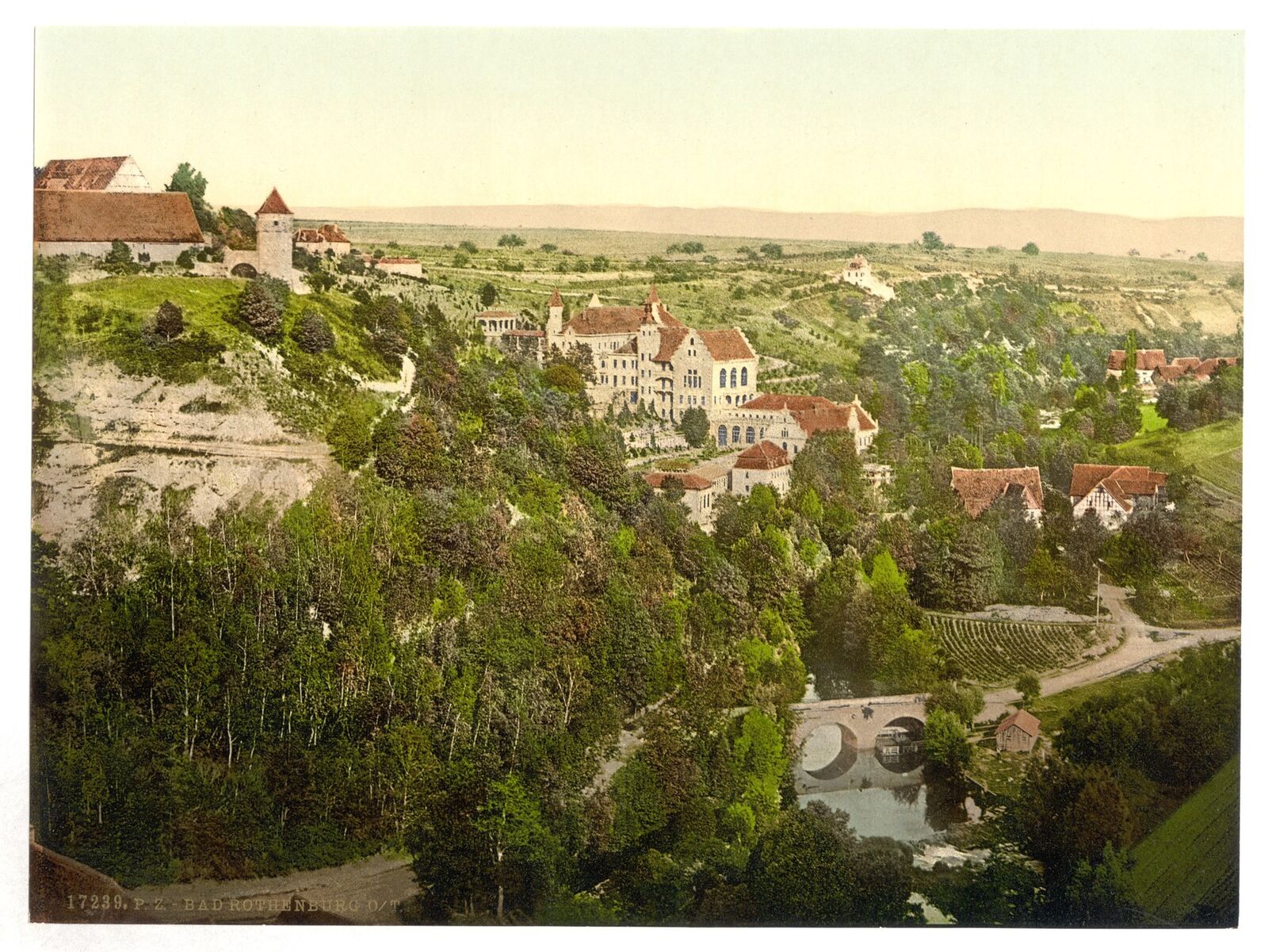
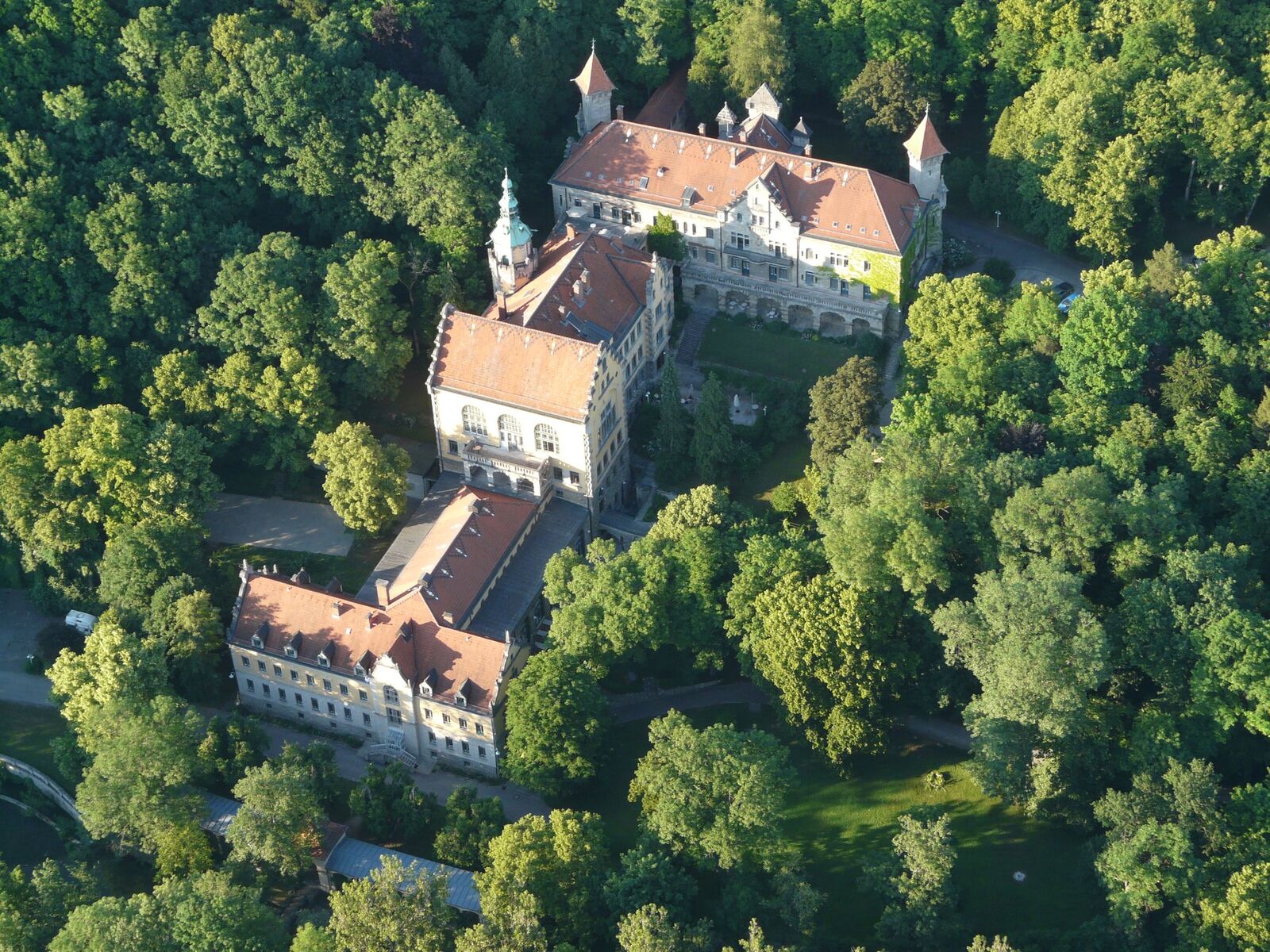
The Wildbad grew up around a sulphur spring. Around 1900 it was rebuilt as a luxurious sanatorium, later run as a luxury hotel, and from 1925 as a convalescent home of the Bavarian health-insurance funds. The Wehrmacht requisitioned it as an auxiliary military hospital in 1939. In 1942 the hospital was cleared to make room for a Hitler Youth music school, and in 1944 the national association of local health-insurance funds moved its head office there after being bombed out of Berlin. In the last days of the war the town’s military commanders sat in the Wildbad, and it was there that American emissaries obtained the withdrawal of German troops on 16 April 1945.
UNRRA Team 167 and the Ukrainian centre
After the American entry the US military used the Wildbad as troop accommodation. On 19 June 1946 UNRRA Team 167 took over the sanatorium as its base for the Rothenburg district, subordinate to the US Town Major. An inventory drawn up in October 1946 found broken windows, damaged paintwork and two outlying buildings almost destroyed. According to the local history, the team mainly cared for and repatriated people from the Baltic countries; a 1950 town account describes the Wildbad as a DP camp for refugees it calls White Russian.
The team was led by an American administrative officer, E. Wilson. UNRRA had run the American zone from a building in Munich-Pasing since November 1945, and the Wildbad was its seat for the Rothenburg district. Alterations to the buildings needed the approval of the Town Major or of the engineer officer. The October 1946 condition survey survives in the town archive as Inventaraufstellung UNRRA 167, 2 October 1946, reference 000/35.
The Ukrainian centre is recorded separately. The inventory opens Rothenburg Town / Summer Camp on 20 August 1946 and closes it on 16 September 1949, with Ukrainian as the only nationality noted, assembly centre number AC 92-302 A and, from September 1948, the IRO designation OMF 368. No capacity is recorded. From November 1946 the centre came under Area Team 1041 Rothenburg. The heading suggests accommodation dispersed in the town together with a seasonal site; the inventory does not record which buildings the centre used, and it is not established whether the summer camp was the Wildbad, which served as a YMCA summer camp in 1949.
Ukrainian returns give the size of the community. UNRRA’s assembly-centre summary of 24 August 1946 counted 384 Ukrainians at Rothenburg, the summary of 31 May 1947 counted 348, and the PCIRO summary of 2 January 1948 counted 351. Cultural life was organised early: the Ukrainian Society St Raphael in Rothenburg issued an eleven-page catalogue of an exhibition of Ukrainian national art in 1946, in English and German editions.
Rothenburg carried three entries in the inventory, all opened on 20 August 1946 and all under Team 167. Beside the Ukrainian Town / Summer Camp stood La Guardia, a Latvian centre with a capacity of 230 under assembly centre number AC 92-302, and the Wildbad itself, a Lithuanian and Latvian centre with a capacity of 540 under AC 93-417. The Ukrainian centre carries La Guardia’s number with the suffix A. The inventory therefore records the Wildbad as a Baltic centre in its own right, which matches the local history’s account of the team’s work; and the Ukrainian centre outlasted both, closing in September 1949 after La Guardia had closed in December 1948.
A list of scouting and guiding in displaced persons camps records a Rothenburg camp for Latvian displaced persons as having Girl Guides and a Scout troop. The list gives no camp number or address, so it cannot be tied to either of the two inventory entries with Latvian residents, La Guardia or the Wildbad.
Arolsen Archives inventory entry for Rothenburg Town / Summer Camp
| Field | Value |
|---|---|
| Opening | 20 August 1946 |
| Closing | 16 September 1949 |
| Capacity | Not recorded |
| Capacity date | 31 October 1947 |
| Assembly centre | AC 92-302 A; from September 1948 OMF 368 |
| UNRRA team | T 167 Ansbach; Area Team 1041 Rothenburg from November 1946 |
| Nationalities recorded | ukrainisch |
| Archive references | ITS Dok-ID 82025547-82025864; Staatsarchiv Nürnberg, Rep. 212/15-III, Fach 83 (Besatzungsmacht und DPs) |
Ukrainians recorded at Rothenburg
| Date | Ukrainians | Source scope |
|---|---|---|
| 24 August 1946 | 384 | UNRRA assembly-centre summary |
| 31 May 1947 | 348 | UNRRA assembly-centre summary |
| 2 January 1948 | 351 | PCIRO assembly-centre summary |
The three centres recorded at Rothenburg
| Centre | Nationality recorded | Capacity | Assembly centre | From September 1948 | Closing |
|---|---|---|---|---|---|
| Rothenburg Town / Summer Camp | Ukrainian | Not recorded | AC 92-302 A | OMF 368 | 16 September 1949 |
| La Guardia | Latvian | 230 | AC 92-302 | OMF 339 | 15 December 1948 |
| Wildbad | Lithuanian, Latvian | 540 | AC 93-417 | OMF 338 | Between 31 March and 30 September 1949 |
Sources for this section
- Wildbad: Sanatorium, Luxushotel, Lazarett, HJ-Musikschule, US-Truppenunterkunft, UNRRA-Camp, Polizeischule
- 1950 stellten Ost- und Westpreußen, Ungarn und Wolhynier ... 35 Prozent aller Einwohner
- DP camp inventory: Rothenburg Town / Summer Camp
- Ukrainian Population Migration after World War II
- Publications by Ukrainian Displaced Persons and Political Refugees, 1945–1954: Research Report No. 29
- DP camp inventory: the other Rothenburg entries and the Team 167 district
- Scouting and Guiding in displaced persons camps
A district team, not a single camp
Team 167 was a district organisation. The inventory records it against camps at Ansbach — an area hospital and the Bleidorn barracks — and at Dinkelsbühl, Gunzenhausen and Langlau, as well as the three Rothenburg entries. All of them lay in Area A 3 Würzburg. From November 1946 they came under area team 1041, entered against the Rothenburg camps as AT 1041 Rothenburg and against the others as AT 1041 Ansbach.
UNRRA itself was wound up at the end of 1946, and its work passed to the Preparatory Commission of the International Refugee Organisation. The change shows in the Rothenburg record as the substitution of the IRO number OMF 368 for the assembly centre number from September 1948.
A crowded town
The displaced persons’ centres were only part of the pressure on housing. The 1950 town account describes every room of any size being taken for accommodation, refugees put up in cellars, halls and schools, and inns in the town and the villages turned into mass billets; the music hall, the hall at the Glocke and the Rossmühle were fitted out as collection camps. Those were German expellees and refugees, a separate population from the displaced persons in the UNRRA centres.
Sources for this section
After the displaced persons
The Ukrainian centre closed in September 1949, the year the Wildbad served as a YMCA summer camp. In April 1951 the Bavarian interior ministry leased the Wildbad for the newly formed riot police, whose school remained there until 1976. In 1978 the town exercised its right of first refusal and passed the property to the Neuendettelsau deaconry; after renovation it opened in the 1980s as a conference centre of the Evangelical Church in Bavaria, which it remains.
The town exercised its right of first refusal in February 1978, buying the Wildbad for 300,000 marks and passing it to the Neuendettelsau deaconry at the same price. A supporting association was formed in 1981 to build a conference centre there after a thorough renovation.
What survives for a researcher
The camp records themselves are held outside the town. The inventory points to the International Tracing Service holdings at Arolsen, where the strength and change returns for Rothenburg carry document numbers 82025547 to 82025864, and to the Staatsarchiv Nürnberg, Repertorium 212/15-III, Fach 83, on the occupying power and displaced persons.
The town’s own records of these years are thin. The fire in the town hall in 1945 destroyed most of the municipal registry for 1920 to 1945, and the surviving historical registration cards, which run to 1945, are incomplete for the same reason. The civil registers are held from 1876 and pass to the archive as the statutory protection periods expire.
Sources for this section
Sources
- DP camp inventory: Rothenburg Town / Summer Camp
Arolsen Archives · 26 October 2023
Entry 1421: opening 20 August 1946, closing 16 September 1949, Ukrainian nationality, AC 92-302 A, OMF 368 from September 1948, Team 167 Ansbach, Area Team 1041 Rothenburg; archive references at ITS and the Staatsarchiv Nürnberg. Serial dates converted from the Excel epoch.
- Wildbad: Sanatorium, Luxushotel, Lazarett, HJ-Musikschule, US-Truppenunterkunft, UNRRA-Camp, Polizeischule
Wolf Stegemann, rothenburg-unterm-hakenkreuz.de (Ev. Bildungswerk Rothenburg) · 19 January 2014
Full article read: building history to 1945, UNRRA Team 167 occupation from 19 June 1946, condition inventory of October 1946, Baltic emphasis, YMCA summer camp 1949, police school from 1951 and later church conference centre. Cites the UNRRA 167 inventory in the Stadtarchiv.
- 1950 stellten Ost- und Westpreußen, Ungarn und Wolhynier ... 35 Prozent aller Einwohner
rothenburg-unterm-hakenkreuz.de, after Dr. Bayersdörfer, 1950 · Accessed 12 September 2026
Town account of refugee accommodation after 1945; states that the Wildbad was converted into a DP camp for refugees it describes as White Russian. Its collection points for German expellees are distinct from the UNRRA centre.
- Ukrainian Population Migration after World War II
Ihor Stebelsky, in The Refugee Experience, Canadian Institute of Ukrainian Studies Press · 1992
Table 7, printed page 50, Rothenburg row: 384 (UNRRA, 24 August 1946), 348 (UNRRA, 31 May 1947), 351 (PCIRO, 2 January 1948); no questionnaire figure. Column assignment checked against the PDF layout.
- Publications by Ukrainian Displaced Persons and Political Refugees, 1945–1954: Research Report No. 29
Yury Boshyk and Wlodzimierz Kiebalo, Canadian Institute of Ukrainian Studies · 1988
Bibliographic records RB127704 and RB127823: English and German catalogues of an exhibition of Ukrainian national art, Ukrainian Society St Raphael, Rothenburg ob der Tauber, 1946, 11 pages each. The catalogues themselves were not read.
- Rothenburg baths, Rothenburg ob der Tauber (photochrom)
Library of Congress, Photochrom Print Collection, via Wikimedia Commons · Between 1890 and 1900
Public domain photochrom of the Wildbad; catalogue record LCCN 2002696190.
- Wildbad Rothenburg Luftbild
Georg Reifferscheid / Happy-Ballooning, via Wikimedia Commons · 10 June 2008
CC0 aerial photograph of the Wildbad from the south.
- DP camp inventory: the other Rothenburg entries and the Team 167 district
Arolsen Archives · 26 October 2023
Spreadsheet queried directly. Entry 1420, La Guardia: Latvian, capacity 230, AC 92-302, OMF 339 from September 1948, opened 20 August 1946, closed 15 December 1948, team director Dennis, field supervisor Johnson. Entry 1422, Wildbad: Lithuanian and Latvian, capacity 540, AC 93-417, OMF 338, opened 20 August 1946, closed between 31 March and 30 September 1949. Team 167 Ansbach also appears against entries for Ansbach, Dinkelsbühl, Gunzenhausen and Langlau. All Rothenburg entries sit in Area A 3 Würzburg. Serial dates converted from the Excel epoch.
- Bestände im Stadtarchiv Rothenburg ob der Tauber
Stadt Rothenburg ob der Tauber · Accessed September 2026
Holdings page read in full: “Aufgrund des Rathausbrandes von 1945 ist weitgehend die städtische Registratur von 1920 bis 1945 verloren gegangen”; “Aufgrund der Kriegsverluste ist der Bestand der historischen Meldekarten leider nicht vollständig und liegt bis 1945 im Stadtarchiv”; “Die Standesamtsbücher sind ab 1876 vorhanden”.
- Scouting and Guiding in displaced persons camps
ScoutWiki (article imported from Wikipedia) · Accessed September 2026
Section ‘Germany – American sector camps’, list entry ‘Rothenburg’ read; the entry records a camp for Latvian displaced persons at Rothenburg with Girl Guides and a Scout troop. A community-edited wiki; no underlying source is cited for the entry.
Last researched 12 September 2026