Rushworth Migrant Camp
Arrival and settlement
Near Rushworth, Victoria, Australia · 1949–1953
A wartime internment camp about five miles from Rushworth became a holding centre for migrant families, including Ukrainians served by travelling Catholic and Orthodox clergy. It closed in June 1953 and its buildings were handed to the Disposals Commission for sale on the site.
Introduction
Rushworth Migrant Camp occupied the former Internment Camp No. 3 near Rushworth in Victoria. Tatura Museum’s collection connects these two uses of the site: wartime internment followed by accommodation for displaced European families. The museum dates the migrant camp’s operation to 1 June 1949–15 June 1953 in its catalogue of a research folder compiled in 2009.
A history in dates
- 1940–1945Internment Camp No. 3 near Rushworth holds mostly German family groups.
- 1 June 1949The migrant camp opened, according to Tatura Museum’s catalogue.
- 27 June 1949A Commonwealth list of centres includes Rushworth among the Victorian holding centres.
- 1949Father Dmytro Burtan was assigned Orthodox pastoral responsibility for Rushworth and other Victorian camps.
- Early 1950Maria and Eugene Fergin moved from Bonegilla to Rushworth.
- April–May 1950The Fergin family moved on to Benalla.
- 12 June 1953The last migrants leave the camp, according to the Shepparton Advertiser.
- 15 June 1953The migrant camp closed, according to Tatura Museum’s catalogue.
- End of June 1953The site is abandoned and handed to the Disposals Commission for sale.
The internment camp before
The site belonged to a group of seven internment and prisoner-of-war camps established around Tatura and Rushworth, chosen for their distance from any seaport and for their food and water supply, and holding between four and eight thousand people at a time. Camps 3 and 4 were the Rushworth pair; Camp 3 held mostly German family groups, while Camp 4 held Japanese families. The land it stood on was leased to the government by the politician John McEwen, and was bought by the Commonwealth when the camp became an immigration centre.
Sources for this section
A Victorian holding centre
Rushworth belonged to the second tier of the Commonwealth system. A list of centres as at 27 June 1949 places it among the holding centres, alongside Benalla, West Sale, Somers and Mildura in Victoria, and distinct from the reception and training centres at Bonegilla and Bathurst; it appears again as a Victorian holding centre in the 1950 Commonwealth hostels programme. Holding centres took the families of workers who had been allocated employment elsewhere, so a stay there generally followed rather than preceded a work placement.
The Shepparton Advertiser, reporting the camp’s end in June 1953, summarised who had lived there. The first migrants to use the camp were displaced families from various parts of Europe, who brought a good deal of business to Rushworth; they were followed by unmarried Italian men, after which the camp mattered less to the town commercially. A photograph in the Making Multicultural Australia collection shows a group of workers at the camp in 1953, at the end of that Italian phase.
Phases of the site
| Phase | Occupants | Source scope |
|---|---|---|
| Internment Camp No. 3, wartime | Mostly German family groups, one of seven camps around Tatura and Rushworth | Museum summary of the camp group; no figure for Camp 3 alone |
| Migrant camp, first phase from 1949 | Displaced families from various parts of Europe | Newspaper summary written at the camp’s closure |
| Migrant camp, second phase | Unmarried Italian men | Same newspaper summary; no dates or numbers given |
Ukrainian families at Rushworth
The 1966 Ukrainian community history explicitly names Rushworth among Victorian camps where Ukrainian families lived. Its account describes the wider pressures of family separation, travel costs and the search for rented rooms or a first home. This places Rushworth within the unsettled early years of Ukrainian migration, when accommodation and employment could be in different places.
Sources for this section
Orthodox pastoral care
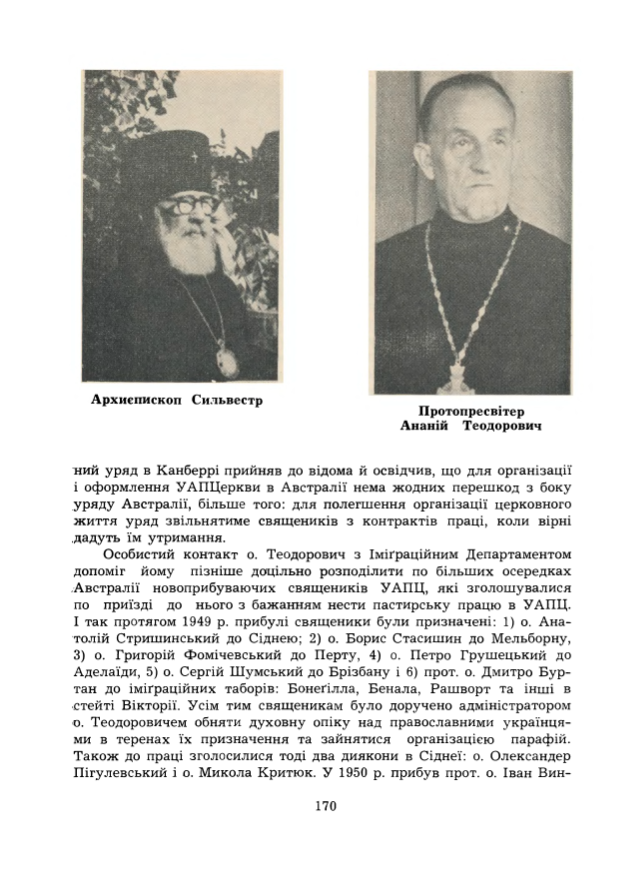
In 1949, Father Dmytro Burtan received an Orthodox pastoral assignment covering Rushworth, Bonegilla, Benalla and other Victorian immigration camps. The history records a responsibility to care for Ukrainian Orthodox people and organise parish life across his assigned area.
Sources for this section
Religious teaching for children
Bishop Ivan Prashko also names Rushworth among camps visited from Melbourne. Recalling the period after his arrival in May 1950, he describes teaching children and preparing them for first communion during his camp visits. Catholic and Orthodox clergy thus maintained connections with Ukrainian families whose accommodation was scattered across Victoria.
Sources for this section
A family follows the fruit-picking season
The Fergin family’s published history gives a personal route through Rushworth. Teodor and Maria arrived in Melbourne with their son Eugene on 14 January 1950 and travelled to Bonegilla. Teodor was then sent to pick fruit around Shepparton. Maria and Eugene moved to Rushworth a few weeks later, before the family relocated to Benalla in April or May. Their daughter Rozalie Dean suggests the Rushworth stay may have lasted only for the fruit-picking season. This Polish family’s story shows how a holding centre fitted around employment and onward accommodation.
Dates and movements
| Date | Event | Source |
|---|---|---|
| 1 June 1949 | Migrant camp opening recorded in museum catalogue | Tatura Museum C1997 |
| 27 June 1949 | Rushworth listed among Victorian holding centres | Commonwealth list, NAA A6006, 1949/04/07 |
| 1949 | Burtan’s pastoral assignment includes Rushworth | 1966 history, p. 170 |
| Early 1950 | Maria and Eugene Fergin move from Bonegilla to Rushworth | Fergin family account |
| April–May 1950 | Fergin family moves to Benalla | Fergin family account |
| 12 June 1953 | The last migrants leave the camp | Shepparton Advertiser, 19 June 1953 |
| 15 June 1953 | Migrant camp closure recorded in museum catalogue | Tatura Museum C1997 |
| End of June 1953 | Camp abandoned; land, buildings and some equipment to the Disposals Commission | Shepparton Advertiser, 19 June 1953 |
Sources for this section
The camp closes, June 1953
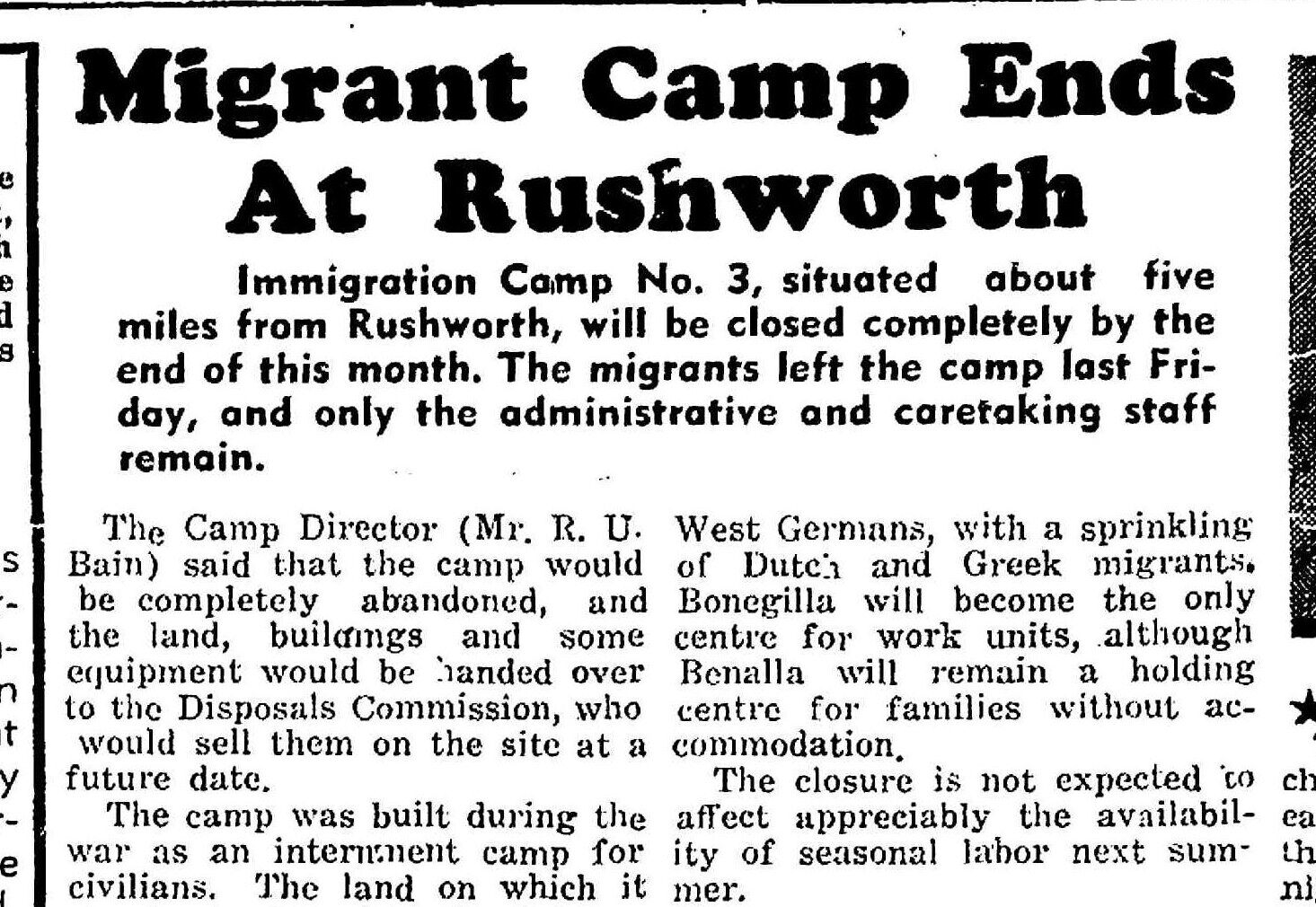
The end was reported in detail. On 19 June 1953 the Shepparton Advertiser announced that Immigration Camp No. 3, about five miles from Rushworth, would be closed completely by the end of that month; the migrants had left the previous Friday and only administrative and caretaking staff remained. The camp director, named in the report as Mr R. Bain, said that the place would be completely abandoned and that the land, buildings and some equipment would be handed to the Disposals Commission, which would sell them on the site at a later date.
The reason given was a slowing immigration programme. The Italian quota had been completed and the main intake was to be West Germans with a sprinkling of Dutch and Greek migrants; Bonegilla was to become the only centre for work units, while Benalla would remain a holding centre for families without accommodation. The paper added that the closure was not expected to affect the availability of seasonal labour the following summer, which is a measure of how far the camp had become part of the district’s working life.
Sources for this section
After the migrant years
The museum dates the end of migrant accommodation to 15 June 1953, which agrees closely with the newspaper’s account of the last residents leaving on 12 June. It preserves the history in a folder of papers and photographs under reference C1997, alongside the Camp No. 3 research collection C7953, and catalogues a photograph of a kindergarten concert at the migrant camp whose title and transcribed inscription give conflicting dates. The camp sites around Tatura and Rushworth are on private property and are not accessible.
Sources
- Tatura Museum, Internment camp No 3 / Rushworth Migrant camp, C7953
Victorian Collections · Undated
Catalogue identity reviewed previously; original folder not inspected. The site was not reachable on 13 September 2026, so the record was not re-read for this revision.
- Tatura Museum, Rushworth Migrant Camp folder, C1997 (2009)
Victorian Collections · 2009
Full original catalogue read previously; operating dates are retrospective catalogue evidence and the binder is unread. The site was not reachable on 13 September 2026.
- Ukrainians in Australia, volume 1, Melbourne, 1966
Melbourne, 1966 · 1966
Original scans visually read. Printed pages match DjVu one-based pages; OCR indexes 81, 82, 116, 168. Catholic and Orthodox narratives kept distinct. Locators: printed pages 83, 84, 118 and 170.
- Rozalie Dean née Fergin, Teodor and Maria Fergin family history
Benalla Migrant Camp · Undated
Original family account read. Polish family; the Rushworth stay is kept separate from the later Benalla narrative.
- Tatura Museum, Kindergarten Concert Rushworth Migrant Camp 1950, L0668
Victorian Collections · Undated
Full original catalogue read previously. The image itself has not been inspected. The catalogue title of 1950 conflicts with the transcribed inscription of February 1920, and the record is marked all rights reserved, so it is cited but not reproduced.
- Migrant Camp Ends At Rushworth
Shepparton Advertiser (Vic.), 19 June 1953, page 2 · 19 June 1953
Contemporary newspaper report, read in full in the Internet Archive capture of 25 December 2024 because trove.nla.gov.au is behind a bot-detection wall. Gives the closure, the camp director’s statement, the transfer to the Disposals Commission, the two phases of residents and the reasons for closure. Article text is Trove OCR and contains recognition errors, including in the director’s surname.
- World War 2 Camps
Tatura Irrigation and Wartime Camps Museum · Undated
Museum web text read in full. Describes the group of seven camps, states that Camp 3 held mostly German family groups, and notes that the camp sites are on private property and not accessible.
- Commonwealth Government Hostels
Migration Heritage Project · 12 April 2022
Reproduces the list of centres as at 27 June 1949 from National Archives of Australia A6006, 1949/04/07, and the 1950 Commonwealth Hostels Programme from MT105/8, 2/71/1146; Rushworth appears as a Victorian holding centre in both.
- Rushworth Camp: migrant camp in 1953
Making Multicultural Australia, image contributed by Andrew Jakubowicz · Added 13 February 2009
Catalogue record read. Captioned as Emilio and fellow workers at Rushworth migrant camp near Tatura in 1953; source of the original photograph is given as not available, so it is cited but not reproduced.
- Migrant camp ends at Rushworth
Shepparton Advertiser (Victoria), page 2 · 19 June 1953
Report of the closure of Immigration Camp No. 3, about five miles from Rushworth: the migrants had left the previous Friday and only administrative and caretaking staff remained; the camp director, Mr R. U. Bain, said the site would be wholly abandoned and the land, buildings and some equipment handed to the Disposals Commission for sale. The report adds that the camp had been built during the war as an internment camp for civilians on land leased from the Rt Hon. John McEwen and bought by the government about four years earlier, that its first migrant occupants were displaced families from various parts of Europe, and that Bonegilla would become the only centre for work units while Benalla remained a holding centre for families without accommodation. Digitised by the National Library of Australia with funding from State Library Victoria; Australian material published before 1955 is out of copyright.
Last researched 13 September 2026