Scheyville Holding Centre
Arrival and settlement
Scheyville, near Windsor, New South Wales, Australia · 1949–1964
Scheyville housed about 1,200 people at a time in converted farm-school buildings and army huts northwest of Sydney between 1949 and 1964. Among them a Ukrainian women’s branch ran a school for thirty-five children and a choir that travelled to Sydney.
Introduction
Scheyville became a home for displaced European migrants about 50 kilometres north-west of Sydney. The official heritage exhibition dates the first arrivals to 14 December 1949 and records 600 residents by year’s end. Families made private rooms out of basic accommodation while sharing meals, bathrooms and laundries. Isolation made finding work difficult; stays intended to last months sometimes stretched into years.
The place had served one government scheme after another before the first migrants arrived: a co-operative settlement of 1893, a casual labour farm, and from 1910 the Dreadnought training farm, where more than 5,600 boys sent from Britain were prepared for farm work between 1911 and 1939. A First World War internment camp and a Second World War military training area came in between.
A history in dates
- 5 April 1949Windsor council told the site will take up to 1,000 migrants at a time
- 14 December 1949First migrants admitted
- September 1950A state school opens at the holding centre
- 27 January 1951Ukrainian women’s branch founded
- 1952Commonwealth Hostels Limited takes over the administration of migrant accommodation
- 1953Branch ends as members leave
- January 1954Central site gazetted for Commonwealth immigration purposes
- 1956A sports field and carpark complete the centre’s shared facilities
- 31 December 1964Migrant Holding Centre closes
- 1 April 1965The site reverts to the army as the Officer Training Unit
- 1995The worst of the decayed migrant buildings are demolished
- 2005The first Back to Scheyville reunion brings former residents together
Becoming a holding centre
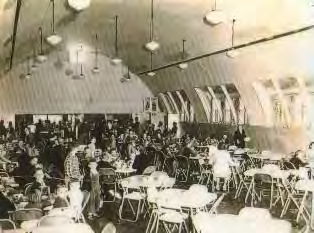
On 5 April 1949 the Commonwealth government told the Windsor aldermen that Scheyville would be used as a reception centre for up to a thousand overseas migrants at a time. The council had to supply the run-down complex with electricity and water, which strained local infrastructure and that of nearby Pitt Town. The 1929 quadrangle was remodelled for staff and offices, and between 1949 and 1956 large numbers of prefabricated army huts were moved in and erected to the west of it. Two big steel arch-rib huts took the expanded kitchen and dining rooms and part of the hospital, education and child-minding facilities.
Responsibility for migrant accommodation of this kind had passed from the Department of Labour and National Service to its Migrant Workers Accommodation Division in 1948, and in 1952 to Commonwealth Hostels Limited, which ran such places until 1978. Legal control of the site itself was only partly clarified in January 1954, when the central portion including the quadrangle was gazetted for Commonwealth immigration purposes.
Scheyville took in dependent families, with Dutch and eastern European arrivals dominating; former residents recalled a camp full of people from the Netherlands, Germany, Poland, Estonia and other eastern European countries. Accounts prepared for the 2011 reunion describe up to 1,500 people a year from twenty-two countries.
The state heritage inventory describes Scheyville between 1950 and 1964 as the largest of the migrant centres in Australia, and the National Parks and Wildlife Service calls the site the largest immigration hostel in the country. The inventory identifies the two steel arch-rib huts as SAARS huts, installed and adapted as dining and recreation accommodation and later used to house a kindergarten.
Who administered the accommodation
| Period | Body responsible |
|---|---|
| 1945–1948 | Department of Labour and National Service |
| 1948–1952 | Migrant Workers Accommodation Division of that department |
| 1952–1978 | Commonwealth Hostels Limited |
Ukrainian women organise
A Ukrainian Women’s Association branch was founded at Scheyville on 27 January 1951. The 1966 community history names Mariia Moskal as chair, with Budnyk, Dakh and O. Maykovska on the committee. I. Pelenska and L. Korzhanivska organised the founding meeting.
Sources for this section
Thirty-five children and a choir
The branch organised a Ukrainian Sunday school with 35 children in two classes. Despite its Sunday-school name, the history says lessons took place twice weekly. O. Maykovska taught the children and directed their choir. The choir performed at camp events and also travelled to Sydney as visiting performers. The history credits Sydney priest N. Kopiakivsky with helping the branch’s educational work.
Sources for this section
Making room for cultural life
The Ukrainian branch history recalls restrictions on ethnic-group gatherings imposed by camp management. The women nevertheless organised lessons and performances. The heritage exhibition describes a multilingual community with music, theatre, religious groups and recreation, activities that made shared accommodation a place of cultural exchange as well as temporary residence.
Buildings for everyday needs
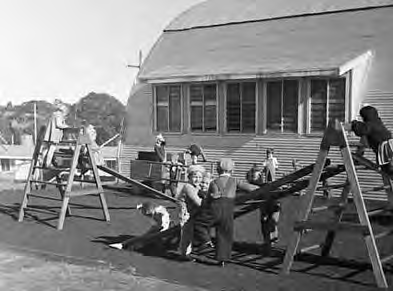
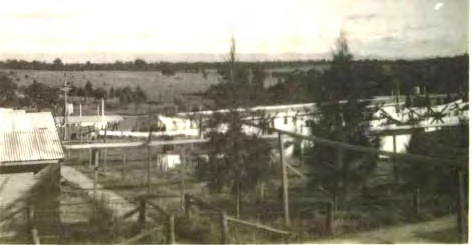
The centre adapted the Quadrangle buildings and added accommodation along the ridge. Educational facilities, a community hall and a sports field supported daily life, while the hospital included twelve maternity beds. The large shared buildings also served as dining rooms; photographs from the 1950s show children playing between the huts and laundry drying outdoors.
What the figures measure
| Date or period | Figure | Scope |
|---|---|---|
| April 1949 | Up to 1,000 | Migrants the site was to receive at any one time, as notified to Windsor council |
| End 1949 | 600 | Residents recorded by heritage exhibition |
| 1951–1964 | About 1,200 | Typical total including service staff, according to conservation plan; not a Ukrainian count |
| Branch’s 1951–1953 period | 35 | Children in Ukrainian school; exact census date unspecified |
| 1949–1964 | Up to 1,500 a year, from 22 countries | Reunion-day figure quoted in 2011 press reporting, not an archival count |
| Hospital, 1950s | 12 | Maternity beds |
| 1956 | 3 pounds a day | Earnings of women picking vegetables for local farmers |
| 1958 | 5 pounds | Rent charged for a room once a family had work; the source does not state the period the sum covered |
| Late 1964 | About 300 | Remaining migrants before closure |
Sources for this section
Huts, laundry and the hospital
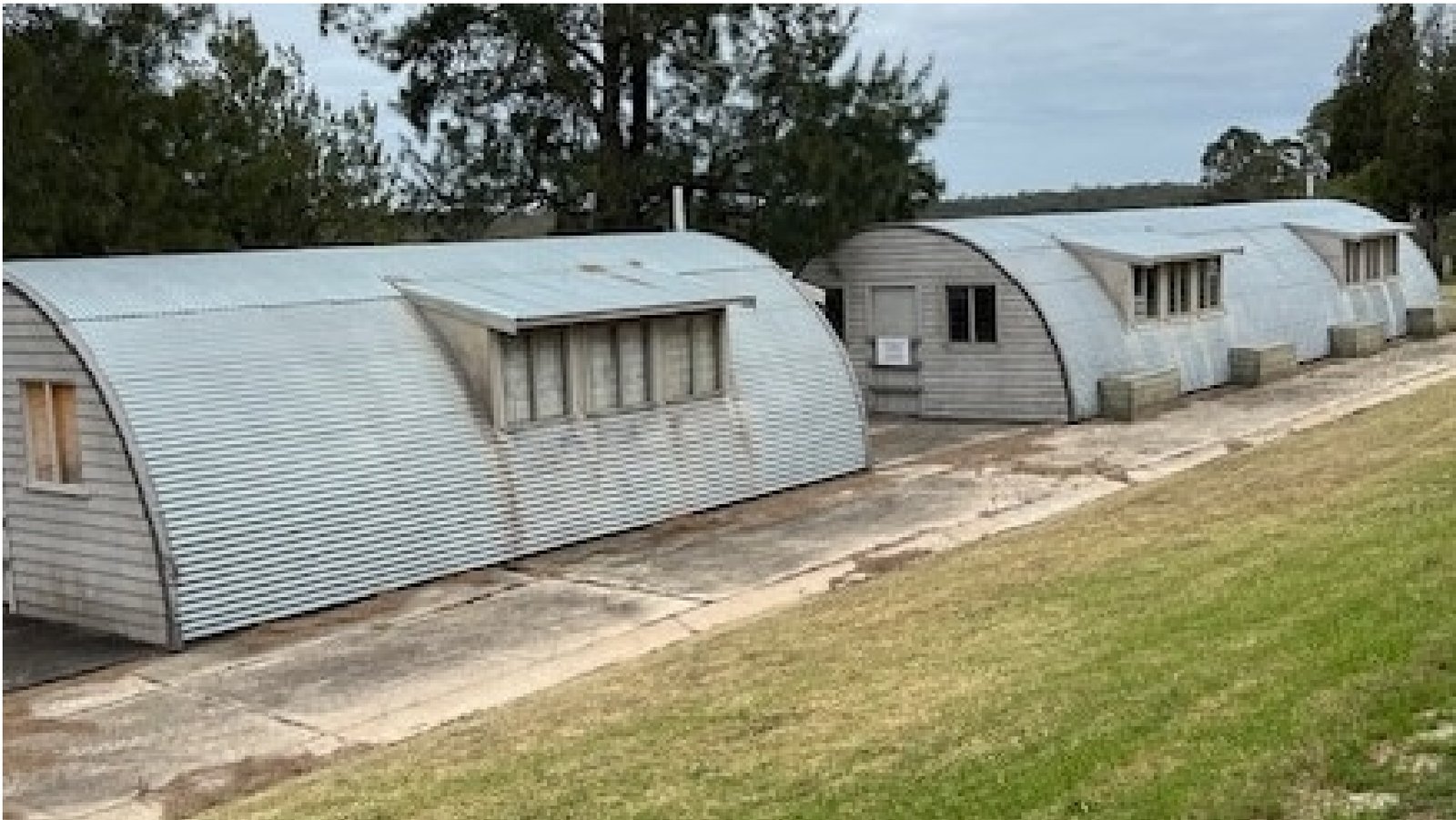
The earliest residents slept in the large semicircular corrugated-iron huts, divided into three rooms with three to five people in each; men and women were at first in separate barracks, and families were housed together once the smaller huts arrived. Those huts were single-skin fibro with louvre windows and no lining, bitterly cold in winter and hot in summer. Rooms measured about four metres square and held a steel-framed bed with a feather mattress for each person and two chairs.
Washing was done in a hall fitted with coppers, tubs and irons, with a drying area of lines propped on forked posts. One former resident described the laundry as the place where older women met each other in the course of the day, which mattered in a camp where many were parted from their husbands. Food from the kitchen could be supplemented from a small shop just outside the gates, run by a local farmer, that stocked familiar European groceries.
Sources for this section
Work, rent and separated families
Accommodation and food were free until a family found work, after which rent was charged; in 1958 this came to five pounds for a room, over a period the source does not state. Some men were employed at the centre itself as cooks, handymen, supervisors and clerks, and residents remembered that the centre doctor was a Polish migrant. Others took the centre’s offer of a lift into Windsor on an open flat-top truck to visit the employment bureau, finding work on local farms or, by 1958, at the Port Kembla steelworks.
Men directed to distant jobs were often housed near their work and came back only at weekends, leaving women to raise families alone in an isolated place with no public telephone and no useful public transport. Many took work themselves. Local farmers came early in the morning looking for people to pick potatoes and other vegetables, work that paid three pounds a day in 1956. One woman saved her picking money for a sewing machine, then sewed for a clothing factory at night after the children were in bed, and taught a neighbour to do the same.
Church, school and the bush
A state school operated at the holding centre from September 1950, and there was a preschool on site as well. Adults had English classes and, in later years, film screenings in the cinema on Friday or Saturday nights, but former residents interviewed at the 2005 reunion said there was otherwise little organised for them. Christmas parties with singing and presents for the children were an annual fixture, and impromptu parties with tables dragged outside the huts were common.
The Catholic community was strong. Nuns ran games and craft activities for children, boys served at Sunday mass, and Father Doyle was remembered for eating with residents after church and helping them settle. The bush and dams around the camp were where many children spent their free time. The centre also had a post office, a convent and a rugby league team.
Leaving Scheyville
The Ukrainian women’s branch ceased in 1953 as members moved away. This was not the end of the migrant centre. The conservation plan dates its closure to 31 December 1964, with about 300 migrants remaining late that year. The site subsequently entered another military phase.
Stays were meant to last three to six months but ranged from three months to ten years. The site reverted to military control on 1 April 1965 as the army’s Officer Training Unit, and later held an agricultural college and a police tactical response group before becoming a national park in 1996. The worst of the decayed buildings were demolished in 1995 and the survivors have been conserved since. A state school record dates the closure of the camp school to December 1965, a year later than the conservation plan’s date for the centre itself; the discrepancy is unresolved.
Traces of the holding centre survive in what is now Scheyville National Park. The heritage inventory records the concrete foundations of the lines of prefabricated accommodation on the slope east of the quadrangle buildings, which housed the migrant families and were later adapted for the officer cadets, and two ablution blocks built for the holding centre and afterwards used by the army. Its assessment of significance treats the park as a representative example of a migrant holding hostel for displaced persons at the end of the Second World War. The National Parks and Wildlife Service has waymarked a Migrant Heritage walk around original structures of the camp, with interpretive panels on the site’s heritage.
Sources
- Ukrainian Women’s Association of Australia, 2001 history
Original 2001 page previously visually inspected. Its cited 1966 source has now been acquired and Scheyville passage visually read; shared textual ancestry, not independent corroboration. Locators: {"printed_pages": [110], "pdf_pages_one_based": [119]}
- Scheyville National Park Conservation Management Plan, March 2009
252-page combined PDF obtained. Volume 1 printed 45/PDF 45 visually inspected; volume 3 photograph catalogue PDF 211–213 read as extracted text. Locators: {"pages": "Volume 1 p 45; Volume 3 pp 29–31"}
- NSW Migration Heritage Centre and NPWS, Fields of Memories: Migrant Accommodation Centre
Full indexed exhibition text read, including attributed 2005 oral-history recollections; original interview recordings unread.
- Ukrainians in Australia, volume 1, Melbourne 1966
Parent visually inspected complete Scheyville branch passage. Retrospective community history, not 1951 minutes. Locators: {"printed_page": 497, "scan_page_one_based": 497}
- Migrant camp seemed more like an adventure playground for young Joe
Sydney Morning Herald · 14 May 2011
Report on the 2011 Back to Scheyville reunion. First-person recollections of a resident of 1953 to 1960 and figures given by the National Parks and Wildlife Service area manager. Reunion-day estimates, not archival counts.
- Scheyville Holding Centre (School)
Hawkesbury People & Places, citing Government Schools of NSW 1848–1998 (NSW Department of Education and Training, 1998), p 129 · Accessed 13 September 2026
School opening date September 1950. Its closure date of December 1965 conflicts with the conservation plan’s 31 December 1964 for the centre and is reported as a discrepancy.
- Scheyville National Park, State Heritage Inventory listing
Heritage NSW
Listing read: Scheyville established as a Migrant Holding Centre in 1949 and described as the largest of the migrant centres in Australia between 1950 and 1964; two SAARS huts installed and adapted as dining and recreation accommodation and later to house a kindergarten; the concrete foundations of the lines of prefabricated accommodation and two ablution blocks still in situ; and an assessment of significance treating the park as a representative example of a migrant holding hostel for displaced persons at the end of the Second World War.
- Migrant Heritage walk, Scheyville National Park
NSW National Parks and Wildlife Service
Walk description read: an easy walk around original structures of the post-war migrant camp, with interpretive panels on the site’s heritage, and the statement that up to 1,500 people a year from more than twenty-two countries passed through the camp between 1949 and 1964.
- Scheyville Camp Precinct
NSW National Parks and Wildlife Service
Overview text read: the precinct described as having become the largest immigration hostel in Australia, its residents arriving as Dreadnought boys, post-war migrants or National Service officers.
- Scheyville Migration Camp, then and now
Dutch Australian Cultural Centre · 2011
Page text read: the camp about 50 kilometres north-west of Sydney, serving as a reception and training centre for thousands of migrants between 1949 and 1964, with residents from the Netherlands, eastern Europe, the Baltic states and southern Europe. An embedded 2011 video was not viewed.
- NSW National Parks under fire over state of Scheyville camp precinct
Task Force Veteran
Article on the condition of the camp precinct in the national park, read with its photographs; it publishes a view of the surviving migrant accommodation huts, captioned as dating from 1949, and of the decaying interior of one of them.
Last researched 13 September 2026