Schloss Neubeuern
Displacement in Europe
Neubeuern · Germany · 1946–1947
A castle above the Inn valley, emptied of the Nazi boarding school that had replaced its own, housed about 600 displaced people of Polish-Ukrainian, Latvian and Estonian background between 1946 and 1947. The camp closed in the late summer of 1947 and the school reopened the following April.
Introduction
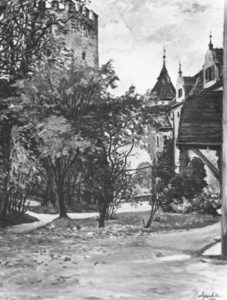
Schloss Neubeuern sheltered displaced families in a castle above the Inn valley. Its postwar community included Ukrainians, Latvians and Estonians. A surviving painting dated 1946 shows the castle grounds during these years, preserving a very different setting from the rows of military barracks found at many other camps.
Sources for this section
A history in dates
- 5 May 1923The boarding school opens in the castle.
- 13 February 1941The existing boarding school is closed by the National Socialist authorities.
- Spring 1942The castle complex is sold to the German state; a National Political Institute of Education is installed.
- 1945A medical company establishes a field hospital in the castle.
- 24 January 1946The DP camp is first recorded in the administrative inventory.
- 24 August 1946The UNRRA return records 419 Ukrainians at Neubeuern.
- 1946A surviving painting depicts the castle during the displaced-person period.
- 31 May 1947The UNRRA return records 345 Ukrainians.
- 25 August to 20 September 1947The inventory places the end of camp operation within this interval.
- April 1948School life resumes on a small scale.
- June 1948The boarding school formally reopens under the new foundation.
A castle becomes temporary accommodation
Before the war, the castle housed a boarding school, opened on 5 May 1923 on the model of Schloss Salem. The National Socialist authorities judged it politically unreliable and closed it on 13 February 1941. To forestall expropriation the owner sold the whole castle complex to the German state in the spring of 1942, and a National Political Institute of Education was installed there, the only one in the Munich and Upper Bavaria district. The castle also served as a military hospital during the war and the occupation, and the municipal history records a medical company setting up a field hospital there in 1945.
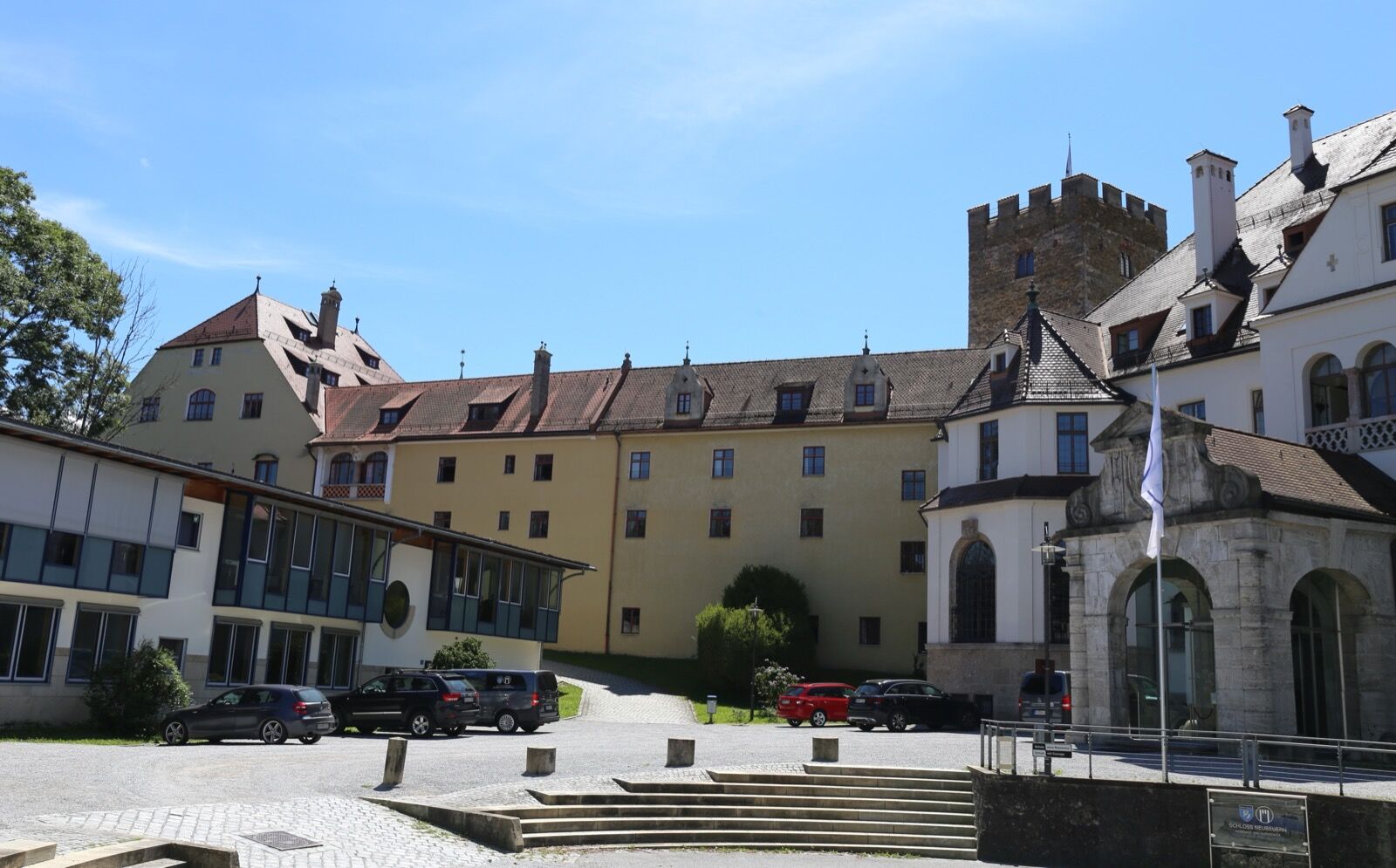
The building stood on a sandstone outcrop above the town, with steep slopes on three sides. Its medieval keep and later residential wings formed a distinctive complex. The central wing had been rebuilt to designs by the architect Gabriel von Seidl between 1904 and 1908, decades before displaced families arrived.
Sources for this section
The displaced community
The administrative inventory identifies the castle as Assembly Centre 95-379, under UNRRA Team 188 at Rosenheim, in district 5 of the American zone, with the area team at Traunstein and Bad Reichenhall from November 1946. It lists approximately 600 people and records Polish-Ukrainian, Latvian and Estonian groups. This figure is an approximate headcount without a stated census date; it is not a count of Ukrainians alone.
Published population returns give Neubeuern its own row and count Ukrainians only: 254 in the questionnaire returns of 1946 to 1947, 419 in the UNRRA return of 24 August 1946 and 345 in the UNRRA return of 31 May 1947. No figure appears for the PCIRO return of 2 January 1948, which is consistent with the inventory’s closing window but does not on its own prove the camp had gone.
A published family recollection independently places a Ukrainian family in the castle during the first postwar years. Their later home in Minneapolis displayed the 1946 castle painting. The same account describes the wider circle of Ukrainian artists rebuilding their work in Bavaria and the continuation of Ukrainian cultural life after emigration. The castle image connects that artistic legacy to an identifiable place of temporary refuge.
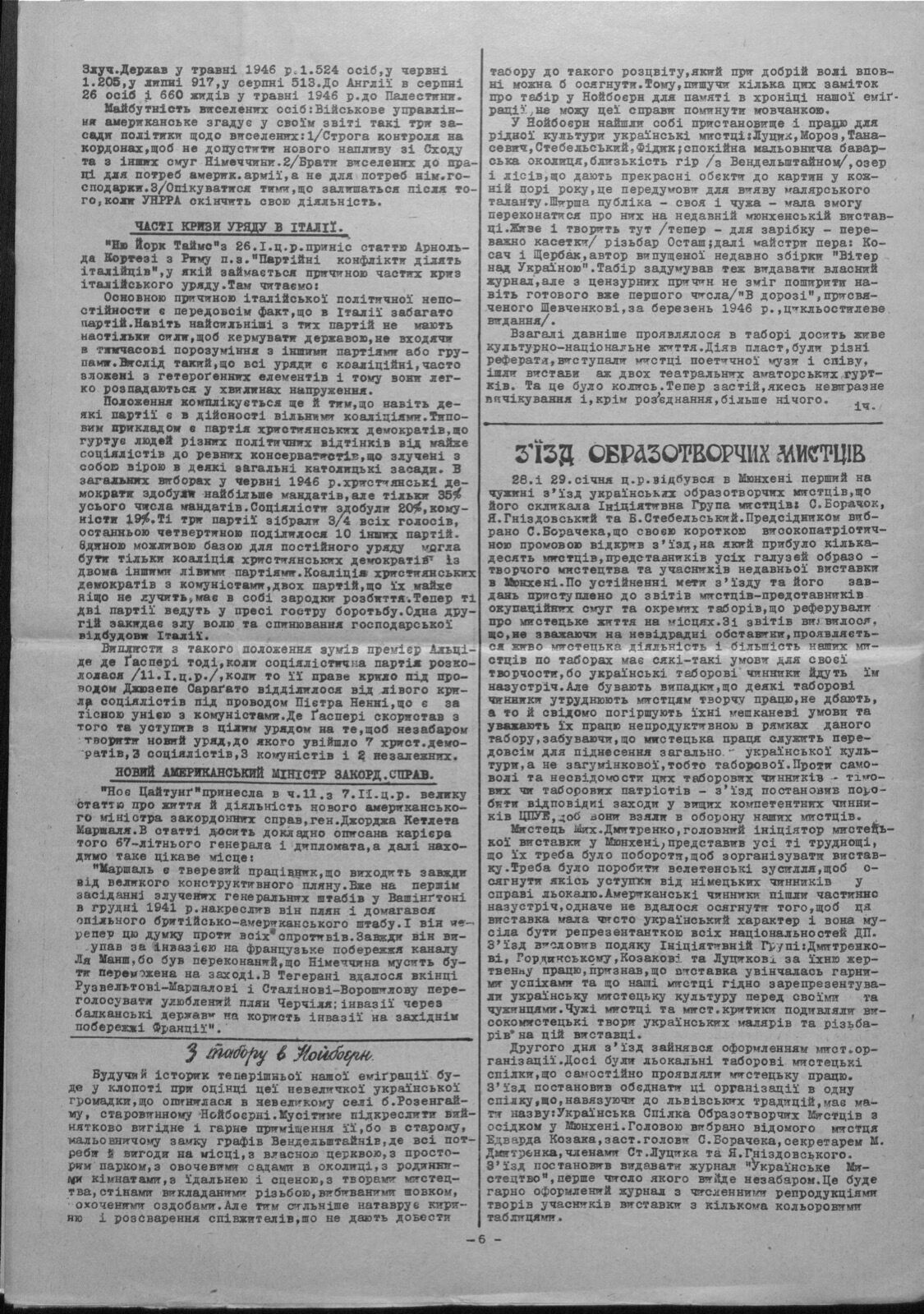
A chronicle note published in the Ukrainian Catholic weekly Khrystiianskyi shliakh on 16 February 1947, under the heading “From the camp at Neubeuern”, describes the community from inside it. Its author calls the Ukrainians there a small group settled in a village near Rosenheim, and singles out their exceptionally comfortable and handsome quarters: the old castle of the counts of Wendelstein, with everything to hand, a church of its own, a spacious park, orchards in the neighbourhood, family rooms, a refectory with a stage, works of art, walls panelled in carving and hung with stamped silk.
The same note records what the camp had made of itself. Ukrainian artists found shelter and work there — it names Lutsyk, Moroz, Tanasevych, Stebelsky and Fidyk, and the carver Ostash, then making small caskets for a living — along with the writers Kosach and Shcherbak, whose collection Viter nad Ukrainoiu had recently appeared. The camp intended a journal of its own: a first Shevchenko number called V dorozi was cyclostyled for March 1946 but could not be circulated for reasons of censorship. Plast was active, lectures were given, poets, singers and two amateur theatre groups performed. By the beginning of 1947 the writer found all this at a standstill, and blamed quarrelling among the residents for a camp that never flourished as it might have.
What the camp was like from day to day is not established. No source read here describes its schooling, its church life, its work or how departures were organised, and the inventory names only the team director and field supervisor. The camp is documented by its administrative record, by the population returns and by one family’s memory, and that is the limit of the evidence.
The camp in administrative records
| Item | Recorded detail |
|---|---|
| Premises | Neubeuern Castle |
| Assembly Centre | AC 95-379, dated from September 1948 |
| UNRRA team | T 188 Rosenheim; team director Carton; field supervisor Cagle |
| Area team | AT 1069 Traunstein and Bad Reichenhall, from November 1946 |
| First listed | 24 January 1946 |
| Closing | Between 25 August and 20 September 1947 |
| Approximate headcount | about 600; capacity date 31 October 1947 |
| Groups listed | Polish-Ukrainian, Latvian and Estonian |
| Archive reference | ITS Dok-ID 82018719-82018721 |
Ukrainians recorded at Neubeuern
| Return | Ukrainians |
|---|---|
| Questionnaire returns, 1946–7 | 254 |
| UNRRA, 24 August 1946 | 419 |
| UNRRA, 31 May 1947 | 345 |
| PCIRO, 2 January 1948 | no figure printed |
Return to a school
The camp inventory places the end of its recorded operation between 25 August and 20 September 1947. The castle’s founding consortium met in 1947, school life resumed on a small scale in April 1948, and the reopening of the boarding school as the Privates Landerziehungsheim Neubeuern am Inn followed in June 1948. The school was to be open from then on to children of every social class and nation as a contribution to understanding between peoples, and in 1948 the castle also housed a youth-leader school of the newly founded Bavarian Youth Council.
Two dates in the inventory row sit oddly with that closing window. The assembly-centre number is dated from September 1948 and the headcount date is 31 October 1947, both after the camp is recorded as having closed. The inventory does not explain this, and the dates are reproduced here as recorded rather than reconciled.
Sources for this section
Sources
- Displaced persons camp inventory: Schloss Neubeuern
Arolsen Archives · 2023
Entry 1311, spreadsheet row 1310, listed under Neubeuren: Schloss; Assembly Centre 95-379 from September 1948; UNRRA Team 188 Rosenheim, team director Carton, field supervisor Cagle; area team AT 1069 Traunstein and Bad Reichenhall from November 1946; district 5; nationalities polnisch-ukrainisch, lettisch, estnisch; headcount about 600 with capacity date 31 October 1947; opening serial equal to the team director date and therefore a first listing rather than a documented opening; closing between 25 August and 20 September 1947; ITS Dok-ID 82018719-82018721.
- Unser Schloss
Markt Neubeuern · Accessed September 2026
Municipal history of the castle, wartime school and hospital, and reopening of the boarding school in April 1948.
- I Grew Up in an Art Gallery
Chrystyna Lucyk-Berger · 8 June 2021
Published family recollection identifies Castle Neubeuern as a DP camp and reproduces a painting dated 1946. Only the nonfiction account is used; the novel extract is excluded.
- Ihor Stebelsky, Ukrainian Population Migration after World War II, Table 7
Canadian Institute of Ukrainian Studies Press · 1992
The Refugee Experience, printed page 50, read visually at 2.6x magnification so that each figure could be matched to its column. Row spelled Neubeuren: 254 (1946–7 questionnaire returns), 419 (UNRRA, 24 August 1946), 345 (UNRRA, 31 May 1947), blank (PCIRO, 2 January 1948). Ukrainians only.
- Schloss Neubeuern
German Wikipedia · Accessed September 2026
Tertiary source used only for the institutional history of the building: the school’s opening on 5 May 1923, its closure on 13 February 1941, the sale to the German state in spring 1942 and the National Political Institute of Education, the wartime and occupation use as a military hospital, the reversal of the sale, the 1947 founding consortium, the resumption of teaching in April 1948 and the formal reopening in June 1948. It does not mention the displaced-persons camp.
- Schloss Neubeuern, photograph of 2024
Wikimedia Commons · 5 July 2024
Photograph licensed CC BY-SA 4.0, uploaded by the Commons contributor named in the credit beneath the image, and taken for the Bavarian listed-building record D-1-87-154-33. Shows the castle on its sandstone outcrop above the town.
- Z taboru v Noiboiern (From the camp at Neubeuern), Khrystiianskyi shliakh, number 7 (55), 16 February 1947, page 6
Ukrainian Catholic Parish, Mittenwald · 16 February 1947
Digitised by the Ukrainian Museum-Archives of Cleveland with the United States Holocaust Memorial Museum as part of the Displaced Persons Camp Periodicals Collection; marked public domain or an orphan work and offered under Creative Commons Attribution-NonCommercial-NoDerivatives 4.0. A signed chronicle note describing the Ukrainian community in the castle, its accommodation, its artists and writers, and the decline of its cultural life.
Last researched 13 September 2026