Servatius Hospital
Displacement in Europe
Augsburg · Germany · June 1945 to at least April 1949
A medieval Augsburg foundation for the sick became DP Hospital No. 1753 B, a 406-bed institution serving displaced people across a wide stretch of Swabia. Ukrainians appear in its returns for 1947, and a document of April 1949 shows it still working under the same number.
Introduction
Servatius Hospital cared for displaced people in Augsburg, Ukrainians among them. Its identity was medical rather than military: it occupied a former home for older people, apart from the city’s barrack camps, and for families in those camps illness could mean a move into this different part of the relief system.
Sources for this section
A history in dates
- 1264A leper hospital is first recorded, the origin of the Servatius foundation.
- 1288Hartmann Langenmantel I endows a house for eight sick people.
- June 1945The displaced-persons hospital starts work with American army approval.
- July 1945A lung-disease department and a tuberculosis dispensary are organised.
- 1946The hospital reports 4,161 people treated during the year.
- October 1946An Augsburg camp paper appeals for slippers and children’s toys for about forty Ukrainians in the DP hospital.
- 31 May 1947A Lithuanian weekly describes ten departments, 406 places, 260 staff and a catchment of nearly 40,000 people.
- May–December 1947Ukrainian returns record 69 and then 72 people.
- 13 April 1949A coroner’s document stamped with the hospital’s number records a death at Servatius Stift, Lindauer Straße 32.
- October 2018A replacement municipal care centre opens near the old site.
The foundation before 1945
The house that carried the Servatius name was one of Augsburg’s oldest charitable institutions. A leper hospital without a patron saint is first recorded in 1264, and in 1288 Hartmann Langenmantel I endowed a house for eight sick people; from the fourteenth century the city appointed its administrators. After leprosy receded it sheltered women with scorbutic illness, was run jointly by the two confessions from 1649, and in 1738 was combined with the St Sebastian hospital into a house for incurable cases.
By the twentieth century the foundation ran a home for older people, and the 1947 report describes the sisters of the St Vincent convent, who had cared for its residents, still helping the displaced-persons hospital. That report tells the origin story differently, crediting a gift of 125 gold pounds and a rebuilding by a bishop named Servatius; the city lexicon’s version is the documented one. The endowment survives as the Paritätische St. Servatiusstiftung.
Sources for this section
Inside the hospital
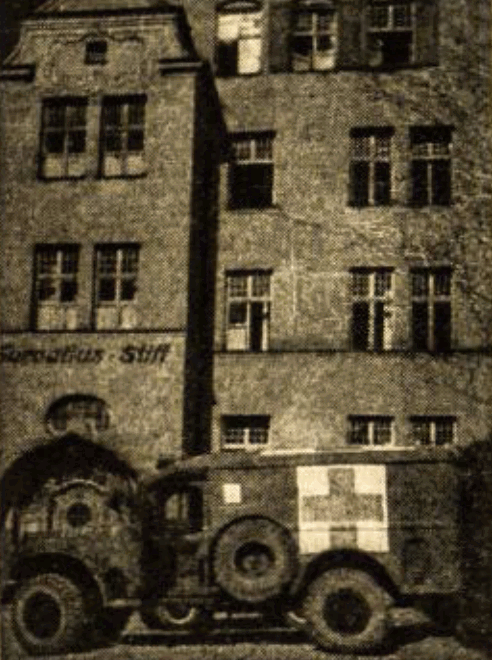
The hospital started immediately after the German capitulation. With American army approval a group of foreigners organised a hospital for foreigners, run separately from German institutions, because, as a May 1947 report put it, more than 25,000 homeless displaced people had no settled medical care. Work began in June 1945 and the building was repaired and then extended. That report identifies the institution as DP Hospital No. 1753 B, standing a short walk west of Hochfeld’s Baltic camp, with rooms for two to four patients and six in the largest.
Ten departments had grown up by 1947: internal and infectious diseases, surgery, a tuberculosis dispensary, radiology, skin and venereal medicine, gynaecology, children’s care, eye treatment, a dental room and a newly founded dental surgery department. Together they held 406 patients. Separate kitchens supplied ordinary and prescribed diets, and a laboratory, a pharmacy and four ambulances supported the wards.
The two largest departments were internal and infectious diseases, with more than 120 beds under a former dean of the Kaunas medical faculty, and surgery, with 80 beds, where more than 800 major operations had been carried out and the work had been commended by American army and UNRRA offices. Direction was shared rather than held by one person.
Sources for this section
Screening for tuberculosis
Tuberculosis work gave the hospital its widest reach. A lung-disease department and a tuberculosis dispensary were organised in July 1945 and grew to 65 beds before the lung department moved elsewhere. Its head reported some 40,000 screenings, which found about 600 displaced people with active or chronic tuberculosis; they were taken into the dispensary or sent on to the sanatoria at Gauting or Neuburg. He said every displaced person in Augsburg had been examined and that the Swiss Red Cross had confirmed it. The hospital also taught, hosting a course in tropical diseases for displaced doctors of several nationalities given by a professor from Tübingen.
Departments named in the 1947 report
| Department | Recorded detail |
|---|---|
| Internal and infectious diseases | More than 120 beds; electrocardiograph and metabolism apparatus |
| Surgery | 80 beds; more than 800 major operations reported |
| Tuberculosis dispensary | About 40,000 screenings; about 600 active or chronic cases found |
| Lung diseases | Organised July 1945, grew to 65 beds, later moved elsewhere |
| Radiology | Reported as distinct from the tuberculosis dispensary |
| Skin and venereal, gynaecology, children’s, eye | Listed without separate bed figures |
| Dental room and dental surgery | Dental surgery newly founded in 1947 |
Sources for this section
Treatment across a wider region
By May 1947 the hospital reckoned it served close to 40,000 displaced people living between Ulm, Dillingen, Schongau and Augsburg. Fifteen to twenty patients arrived on a typical day, and 4,161 people had been treated during 1946. A hospital record may therefore mark a stage of care rather than a change of home.
Sources for this section
Ukrainians among the patients
The Ukrainian returns count 69 people in May 1947 and 72 in December. They establish a Ukrainian presence within a wider international institution; they do not identify the nationality of every patient or give the hospital’s total occupancy.
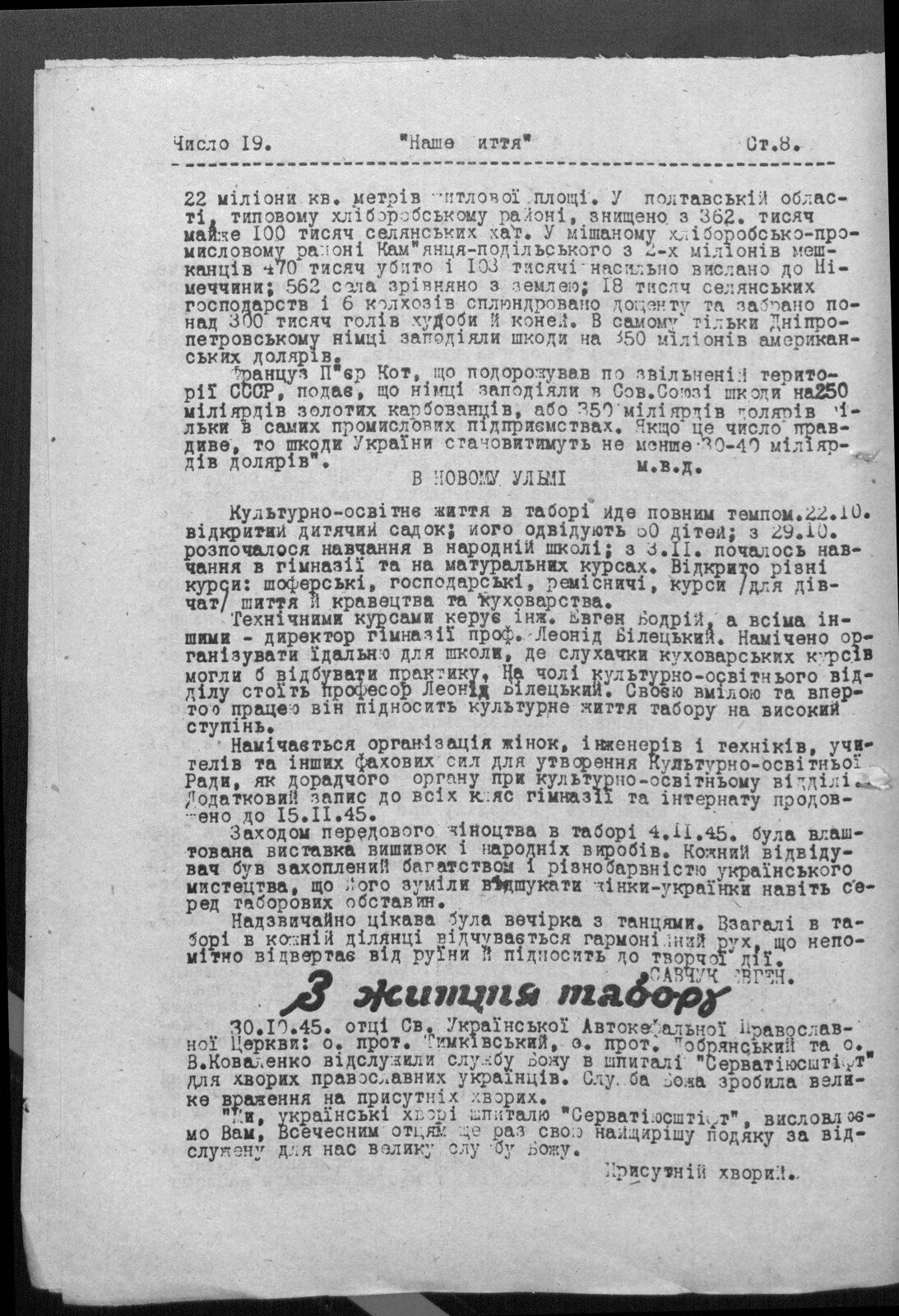
A Ukrainian paper published at Somme-Kaserne in October 1946 carried an appeal from an UNRRA welfare officer to the Augsburg scouts: about forty Ukrainians were in the DP hospital and needed slippers, which could be made from old material, and toys for the children, to be handed in at the Ukrainian social welfare office. The appeal does not name the hospital, but it shows Ukrainian patients supplied through their own community as well as by the institution.
Figures reported in the May 1947 hospital report
| Measure | Reported figure |
|---|---|
| Places for patients | 406 |
| Departments | 10 |
| Staff | 260 |
| Doctors | 27 |
| Ambulances | 4 |
| Typical daily admissions | 15–20 |
| Treated during 1946 | 4,161 |
| Displaced people in the catchment | close to 40,000 |
| Ukrainians, May 1947 | 69 |
| Ukrainians, December 1947 | 72 |
Sources for this section
Where it stood and how long it worked
A coroner’s document of 1949 stamped “DP 1753 B Hospital Servatius Stift Augsburg” gives the address as Lindauer Straße 32 and records a death there on 13 April 1949, in a case whose family was living in the Landsberg camp. The hospital was still working under the same number nearly four years after it opened. The foundation’s present care home is recorded at Windprechtstraße 32.
Sources for this section
The later site
Municipal elder care continued the Servatius name long after the displaced-persons period. In October 2018 a replacement care centre opened a few metres from the previous location. That modern institution belongs to the site’s later history; it is not the building shown in the 1947 hospital photograph.
Sources for this section
Sources
- DP Hospital No. 1753 B
Žiburiai / Spauda digital archive · 31 May 1947
Original Lithuanian reportage, printed page 8. Describes the Servatius hospital, staffing, facilities, admissions and referrals. Building photograph credited to V. Račkauskas; cropped from the original montage.
- Ukrainians at Servatius Hospital
Canadian Institute of Ukrainian Studies Press · 1992
Stebelsky table 7, printed page 48: 69 in May 1947 and 72 in December 1947. Columns visually checked.
- Visit from the past
Amerika in Augsburg · Accessed September 2026
Local historical association explicitly identifies a DP facility in Servatius-Stift, distinct from the barrack camps.
- Seniorenzentrum Servatius
Altenhilfe der Stadt Augsburg · Accessed September 2026
Municipal care provider identifies the October 2018 replacement centre a few metres from the old site.
- St. Servatius
Stadtlexikon Augsburg, Wissner Verlag · Accessed 13 September 2026
Medieval and early modern history of the foundation: first mention 1264, Hartmann Langenmantel I’s endowment of 1288, municipal administration, later uses and the 1738 amalgamation. The article carries nothing on 1945–1950.
- Paritätische St. Servatiusstiftung
Stadtlexikon Augsburg, Wissner Verlag · Accessed 13 September 2026
The surviving foundation, its thirteenth-century origin and its present home at Windprechtstraße 32. No displaced-persons content.
- Welfare appeal for Ukrainians in the DP hospital
Українська Думка (Ukrainian Thought), Somme-Kaserne, Augsburg; Ukrainian Museum-Archives of Cleveland / USHMM digitisation · Issue 3, October 1946
Appeal signed by an UNRRA welfare officer, printed after a message to the Augsburg Plast rally: about forty Ukrainians in the DP hospital need slippers and children’s toys, to be handed in at the social welfare office. The issue reports events of early October 1946. The hospital is not named in the appeal.
- The displaced baby of a Landsberg family
Jüdisch Historischer Verein Augsburg · 27 May 2009
Reproduces a 1949 coroner’s document stamped “DP 1753 B Hospital Servatius Stift Augsburg”, giving the address Lindauer Straße 32 and a death on 13 April 1949. Used only for the hospital’s number, name, address and continued operation; no names or images from the post are reproduced.
- З життя табору (From camp life), Наше життя, number 19, page 8
Nashe zhyttia, cultural and educational department of the Ukrainian camp, Augsburg; digitised in the Ukrainian Museum-Archives of Cleveland Displaced Persons Camp Periodicals Collection with the United States Holocaust Memorial Museum · 1945
Camp newspaper item recording that on 30 October 1945 three priests of the Ukrainian Autocephalous Orthodox Church celebrated the liturgy in the Servatius hospital for sick Orthodox Ukrainians, followed by a note of thanks signed ‘a patient who was present’. Public domain or an orphan work as marked by the holding libraries, and offered on the Internet Archive under a Creative Commons Attribution-NonCommercial-NoDerivatives 4.0 licence; the page is reproduced whole and unaltered.
Last researched 13 September 2026