Somers Migrant Holding Centre
Arrival and settlement
Somers, Mornington Peninsula, Victoria, Australia · 1949–late 1950s
Ukrainian and other migrant families made temporary homes at Somers, where school, work and visiting clergy shaped everyday life before the centre became a school camp.
Introduction
Somers Migrant Holding Centre was a temporary home for families settling in Australia after the Second World War. On the Mornington Peninsula, former air-force buildings became living quarters, classrooms and places of work. Ukrainian families were among its residents, alongside migrants from other European countries.
Life at Somers could bring both separation and reunion. Some fathers worked far from the centre while their wives and children stayed behind. Others found jobs within the camp. Children went to school, families watched films, and visiting clergy maintained connections with the Ukrainian community beyond the peninsula.
A history in dates
- 1947The former RAAF camp becomes a private seaside holiday resort.
- 1949Migrant-hostel use begins according to the council history.
- From May 1950Ivan Prashko’s Melbourne ministry includes religious teaching visits to Somers and other family camps.
- 9 September 1952Five children die in the centre’s hospital fire.
- 1954A census footnote records 526 people at the immigration centre, counted apart from the listed population of Somers.
- 1957–late 1950sThe school’s final pupils leave and the migrant centre closes during the transition to educational use.
- September 1959The first educational camp welcomes 100 boys.
- 27 November 1959Somers School Camp is formally opened.
Sources for this section
- Somers School Camp, Camp History
- Mornington Peninsula Shire Thematic History, Context, 2013
- Ukrainians in Australia, volume 1, 1966
- Children Burn to Death, Register-Guard, Eugene, Oregon, 10 September 1952, p. 8
- House of Representatives, Votes and Proceedings No 93, Tuesday 9 September 1952, item 2
- Somers
- Rod Nuske, Leon’s Story, Somers Paper Nautilus 60, November–December 2015
From air-force camp to migrant accommodation
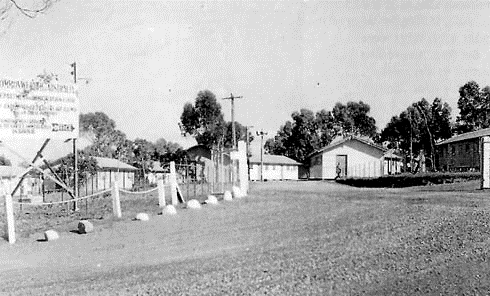
The buildings were erected in the 1940s as a Royal Australian Air Force Initial Training Centre. In 1947 a private group bought the camp, altered it and operated a holiday resort called Feature Holidays–Somers By The Sea. The Commonwealth subsequently reacquired the property for migrant families.
The migrant centre occupied part of the former military site that later became Somers School Camp. It was a different establishment from neighbouring Lord Somers Camp. Council history places migrant-hostel use in 1949–1957, followed by closure soon afterwards. A Victorian place history gives a slightly later span, recording holiday-centre use until 1949 and use as a migrant holding centre until 1958, after which the property passed to the Victorian Government for a school camp.
Sources for this section
Families and the size of the centre
At its peak, Somers accommodated about 1,300 people of several nationalities. The camp school had up to 250 children and 14 teachers. These figures describe the centre as a whole. The surviving Ukrainian account establishes the presence of Ukrainian families without giving a separate population total.
For some families, the holding-centre system meant living apart. Men assigned to jobs could be housed elsewhere, leaving wives and children in family accommodation. The Ukrainian community history describes the difficulty of sustaining weekend visits when journeys were long, fares expensive and transport inconvenient.
A census snapshot survives from the centre’s middle years. The Victorian place entry annotates the 1954 census figure for Somers with a footnote recording a further 526 people at the immigration centre.
Somers in numbers
| Measure | Reported figure | Scope |
|---|---|---|
| Peak residents | 1,300 | All nationalities; peak date unspecified |
| Schoolchildren | Up to 250 | Camp school |
| Teachers | 14 | Camp school |
| Final pupils relocated in 1957 | 7 | School closure |
Work, separation and a home together
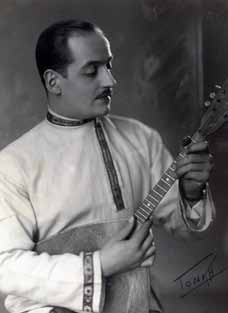
Leonid Bunjevic, known as Leon, was a trained draughtsman and musician. After the family’s arrival at Bonegilla, he picked grapes near Mildura and later worked at the International Harvester factory in Geelong. His wife Tina and their children moved to Somers. The children enjoyed the seaside surroundings and the camp cinema; Leon bought a bicycle and made the long journey to see them every second weekend.
Leon later obtained work in the Somers kitchen and then became storeman. The second position brought a slightly higher wage and better accommodation, allowing the family to live together. Tina found part-time work with local farming families and cultivated vegetables. The family’s experience combined insecure employment, practical adaptation and friendships within and beyond the camp.
Neither Leon nor Tina initially spoke English, although they knew several European languages. Migrants relied on one another for company and support. Leon’s music also helped him make local connections: a former camp teacher encouraged him to perform publicly, and his balalaika playing eventually brought television appearances. The Bunjevic family’s story belongs to Somers’ wider migrant history.
Sources for this section
School, preschool and Ukrainian religious life
School brought together children from a multilingual community. Preschool worker Romola Wollaston remembered transferring from Greta to the smaller Somers centre and enjoying her work there. In her recollection, families at Somers seemed more often able to stay together than at the earlier centres where she had worked.
Ukrainian religious teaching connected children at Somers with the community developing in Melbourne. Bishop Ivan Prashko’s account names Somers among the family camps he visited after beginning his Melbourne work in May 1950. He describes devoting two or three hours a day to religious instruction during visits to the camps. This was a visiting ministry across several centres, alongside the children’s ordinary schooling.
A compiled list of Victorian schools carries the camp school as Somers Migrant Centre, school number 4653, entered separately from the Somers school, number 4458. The further reading list of the Victorian place entry cites Marina Lutz’s published recollections of teaching at that school in 1950.
The hospital fire
Five migrant children died when fire struck the centre’s hospital on 9 September 1952. The deaths were reported in Parliament that day, where Acting Immigration Minister Mr Beale said an inquiry was under way. The Australian Institute for Disaster Resilience records that the fire began at about three in the morning, burned for two hours in strong winds and destroyed two of the wooden hospital huts, and that firefighters rescued twenty-five children and one adult. The newspaper reports it cites, both of 10 September 1952, described the site as a migrant camp hospital.
For Leon, then in Geelong, news of the fire brought a frightening wait. His young son had recently been in the hospital. Leon sought information from the police and learned that his son was not among the children who had died.
Sources for this section
Leaving Somers
As the centre wound down, families had to find accommodation elsewhere. Leon’s account recalls discussions among residents about places including Sunshine, Footscray and Dandenong. His camp employment continued for a time, but in late 1957 he lost his position during the transfer to educational use. The family moved into a weatherboard house at Crib Point.
The council history records the relocation of the school’s final seven pupils in 1957 and the centre’s closure soon afterwards. Wollaston returned to work at Woodside when Somers closed. The transition stretched across several stages rather than a single documented departure day.
After alterations for educational use, the first Somers school camp welcomed 100 boys from the St Kilda Inspectorate in September 1959. Governor Sir Dallas Brooks formally opened it on 27 November 1959. The former migrant centre had become a place where new generations of children came to stay.
Sources
- Somers School Camp, Camp History
Somers School Camp · Undated
Full first-party history read.
- Mornington Peninsula Shire Thematic History, Context, 2013
Mornington Peninsula Shire · 2013
Section on postwar immigration, Figure 12; PDF page 47 (zero-based 46).
- Ukrainians in Australia, volume 1, 1966
Ukrainian community history · 1966
Printed pages [83, 84, 118]
- Romola Wollaston interviewed by Helen Miller, 22 June 2006, OH 728/36, State Library of South Australia
State Library of South Australia · 22 June 2006
Printed pages [19, 22]
- Rod Nuske, Leon’s Story, Somers Paper Nautilus 60, November–December 2015
Somers Paper Nautilus · November–December 2015
Printed 28–29, PDF 15
- Children Burn to Death, Register-Guard, Eugene, Oregon, 10 September 1952, p. 8
Register-Guard / University of Oregon · 10 September 1952
University of Oregon original scan downloaded; printed masthead date and article visually read. Right edge curved or clipped, but Tuesday, five European immigrant children and Somers hospital are legible. The Tuesday preceding Wednesday 10 September 1952 was 9 September.
- House of Representatives, Votes and Proceedings No 93, Tuesday 9 September 1952, item 2
Parliament of Australia · 9 September 1952
Official original indexed PDF text read; direct download returned 403. States that Mr Beale, acting Immigration Minister, announced five children had been lost and an inquiry was ongoing. No image inspection.
- Schools S, T and U
Victorian School Histories · Undated; read 14 September 2026
Compiled list of Victorian school names and numbers. The ‘S’ list was read; it carries ‘Somers Migrant Centre’ with its school number, separately from the Somers school. An unattributed and undated compilation.
- Somers
Victorian Places, Monash University and the University of Queensland · Undated; read 14 September 2026
Place entry read in full: the narrative of holiday-centre and migrant holding-centre use, the census populations table with its footnote on the immigration centre, and the further reading list.
- Somers hospital fire, Victoria, 9 September 1952
Australian Institute for Disaster Resilience, Knowledge Hub · 2021
Disaster summary read in full, with its list of information sources. It gives the time, duration and extent of the fire and the numbers who died and were rescued, and cites two newspaper reports of 10 September 1952.
Last researched 12 September 2026