St. Martin Camp
Displacement in Europe
St. Martin, Untere Fellach, Villach, Carinthia, Austria · Documented 1946–1959
Hundreds of Ukrainians lived at St. Martin in Villach, the camp into which the town’s scattered barrack accommodation was gathered from 1946. Its story connects a bombed-out town, Ukrainian education, the paperwork of emigration and the slow move from barracks into permanent homes.
Introduction
St. Martin was a displaced-persons camp at Untere Fellach, on the northern edge of Villach, in Austria’s British occupation zone. In June 1950 it held 426 Ukrainians. It also served as an International Refugee Organisation field office, bringing temporary accommodation and the administration of possible new lives abroad into the same place.
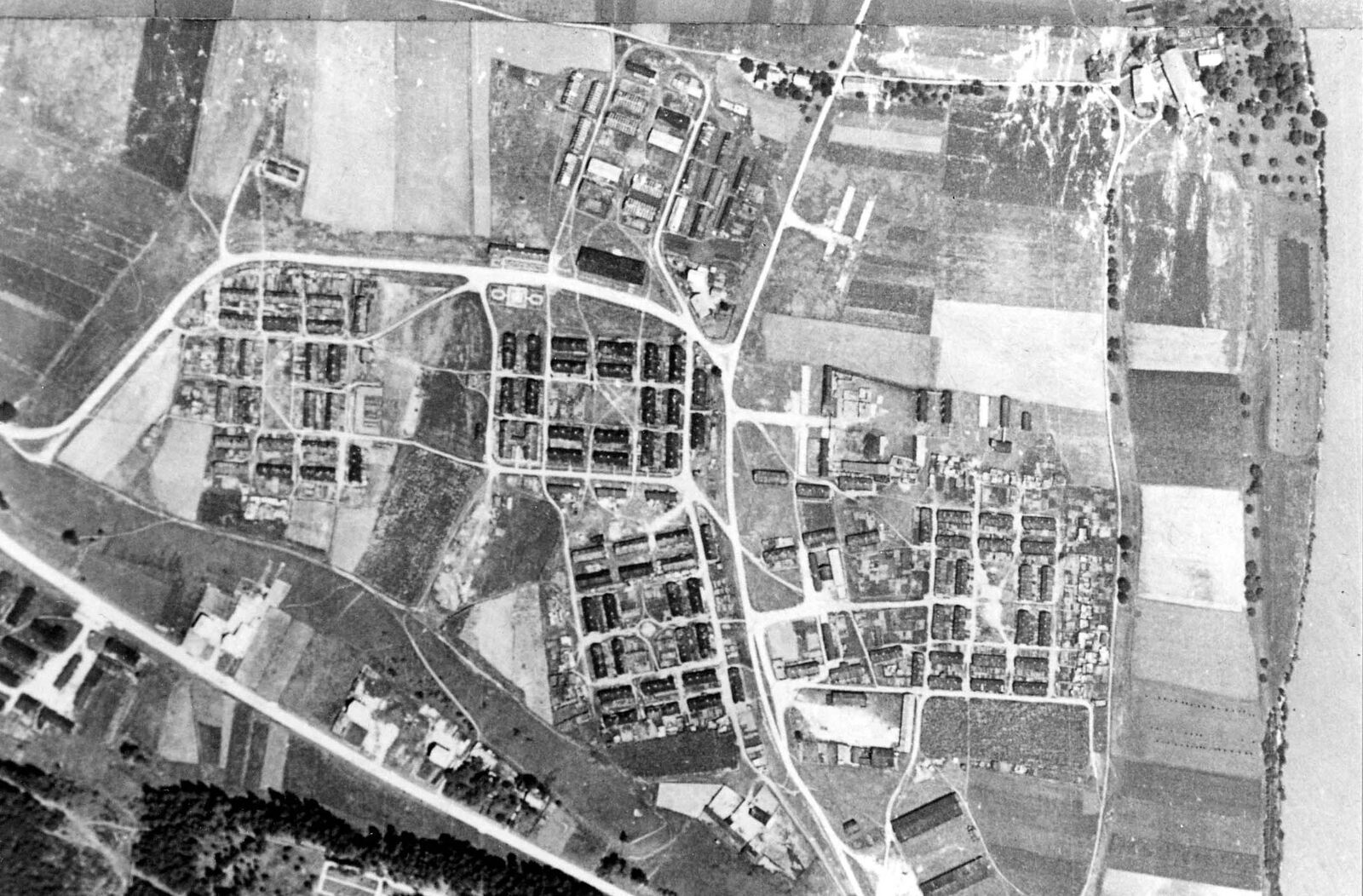
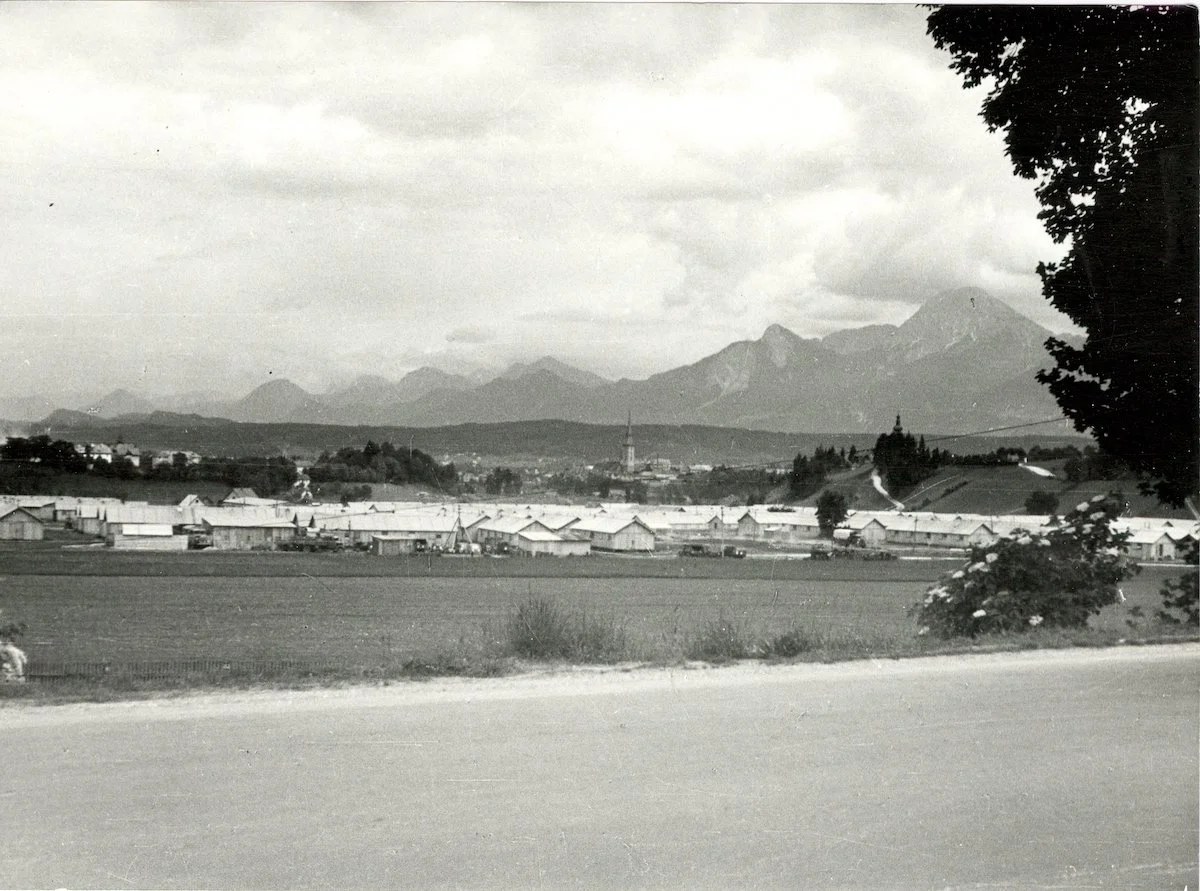
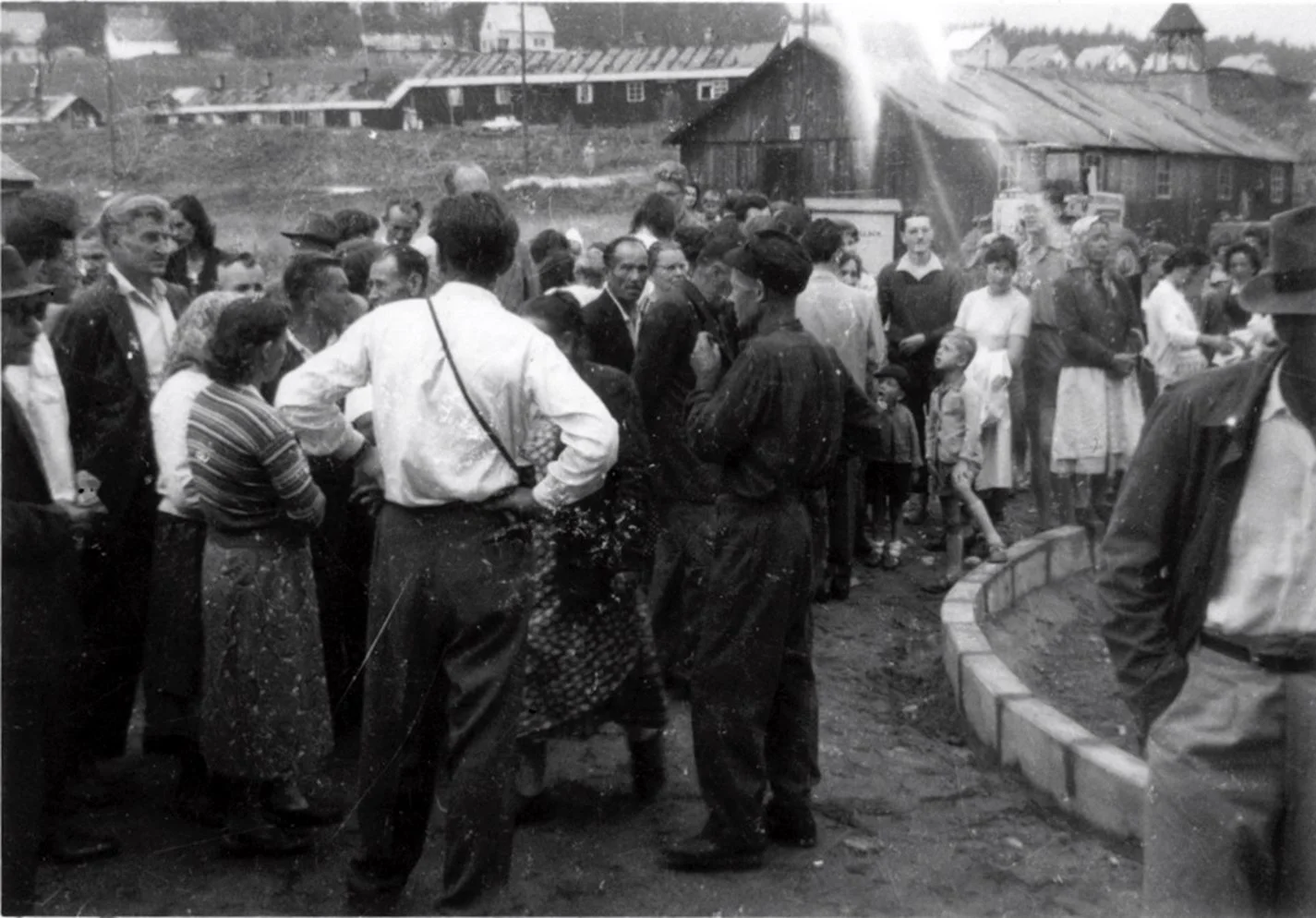
Consolidation of Villach’s scattered camps into St. Martin began in 1946. City-archive photographs document the camp in 1947 and 1953 and the new housing that replaced it.
A history in dates
- 25 July 1944The first heavy air attack falls on Villach’s railway installations; fifty-two raids follow before the war ends.
- 8 May 1945British tanks enter Villach.
- February 1946A United Nations statement describes Bauleitung and four other Villach camps administered together.
- 1946Consolidation of the Villach camps into St. Martin begins.
- 1947A city-archive photograph records the camp.
- 30 September 1948The IRO return lists 871 Ukrainians under Villach, within a British-zone total of 1,527.
- 1949Government records cover repair work at St. Martin.
- 30 June 1950The IRO return lists 426 Ukrainians at St. Martin, out of 881 in the whole British zone of Austria.
- 1951–1952Accounts are rendered for IRO stocks at St. Martin as the organisation winds down.
- 1953An aerial photograph records the camp in Untere Fellach.
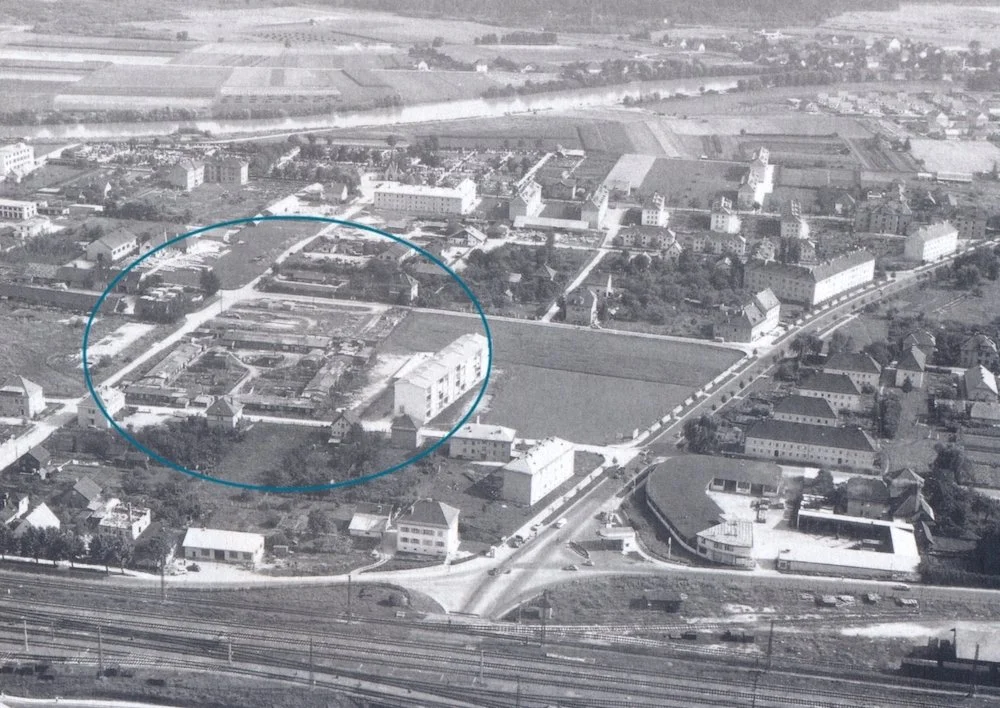
- July 1959A photograph records the opening of new residential blocks.
- 1960sVillach clears the last of its wartime barrack camps.
- 1973Fellach is incorporated into the city of Villach.
A town short of roofs
Villach is a railway junction, and from 1944 that made it a target. Fifty-two air attacks fell on the town, the worst of them on the railway installations on 25 July 1944; from November 1944 until the end of the war the air-raid alarm was near continuous. Some 1,300 houses were destroyed or badly damaged and about 300 inhabitants were killed. Few Austrian towns were harder hit from the air.
About 5,000 people were made homeless, and many of them were put into emergency dwellings and barrack camps which, in the city historian’s words, were characteristic of Villach for years afterwards. British tanks entered the town on 8 May 1945. The barracks that housed displaced people therefore stood in a town where a large part of the Austrian population was itself living in huts, and the competition for building materials and permanent housing shaped everything that followed.
Sources for this section
The earlier Villach camps
UNRRA Team 336 administered five Villach camps: Bauleitung, Judendorf, Völkendorf, Magdalene and Piccolo. The neighbouring team, 330, worked at Spittal an der Drau.
A contemporary United Nations document independently describes Bauleitung and four other camps as a combined administrative group in February 1946. This matters when reading a record labelled simply “Villach”: the name can refer to a network of accommodation rather than one building.
The same document records a dispute over repatriation. The Byelorussian delegate accused the camp administration of obstructing people who wished to return to the Soviet Union. It is evidence of the political arguments surrounding the camps, rather than an impartial account of what every resident wanted. Its reported total of Soviet citizens is not a Ukrainian population figure.
The Villach camp group
| Camp | Location recorded |
|---|---|
| Bauleitung | Ghonallee |
| Judendorf | Villach |
| Völkendorf | Villach |
| Magdalene | Villach |
| Piccolo / Picolo | Purtscherstraße / Ossiacher Zeile |
| St. Martin | Untere Fellach |
Sources for this section
Ukrainian life and education
Villach was one of the Ukrainian centres of the British zone. Its educational activities included an elementary school, vocational schools and a folk university: organised adult education alongside schooling for children. These institutions are documented for the Villach community; the available account does not assign each school to a particular barracks or to St. Martin itself.
The surviving population table records 871 Ukrainians under “Villach” in September 1948 and 426 under “St. Martin” in June 1950. Both figures describe Ukrainians within the relief system. They are separate snapshots under different place labels, so subtracting them would not establish how many residents emigrated from St. Martin.
The same table shows how large a share of the zone St. Martin had become. The British zone of Austria held 1,527 Ukrainians in IRO accommodation on 30 September 1948 and 881 on 30 June 1950. By the later date the only Carinthian and Styrian places still returning Ukrainians were St. Martin with 426, Treffling with 196, Trofaiach with 145 and Spittal with 114 — so almost half the Ukrainians left in the whole British zone of Austria were at St. Martin. Villach itself had by then disappeared from the table as a separate label.
Ukrainians in the IRO returns
| Reporting date | Place label | Ukrainians recorded | British zone of Austria, all camps |
|---|---|---|---|
| 30 September 1948 | Villach | 871 | 1,527 |
| 30 June 1950 | St. Martin | 426 | 881 |
The work of leaving
A place in a camp did not automatically settle a family’s prospects. Recent research using IRO case files shows how officials assessed nationality, wartime history and eligibility for assistance. Families also had to negotiate separation, childcare and the admission rules of potential destinations.
One anonymised case follows a mother with three children from Feffernitz to registration at St. Martin in 1950. She had considered several destinations and faced uncertainty over the family’s classification. Later tracing correspondence records that she and the children reached Australia in 1951. This documents one route through the camp and its field office; the study does not identify the family as Ukrainian.
From barracks towards permanent homes
A 1953 aerial photograph locates St. Martin in Untere Fellach. Another records new residential blocks opening in July 1959.
Administrative records add another part of that picture. The Austrian State Archives holds the Interior Ministry’s refugee files, in which the Carinthian camps form their own group. St. Martin’s file, IV-2.10, covers repair work in 1949, accounts for IRO stocks in 1951–52 and descriptions of the camp, running to 1968. Its neighbours in the series are the files for Feffernitz, Fürnitz, the Jesuitenkaserne and Tessendorf barracks at Klagenfurt, Kellerberg, Seebach, Spittal an der Drau, Treffling, Viktring and Waidmannsdorf: the administrative map of refugee Carinthia in a single shelf-list.
Those files record the pattern that ended camp life across the province. Barracks were handed over, camps dissolved and replaced by houses and flats built with state credit — Treffling was wound up in 1951–52, Kellerberg in the same years, and building projects for refugee houses appear at Spittal from 1956. At St. Martin the new residential blocks of July 1959 belong to that programme. Villach cleared the last of its wartime barrack camps during the 1960s, and in 1973 Fellach was incorporated into the city.
The Carinthian camps in the Interior Ministry’s refugee files
| Item | Camp | Coverage |
|---|---|---|
| IV-2.6 | Feffernitz | 1949–1968 |
| IV-2.7 | Fürnitz | 1949–1958 |
| IV-2.8 | Jesuitenkaserne, Klagenfurt | 1949–1953 |
| IV-2.9 | Kellerberg | 1951–1952 |
| IV-2.10 | Sankt Martin bei Villach | 1949–1968 |
| IV-2.11 | Seebach | 1950–1954 |
| IV-2.12 | Spittal an der Drau | 1950–1968 |
| IV-2.13 | Tessendorfer Kaserne, Klagenfurt | 1954–1966 |
| IV-2.14 | Treffling | 1949–1952 |
| IV-2.15 | Viktring | 1949 |
| IV-2.16 | Waidmannsdorf | 1950–1968 |
The surviving record
The evidence is dispersed across several kinds of source: dated nationality returns, a contemporary diplomatic document, city-archive photographs, government accommodation files, local town history and later research into emigration cases. Together they distinguish the physical St. Martin camp from the broader Villach camp group and show both Ukrainian community life and the practical machinery of resettlement.
Sources for this section
- Population Migration after World War II, Table 5
- Ukrainians in the Displaced Persons Camps of Austria and Germany
- Displaced Persons Camps Carinthia
- Lager Sankt Martin bei Villach, IV-2.10
- Statement made by the delegate for Byelorussia, 15 May 1946
- Making Single Mothers Matter: Reflections on the Vulnerability and Agency of Displaced Persons in Postwar Occupied Austria and Beyond
- Beiträge zur Stadtgeschichte, in Neues aus Alt-Villach, 47. Jahrbuch 2010
Sources
- Population Migration after World War II, Table 5
Ihor Stebelsky, The Refugee Experience (1992) · Accessed September 2026
Printed p 43/PDF 70, original table visually checked. Villach: 871 Ukrainians, 30 September 1948; St. Martin: 426, 30 June 1950. British Zone block totals 1,527 and 881, with Spittal 114, Treffling 196 and Trofaiach 145 in the 1950 column. These are different reporting labels.
- Ukrainians in the Displaced Persons Camps of Austria and Germany
Ihor Stebelsky, Ukrainian Historical Review (1986) · Accessed September 2026
Printed p 45/PDF 47 identifies Ukrainian educational provision in Villach. Older Austrian table has an inconsistent 1948 date; revised 1992 edition used for dates.
- Displaced Persons Camps Carinthia
Project Ancestry; photographs credited to Stadtarchiv Villach · Accessed September 2026
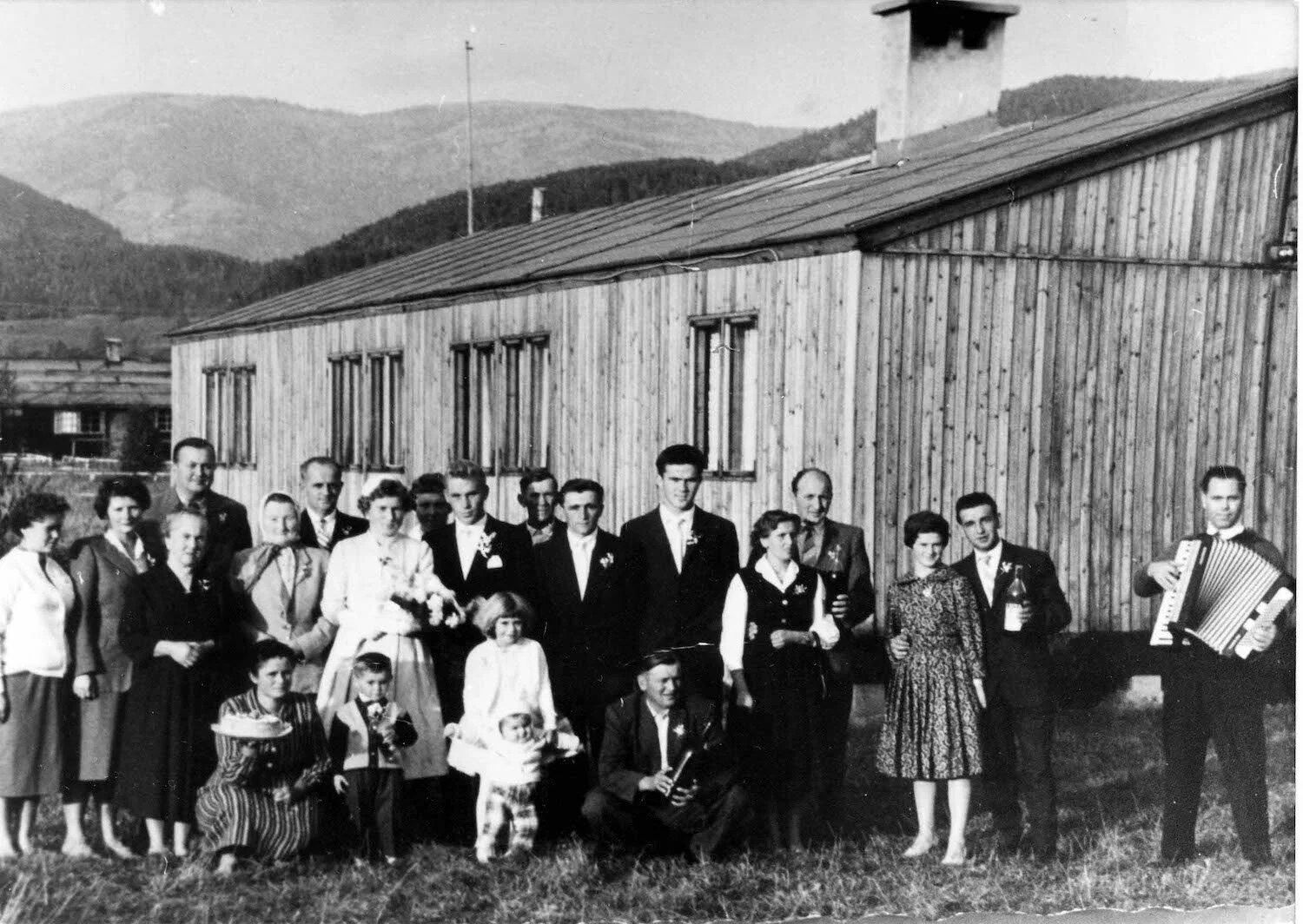
Villach camp group under UNRRA Team 336 and consolidation from 1946; Stadtarchiv Villach photographs of the camp in 1947 and 1953, a wedding at the camp, and the new residential blocks of July 1959.
- Lager Sankt Martin bei Villach, IV-2.10
Austrian State Archives · Accessed September 2026
Ministry of Interior refugee accommodation catalogue, AT-OeStA/AdR Inneres BMI Flüchtlingswesen, series IV-2c Lager in Kärnten. Item IV-2.10, Lager Sankt Martin bei Villach: repairs 1949, accounts for IRO stocks 1951–52 and camp descriptions, 1949–1968. Neighbouring items IV-2.5 to IV-2.16 read for the Carinthian series. Catalogue inspected, not the underlying case files; the date range is archival coverage, not camp lifespan.
- Statement made by the delegate for Byelorussia, 15 May 1946
United Nations, E/REF/69/Rev.1 · Accessed September 2026
Contemporary diplomatic statement describes Bauleitung and four other Villach camps administered together. Allegations about repatriation are attributed statements, not independent findings.
- Making Single Mothers Matter: Reflections on the Vulnerability and Agency of Displaced Persons in Postwar Occupied Austria and Beyond
Franziska M. Lamp-Miechowiecki, International Migration Review 59(2), 2025 · Accessed September 2026
Peer-reviewed analysis of original IRO and tracing files. Identifies St. Martin as a camp and IRO field office; anonymised Family D registered there in 1950 and mother/children emigrated to Australia in 1951. No names reproduced.
- Beiträge zur Stadtgeschichte, in Neues aus Alt-Villach, 47. Jahrbuch 2010
Dieter Neumann, Museum der Stadt Villach · 2010
Original PDF read; PDF page 23 for the air war (52 attacks, the raid of 25 July 1944, 1,300 houses destroyed or badly damaged, about 300 dead, about 5,000 made homeless and housed in emergency dwellings and barrack camps) and the British entry on 8 May 1945; PDF page 24 for the clearance of the wartime barrack camps in the 1960s and the incorporation of Fellach in 1973. The article does not discuss the displaced-persons camp itself.
Last researched 12 September 2026