Flakkaserne Stephanskirchen
Displacement in Europe
Stephanskirchen · Germany · 1946–1950
Displaced people lived in the barracks of a former anti-aircraft garrison near Rosenheim from late 1946 until March 1950, among them more than a thousand Ukrainians who arrived with their camp from Rosenheim in the spring of 1947. The ground had carried a Dachau outstation and an internment camp before them, and became the expellee settlement of Haidholzen after them.
Introduction
At the former Flakkaserne in Stephanskirchen, near Rosenheim, displaced people lived in military accommodation during the late 1940s. The community included Ukrainian Catholics and Orthodox Christians. After the DP camp closed, the area took on another role as accommodation for German expellees and eventually became the neighbourhood of Haidholzen.
Sources for this section
A history in dates
- From 1937Building of the barracks at the Haidenholz is prepared; it is completed in 1940 and used by an anti-aircraft unit.
- December 1944 to March 1945An outstation of Dachau concentration camp operates on the military ground.
- 1 and 2 May 1945American troops enter Stephanskirchen.
- July 1945 to end of 1946An internment camp for about a thousand former National Socialist functionaries occupies part of the grounds.
- 20 August 1946The camp inventory records the opening of DP 2 Stephanskirchen.
- Late 1946The reconstruction atlas dates the beginning of the UNRRA and IRO camp for displaced persons in the former Flak barracks.
- Spring 1947A Ukrainian camp is transferred from Rosenheim to Stephanskirchen, bringing its sports society with it.
- 31 May 1947The UNRRA return records 923 Ukrainians at Stefanskirchen.
- 31 October 1947The inventory records a capacity of 1,750.
- 2 January 1948The PCIRO return records 883 Ukrainians.
- March 1950The DP camp phase ends, according to the reconstruction atlas.
- 13 September 1950The municipality counts 1,528 expellees among 5,705 inhabitants.
- 1953The later settlement receives the name Haidholzen.
- 8 May 2025The municipality commemorates the end of the war at the local memorial.
Sources for this section
- Tina Blum, Einst KZ-Außenlager, heute Bonbonfabrik: So hat sich Haidholzen seit dem Kriegsende entwickelt
- Stephanskirchen: Atlas zum Wiederaufbau
- DP camp inventory: DP 2 Stephanskirchen / Pavlovich
- S. Kikta, A mirror of the sports societies, Almanac of the Ukrainian Council for Physical Culture 1945–1948, pp 78–79
- Ihor Stebelsky, Ukrainian Population Migration after World War II, Table 7, with the Atlas zum Wiederaufbau
- Gedenken an das Kriegsende 1945
Different chapters on the same ground
Until the mid-1930s the site was woodland, meadow and a single farm. Preparation for building the barracks at the Haidenholz began in 1937, and from 1939 the barracks completed in 1940 served an anti-aircraft unit. By 1942 about fifty huts stood between Haidholzen and Waldering, used to produce Luftwaffe ammunition and to house officers. Air raids in 1944 and 1945 destroyed parts of the barracks.
Between December 1944 and March 1945 the military ground held an outstation of Dachau concentration camp, with about 230 prisoners on average and 217 men recorded at forced labour in April 1945, shortly before it was abandoned. At least three of them died; two are commemorated by Stolpersteine in the Haidenholzstraße. American troops entered on 1 and 2 May 1945. From July 1945 until the end of 1946 the occupying forces ran an internment camp on part of the grounds for around a thousand former National Socialist functionaries, and from the beginning of 1946 a separate German refugee camp for 110 people occupied the southern part of the barracks. These were distinct institutions from the displaced-persons camp.
The reconstruction atlas dates the UNRRA and later IRO camp for displaced persons in the area of the former Flakkaserne from late 1946 to March 1950. The four occupations of the site overlapped in time and shared the same huts, so their populations must never be combined.
Understanding the successive uses
| Phase | Institution or residents |
|---|---|
| From 1939 | Anti-aircraft barracks; about fifty huts by 1942, making Luftwaffe ammunition |
| December 1944 to March 1945 | Outstation of Dachau concentration camp, about 230 prisoners |
| July 1945 to end of 1946 | American internment camp for about 1,000 former National Socialist functionaries |
| From early 1946 | German refugee camp for 110 people in the southern part of the barracks |
| Late 1946 to March 1950 | UNRRA and IRO displaced-persons camp |
| From 1950 | Larger settlement for German expellees |
| From 1953 | Haidholzen neighbourhood; the huts cleared from 1956 |
The camp in the administrative record
The Arolsen displaced-persons camp inventory carries one Stephanskirchen entry, headed DP 2 Stephanskirchen / Pavlovich. It records an opening on 20 August 1946, a capacity of 1,750 at 31 October 1947, the assembly-centre designations DP 6, AC 95-443 and AC 95-450 with OB 729 from September 1948, UNRRA Team 188 at Rosenheim, area team AT 1069 and area A 7 Munich, and nationalities given as Polish, Russian, stateless and Polish-Ukrainian. The closing is recorded as falling between 30 September 1949 and 30 September 1950.
That row and this camp are the same place. The reconstruction atlas and the local history both describe a single displaced-persons facility in the municipality, in the former Flak barracks, and the inventory dates match it; no other site in Stephanskirchen fits. The designation DP 2 reads as the Rosenheim team’s own serial numbering. The word Pavlovich is not explained by any source read here and remains open; it may be a camp or section name used in the tracing-service lists.
The two closing dates are different kinds of statement. March 1950 is the atlas date for the clearing of the camp; the inventory’s window of a year simply records when the entry dropped out of the returns.
The camp in the Arolsen inventory
| Item | Recorded detail |
|---|---|
| Entry | DP 2 Stephanskirchen / Pavlovich |
| Opening | 20 August 1946 |
| Closing | Between 30 September 1949 and 30 September 1950 |
| Capacity | 1,750 at 31 October 1947 |
| Assembly centres | DP 6; AC 95-443; AC 95-450; OB 729 from September 1948 |
| UNRRA team | T 188 Rosenheim; area team AT 1069; area A 7 München |
| Nationalities | Polish, Russian, stateless, Polish-Ukrainian |
| Archive reference | ITS Dok-ID 82029425-82029514 |
A Ukrainian community
The Rosenheim Ukrainian Catholic community traces its beginnings to the postwar camps. Its own parish history recalls several hundred Ukrainians among the different nationalities living at Stephanskirchen from 1947. Some followed the Orthodox faith; others belonged to the Ukrainian Catholic Church and celebrated the Byzantine liturgy.
The published population returns count Ukrainians alone and are larger. A single Stefanskirchen row records 1,168 in the questionnaire returns of 1946 to 1947, 923 in the UNRRA return of 31 May 1947 and 883 in the PCIRO return of 2 January 1948. In his earlier 1986 printing Stebelsky groups Stephanskirchen among the notable Ukrainian concentrations in Bavaria, at over 1,100 people. The neighbouring Rosenheim camps are counted separately and fall over the same period, from 473 to 268 and then 177.
A Ukrainian sports society records the move that lies behind those numbers. The society Bohun was founded at Rosenheim on 3 August 1946 and in the spring of 1947 was transferred, together with its camp, to the nearby village of Stephanskirchen, where the survey counted 1,100 Ukrainians and the society 45 members. It ran sections for football, men’s volleyball, table tennis, chess and athletics, although the reviewer judged their activity slight and intermittent and the society’s organisation weak throughout. Only the footballers competed regularly, in the regional class.
This community continued beyond the barracks. The parish account describes emigration in the 1950s to Brazil, Canada, Britain, Australia and the United States. Those destinations belong to the wider Rosenheim Ukrainian community; they are not a complete passenger list or a breakdown of departures from this particular camp.
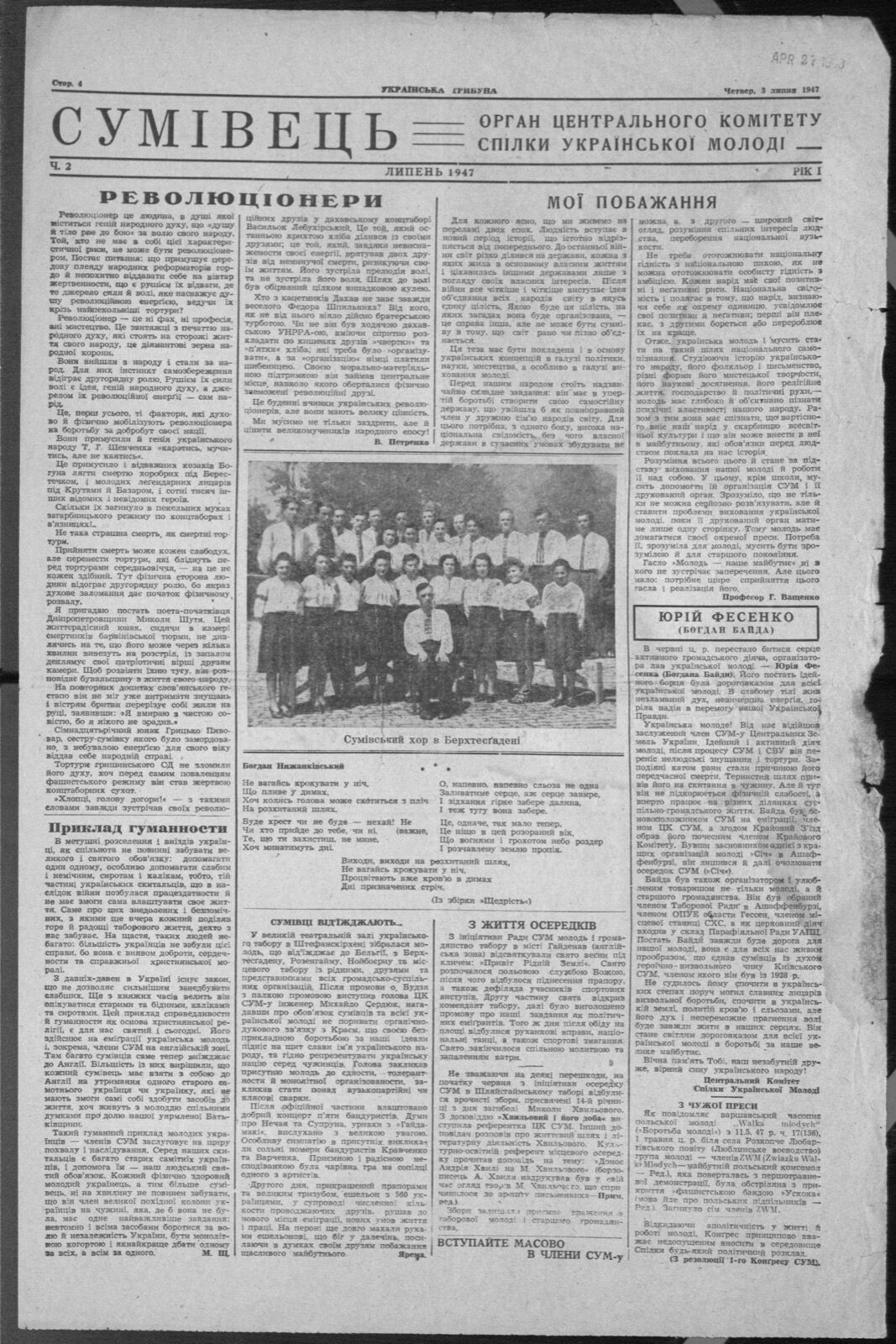
The youth paper Sumivets recorded one occasion in the camp in the summer of 1947. In the large theatre hall of the Ukrainian camp at Stephanskirchen, young people leaving for Belgium gathered with their families, their friends and representatives of every Ukrainian organisation. They had come from Berchtesgaden, Rosenheim and Neubeuern as well as from the camp itself. After an address by Father Budz and a speech by the chairman of the central committee of the Union of Ukrainian Youth, five banduryst players gave a concert, and one of them surprised the hall by playing the sopilka. The following day a train hung with flags and a large trident carried 560 Ukrainians away, with a crowd seeing them off from the platform.
Ukrainians recorded at Stefanskirchen and at Rosenheim
| Return | Stefanskirchen | Rosenheim |
|---|---|---|
| Questionnaire returns, 1946–7 | 1,168 | 473 |
| UNRRA, 24 August 1946 | no figure printed | 240 |
| UNRRA, 31 May 1947 | 923 | 268 |
| PCIRO, 2 January 1948 | 883 | 177 |
Sources for this section
- Ukrainisch-katholische Gemeinde
- Ihor Stebelsky, Ukrainian Population Migration after World War II, Table 7, with the Atlas zum Wiederaufbau
- S. Kikta, A mirror of the sports societies, Almanac of the Ukrainian Council for Physical Culture 1945–1948, pp 78–79
- Sumivtsi vidizhdzhaiut… (The SUM members are leaving…), Sumivets, number 2, July 1947, year I, printed as page 4 of Ukrainska trybuna, Thursday 3 July 1947
Haidholzen after the DP camp
After the IRO camp was cleared in 1950, accommodation for German expellees expanded into a settlement for several hundred people. By 13 September 1950 the municipality counted 1,528 expellees among 5,705 inhabitants. New housing followed from 1952, the settlement received the name Haidholzen in 1953, when it already had 925 inhabitants and was the largest expellee settlement in the old district of Rosenheim, and the huts were systematically cleared and built over from 1956.
The camp school that served that settlement was founded in October 1946 by an expelled teacher and taught about 120 children in a single hut; it was wound up in 1958 and its classes were absorbed into the Stephanskirchen elementary school. It belonged to the German expellee camp and not to the displaced-persons camp, and the two should not be confused.
Parts of the barracks entrance remain. In May 2025, the municipality commemorated the end of the war at Haidholzen’s memorial, remembering the site’s history of persecution, war and displacement. A municipal history tour that year also traced the change from military compound to postwar neighbourhood.
Sources for this section
Sources
- Stephanskirchen: Atlas zum Wiederaufbau
Haus der Bayerischen Geschichte · Accessed September 2026
Institutional reconstruction atlas identifies the DP camp in the former Flak barracks from late 1946 to March 1950, followed by housing for German expellees. These phases are distinguished. Under ‘Wiederaufbau – Umsetzung’: “1952: Errichtung von Einfachstwohnungen durch die „Oberbayerische Heimstätte“ in mehreren Wohnblöcken als erster Ersatz für einige Barackenunterkünfte; 1953: Benennung der Lagersiedlung mit dem neuen Ortsnamen „Haidholzen“”.
- Ukrainisch-katholische Gemeinde
Rosenheim Catholic parish publication, Stationen · November 2021
Printed page 12: the community’s own history describes several hundred Ukrainian Catholics and Orthodox residents in the Stephanskirchen camps from 1947 and later emigration.
- Gedenken an das Kriegsende 1945
Gemeinde-Kurier: Stephanskirchen municipal news · 13 June 2025
Page 3 records commemoration at Haidholzen and surviving barracks entrance remains; page 4 describes a local history tour.
- DP camp inventory: DP 2 Stephanskirchen / Pavlovich
Arolsen Archives · 2023
Entry 1474, spreadsheet row 1473. Opening 20 August 1946; closing between 30 September 1949 and 30 September 1950; nationalities polnisch, russisch, staatenlos, polnisch-ukrainisch; capacity 1,750 at 31 October 1947; assembly centres DP 6, AC 95-443, AC 95-450, and OB 729 from September 1948; UNRRA Team 188 Rosenheim; area team AT 1069 Rosenheim, Traunstein and Bad Reichenhall from November 1946; area A 7 München; ITS Dok-ID 82029425-82029514. The project’s merge review of 2026-09-13 identifies this row with the Flakkaserne camp described by the reconstruction atlas and the local history; the meaning of Pavlovich remains unexplained.
- Tina Blum, Einst KZ-Außenlager, heute Bonbonfabrik: So hat sich Haidholzen seit dem Kriegsende entwickelt
Mangfall 24 regional news · 8 May 2025
Local history report quoting Karl Mair, mayor of Stephanskirchen and former head of the Stadtarchiv Rosenheim: the barracks prepared from 1937 and completed in 1940, about fifty huts by 1942 making Luftwaffe ammunition, the Dachau outstation of December 1944 to March 1945 with about 230 prisoners, American use of the huts from July 1945 as an internment camp and a transit camp for displaced persons, and the expellee camp school founded in October 1946.
- Ihor Stebelsky, Ukrainian Population Migration after World War II, Table 7, with the Atlas zum Wiederaufbau
Canadian Institute of Ukrainian Studies Press; Haus der Bayerischen Geschichte · 1992; accessed September 2026
Table 7, printed page 50, read visually at 2.6x: Stefanskirchen 1,168 (1946–7 questionnaire), 923 (UNRRA, 31 May 1947), 883 (PCIRO, 2 January 1948); Rosenheim 473, 240, 268, 177. The narrative sentence placing Stefanskirchen among the Bavarian concentrations at over 1,100 Ukrainians belongs to Stebelsky’s earlier 1986 printing in Ukrainskyi Istoryk, printed page 46; it is not carried in the condensed narrative of the 1992 book. The Atlas zum Wiederaufbau entry for Stephanskirchen supplies the postwar settlement figures of 1950 to 1958.
- S. Kikta, A mirror of the sports societies, Almanac of the Ukrainian Council for Physical Culture 1945–1948, pp 78–79
Molode Zhyttia, Munich · 1951
Entry 16, Bohun, Stephanskirchen, read visually from the page images because the file’s text layer is a mis-mapped encoding. Founded 3 August 1946 at Rosenheim, transferred with the camp to Stephanskirchen in spring 1947, 1,100 Ukrainians and 45 members; sections for football, men’s volleyball, table tennis, chess and athletics. A named player who was a camp resident is not reproduced.
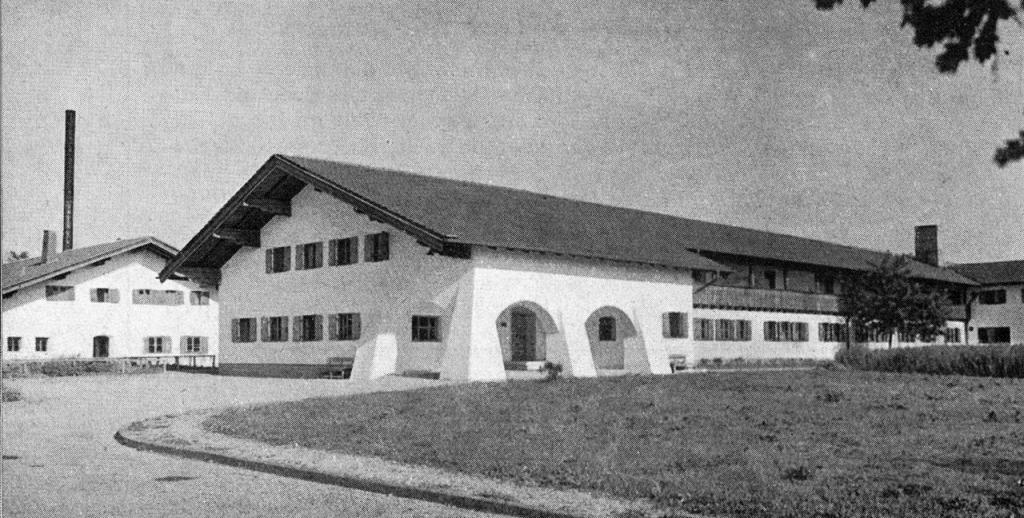
- ehem. Stabsgebäude der Flak-Kaserne bei Stephanskirchen, 1958
Gemeindeverwaltung Stephanskirchen, in Atlas zum Wiederaufbau, Haus der Bayerischen Geschichte · 1958
Photograph of the former staff building of the anti-aircraft barracks, the long Bavarian-style block with the arched entrance that stood at the centre of the site the displaced persons camp used. Published in the reconstruction atlas entry for Stephanskirchen and marked © Gemeindeverwaltung Stephanskirchen; no reuse licence is stated.
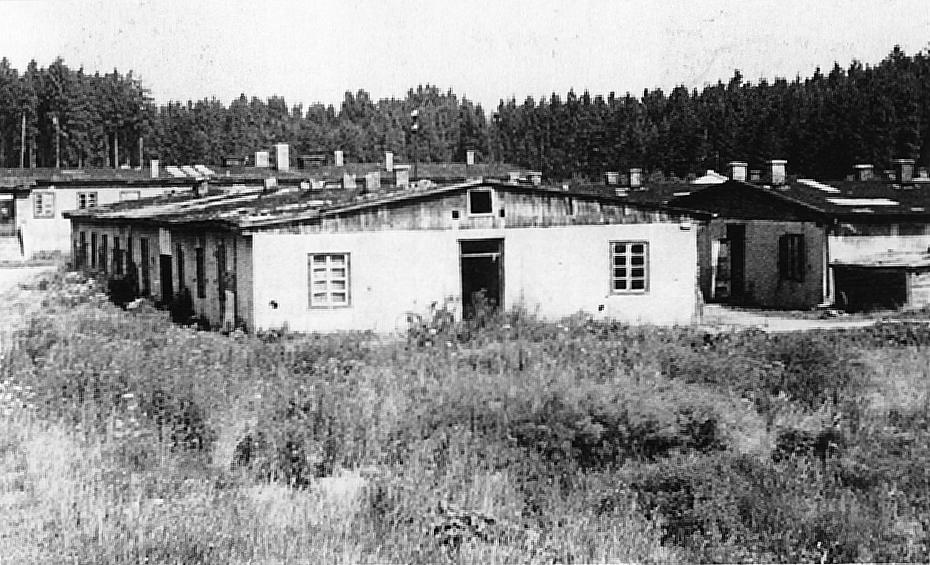
- Baracken des Vertriebenenlagers Haidholzen, 1956
Gemeindeverwaltung Stephanskirchen, in Atlas zum Wiederaufbau, Haus der Bayerischen Geschichte · 1956
Photograph of the rendered huts of the expellee camp at Haidholzen, the same barracks on the former Flakkaserne ground that the UNRRA and IRO camp had used until March 1950. Published in the reconstruction atlas entry for Stephanskirchen and marked © Gemeindeverwaltung Stephanskirchen; no reuse licence is stated.
- Sumivtsi vidizhdzhaiut… (The SUM members are leaving…), Sumivets, number 2, July 1947, year I, printed as page 4 of Ukrainska trybuna, Thursday 3 July 1947
Central Committee of the Union of Ukrainian Youth, Munich · 3 July 1947
Digitised by the Ukrainian Museum-Archives of Cleveland with the United States Holocaust Memorial Museum in the Displaced Persons Camp Periodicals Collection; marked public domain or an orphan work and offered under Creative Commons Attribution-NonCommercial-NoDerivatives 4.0. A report of the farewell gathering in the theatre hall of the Ukrainian camp at Stephanskirchen for young people leaving for Belgium.
Last researched 13 September 2026