Grenadier-Kaserne
Displacement in Europe
Stuttgart-Zuffenhausen, Germany · Ukrainian DP camp 1947–1949/1950
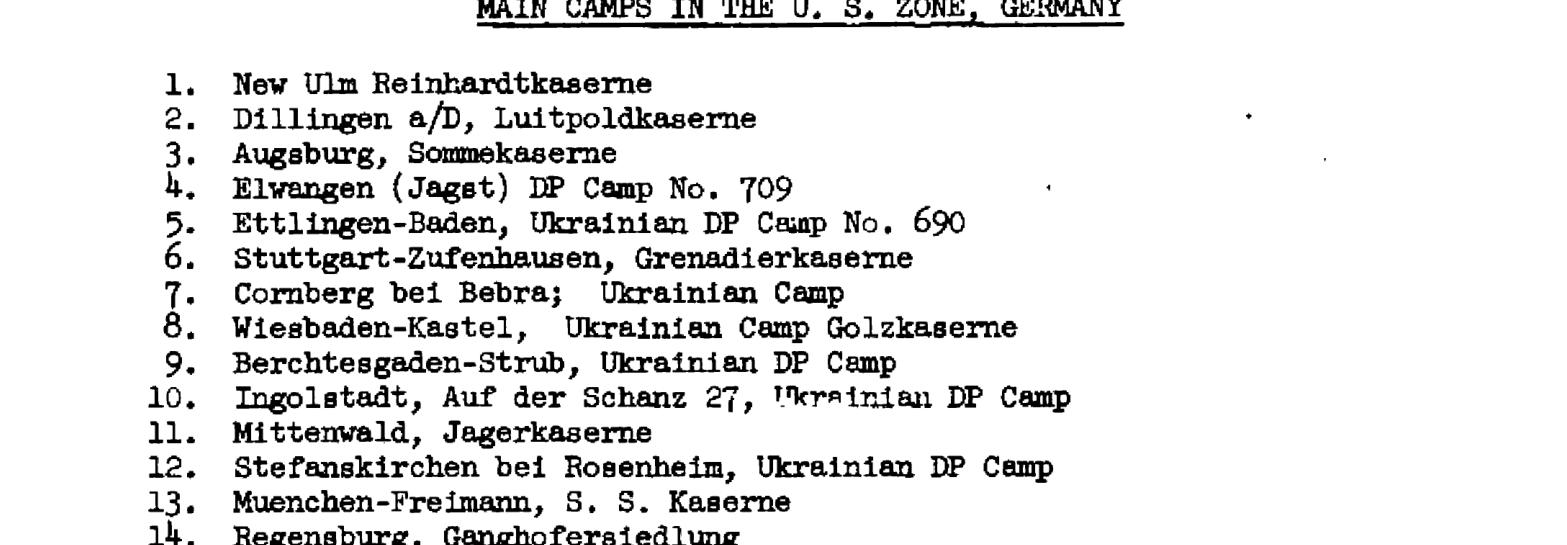
The Grenadier-Kaserne on the Burgholzhof was the Ukrainian assembly centre for Stuttgart, recorded in the camp inventory as an exclusively Ukrainian camp with a capacity of 1,730 from February 1947. It also housed the Holy Synod of the Ukrainian Autocephalous Orthodox Church and a Ukrainian school.
Introduction
Grenadier-Kaserne was the Ukrainian displaced-persons camp at Stuttgart-Zuffenhausen. The Arolsen camp inventory records it as Assembly Centre 95-461, later WG 221, opening on 7 February 1947 with the single nationality entry Ukrainian and a capacity of 1,730. The United Ukrainian American Relief Committee listed it in June 1948 among fifteen principal Ukrainian centres in the American zone.
The barracks belonged to a larger military landscape on the Burgholzhof heights between Zuffenhausen and Bad Cannstatt. The adjoining Flandern-Kaserne also housed displaced people, but had its own administrative chronology. Keeping the two buildings’ histories separate makes the camp’s changing uses easier to understand.
A history in dates
- 1927Military use of the Burgholzhof begins with an army training ground.
- May 1939The first battalion of Infantry Regiment 119 moves into the new Grenadier-Kaserne.
- 10 September 1945 – 4 January 1947The garrison historian dates Grenadier’s internee-camp use to this period; Müller records it as war-crimes internment camp 78.
- 7 February 1947The camp inventory dates the opening of the Ukrainian displaced-persons camp, Assembly Centre 95-461.
- 31 May 1947An UNRRA return counts 740 Ukrainians at the camp.
- 31 October 1947Recorded capacity is 1,730 places.
- 2 January 1948A PCIRO return counts 1,509 Ukrainians at the camp.
- 30 June 1948The Ukrainian relief committee lists Grenadier-Kaserne among its main camps in the American zone and places the Orthodox Holy Synod at Zuffenhausen.
- 1949–1950The inventory places the camp’s closure within this interval.
- 1993The barracks are handed back to the Federal Republic and the city of Stuttgart.
From military buildings to refugee accommodation
Military use of the Burgholzhof ridge began in 1927 with an army training ground, followed from 1935 by the building of the Flandern-Kaserne. In May 1938 the city of Stuttgart and the army agreed on a further barracks in the Mönchsberg-Rappenberg district, and in May 1939 the first battalion of Infantry Regiment 119 moved into the new Grenadier-Kaserne. It consisted of a guardhouse, five large barrack blocks, a staff building, a men’s building and a sports hall, with seven storage halls for materiel and vehicles; one of the surviving buildings had been a horse stable until 1945.
The setting therefore provided substantial existing buildings, rather than an entirely new refugee settlement. An official United States Army account locates the installations above Stuttgart’s wine-growing hills and traces their later transformation into a major military support and housing area.
Sources for this section
An internment camp before the DP camp
Before the Ukrainian camp opened, the barracks held German internees. Ulrich Müller’s survey of the internment camps in and around Ludwigsburg lists Internment Camp 78 at Zuffenhausen, Grenadier-Kaserne, and describes it as a war-crimes camp from which men were moved on to Nuremberg and Dachau or handed over to the other Allied powers; its last inmates went to Kornwestheim in 1947. The garrison historian dates the internee use from 10 September 1945 to 4 January 1947, which fits the inventory’s opening of the displaced-persons camp on 7 February 1947.
A local history of the district repeats the reference to Camp 78 but states that 7,000 displaced persons were housed in it. That reading is not supported by the work it cites, which describes Camp 78 as an internment camp for Germans, and it is not followed here.
A Ukrainian centre in Stuttgart
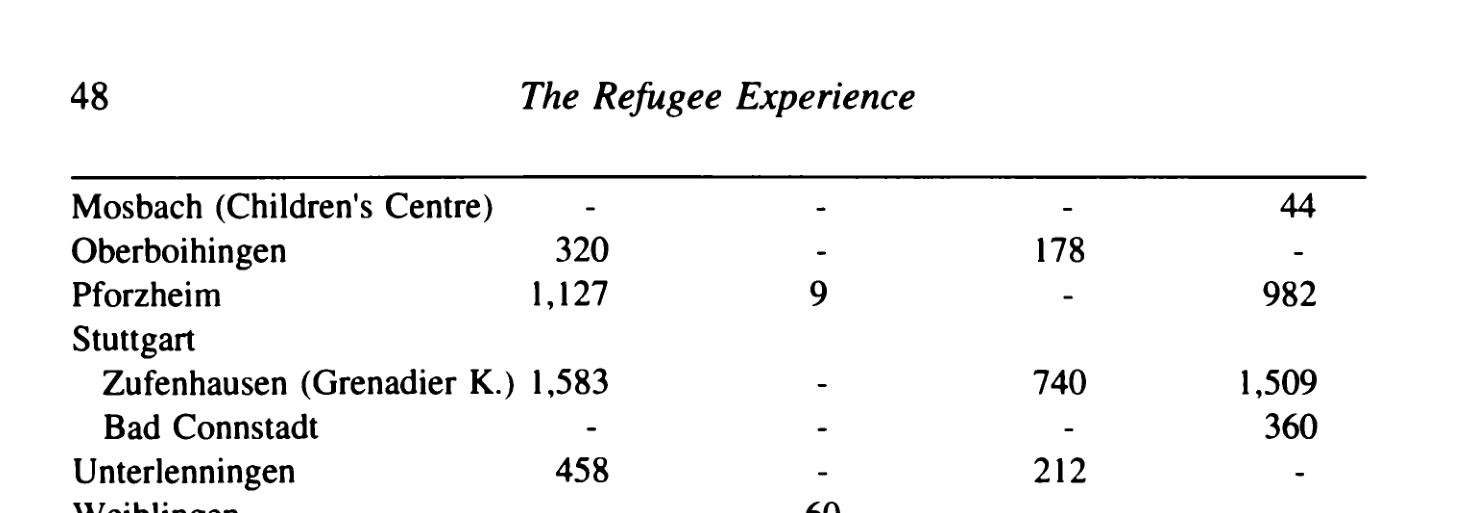
Stebelsky’s tabulation of Ukrainians in American-zone camps gives Stuttgart-Zuffenhausen, Grenadier-Kaserne, 1,583 in the questionnaire returns collected during 1946 and 1947, 740 in the UNRRA return of 31 May 1947 and 1,509 in the PCIRO return of 2 January 1948. This is one of the few rows in that table that names a building rather than only a town, so the figures can be read as camp figures. The Encyclopedia of Ukraine separately gives Stuttgart-Zufenhausen a Ukrainian population of 1,580 for 1946 and 1947.
The Ukrainian Greek Catholic parish history of Württemberg, citing Dmytro Blazhejowskyj’s directory of clergy in the diaspora, records that in 1947 the Stuttgart-Zuffenhausen-Grenadierkaserne camp held 1,482 Greek Catholics, 160 Orthodox and 13 others from Ukraine. It names Father Yulian Mykytyn as the priest serving Stuttgart-Zuffenhausen through the camp years, and reproduces a photograph captioned as the Ukrainian school at Stuttgart-Zuffenhausen at the end of the 1940s. Regular parish life in Stuttgart itself was organised from 1951, after the camp had closed.
The June 1948 relief report also places the Holy Synod of the Ukrainian Autocephalous Orthodox Church at Stuttgart-Zuffenhausen under Bishop Platon, with Metropolitan Polikarp at Gronau. Alongside the camp listing, this establishes the locality’s importance as a religious administrative centre. It does not identify a particular room or building within Grenadier-Kaserne as the synod’s office.
Ukrainians recorded at the Grenadier camp
| Source and date | Scope | Figure |
|---|---|---|
| Central Representation questionnaires, 1946–1947 | Stuttgart-Zufenhausen (Grenadier K.) | 1,583 |
| UNRRA return, 31 May 1947 | Stuttgart-Zufenhausen (Grenadier K.) | 740 |
| PCIRO return, 2 January 1948 | Stuttgart-Zufenhausen (Grenadier K.) | 1,509 |
| Parish history after Blazhejowskyj, 1947 | Camp, Greek Catholics | 1,482 |
| Parish history after Blazhejowskyj, 1947 | Camp, Orthodox | 160 |
| Parish history after Blazhejowskyj, 1947 | Camp, other denominations | 13 |
| Arolsen inventory, 31 October 1947 | Recorded capacity, not a headcount | 1,730 |
Two neighbouring barracks, different histories
The inventory places Grenadier under Area Team 1003 Stuttgart and Area Team 1002 Ludwigsburg from November 1946, in Area A 2 Ludwigsburg and later A 2 Nellingen, and gives no UNRRA team of its own, which is consistent with a camp that opened after UNRRA’s Stuttgart team had been reorganised. Its closure is placed between 30 September 1949 and 30 September 1950. Flandern meanwhile had an UNRRA period from December 1945 and its inventory entry ends before 29 July 1948.
The 1948 relief report is particularly valuable here: it fixes the connection to Grenadier-Kaserne during the displaced-persons period. Neither a general photograph of Stuttgart nor an account of the separate Jewish camp at Stuttgart West on Bismarckstrasse establishes the history of this Ukrainian facility, and the inventory keeps the two apart.
The adjoining installations
| Installation | Documented postwar use |
|---|---|
| Flandern-Kaserne, Bad Cannstatt | UNRRA relief use from 10 December 1945; inventory entry ends before 29 July 1948 |
| Grenadier-Kaserne, Zuffenhausen | Internment camp 78 for German war-crimes suspects, 10 September 1945 to 4 January 1947 |
| Grenadier-Kaserne, Zuffenhausen | Ukrainian DP camp AC 95-461 and WG 221, 7 February 1947 to 1949/1950 |
| Stuttgart West, Bismarckstrasse | A separate Jewish DP camp, AC 664 and WG 219, closing 13 June 1949 |
After the DP period
American military occupation of the installations followed, and the United States Army used Grenadier-Kaserne for logistical support of the Stuttgart area for four decades. The barracks were handed back to the Federal Republic and the city of Stuttgart in 1993. From 2003 the buildings were demolished apart from building 406, and from 2006 the residential district known as In Raiser was built on the site.
Today these later layers can obscure the brief refugee chapter. The 1948 camp directory and the church records preserve an earlier moment when a place built for soldiers was the main institution supporting Ukrainian civilian life in Württemberg.
Sources
- Report: history, accomplishments, statistics and plans
United Ukrainian American Relief Committee · 30 June 1948
Scan pages 21–22. Grenadier-Kaserne among the main camps in the American zone; the Holy Synod of the Ukrainian Autocephalous Orthodox Church at Stuttgart-Zuffenhausen under Bishop Platon; 10,005 Ukrainians in the Württemberg-Baden district, of whom 8,452 in camps.
- A brief history of Robinson Barracks
Bill Butler, EUCOM Command Historian, Stuttgart Citizen · November 2021
Original PDF page 16. Precise Flandern and Grenadier distinction; its expanded UNRRA name is erroneous and is not copied.
- Stuttgart’s Robinson Barracks continues to transition
US Army, Carola Meusel · 25 January 2010
Official site history; later military use and setting.
- Ukrainians in the Displaced Persons Camps of Austria and Germany, Table 8
Ihor Stebelsky, Ukrainskyi Istoryk 3 · 1986
PDF page 56, printed page 54. Row “Stuttgart, Zufenhausen (Grenadier K.)”: 1,583 in the 1946–1947 questionnaire returns, 740 on 31 May 1947 and 1,509 on 2 January 1948. Column assignment checked against the page image.
- DP camp inventory: Stuttgart-Zuffenhausen, Grenadier-Kaserne
Arolsen Archives · 26 October 2023
Row 1505: nationality Ukrainian, capacity 1,730 on 31 October 1947, AC 95-461, WG 221, opening 7 February 1947, closure between 30 September 1949 and 30 September 1950, Area Teams 1003 Stuttgart and 1002 Ludwigsburg. Archive reference 82029685–82032230 covers Stuttgart as a whole.
- Die Grenadierkaserne (1938/1939–2003)
Rainer Fiechtner, Stadtteilgeschichtliche Sammlungen Rot, Stuttgart · 22 May 2012
Construction and layout of the barracks, the 1927 training ground, the return to German ownership in 1993 and the demolition from 2003. Its claim that 7,000 displaced persons were held in internment camp 78 misreads the work it cites and is not used.
- Germany
Internet Encyclopedia of Ukraine · Historical survey
Stuttgart-Zufenhausen 1,580 for 1946–1947, explicitly in the American zone.
- Under the protection of St Basil the Great: the Ukrainian church in Württemberg
Parish of St Basil the Great, Stuttgart, Ukrainian Greek Catholic Church · Accessed 13 September 2026
Parish history citing Dmytro Blazhejowskyj, Ukrainian Catholic Clergy in the Diaspora 1751–1988 (Rome, 1988): 1,482 Greek Catholics, 160 Orthodox and 13 others at the Grenadierkaserne camp in 1947; Father Yulian Mykytyn; a photograph captioned as the Ukrainian school at Stuttgart-Zuffenhausen at the end of the 1940s.
- Ukrainian Population Migration after World War II, Table 7
Ihor Stebelsky, in The Refugee Experience, Canadian Institute of Ukrainian Studies Press · 1992
Scan published by diasporiana.org.ua; no reuse licence is stated by the holder. Page image rendered from the digitised volume and the camp’s row read visually.
Last researched 13 September 2026