Trofaiach Camp
Displacement in Europe
Trofaiach–Gai, near Leoben, Styria, Austria · DP occupation documented 1945–1954
A wartime resettlement camp on former powder-factory land near Leoben became a British-run displaced persons centre and then an IRO emigration transit camp. Ukrainians arrived in numbers during 1948 and remained among its mixed population as overseas departures slowed.
Introduction
Trofaiach Camp stood on former powder-factory land near Leoben. The British army requisitioned it on 14 September 1945 for refugees. Its postwar community included Ukrainians, Jewish survivors and other displaced people; the camp also appears under the name Trofaiach–Gai.
A history in dates
- 1940The Volksdeutsche Mittelstelle builds a resettlement camp on the former powder-factory land.
- 24 October 1941The resettlement camp is handed over to the Reichswerke Alpine Montanbetriebe “Hermann Göring”.
- 14 September 1945The British army requisitions the compound for refugee accommodation.
- January–February 1946Poor living conditions prompt transfers of Jewish refugees to Kobenz and Judenburg-Murdorf.
- September 1947A British list records 2,280 people at Camp Trofaiach-Gai.
- 7 April 1948A convoy of families is trucked in from the Liechtenstein camp near Judenburg.
- 26 April 1948A first group leaves by IRO train from Leoben for a ship to Canada.
- 13 June 1948The papal delegate Dr Jagodic confirms thirty young people in the camp.
- 12 July 1948Three hundred refugees, mostly Ukrainians, arrive from Kapfenberg.
- 30 September 1948An IRO return counts 378 Ukrainians.
- 1949The camp operates as an emigration transit centre.
- 8 May 1949A first group of fifty people leaves for New Zealand; their train goes off the tracks at Trofaiach station.
- 16 September 1949A large group leaves the camp for America, including Ukrainian residents.
- 28 October 1949A further large group leaves the camp for America, including Ukrainians.
- 25 November 1949A party of eighty-eight emigrants leaves the camp by IRO lorry from the station at Trofaiach.
- 1 February 1950Children enter local public schools.
- 30 June 1950An IRO return counts 145 Ukrainians.
- 23 June 1950The camp passes to Austrian administration with 1,200 residents.
- 1 February 1952Trofaiach is reclassified from transit camp to residential and welfare camp.
- 1954A camp report records 259 residents, including 23 “Ukrainian Poles”.
- November–December 1960The camp register records demolition of the Schlagfeld huts and the closure of the camp.
Sources for this section
- Flüchtlingslager in der Steiermark 1945–1955
- Das American Jewish Joint Distribution Committee (AJDC) in der britischen Besatzungszone Österreichs
- Life in the Refugee Camps 1948
- Trofaiach Displaced Persons Camp
- Ukrainians in the Displaced Persons Camps of Austria and West Germany
- Life in the Refugee Camps, 1949
- AustriaCampsV7.xls, compiled register of camps in Austria
The site before 1945
The land had been expropriated during the First World War for a powder factory, and the farmers affected expected to get their fields back. In 1940 the Volksdeutsche Mittelstelle built a resettlement camp on the site, and in 1941 it was handed over to the Reichswerke Alpine Montanbetriebe “Hermann Göring”, which later used it for foreign workers. The Trofaiach diarist, writing on 1 January 1949, recalled the wartime barracks on the site as housing Ostarbeiter, workers forcibly relocated from eastern Europe and, in his words, mostly Ukrainians.
The compiled register of Austrian camps gives the 1940 camp a capacity of 2,000 and notes Soviet troops on the site immediately after the war. Drawing on the local study by Werner Anzenberger, Heimo Halbrainer and Gabriela Stieber, it also records a prisoner-of-war camp on the adjoining Gai ground at Untergimplach as early as 1915, and the Schlagfeld barracks in use as a forced-labour and prisoner-of-war camp between 1941 and 1945. These neighbouring compounds are not one continuous institution.
Food, relief and the first winter
The first winter brought an urgent struggle over living conditions. A 2021 archival study describes inspections by Jewish relief workers in November 1945. By mid-December the population had fallen from about 1,500 to 900, but some residents still lived in poor accommodation. The American Jewish Joint Distribution Committee established a local worker at Trofaiach to supervise food distribution. Relief involved the British camp authorities, the Red Cross, UNRRA and the residents’ camp committee.
In January 1946 an incoming UNRRA team refused to assume management under the existing conditions. Discussions led to a decision to move the Jewish refugees, both to improve hygiene and health and to give the community a fresh start. Some were transferred to Kobenz on 1 February; others went to Judenburg-Murdorf. These early transfers belong to the history of Trofaiach’s Jewish residents. The Ukrainian population recorded in 1948 and 1950 belongs to a later phase of the same camp’s changing life.
A regional encyclopaedia article on the town records that the Jewish refugees quartered at Trofaiach by the British military administration until the beginning of January 1946 came mostly from Hungary and emigrated to Palestine.
Names, numbers and administration
The camp carried several designations at once. The register of Austrian camps records that from December 1945 it served as Assembly Centre S, Control Camp P and Forwarding Group K, and that it was worked by UNRRA team 327. In the ministry’s renaming of 1951 it became simply Lager Trofaiach.
A British list of November 1947 gives the September occupancy of Camp Trofaiach-Gai as 2,280, the second largest figure in Styria. In February 1948 the British headquarters proposed handing the camps housing ethnic Germans, Trofaiach among them, to Austrian administration; the transfer in fact came on 23 June 1950, with 1,200 residents, and the camp continued as an IRO transit centre under a British camp director.
Recorded occupancy of the camp
| Date | People | What the figure counts |
|---|---|---|
| September 1947 | 2,280 | Camp Trofaiach-Gai in the British November 1947 list of Styrian camps |
| 1949 | 1,200 | Residents awaiting departure from Austria |
| May 1950 | 1,600 + 200 | Permanent places and transit places; beds for only 1,250 |
| 23 June 1950 | 1,200 | Residents at the handover to Austrian administration |
| 1954 | 259 | Residents in the camp adoption-programme report |
Ukrainians in a changing population
The IRO returns reproduced by historian Ihor Stebelsky record 378 Ukrainians on 30 September 1948 and 145 on 30 June 1950. These are national-group snapshots, not the total camp population. They establish a Ukrainian presence across the transition from international relief to Austrian administration.
A diary kept at Trofaiach through 1948 helps explain the first of those figures. On 12 July 1948 its author recorded that 300 new refugees arrived from Kapfenberg, mostly Ukrainians, and that everyone had to make room in their barracks. Three months earlier a convoy of Slovenian families had been trucked in from the Liechtenstein camp near Judenburg, part of what the camp register calls an exchange of populations between the two camps in April 1948.
In a 1954 camp report, the category “Ukrainian Poles” contained 23 people out of 259 still resident. This later administrative label should not be treated as identical to the earlier Ukrainian category.
Ukrainian population returns
Nationalities recorded in the 1954 camp report
| Group as recorded | People |
|---|---|
| Yugoslavs | 105 |
| Russians | 28 |
| “Ukrainian Poles” | 23 |
| Hungarians | 20 |
| Stateless people and ethnic Germans from Yugoslavia | 14 |
| Poles | 8 |
| Czechoslovaks | 3 |
| Lithuanians | 3 |
| Romanians | 2 |
| Total residents | 259 |
School, chapel and workshops
Schooling ran inside the camp until the Austrian takeover: 79 children in four classes, in a school very well supplied with teaching materials provided by the IRO. Camp schools under Allied administration were treated by the Austrian state as quasi-extraterritorial and handled like private schools without public status, so their certificates carried no recognition. A kindergarten occupied two rooms and averaged about forty children. The Holocaust Memorial Museum encyclopedia records a kindergarten, a choir, a carousel, and classes in English and Spanish to help residents emigrate. A tailoring shop and a shoemaking shop worked only for residents, alongside a locksmith, an electrician, a joiner and a barber. In May 1950 the camp had 1,600 permanent places and 200 transit places but beds for only 1,250 people.
The compiled camp register lists the kindergarten and school as teaching in Slovenian, Croatian and Ukrainian, a Slovenian trade school, and camp churches for Roman and Greek Catholic and for Greek Orthodox worship. That is the clearest indication that Ukrainian residents had their own language teaching and their own liturgy on the site.
A year inside the camp
The diary of Anton Zakelj, translated and edited by his son John Zakelj, records the texture of camp life in 1948. New arrivals were assigned to a room shared with two other families. Breakfast and supper were coffee; lunch was pea soup and a little bread, with milk and white bread only on a doctor’s prescription. Mass was said at half past six in a chapel that had no windows and a cold concrete floor. When camp pay for labouring was cut to 120 Schillings a month, nine Ukrainians were called in and offered the work; four of them refused it.
Emigration shaped the year. A first group left for Canada on 26 April 1948 by IRO train from Leoben, each person allowed 200 pounds of luggage, and in June the Chilean consulate accepted 100 Slovenians and about 400 Croatians and Ukrainians. Photographs of the camp choir and of a Corpus Christi procession record the Slovenian community and should not be read as Ukrainian.
Sources for this section
Medical examinations and the wait to leave
Trofaiach became an emigration transit centre. In 1949 it housed 1,200 people awaiting departure; medical teams sometimes examined up to 400 people daily. People excluded from emigration because of age, illness or disability stayed on and depended on camp support.
The diary continued through 1949 and shows the camp organised into national sections. Its author worked as camp mail carrier, distributing post in the Croatian and Ukrainian sections, and later collected donations for that work in the Ukrainian part of the camp.
Departures ran through the year. On 8 May 1949 a first group of fifty people left for New Zealand, among them three Slovenians and a number of Ukrainians; their train went off the tracks at Trofaiach station soon after everyone had boarded. Large groups left for America on 16 September and again on 28 October, each including Ukrainian residents. On 25 November the diarist himself left with a party of eighty-eight, taken by IRO lorry to the station at Trofaiach.
Sources for this section
The camp in 1950
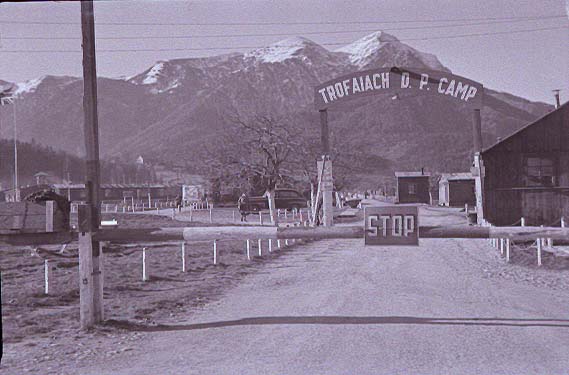
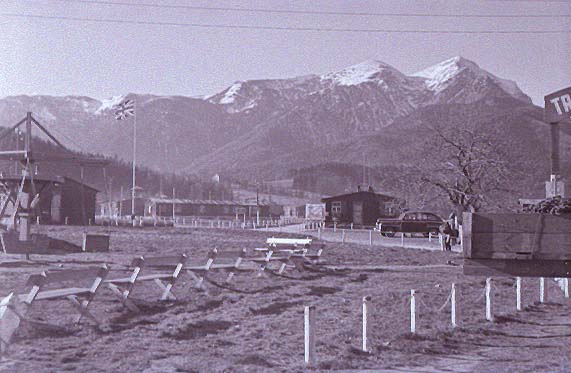
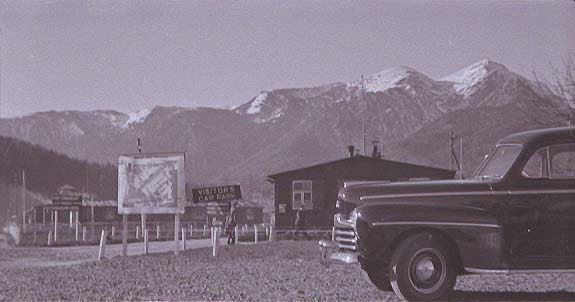
Photographs taken by relief worker Edward Crommelin in 1950 show the entrance marked “Trofaiach D.P. Camp”, the roadside barrier and rows of buildings beneath the mountains. The series records the actual camp during the same year as the second Ukrainian population return.
Sources for this section
Running down the camp
Once the IRO wound up its work Trofaiach lost its transit function, and from 1 February 1952 it counted as a residential and welfare camp. The camp hospital closed that year for want of use, forty-seven residents moved to Feffernitz in Carinthia in August, and many huts were returned to the Alpine-Montan company, which demolished them. Neither Gai nor Trofaiach nor Leoben wanted to keep the site as a private housing camp, because the repair costs were too high.
By the 1954 report the camp had fifteen residential huts and buildings used as workshop, bathhouse, store, kindergarten and clinic. Most of the 259 residents had health problems, and most of those in work were labourers who were usually unemployed in winter. The camp register dates the closure to December 1960.
Sources
- Flüchtlingslager in der Steiermark 1945–1955
Gabriela Stieber, Historischer Verein für Steiermark · 1992
Original PDF read in full: printed pages 453 and 455–456 for camp lists, designations and handovers, page 466 for the camp school, and section 3.7 on printed pages 479–483 for the site history, facilities, 1954 report and run-down. The date range does not assert final closure. The 1946 cost table on pages 450–451 extracts as misaligned columns and no occupancy figure has been taken from it.
- Ukrainians in the Displaced Persons Camps of Austria and West Germany
Ihor Stebelsky, The Refugee Experience · 1992
Table 5, printed page 43: 30 September 1948 and 30 June 1950. Original table inspected.
- Displaced Persons Camps in the Steiermark District
United States Holocaust Memorial Museum · 2019
Trofaiach section: cultural facilities and a survivor account. The inaccurate approximate distance from Vienna is not used.
- Trofaiach Displaced Persons Camp, Austria
Crommelin family archive · Photographs 1950
Edward Crommelin’s original camp photographs; the separately captioned, uncertain Leoben view is excluded.
- Das American Jewish Joint Distribution Committee (AJDC) in der britischen Besatzungszone Österreichs
Heribert Macher-Kroisenbrunner, zeitgeschichte 48/2, in Nachkriegserfahrungen · 2021
Pages 237–239, scholarly account drawing on contemporary AJDC and UNRRA reports. Relevant passage read in indexed full-text mirror; underlying archival files not inspected.
- AustriaCampsV7.xls, compiled register of camps in Austria
Klaus Fohringer, published by DP Camps.org · Workbook last saved 24 July 2021
Workbook downloaded and read; sheet Blatt 1, rows for Trofaiach, Trofaiach/Gai Schlagfeld and Untergimplach. A compiled secondary register with heavy abbreviation; each row names its own literature, here Stieber and Anzenberger, Halbrainer and Stieber. Its figures are reported as register entries, not as archival returns.
- Life in the Refugee Camps 1948
Diary of Anton Zakelj, translated and edited by John Zakelj · Diary 1948; web edition 2007
Full 1948 text read. A Slovenian resident’s day-by-day account of the move from Judenburg to Trofaiach and of camp work, food, worship, pay and emigration. Names of fellow residents in the diary are not reproduced; the diarist, his editor, the clergy and the British camp official are named as authors or officials.
- Trofaiach Displaced Persons Camp
DP Camps.org, photographs contributed by John Zakelj and Miff Crommelin · Photographs 1948; page retrieved 2026
Page text and captions read in full. Used for the Slovenian camp choir, the Corpus Christi procession and the April 1948 Canada departure. The page’s claim that Trofaiach lies about 50 miles south-west of Vienna is wrong and is not used; resident names in the captions are not reproduced.
- Life in the Refugee Camps, 1949
Diary of Anton Zakelj, translated and edited by John Zakelj · 1949
The 1949 continuation of the diary already cited for 1948 read in full: the camp organised in national sections, with mail distributed in the Croatian and Ukrainian sections; departures for New Zealand on 8 May and for America on 16 September, 28 October and 25 November; and the diarist’s recollection, on 1 January 1949, of the wartime barracks as housing Ostarbeiter, mostly Ukrainians. Names of camp residents are not reproduced here.
- Trofaiach
AustriaWiki, Austria-Forum
Section “Geschichte”, subsection on the twentieth century, read: up to 1,500 Jewish displaced persons quartered by the British military administration until the beginning of January 1946, mostly from Hungary and emigrating to Palestine; ethnic German expellees admitted from January 1946; the camp reduced from 1952. A collaborative encyclopaedia article with no named author.
Last researched 13 September 2026