Uranquinty Migrant Centre
Arrival and settlement
Uranquinty, near Wagga Wagga, New South Wales, Australia · From October 1948; transition to military use in late 1951
A former air-force base near Wagga Wagga where the wives and children of directed workers waited for a home, with its own school, play centre and Ukrainian pastoral visits, until the Air Force took it back in 1951.
Introduction
Uranquinty Migrant Centre provided a temporary home for displaced European families near Wagga Wagga. Its first residents arrived in October 1948. It was built to hold families rather than workers: husbands were placed in employment elsewhere by the Commonwealth, while their wives and children waited at Uranquinty until a house could be found. Schooling, child health, a camp school and visiting clergy became the substance of daily life there.
A history in dates
- October 1948First residents arrive while conversion work continues.
- By January 1949There are 70 women and 112 children at the camp; the director says there is space for at least 1,000 families.
- January 1949The migrant camp school opens.
- 18 June 1949The Wagga Teachers’ Association opens a public appeal for equipment for the migrant school.
- December 1949About 250 schoolchildren and 120 children of kindergarten age are at the centre; the Immigration Department cancels its play-centre subsidy.
- 3 January 1950A three-week play centre is due to open with five trained supervisors.
- 22 March 1950Two Redemptorist priests reach Sydney from Canada to serve Ukrainian Catholics in Australia.
- 27–29 March 1950Father N. Kopiakivsky visits Uranquinty before continuing to Bonegilla.
- By 8 April 1951A letter reports a further visit to Uranquinty during the travelling ministry.
- 20 September 1951Uranquinty is reported as about to be handed back to the Air Force, and Kapooka to the Army.
- October 1951The migrant camp school closes.
- Late 1951The decision is made to return the site to RAAF pilot training; many residents move to Bonegilla.
- 14 April 2001The Displaced Persons Memorial at Uranquinty is dedicated, commemorating the migrant centre community of 1948 to 1952.
- Easter 2001Former residents and the community gather for Uranquinty Remembers.
Sources for this section
- Wagga Wagga Community Heritage Study, volume 2: Thematic History
- Bits and Pieces: ‘Husbands Not Wanted’
- Teaching English to post-WWII migrants
- Aid Needed for Uranquinty Migrant School: Wagga appeal opened
- Uranquinty Migrant Director Seeks Donations for Play Centre
- N. Kopiakivsky, letter reprinted in St Andrew’s Parish Sydney 1948–1998
- Українці в Австралії / Ukrainians in Australia, volume 1
- Troops for Kapooka, Uranquinty?
- Displaced Persons Memorial, Uranquinty
- Uranquinty Remembers
A former air base near Wagga Wagga
The centre occupied a former Royal Australian Air Force base in the Riverina. Migrants arrived while conversion work was still under way, and Uranquinty received people from an overcrowded Bonegilla. The council history describes accommodation intended particularly for women and young children whose male breadwinners went to government-directed employment.
By the first days of January 1949 the arrangement was already being explained to newspaper readers in Queensland. The camp’s director, Robert Bain, told a reporter that the men were found jobs by the Employment Office and the women and children sent to Uranquinty until their husbands could make their own homes. There was space, he said, for at least 1,000 families, and the number of people at Uranquinty would rise as more migrant ships arrived.
Families, housing and population
Uranquinty’s accommodation was organised around temporary family settlement. The Migration Heritage Centre places it within a history of families separated by employment: the centre housed migrants and the partners and children of workers on projects including the Snowy Mountains Scheme. A family might therefore experience Uranquinty as a home for some members while another member lived at a distant work project or sought employment elsewhere.
The earliest figure for the camp is small. At the beginning of January 1949 there were 70 women and 112 children at Uranquinty, against the space Bain claimed for a thousand families. Within a year there were about 250 children of school age and 120 more of kindergarten age at the centre.
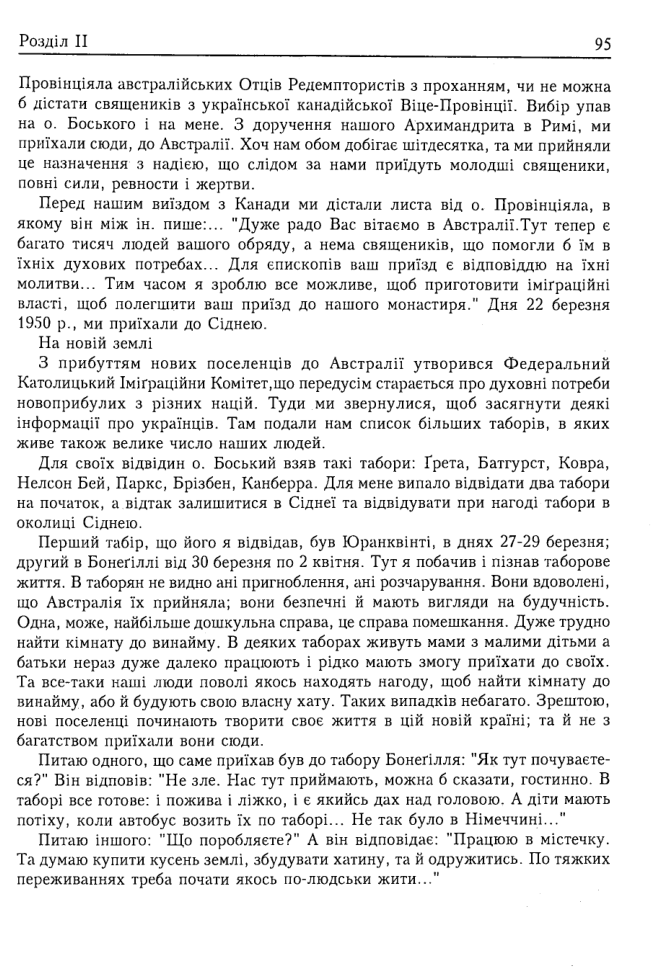
A Ukrainian priest’s account from March 1950 records the human consequences of this system. Father N. Kopiakivsky visited Uranquinty from 27 to 29 March before travelling to Bonegilla. In his account, difficulty finding rooms to rent and the separation of mothers and small children from fathers working far away were the sharpest problems he met on his journey. The testimony is not a statistical survey of Uranquinty alone, but it helps explain why a holding centre could remain necessary even after a worker had left for a job.
Recorded numbers at the centre
| Date | Recorded | Coverage |
|---|---|---|
| Early January 1949 | 70 women and 112 children | People then at the family camp, as given by the director |
| December 1949 | About 250 schoolchildren and 120 of kindergarten age | Children at the centre, as given by the director |
| Towards the end of 1951 | About 900 | All residents at the migrant centre |
Work and daily life in a temporary settlement
Employment and family accommodation could be far apart. Uranquinty housed partners and children of workers on projects including the Snowy Mountains Scheme. Families needed somewhere to stay while workers were assigned jobs and searched for permanent housing.
The separation was a matter of policy as well as distance. ‘This is supposed to be a camp for women and children,’ Bain said in January 1949. ‘We don’t want the men running up here all the time when they’re supposed to be working in Sydney or Melbourne. We want them to save their money, and try to make their own homes.’ At Christmas the men had been given special leave to visit their wives and children; before and after it, he said, they stayed away.
Isolation shaped the rest of camp life. When the Immigration Department withdrew its subsidy for a children’s play centre in December 1949, Bain appealed to Wagga businessmen for the £50 still needed, arguing that such a centre mattered more at a migrant camp than in a district where children had homes of their own. ‘They are isolated at Uranquinty,’ he said, ‘and it would not be good for them to be there for six weeks with nothing to do.’ The National Fitness Council was to pay half the cost of five trained supervisors, and the three-week centre was to open on 3 January 1950 with schooling, hygiene and physical education.
The camp school
The Uranquinty Migrant Camp school operated from January 1949 to October 1951. It was one of ten state-run migrant-camp schools in New South Wales, established to teach English and help children adjust to Australian schooling before entering local schools. A 1949 administrative file covers weekend religious use of the school and accommodation for teachers.
Its equipment was poor enough to prompt a public appeal. In June 1949 the Wagga Teachers’ Association opened a fund for the school, saying that the Department of Education provided only blackboards, chalk, exercise books and classroom furniture, and that it would take at least £200 a year to bring the school anywhere near the standard of an ordinary Australian school. The association asked for library books, pictures, visual-aid devices, radio equipment, infants’ free-work equipment, sporting and physical education equipment, and a piano.
Text-books, pictures and strip films were said to be particularly necessary because most of the children were held back by language difficulties. In a New South Wales public school such things came from the parents’ and citizens’ association, but the teachers’ deputation pointed out that the school could not have one, for want of money and because of what it called the continual floating state of the population. Wagga organisations took the place of one instead, among them the Country Women’s Association Younger Set, the Yerong Creek branch, the Boy Scouts, the Public Schools’ Amateur Athletic Association and the Wagga and District Chamber of Commerce.
The migrant camp school
What the migrant school lacked in June 1949
| Provided by the Department of Education | Asked for by the Wagga Teachers’ Association |
|---|---|
| Blackboards | Library books |
| Chalk | Pictures and strip films |
| Exercise books | Visual-aid devices, including movie projectors |
| Classroom furniture | Radio equipment |
| Infants’ free-work equipment | |
| Sporting equipment | |
| Physical education equipment | |
| A piano |
Ukrainian religious life
Ukrainian Catholics in Australia were served at first by two priests for the whole country. In 1950 the Australian bishops asked the Redemptorists’ Canadian Ukrainian vice-province for help, and Father N. Kopiakivsky and Father Bosky flew from Vancouver, reaching Sydney on 22 March 1950. The camps were divided between them: Father Bosky took Greta, Bathurst, Cowra, Nelson Bay, Parkes, Brisbane and Canberra, while Kopiakivsky took two camps to begin with and then remained in Sydney.
The first of those two was Uranquinty, from 27 to 29 March 1950; the second was Bonegilla, from 30 March to 2 April. Services at both camps were announced over the loudspeakers the day before, and Kopiakivsky wrote that a considerable number of people came to them. He found the residents neither depressed nor disillusioned, and glad that Australia had taken them in.
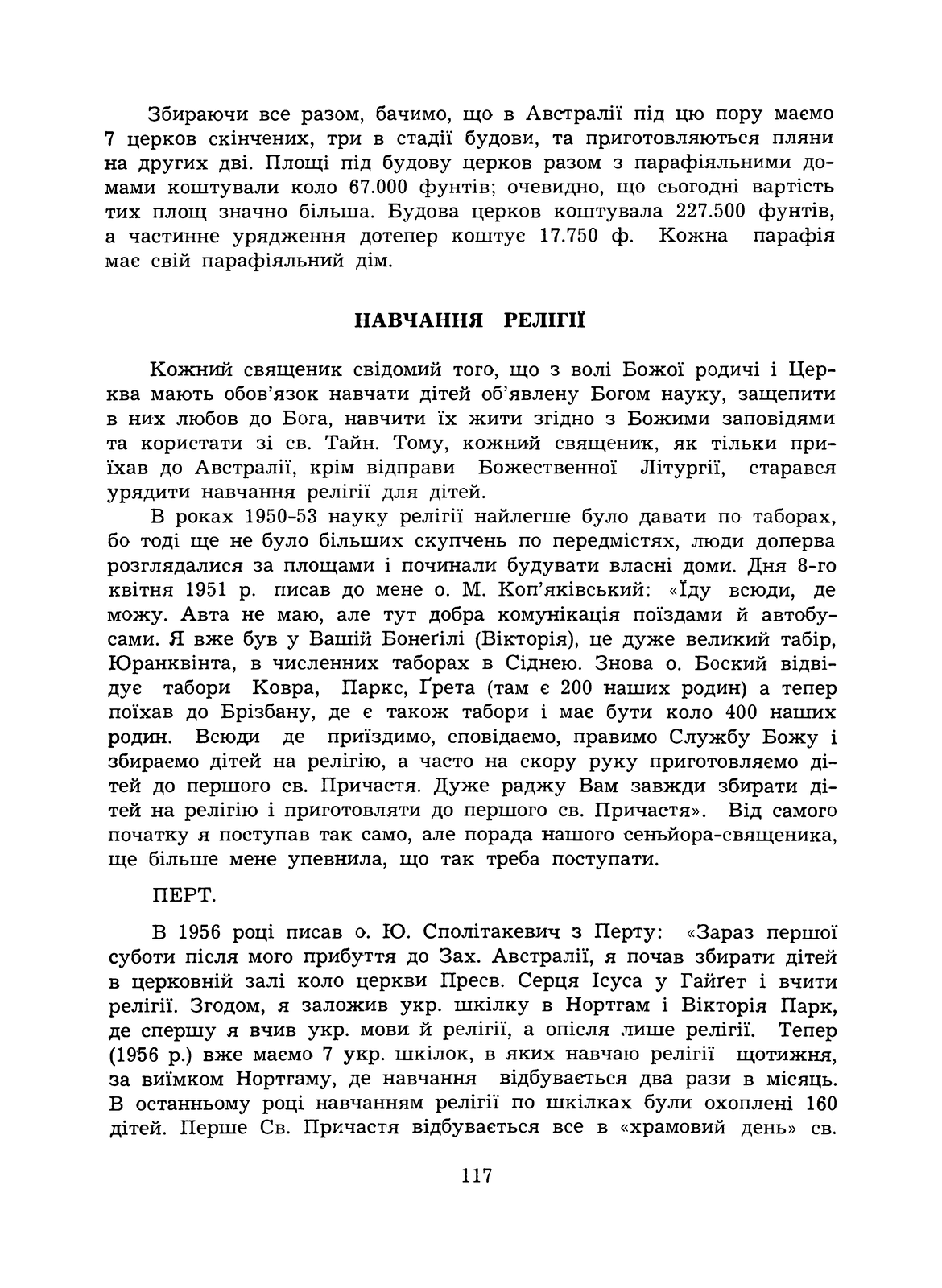
A letter dated 8 April 1951 shows the pattern continuing. It reports visits to Uranquinty, Bonegilla and camps around Sydney, made by train and bus for want of a car, and describes hearing confessions, conducting services, gathering children for religious instruction and preparing them for first communion.
Identified residents and personal testimony
Sophie Arendt, born Zofia Golonski, recalled living at Uranquinty before her Polish family moved to Benalla. Her brother Tadeusz contracted polio, and their mother wanted to be near the hospital. In her 2012 interview, Sophie placed their arrival at Benalla in 1951 or 1952. Their move shows how a child’s health and access to care could shape a family’s journey between migrant settlements.
Sources for this section
Migration, closure and afterlife
The migrant camp school closed in October 1951. On 20 September that year the Daily Advertiser reported that Kapooka and Uranquinty migrant camps were expected to be handed back to the Army and the Air Force respectively within a few weeks, after a party of fourteen including senior Army officers and executives of the Department of Works and Housing had inspected Kapooka. The council history records about 900 residents at the transition, with many moved to Bonegilla. That figure describes residents of all backgrounds.
Over Easter 2001, former residents and the local community gathered for Uranquinty Remembers. The Progress Association organised the commemoration with support from Wagga Wagga Council, the NSW Premier’s Department and the Migration Heritage Centre. It recognised the men, women and children whose lives had passed through this temporary settlement.
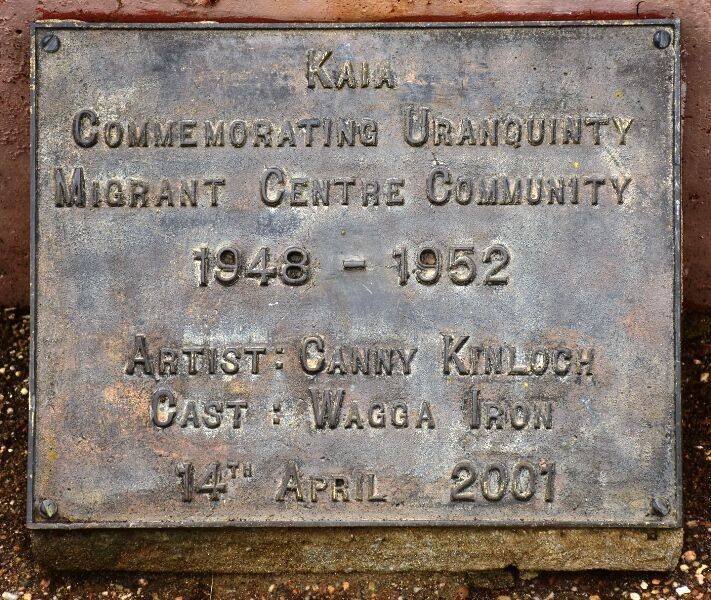
A permanent memorial now marks the community. The front inscription of the Displaced Persons Memorial at Uranquinty reads: “Commemorating Uranquinty Migrant Centre Community 1948 - 1952 Artist : Canny Kinlock Cast : Wagga Iron 14th April 2001”. The monument includes a sculpture commemorating the wives and children of the refugees who worked on the Snowy Mountains Scheme. Its descriptive text places Uranquinty among the reception and training centres established in disused army and air force camps from 1948, when married displaced persons with their families were being allowed entry into Australia. The inscription dates the centre community to 1952, a year later than the handover to the Air Force.
Sources
- Wagga Wagga Community Heritage Study, volume 2: Thematic History
Wagga Wagga City Council
Council thematic history; printed pages 9 and 28. Supports first arrivals in October 1948, the centre’s military context and the end-of-1951 decision or intended transition with approximately 900 residents. Population passage cites Sherry Morris, Uranquinty Remembers (2001), p. 151; that underlying book has not been inspected.
- Українці в Австралії / Ukrainians in Australia, volume 1
Ukrainian community publication, Melbourne · 1966
Printed page 117. Published transcription of a letter dated 8 April 1951 from the Redemptorist priest whose surname is transliterated here as Kopiakivsky; it documents visits to Uranquinty and other migrant camps and the travelling ministry. The initial is the Cyrillic Н, which the priest’s own signature in source 6 renders ‘о.Н. Коп’яківський ЧНІ’; the page therefore uses N throughout.
- Teaching English to post-WWII migrants
Museums of History NSW
Official education guide listing the Uranquinty Migrant Camp school as open from January 1949 to October 1951 and describing file 14/7896.
- Bruno and Irene Golonski: Sophie Arendt’s recollections
Benalla Migrant Camp · 2012 interview; published account
Written by Sabine Smyth from November 2012 interview notes. Documents Sophie Arendt’s recollection of Uranquinty, her brother’s illness and the family’s move to Benalla.
- Uranquinty Remembers
NSW Migration Heritage Centre · 2001
Institutional project page documenting the Easter 2001 commemoration and the centre’s role in housing families of workers on postwar projects.
- N. Kopiakivsky, letter reprinted in St Andrew’s Parish Sydney 1948–1998
Ivan Shevtsiv · 1999; letter originally dated 1950
Printed pages 93–96 read in the original. The reprinted letters record the journey from Yorkton to Sydney, arrival on 22 March 1950, the division of camps between the two Redemptorist priests, the Uranquinty visit of 27–29 March 1950 and the Bonegilla visit of 30 March to 2 April, the loudspeaker announcement of services, and observations about housing and separated families. Signed ‘о.Н. Коп’яківський ЧНІ’.
- Bits and Pieces: ‘Husbands Not Wanted’
Warwick Daily News, p. 2 · 4 January 1949
Read from the digitised newspaper page image, Trove page 21004606. Quotes the camp’s director, Robert Bain, on the purpose of the family camp, and gives 70 women and 112 children then at Uranquinty and space for at least 1,000 families.
- Aid Needed for Uranquinty Migrant School: Wagga appeal opened
Daily Advertiser, Wagga Wagga, p. 1 · 18 June 1949
Read from the digitised newspaper page image, Trove page 15903281. Reports the Wagga Teachers’ Association appeal, the £200 a year teachers said was needed, the equipment lacking, the language difficulties of the children and the impossibility of forming a parents’ association.
- Uranquinty Migrant Director Seeks Donations for Play Centre
Daily Advertiser, Wagga Wagga, p. 2 · 16 December 1949
Read from the digitised newspaper page image, Trove page 15904408. Names the director as Mr R. U. Bain, gives about 250 schoolchildren and 120 children of kindergarten age at the centre, the cancelled Immigration Department subsidy and the three-week play centre planned to begin on 3 January.
- Troops for Kapooka, Uranquinty?
Daily Advertiser, Wagga Wagga, p. 1 · 20 September 1951
Read from the digitised newspaper page image, Trove page 15908417. Reports the expected handing back of Kapooka and Uranquinty migrant camps to the Army and the Air Force respectively within a few weeks, and the inspection party from Army Headquarters and the Department of Works and Housing.
- Displaced Persons Memorial, Uranquinty
Monument Australia, page by Henry Moulds · Page dated 28 July 2022; memorial dedicated 14 April 2001
Descriptive text and the transcription of the front inscription read. They record the memorial commemorating the Uranquinty Migrant Centre community of 1948 to 1952, its artist and founder, its dedication on 14 April 2001, and a sculpture commemorating the wives and children of refugees who worked on the Snowy Mountains Scheme.
Last researched 12 September 2026