Virnsberg
Displacement in Europe
Virnsberg · Germany · Ukrainian DP camp: 1946–1947
The castle above the village of Virnsberg, in the Ansbach district, held a Nazi land-service training school until 1945 and then served UNRRA as a refugee camp. Ukrainian returns count between 210 and 355 Ukrainians there in 1946 and 1947 — at times more people than lived in the village below — before the camp closed around the turn of 1948.
Introduction
Virnsberg is a small village in the Ansbach district of Middle Franconia, now part of the market town of Flachslanden. The Arolsen Archives inventory lists a Ukrainian displaced persons centre named simply Virnsberg, under UNRRA Team 548 Ansbach, which closed between the end of October 1947 and the end of January 1948. The castle’s own history and Ukrainian population returns give the camp a place and a size.
The camp occupied a building that had already changed hands many times in seven centuries: a Teutonic Order commandery until secularisation, a private seat in the nineteenth century, a Nazi training school during the war, and then in turn a refugee camp, American quarters and a medical station. Nothing on the site marks the Ukrainian years.
A history in dates
- 1235The castle is first documented, as Virnsperc.
- 1294Virnsberg passes to the Teutonic Order.
- 1532The commandery builds a hospital in the village; the building later becomes the schoolhouse.
- 1905The von Friesen family acquires the castle and lives there until shortly before the war.
- 1943 to 1945The Nazi land service runs a training establishment in the castle.
- 16–17 April 1945American armour takes Sondernohe and then Virnsberg; seven German soldiers and a civilian are killed and twenty-two buildings burn.
- 1946The Arolsen inventory records the Virnsberg centre in District 3 of the American zone under Team 548 Ansbach.
- 24 August 1946UNRRA counts 355 Ukrainians at Virnsberg.
- November 1946Virnsberg comes under Area Team 1041 Ansbach.
- 31 May 1947UNRRA counts 230 Ukrainians at Virnsberg.
- September to October 1947The neighbouring Ukrainian centre at Oberzenn, AC 92-306, closes.
- October 1947Date of the Camp Virnsberg file in the IRO records in Paris.
- Late 1947 to January 1948The inventory places the closure of the centre in this window.
- About 1954The castle becomes an evangelical welfare institution.
- 1963The welfare institutions in the castle come to an end.
- 1 May 1978The municipality of Virnsberg is incorporated into the market town of Flachslanden.
The castle before 1945
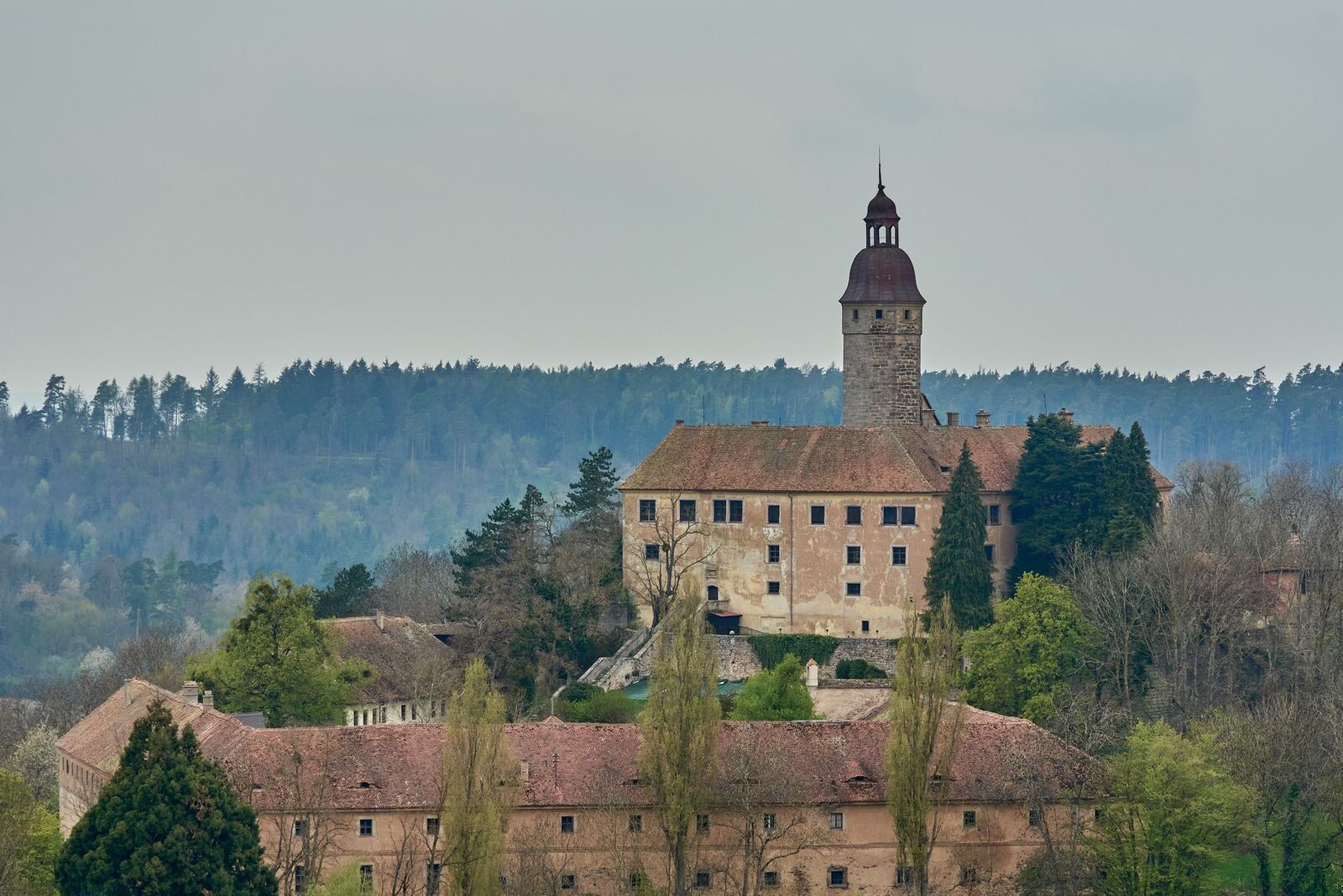
Schloss Virnsberg is unusual in combining two castle forms: it was built as a hill castle and is at the same time a moated castle. The medieval core was extended around 1700 by a baroque farm court. The castle is first recorded in 1235 as Virnsperc, when it belonged to the imperial ministerials of Uffenheim; the Hohenzollern burgraves of Nuremberg held it from 1259 and made it over to the Teutonic Order in 1294.
Virnsberg then stood under the Teutonic Order from 1294 until 1806. From 1525 the Commandery of Virnsberg formed part of the order’s Franconian bailiwick, and after the Reformation it was a Catholic enclave inside the Protestant principality of Ansbach. The commandery built a hospital in the village in 1532; the building, with its inscription stone of that year, later became the schoolhouse.
After secularisation the castle passed first to the Bavarian state and then changed owners often, among them private families and, for some years, an evangelical welfare body. In 1905 a member of the von Friesen family bought it; the family lived there until shortly before the Second World War and, according to the castle’s own history, fled from the Nazis before the war began.
Sources for this section
The war and the end of it
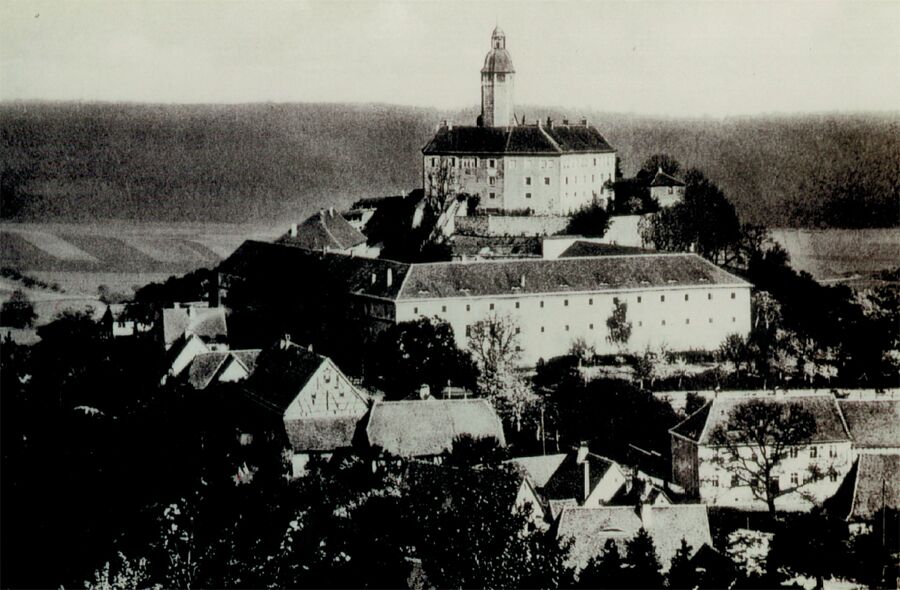
From 1943 to 1945 the castle housed the Nazi land service, the NS-Landdienst, with a training establishment inside its walls. That is the wartime use behind the heading “Ab 1943” under which the castle’s own chronology places its later service to UNRRA — the heading marks the start of the wartime occupation of the building, not the start of the refugee camp.
The fighting reached the district in April 1945. American troops entered Sondernohe on 16 April 1945, the first village in the Ansbach district and so the first in the Flachslanden municipality, and the 17th Tank Battalion then advanced on Virnsberg. Seven German soldiers and one civilian died in the fighting at Virnsberg; eight dwelling houses and fourteen barns burned down.
In the postwar years the castle was used as a refugee camp, as American quarters and as a medical station. The three uses are listed together and are not separately dated, but they place the UNRRA camp in a building that the occupying army was also using.
Sources for this section
UNRRA camp in the castle
The Arolsen inventory carries the Virnsberg centre in District 3 of the American zone, records only Ukrainian nationality, assigns assembly centre number AC 92-305 and places it under Team 548 Ansbach, with Area Team 1041 Ansbach from November 1946. The team director is given as Ronald and the field supervisor as Johnson. No capacity figure is recorded. The inventory closing date lies between 31 October 1947 and 30 January 1948.
Two dates in the entry are easy to misread. The opening date of 24 January 1946 is the inventory’s general first-listing date, entered against a thousand of its rows, and the assembly-centre date “from 09.1948” is likewise a column-wide note attached to more than a thousand entries rather than a date for this camp. Neither should be read as an event at Virnsberg.
Team 548 Ansbach ran a small group of centres. Besides Virnsberg it had the Baltic camp in the Ansbach Gymnasium as AC 92-300, the Hindenburg-Kaserne in Ansbach with a recorded capacity of 2,050 as AC 92-307, and, immediately alongside Virnsberg in the numbering, the Ukrainian centre at Oberzenn in the Uffenheim district as AC 92-306. Oberzenn closed a little earlier than Virnsberg, between 20 September and 17 October 1947. The two were the team’s Ukrainian houses.
Ukrainian sources give the size of the community. Questionnaire returns collected by the Central Representation of the Ukrainian Emigration in 1946 and 1947 counted 210 Ukrainians at Virnsberg. UNRRA’s assembly-centre summary of 24 August 1946 counted 355 and that of 31 May 1947 counted 230. The PCIRO summary of 2 January 1948 has no entry for Virnsberg, which is consistent with the inventory’s closing window.
Those figures are worth setting against the place. The village of Virnsberg had 237 inhabitants at the census of 1925 and 266 in 1950. For a period in 1946 the castle therefore held more Ukrainians than there were villagers below it.
The IRO records held in the French national archives include a file on Camp Virnsberg dated October 1947, listed between files on Camp Gunzenhausen of October 1947 and Camp Langlau of April 1947. Those two centres lay outside the Ansbach district but inside the same UNRRA area: the inventory places Gunzenhausen and Langlau under Team 167 Ansbach and, like Virnsberg, under Area Team 1041 Ansbach. Together with the Arolsen strength and change reports for Virnsberg, these are the administrative records that would document the camp’s final months.
A family-supplied obituary published by an American funeral home in 2025 records one route through the camp. It states that a Ukrainian family “ultimately wound up in a displaced persons (DP) camp in Erlangen, Germany. After Erlangen, they were moved to Virnsberg, then to Bayreuth, Germany.” The obituary gives no dates for the stay at Virnsberg and does not say how the moves were arranged.
Arolsen Archives inventory entry for Virnsberg
| Field | Value |
|---|---|
| Opening (first listing) | 24 January 1946 |
| Closing | Between 31 October 1947 and 30 January 1948 |
| Capacity | Not recorded |
| Capacity date | 31 October 1947 |
| Assembly centre | AC 92-305 |
| Assembly-centre date | Ab 09.1948 |
| UNRRA team | T 548 Ansbach; Area Team 1041 Ansbach from November 1946 |
| Team director | Ronald |
| Field supervisor | Johnson |
| Nationalities recorded | ukrainisch |
| Archive references | ITS Dok-ID 82038285-82038290 |
Ukrainians recorded at Virnsberg
| Date | Ukrainians | Source scope |
|---|---|---|
| 1946–47 | 210 | Central Representation of the Ukrainian Emigration questionnaire |
| 24 August 1946 | 355 | UNRRA assembly-centre summary |
| 31 May 1947 | 230 | UNRRA assembly-centre summary |
| 2 January 1948 | No entry | PCIRO assembly-centre summary |
Centres under UNRRA Team 548 Ansbach
| Location and building | Assembly centre | Nationalities recorded | Capacity | Closing |
|---|---|---|---|---|
| Ansbach, Gymnasium (Baltic camp) | AC 92-300 | Latvian, Estonian, Lithuanian | Not recorded | Between 19 October and 20 December 1946 |
| Ansbach, Polish DP camp | AC 93-404 | Not recorded | Not recorded | 19 October 1946 |
| Virnsberg (Kreis Ansbach) | AC 92-305 | Ukrainian | Not recorded | Between 31 October 1947 and 30 January 1948 |
| Oberzenn (Kreis Uffenheim) | AC 92-306 | Ukrainian | Not recorded | Between 20 September and 17 October 1947 |
| Ansbach, Hindenburg-Kaserne | AC 92-307 | Latvian, Estonian, Lithuanian | 2,050 | Between 30 September 1949 and 30 September 1950 |
| Raitersaich (Kreis Fürth), air depot | AC 93-391 | Jewish, Polish-Ukrainian | 1,000 | 17 June 1949 |
The castle after the camp
From about 1954 an evangelical welfare association from Nuremberg ran the castle as an old people’s home, a youth hostel and accommodation for migrant workers, until fire-safety concerns closed those institutions. A parallel account of the same years lists the uses as an old people’s home, a youth home and a school country home, running from 1954 to 1963, and has the building serve as an inn for thirteen years after that.
Fritz Rang bought the castle in about 1966 and developed a restaurant business in it. In 1977 the castle was bought by a Nuremberg lawyer, who transferred it to a charitable castle association in 2001; it was sold to a Munich investment company in 2017. The whole estate is now managed through Schloss Virnsberg GmbH & Co. KG, and the castle is opened for guided tours and hired out for private functions.
The village itself lost its independence on 1 May 1978, when the municipality of Virnsberg was incorporated into the market town of Flachslanden under the Bavarian local-government reform. It had 267 inhabitants in 2022.
Sources for this section
Sources
- DP camp inventory: Virnsberg (Kreis Ansbach)
Arolsen Archives · 26 October 2023
Entry 1558: District 3, Ukrainian nationality, AC 92-305, Team 548 Ansbach, team director Ronald, field supervisor Johnson, Area Team 1041 Ansbach from November 1946, closing between 31 October 1947 and 30 January 1948, ITS Dok-ID 82038285-82038290. No capacity recorded. Whole spreadsheet read: the opening serial of 24 January 1946 and the assembly-centre note “Ab 09.1948” are constants across the inventory rather than camp dates. Neighbouring rows read for Team 548 Ansbach (entries 704, 705, 706, 1350, 1393) and for Area Team 1041 Ansbach, including Gunzenhausen (entry 1015) and Langlau (entry 1161).
- Die Geschichte von Schloss Virnsberg
Schloss Virnsberg GmbH & Co. KG · Accessed 12 September 2026
Owner’s chronology: Teutonic Order commandery to 1806, von Friesen ownership 1905 to 1954, UNRRA refugee camp in the postwar years, welfare institution from about 1954 and later owners.
- Ukrainian Population Migration after World War II
Ihor Stebelsky, in The Refugee Experience, Canadian Institute of Ukrainian Studies Press · 1992
Table 7, printed page 50, Virnsberg row: 210 (1946–47 questionnaire), 355 (UNRRA, 24 August 1946), 230 (UNRRA, 31 May 1947), no figure for January 1948. Column assignment checked against the PDF layout.
- Political Refugees and Displaced Persons, 1945–1954: Research Report No. 2
Yury Boshyk and Boris Balan, Canadian Institute of Ukrainian Studies · 1982
Printed page 33: the French national archives’ IRO series AJ 43 contains a file on Camp Virnsberg, October 1947.
- Virnsberg, Deutschordensburg, von Süden
Wikimedia Commons · 1 May 2021
CC BY-SA 4.0 photograph of the castle from the south.
- Schloss Virnsberg
burgen-und-schloesser.de · Accessed 13 September 2026
Full entry read: hill castle and moated castle in one, baroque farm court added about 1700, the NS-Landdienst training establishment of 1943 to 1945, postwar use as refugee camp, American quarters and medical station, and 1954 to 1963 as old people’s home, youth home and school country home followed by thirteen years as an inn.
- Kriegsende am 16. und 17. April 1945
Markt Flachslanden; article by Fritz Arnold · 30 May 2020
Full article read: the American advance on Sondernohe on 16 April 1945 and on Virnsberg by the 17th Tank Battalion; seven German soldiers and one civilian killed at Virnsberg; eight dwelling houses and fourteen barns destroyed. The municipality names the local history society’s 2013 volume on Flachslanden in the Third Reich as its source.
- Virnsberg
Wikipedia (German) · Accessed 13 September 2026
Article text read: first documentary mention in 1235 as Virnsperc, the Uffenheim ministerials, the Nuremberg burgraves from 1259, the Teutonic Order from 1294 to 1806, the Commandery of Virnsberg in the Franconian bailiwick from 1525 as a Catholic enclave in Protestant Ansbach, the hospital of 1532 and its later use as the schoolhouse, incorporation into Markt Flachslanden on 1 May 1978, and the population tables for the village (237 in 1925, 266 in 1950, 267 in 2022) drawn from the Bavarian place directories.
- Schloss Virnsberg, 1944
Schloss Virnsberg, historical photograph gallery · 1944
Photograph of the castle and its long lower range above the village, dated 1944, two years before UNRRA used the buildings as a refugee camp. Published in the owner’s gallery of historical photographs; no reuse licence is stated.
- Obituary of a Ukrainian displaced person (family-supplied)
Fletcher Nasevich Funeral Home · 2025
Web page body, second paragraph, read in full: a family-supplied obituary recording that a Ukrainian family reached a displaced persons camp at Erlangen and was then moved to Virnsberg and afterwards to Bayreuth. The individual is not named here, in keeping with the site’s practice of not naming camp residents.
Last researched 12 September 2026