Von-der-Tann-Kaserne
Displacement in Europe
Regensburg · Germany · 1945–1949; related IRO hospital from 1948
A nineteenth-century infantry barracks on Landshuter Straße became a mixed displaced-persons assembly centre with Latvian, Ukrainian, Polish and Russian residents. Its records are administrative rather than communal, and it should not be confused with the far larger Ukrainian settlement at Ganghofersiedlung on the other side of the city.
Introduction
Von-der-Tann-Kaserne accommodated displaced people in Regensburg soon after the war. A May 1945 document identifies a Polish camp in the barracks on Landshuter Straße. The Arolsen Archives inventory later records the site as assembly centre 93-412, subsequently coded NBO 408, with Latvian, Ukrainian, Polish and Russian residents under UNRRA Team 120 in Regensburg. This is a different place from Ganghofersiedlung, the workers’ estate in the south of the city that housed Regensburg’s Ukrainian community; the two sites are documented separately and their figures must not be pooled.
Sources for this section
A history in dates
- 1887The War Ministry decides to build a new infantry barracks outside the town on Landshuter Straße.
- 1891Construction of the infantry barracks begins, continuing in stages into the First World War.
- 1938The complex is named Von-der-Tann-Kaserne after the Royal Bavarian infantry regiment formerly stationed there.
- 27 April 1945American troops enter Regensburg.
- 23 May 1945The Polish committee identifies its camp and a former Mauthausen prisoners’ organisation in the barracks.
- 19 October 1946The Arolsen inventory dates the assembly centre’s opening.
- 31 October 1947Recorded accommodation capacity of 1,300.
- October 1947 – October 1949Period covered by the IRO dossier on the camp in the Archives Nationales, Paris.
- 1948The IRO opens a hospital in separately documented barracks blocks.
- 31 August 1949The inventory records closure of the residential camp.
- 1 October 1950Caritas takes over the IRO hospital.
- 1952A nursing school opens in the former cinema.
Sources for this section
The infantry barracks
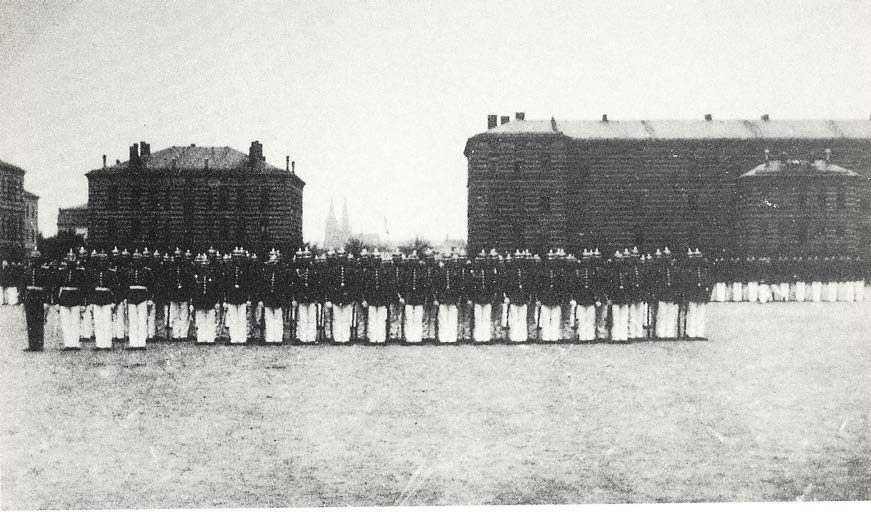
The War Ministry decided in 1887 to build a new barracks for the Regensburg infantry regiment, and chose a site outside the town on Landshuter Straße. The university survey of Regensburg’s barracks gives the reasons plainly: there were no breweries or inns nearby, the shooting and drill ground was closer, and the soldiers would be undisturbed by civilians. Building began in 1891 and continued in stages into the First World War. The Bavarian State Police used part of the complex for a time. In 1938 the barracks took the name Von-der-Tann-Kaserne, after the Royal Bavarian infantry regiment formerly stationed there, and it remained in military use until 1945. A surviving photograph shows soldiers on its parade ground in 1910, long before displaced people lived here.
Sources for this section
Representation after liberation
On 23 May 1945, four weeks after American troops entered Regensburg, the Polish committee at Weingasse 1 informed the mayor that it now acted as the umbrella body for the Polish organisations in the city. Roman Smolorz’s study names two of them in this barracks: the Polish displaced-persons camp in the Von-der-Tann-Kaserne on Landshuter Straße, and an association of former political prisoners of Mauthausen also accommodated there. The committee claimed to represent 4,000 Poles in Regensburg, took responsibility for subordinate offices at Landshut, Mainburg and Schwandorf, and gave rapid repatriation as its main aim. Its leader was recorded as Colonel Kazimierz Rawicz, a name the study suspects was a pseudonym. The committee’s city-wide constituency should not be mistaken for a count of people living in this barracks.
Sources for this section
Administration, dates and scale
The Arolsen inventory dates the camp’s opening to 19 October 1946 and its closure to 31 August 1949, records a capacity of 1,300 on 31 October 1947, and assigns it to UNRRA Team 120. Its archive reference points to holdings of the International Tracing Service and to files of the Bezirksamt Regensburg in the Staatsarchiv Amberg. The International Refugee Organisation kept its own file on the camp: the Boshyk and Balan guide to displaced-persons research lists, among the IRO papers in the Archives Nationales in Paris, a dossier on the Von-der-Tann-Kaserne at Regensburg covering October 1947 to October 1949. Neither the capacity nor the archive’s list of nationalities establishes a separate Ukrainian census; the records describe a mixed institution.
Published Ukrainian population figures do not reach this camp individually. Stebelsky’s table of Ukrainians in the assembly centres of the American zone lists Regensburg as a single entry, giving 4,664 for 1946–47, 1,985 in August 1946, 4,293 in May 1947 and 4,560 in December 1947. Those are city totals covering all the Regensburg centres together, and the largest share belongs to Ganghofersiedlung. They cannot be divided between the barracks and the settlement.
The camp in the administrative record
| Field | Recorded value | Source and scope |
|---|---|---|
| Assembly centre number | AC 93-412, later NBO 408 | Arolsen inventory, record 1406 |
| Relief team | UNRRA Team 120, Regensburg | Arolsen inventory; the team also ran Ganghofersiedlung and Wolkering |
| Opening | 19 October 1946 | Arolsen inventory; the barracks already held a Polish DP camp in May 1945 |
| Capacity | 1,300 on 31 October 1947 | Recorded accommodation capacity, not a census |
| Nationalities listed | Latvian, Ukrainian, Polish, Russian | Order as printed in the inventory; no numbers are given |
| Closure | 31 August 1949 | Arolsen inventory |
| IRO file | Von der Tann Kaserne, Regensburg, October 1947 – October 1949 | Archives Nationales, Paris, AJ 43 825/47, as listed by Boshyk and Balan; file not consulted |
Residential camp and hospital: separate measures
| Institution and date | Figure | Measure |
|---|---|---|
| Residential camp, 31 October 1947 | 1,300 | Recorded accommodation capacity |
| Hospital at Caritas takeover, October 1950 | 300 | Hospital beds |
Ukrainians recorded at Regensburg: a city figure, not a camp figure
| Return | Ukrainians recorded at Regensburg |
|---|---|
| 1946–47 (questionnaire returns) | 4,664 |
| August 1946 (UNRRA) | 1,985 |
| May 1947 (UNRRA) | 4,293 |
| December 1947 (PCIRO) | 4,560 |
Medical care in related barracks blocks
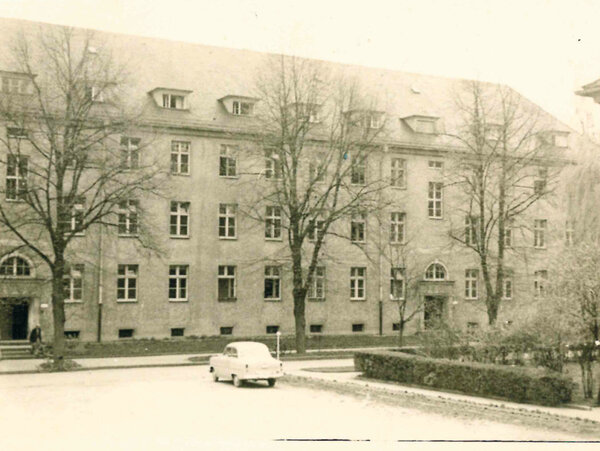
A separate hospital history traces St. Josef to an IRO facility opened in 1948 for displaced people with chronic illnesses. It occupied blocks built in 1936 and described by the institution as part of Von-der-Tann-Kaserne. When Caritas took over in October 1950, the hospital had 300 beds, simple six-bed rooms and corridor toilets. These hospital figures refer to a medical facility, not the camp’s residential population. The former cinema subsequently became a nursing school in 1952.
Sources for this section
What survives in the city
The former barracks ground now serves several purposes. The municipal account identifies Ostpark as the old parade ground, between Landshuter, Safferling and Plato-Wild streets, and the university survey records that the site today is partly parkland and partly the seat of several public authorities. The hospital continued to develop as St. Josef. The two histories preserve different parts of the postwar response to displacement: temporary accommodation and continuing medical care.
Sources for this section
Sources
- Das so genannte polnische Konsulat Regensburg
Roman Smolorz, regional historical research
Printed page 395, re-read 13 September 2026: US entry 27 April 1945; Polish committee at Weingasse 1 acting for the DP camp in the Von-der-Tann-Kaserne and for the Mauthausen former-prisoners’ organisation there; 4,000 Poles claimed city-wide; branches at Landshut, Mainburg and Schwandorf; Colonel Kazimierz Rawicz. The article’s table of Poles and 'Polish Ukrainians' living outside the camps is a Landkreis figure and is not reused.
- Kasernen in Regensburg im Überblick
Christoph Kaindl and Philipp Weiß, University of Regensburg
Printed pages 10–12, re-read 13 September 2026: 1887 decision, siting on Landshuter Straße, construction from 1891, use by the Bavarian State Police, 1938 renaming, present-day parkland and public offices. Figure 9, 1910 parade ground, Bavarian Army Museum inventory 0287-1998.5. The neighbouring Kavalleriekaserne is a separate site.
- Unsere Meilensteine: 1950 bis 2025
Caritas-Krankenhaus St. Josef
Institutional history and archive images: separate 1936 blocks converted into an IRO hospital in 1948; Caritas takeover in 1950.
- DP camp inventory: von der Tann-Kaserne
Arolsen Archives
Record 1406: AC 93-412, later NBO 408, Latvian/Ukrainian/Polish/Russian population, UNRRA Team 120, opening 19 October 1946, capacity 1,300 on 31 October 1947, closure 31 August 1949. Archive reference: ITS documents for Regensburg and Staatsarchiv Amberg files 12278, 12281, 12282 and 12295.
- Ostpark
City of Regensburg
Municipal account identifies former parade ground between Landshuter, Safferling and Plato-Wild streets.
- Yury Boshyk and Boris Balan, Political Refugees and 'Displaced Persons', 1945-1954: A Selected Bibliography and Guide to Research
Canadian Institute of Ukrainian Studies, University of Alberta, Research Report No. 2 · 1982
Inventory of IRO records in the Archives Nationales, Paris. AJ 43 825, sub-series 34/2, item 47: 'Von der Taun Kaserne a Regensburg, octobre 1947 - octobre 1949'. The date range is the coverage of the file, not the life of the camp. The file itself has not been consulted.
- Ihor Stebelsky, Ukrainian Population Migration after World War II, Table 7
in The Refugee Experience, Canadian Institute of Ukrainian Studies Press · 1992
Printed pages 47–51. 'Regensburg' appears as a single row: 4,664 (1946–47), 1,985 (August 1946), 4,293 (May 1947), 4,560 (December 1947). A city-level total for all Regensburg assembly centres, not a figure for this camp.
Last researched 13 September 2026