Vorkloster Camp
Displacement in Europe
Vorkloster, Bregenz, Vorarlberg, Austria · Ukrainian residence documented 1945–1950
A Ukrainian community in the French occupation zone waited in Bregenz in the huts of a former Reich Labour Service camp before dispersing overseas. Contemporary returns trace a sharp fall in numbers, while family photographs preserve Christmas celebrations and departure by train.
Introduction
Vorkloster Camp sheltered displaced people in Bregenz, near today’s Handelsakademie. A Ukrainian family’s recollection places its residence there from 1945 to 1949. The camp was part of Vorarlberg’s postwar accommodation network, where refugees waited while arranging their next move.
Sources for this section
A history in dates
- Summer 1915About 2,000 Ukrainian internal refugees are in Vorarlberg during the First World War.
- 1919The district of Rieden-Vorkloster is incorporated into Bregenz.
- 1942Just under 3,000 Ukrainian forced labourers are counted in the province.
- May 194565,000 people classed as strangers to the province are in Vorarlberg, one inhabitant in four.
- 1945Ukrainian family residence at Vorkloster is documented in a later recollection.
- December 1945About 7,270 displaced people remain in Vorarlberg.
- September 1946A return includes stateless Ukrainian-speaking residents at Vorkloster.
- 1947Five camps are still working in Vorarlberg, among them Vorkloster; together they house a tenth of the province’s refugees.
- 30 September 1948An IRO return records 255 Ukrainians at Vorkloster.
- 1949About 200 Ukrainian refugees remain in Vorarlberg; Vorkloster is one of four camps left at the year’s end.
- 30 June 1950An IRO return records 27 Ukrainians.
Sources for this section
- Gestrandet im Camp Vorkloster
- Bregenz, Österreich-Lexikon
- Als jeder Vierte ein Fremder war
- La politique française à l’égard des personnes déplacées, identique en Allemagne et en Autriche après la seconde guerre mondiale ?
- Ukrainian Population Migration after World War II, Table 5
- Rechenschaftsbericht der Vorarlberger Landesregierung über das Jahr 1949
A province used as a corridor
At the end of the war 65,000 people classed as strangers to the province were in Vorarlberg, one inhabitant in four. Between May and December 1945 about 130,000 people travelled through, and as many as 3,000 a day are said to have passed through Bregenz that summer. By December 1945 some 7,270 displaced people remained, the largest groups being 1,400 Polish and 1,000 Soviet citizens. The French military government with its Service social was responsible for them, and later the provincial government.
The historian Wolfgang Weber records that Ukrainians reached Vorarlberg in two earlier waves as well: about 2,000 internal refugees in the summer of 1915, and just under 3,000 forced labourers counted in 1942, with roughly 3,000 more arriving as refugees after 1944. The provincial policy after 1945 was emigration and repatriation rather than settlement.
Sources for this section
The buildings and the routine
Vorkloster was a named place before any camp stood there. The Österreich-Lexikon records that Rieden-Vorkloster was incorporated into Bregenz in 1919, and names in the district the Maria Hilf parish church, built between 1925 and 1931 to designs by Clemens Holzmeister, and the Cistercian monastery of Mehrerau.
Weber describes Camp Vorkloster as one of about ten former Reich Labour Service camps between Bludenz and Bregenz that were pressed into use as quarters. The largest of them held up to 500 people. Each consisted of at least six huts, with a central corridor serving between eight and twelve rooms for four people each, a communal kitchen and a communal shower. Basic needs, in his account, were met.
Military authorities, the provincial government and the Service social ran the camps through resident self-administration: the refugees filled every function the camp required, and the day was structured by that self-government. Contact with the outside was slight and there was no work to be had. The declared aim was onward migration rather than integration.
A gazetteer maintained by avArc records a “Prisoners of War Camp Vorkloster” in the municipality of Bregenz, citing the Austrian Federal Monuments Office. The entry gives no dates, no published field observations and no reference to displaced persons, and nothing in it connects the camp it records to the camp described here.
Sources for this section
A mixed community in the French zone
A September 1946 record discussed by Julia Maspero lists Polish, Yugoslav, Dutch and Czechoslovak displaced people at Vorkloster, together with stateless Russian-speaking and Ukrainian-speaking residents. Camps in Vorarlberg were administered by the French authorities during this period, outside UNRRA’s direct camp-management network in Tyrol.
The distinction between language, citizenship and nationality matters in tracing this community. A person recorded as stateless and Ukrainian-speaking in one return need not appear under an identical label in another. The later IRO figures nevertheless establish a continuing Ukrainian presence at the named camp.
Vorarlberg’s camps were also organised by nationality where possible. A 2015 survey of the same research names Rappenwald, Schindler at Kennelbach and Weidach in Bregenz as the camps intended for Ukrainians and Russians. Weidach lies within the Vorkloster quarter, but that survey counts Vorkloster and Weidach as two of the five camps still working in 1947, so the two names should not be merged.
A community preparing to leave
Stebelsky’s Table 5 of Ukrainians in the PCIRO or IRO camps of Austria records 255 Ukrainians at Vorkloster on 30 September 1948 and 27 on 30 June 1950, the third largest of the five French-zone camp entries, after Landeck and Kufstein. The decrease was 228 people, about 89 per cent of the earlier number. It measures a change between two snapshots; the returns do not identify individual destinations or show every arrival and departure between those dates.
Across Vorarlberg, only about 200 Ukrainian refugees were left in 1949, a year before the camps closed. The five camps still open in 1947, Alberschwende, Mehrerau, Vorkloster, Weidach and Levis at Feldkirch, between them fed and housed a tenth of all refugees in the province; the rest were in private quarters.
Ukrainians recorded in the IRO returns for the French zone of Austria
| Camp or zone total | 30 September 1948 | 30 June 1950 |
|---|---|---|
| Vorkloster | 255 | 27 |
| Landeck | 1,161 | 339 |
| Kufstein | 464 | 123 |
| Hötting | 41 | 31 |
| Wörgl A | 85 | no entry |
| French zone total | 2,006 | 520 |
Everyday life and onward journeys
A child who spent her first four years in the camp remembered colouring books, concerts, church festivals and German nursery rhymes she can still recite, together with a vivid warning to be careful of strangers, prompted by the fear that Soviet agents were infiltrating the camps. North America, Australia and Argentina were the destinations that mattered to Ukrainian refugees in Vorarlberg.
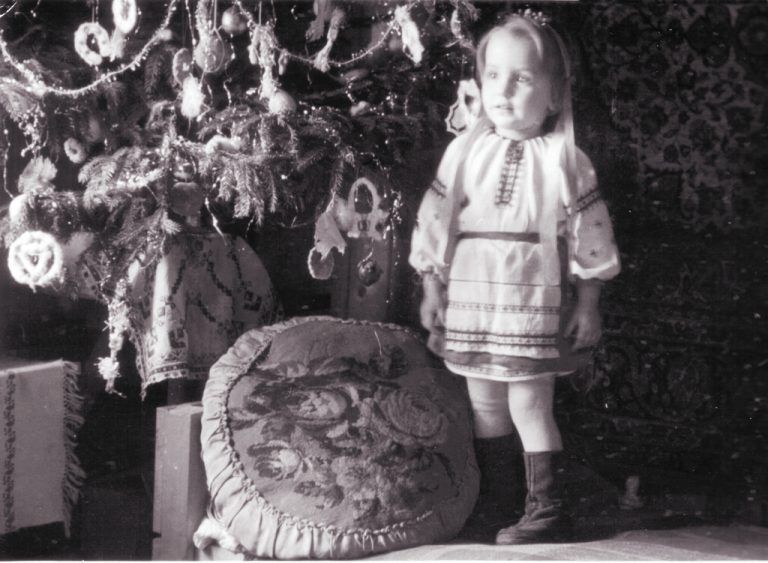
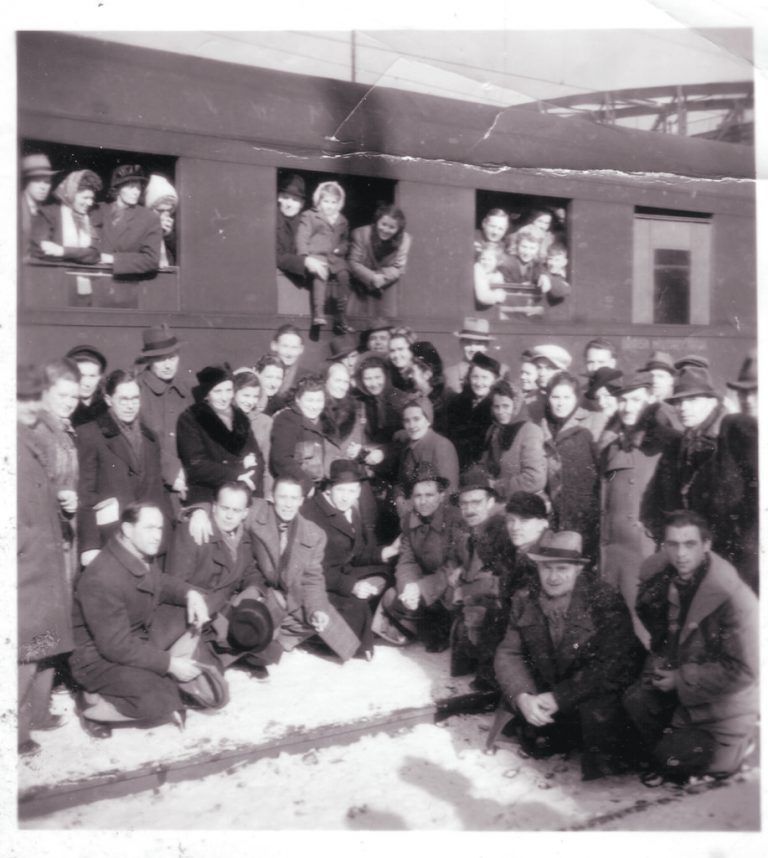
A family photograph from Vorkloster shows a child beside a decorated Christmas tree, wearing embroidered clothing. Another image records Ukrainian refugees leaving Bregenz towards Argentina. One former camp family left in 1949 via Bremerhaven and Halifax for Canada. These photographs and recollections connect the administrative returns with domestic celebrations and the practical journey beyond Austria.
Ukrainian relief work in the town is documented in an archive rather than on the ground. The Ukrainian Central Relief Union in Austria deposited its papers with Osredok in Winnipeg, and they include files of the Ukrainian Social Service in Bregenz alongside papers from the camp at Landeck. Those files are attributed to Bregenz as a town, not to Vorkloster camp itself.
One of four camps remaining in 1949
The provincial government’s report for 1949 names Vorkloster alongside Mehrerau, Waidach, spelled Weidach in the 2015 survey, and Alberschwende as the four remaining foreign-resident camps after Feldkirch-Levis and the Riedenburg hospital closed. Together they housed 986 people at year-end, compared with 1,298 at the start of the year. Of the year-end total, 175 were recorded as employed.
Those figures describe the four-camp network, not Vorkloster alone. They show that overseas departures coexisted with continuing needs for accommodation and support. The report recorded expenditure of 3,472,182.07 Austrian schillings on the camp network during the year.
The four remaining foreign-resident camps in Vorarlberg during 1949
| Measure | Figure |
|---|---|
| Residents at the start of 1949 | 1,298 |
| Residents at the end of 1949 | 986 |
| In employment at the end of 1949 | 175 |
| Expenditure on the camp network during 1949 | 3,472,182.07 Austrian schillings |
Sources for this section
Sources
- Gestrandet im Camp Vorkloster
Vorarlberger Nachrichten; historian Wolfgang Weber and family recollection · 3 April 2022
Full article and original photographs inspected. Regional camp descriptions not converted into unsupported Vorkloster-specific numbers.
- Ukrainian Population Migration after World War II, Table 5
Ihor Stebelsky, in The Refugee Experience: Ukrainian Displaced Persons after World War II (Edmonton: CIUS Press) · 1992
Appendix, Table 5, “Ukrainians in the PCIRO or IRO Camps of Austria”, printed page 43: Vorkloster 255 and 27. Page image rendered from the PDF and read directly. The columns are headed 30 September 1948 and 30 June 1950, matching the IRO Field Service Office returns cited in the footnotes.
- La politique française à l’égard des personnes déplacées, identique en Allemagne et en Autriche après la seconde guerre mondiale ?
Julia Maspero, Austriaca 95 · 2022; online 2023
Printed page 69, relevant passage read in search-indexed original PDF. Full retrieval returned publisher anti-bot screen; no claim to have inspected underlying archival files.
- Rechenschaftsbericht der Vorarlberger Landesregierung über das Jahr 1949
Vorarlberger Landesregierung / Landtag · 1950
Original PDF, page 224 (PDF page 4). Aggregate figures cover four camps, not Vorkloster alone.
- Als jeder Vierte ein Fremder war
Michael Prock, Vorarlberger Nachrichten, drawing on the historian Wolfgang Weber · 24 August 2015
Full article read. Provincial totals for 1945, the nationality allocation of camps, and the list of five camps still working in 1947. Lists Vorkloster and Weidach separately.
- Research Report No. 2: Political Refugees and “Displaced Persons”, 1945–1954
Yury Boshyk and Boris Balan, Canadian Institute of Ukrainian Studies · 1982
Printed page 21: the Osredok holding of the Ukrainian Central Relief Union in Austria, including files of the Ukrainian Social Service in Bregenz. Attributed to the town, not to Vorkloster camp.
- Bregenz, Österreich-Lexikon
AEIOU Österreich-Lexikon (aeiou.at) · Accessed 14 September 2026
Article read in full for the “History” and “Buildings” sections: Rieden-Vorkloster incorporated into Bregenz in 1919; the district of Vorkloster containing the Maria Hilf parish church (1925–1931, C. Holzmeister) and the Cistercian monastery of Mehrerau. The article mentions no camp.
- Prisoners of War Camp Vorkloster
avArc, PoH-Code poh.3797 · Accessed 14 September 2026
Single gazetteer entry read in full: a prisoners-of-war camp named Vorkloster in Bundesland Vorarlberg, Gemeinde Bregenz, citing Bundesdenkmalamt Österreich (BDA-Österreich 201205). The entry carries no dates, no published field observations and no reference to displaced persons. The underlying monuments register was not inspected.
Last researched 13 September 2026