Waterschei Camp
Displacement in Europe
Wildekerslaan, Waterschei, Genk, Belgium · 1942–1944
A barracks camp built beside the Waterschei coal mine in 1942 became the one camp in the Limburg mining district reserved for Ostarbeiter, civilians deported from Ukraine and other eastern territories. Mining records, a wartime return and police statements taken in Genk in 1968 describe the work, the punishments and the deaths behind its wire.
Introduction
Waterschei’s wartime camp stood on Wildekerslaan in Genk. Ukrainians were among its forced labourers, alongside other eastern Europeans. Later testimony describes coercion and violence inside the camp. This was a German-controlled labour camp during the occupation of Belgium.
From the autumn of 1942 Waterschei held a distinct population. Soviet prisoners of war were spread across the other Limburg mining camps, while the civilian deportees known as Ostarbeiter were brought together here. Jean Put’s tables of camp strength carry the note that the Kempen figures are prisoner-of-war figures with the exception of Waterschei, which counted Ostarbeiter.
Sources for this section
A history in dates
- 5 December 1941Germany announces that Russian prisoners will be sent to the Limburg pits and orders the collieries to build fenced lodgings.
- Spring 1942The barracks camp is built near Steenbeukstraat, Waterschei.
- Late June or early July 1942A convoy of 1,496 eastern civilians reaches Limburg; 702 are allocated to Waterschei.
- 18 July 1942A return records 693 people in the camp and 533 working in the mine.
- 21 July 1942A first convoy of people judged unfit is sent back towards Germany, including 150 from Waterschei.
- September 1942Eastern civilian workers are concentrated at Waterschei as Soviet prisoners arrive in the mining region.
- 21 October 1942The transfers are complete and all the Ostarbeiter in Limburg are held at Waterschei.
- 31 December 1942The camp strength is recorded as 1,215.
- August 1944The camp strength is recorded as 1,078.
- September 1944Retreating German forces take prisoners towards Germany.
- 14 September 1944After the liberation of Genk, arrested collaborators are held in the camp until December.
- About 1949Redemptorist priests found a Ukrainian congregation at Waterschei.
Barracks in a mining district
The settlement had developed around the coal mine. Its garden suburb, designed during the 1920s, housed mining employees; the company also maintained churches, schools and other communal buildings. The forced-labour barracks formed a different kind of accommodation within this company-dominated landscape.
In 1941 the German Reichsvereinigung Kohle placed the Limburg collieries in a regional division, Kempen-Bergbau, with its office at Hasselt. The announcement on 5 December 1941 that Russian prisoners would be sent to the pits came with an instruction to provide lodging: a single block close to the mine and ringed with barbed wire. No colliery had suitable buildings, so barracks camps were built to conditions set by Kempen-Bergbau. The Waterschei camp went up in the spring of 1942 near Steenbeukstraat.
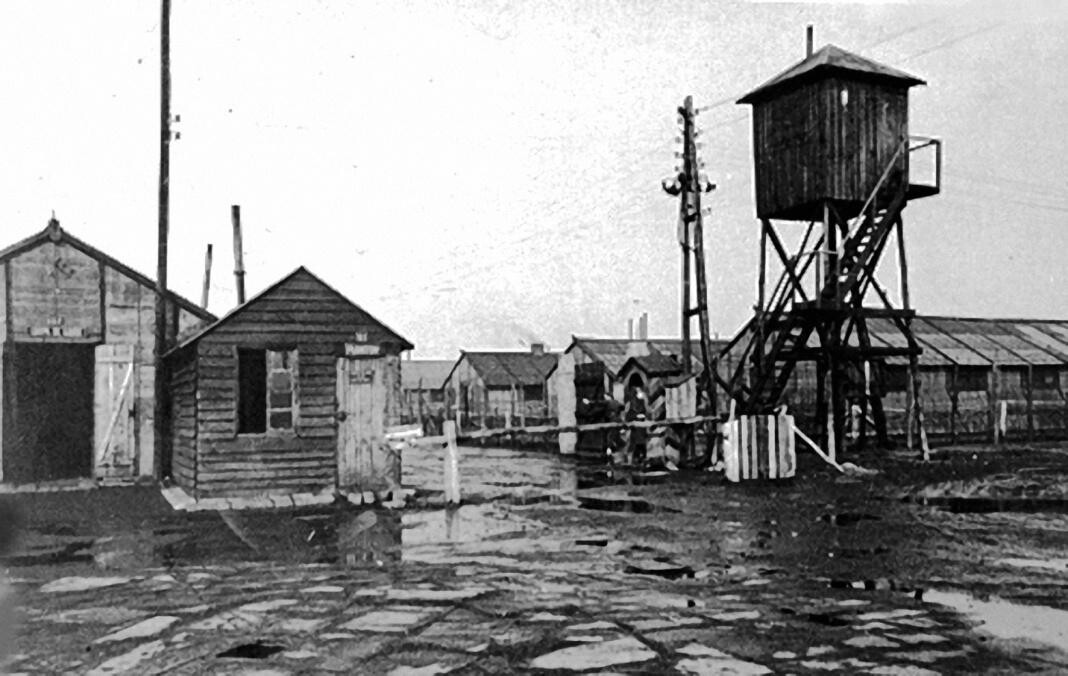
The camp has since been demolished. A photograph reproduced by local historians shows wooden huts and a raised water tank, preserving a view of an otherwise vanished institution.
The first convoy
A convoy of 1,496 Soviet civilians reached Limburg in the summer of 1942, 702 of them allocated to Waterschei. About a third were seventeen or younger. Four days later the German authorities published the camp rules: musical instruments and a radio were allowed, wage tables applied, contact with the Belgian population was to be avoided, and each site was run by a camp commander.
A return for 18 July 1942 records 693 people in the camp, with 533 working in the mine. Illness, injury and duties inside the compound account for most of the others. These are whole-camp figures, not a Ukrainian subtotal. Kempen-Bergbau expected no more than three per cent non-producers; at Waterschei the figure was twenty-three per cent. On 21 July a first convoy of people judged unfit was sent back towards Germany, 150 of them from Waterschei.
In September 1942, as Soviet prisoners of war began to arrive at the other mining camps, the eastern civilians were moved together: those at Zwartberg to Waterschei, those at Eisden to Winterslag and Houthalen. From 21 October 1942 all of them were at Waterschei, and they stayed until the end of the occupation.
Camp and work return, 18 July 1942
| Category | People |
|---|---|
| Camp population | 693 |
| Working in the mine | 533 |
| Sick | 118 |
| Injured | 14 |
| Camp work | 27 |
| Under punishment | 1 |
Sources for this section
Working underground
Almost none of the deportees had seen a coal mine. Colliery managements were required to run short courses, with one instructor for every five men, and to work them in their own stalls as hewers and haulers. In the pit they were told apart by their lamps: straight lamps painted with white stripes, first down the shaft and last back up.
Wages were not handed over. Each man had a pay book in which a share of his earnings was entered every fortnight, to be spent in the camp canteen on fruit, beer, tobacco, writing materials, clothing, the cinema or a dentist. A former prisoner told Genk police that in the last year the men received about sixty francs a fortnight.
Food, punishment and sickness
Statements collected by Genk police in 1968 describe poor food, beatings and work imposed despite illness. One Ukrainian witness recalled violent punishment for taking soup. Other testimony records help given to prisoners by local resistance members.
The same statements name the guards. Flemish Guards and German staff supervised the compound. A Ukrainian witness, Kalina Jermalok, saw the camp chief strike men with a length of rubber hose and beat a Russian with a piece of wood for taking half a litre of soup. Polish survivors described blows with a rifle butt, beatings administered on a table, and men sent naked into a cellar of ice-cold water that a Russian prisoner later described to Jean Put as standing water with no sanitation.
Jean Put describes tuberculosis among weakened workers and treatment at the André Dumont clinic. A 1943 Red Cross report praised clinical care; this did not describe conditions throughout the camp. Twenty Russian workers died of the disease in Genk during the war, ten of them from Waterschei. The clinic’s secretary recalled a German order at the end of 1943 to list the unfit for repatriation, after which feverish patients were sent away in cattle wagons in midwinter.
Not every recorded cause of death can be taken at face value. In May 1945 a Waterschei mineworker lodged a complaint about a twenty-seven-year-old Ostarbeiter born at Kryvyi Rih who had been struck on the head with a shovel by an overseer. The mine doctor’s papers recorded skull fractures but gave the cause as a falling object in a mining accident; the Genk police officer who traced him treated it as a violent death. Jean Put’s list of deaths by camp gives twenty-six for Waterschei.
Transfers and the end of occupation
During the German retreat in September 1944, prisoners were taken towards Germany. Some eastern Europeans remained in the Genk region after the war, and their later settlement should be distinguished from the camp’s wartime function.
The buildings did not stand empty. After the liberation of Genk on 14 September 1944 arrested collaborators were held in the Waterschei and Zwartberg camps until December, and at the end of January 1945 both camps were taken over by officers and men of the American air force.
Sources for this section
A Ukrainian parish at Waterschei
Ukrainians returned to Waterschei in a different capacity after the war, when the coal drive brought several thousand displaced people from Germany to the Limburg pits. Redemptorist priests founded the first congregations at Waterschei, Winterslag and Zwartberg about 1949 and 1950. From 1950 to 1963 a single priest served Genk and Zolder, given a miner’s house and a subsidy by the director of the André Dumont mine, and travelling between the communities at first by bicycle. Children were taught beside his terraced house on Thursday, Saturday and Sunday afternoons, in reading and writing, catechism, Ukrainian geography and history and church music. As families moved away the centres were reduced to three: Waterschei-Genk, Zolder and Eisden. In 1984 a former colliery lodging house at Waterschei was bought and converted into a church, consecrated in 1988.
Sources for this section
A vanished camp, a surviving landscape
The wider mining landscape remains recognisable: the official heritage inventory records the garden suburb and major industrial buildings. The former mine now houses the Mijndepot museum.
Sources for this section
Sources
- Ostarbeiter in de mijnstreek van Genk
Alex Marut and Roger Rutten / Comité II · 2020
Pages 3–7; camp photograph, the 1968 Genk police statements, named guards and camp leaders, pay, and the Ukrainian connection.
- Zorgwekkende fysieke conditie
Jean Put · Undated
Mining historian’s transcription of the 18 July 1942 return, the Kempen-Bergbau norm, the arrival convoy and clinical testimony.
- Mijnsite Waterschei, Klaverberg en Heiderbos
Agentschap Onroerend Erfgoed · Undated
Official inventory of the wider mining landscape; not a camp population source.
- Mijndepot Waterschei
Visit Limburg · Undated
Former mine’s museum use.
- Herinnering / Pamyat’
Marc Bertrands / Comité II · 2018
Regional memorial study: Kempen-Bergbau, camp construction and rules, convoy figures, transfers, provincial strengths, and the investigation into a violent death at Waterschei.
- De barakkenkampen
Jean Put · Undated
Administration of the camps; the detailed barrack specification on this page describes Heusden-Zolder, not Waterschei.
- Ostarbeiter en krijgsgevangenen
Jean Put · Undated
Table of camp strengths at 31 December 1942, 31 December 1943 and August 1944, noting that Waterschei counted Ostarbeiter and the other camps prisoners of war.
- Russen in de Pijlers
Jean Put · Undated
Testimony of a Russian prisoner who worked at Waterschei: training, lamps, punishment cellar and self-injury.
- Vrijetijdsbesteding
Jean Put · Undated
The pay book and canteen system, with a priced list of canteen goods; the sampled purchase figures on this page relate to the Zolder camp.
- Begraven in vreemde bodem
Jean Put · Undated
Numbers of prisoners of war and Ostarbeiter who died, given per camp.
- Oekraïense parochies OGKK in Limburg 1947–2016
Dr J. Koziej, Heilige Sophia vzw, Waterschei-Genk · 29 November 2016
Institutional parish history: clergy, teaching, the reduction to three centres and the 1984 purchase of a colliery lodging house at Waterschei.
- QR: Barakkenkamp voor Sovjetrussen te Zwartberg
Alex Marut, Taskforce Liberty · 2 December 2018
Written for Zwartberg, but records the detention of collaborators in both the Zwartberg and Waterschei camps and their occupation by American air force personnel.
- Herinnering / Pamyat’, page 9
Marc Bertrands, Comité II, Genk · 2018
Photograph reproduced on page 9 of the commemorative brochure and captioned there ‘Het Russisch kamp van Waterschei’ — the Russian camp at Waterschei. It shows wooden barracks, a sentry box, a barrier and a raised timber watchtower over waterlogged ground. The brochure gives no photographer, no date and no reuse licence; it was compiled by Comité II for the 2018 commemoration at the Genk municipal cemetery.
Last researched 13 September 2026