Watsonia
Arrival and settlement
Melbourne · Victoria · Australia · Late 1940s–1952
The wartime Watsonia military camp northeast of Melbourne was handed to the State Housing Commission as emergency housing, and migrant families including Ukrainians lived in its huts before the army took the site back in 1952. For some Ukrainian families nearby Macleod became a permanent home.
Introduction
Watsonia’s migrant accommodation reused army buildings in Melbourne’s northeast. It received people moving on from Bonegilla and other early arrival arrangements, including Ukrainians, and the Ukrainian community’s 1966 history names Watsonia among the Melbourne places where newcomers lived.
The status of the place needs care. The district was best known for the Watsonia Military Camp built during the Second World War on land the Commonwealth had bought from the Meares estate. After the war the camp was handed to the State Housing Commission for emergency housing, and a temporary primary school opened there in 1947. In 1952 the Department of the Army resumed the camp for national service training, and the site is now Simpson Barracks, Yallambie. Watsonia does not appear in the standard list of Melbourne’s Commonwealth migrant hostels, which names Altona, Broadmeadows, Brooklyn, Fishermans Bend, Holmesglen, Maribyrnong, Nunawading and Preston. On the available evidence Watsonia was state emergency housing in a former army camp rather than a Commonwealth hostel, and the first-person accounts below describe living in the camp rather than in a hostel of that kind.

A history in dates
- Second World WarThe Commonwealth establishes the Watsonia military camp on land bought from the Meares estate.
- After 1945The camp is handed to the State Housing Commission for emergency housing.
- 1947A temporary primary school opens at the camp.
- 1948A documented arrival from Bonegilla lives at Watsonia while working in a Brunswick brickworks.
- From 1949Ukrainian newcomers pass through Watsonia before settling in Macleod.
- 1951A documented former resident buys land in St Albans.
- 1952The Department of the Army resumes the camp for national service training.
Life in the former barracks
A child resident who reached Australia in November 1949 remembered corrugated-iron buildings and very basic conditions. Some family spaces were divided only by blankets. Noise travelled easily, and crowded domestic arrangements sometimes produced arguments between neighbours.
The same recollection describes women washing clothes in large copper kettles. Families paid for board and accommodation, which made saving for a home difficult. A move into even a modest bungalow could offer something the camp lacked: a private space under the family’s own control.
Sources for this section
Employment beyond the camp
A Museums Victoria family history records a Serbian migrant sent from Bonegilla to brickworks employment in Brunswick while living at Watsonia. His wife worked and lived at Kew Mental Hospital. Their early working lives separated the couple despite their having migrated together.
Another family account places a mother at the Austin Hospital, where migrant women worked in cleaning, domestic service and kitchens. Employment therefore connected the camp with workplaces across Melbourne; residence at Watsonia did not mean everyone held the same kind of job.
Sources for this section
A Ukrainian neighbourhood in Macleod
One Ukrainian couple arrived in 1949, stayed at Bonegilla and Watsonia, then bought land in nearby Macleod. Their street became home to eight other Ukrainian couples. Families lived in bungalows while saving to build houses and supported each other through the difficulties of establishing new homes.
The account follows community life beyond camp: children attended Ukrainian classes, first in a neighbour’s garage and later in North Melbourne. Choir singing, Plast scouting, concerts and religious traditions helped sustain Ukrainian identity. Journeys to community gatherings could mean long train trips and late returns.
Sources for this section
Moving into independent housing
St Albans also attracted former Watsonia residents. A local housing history records a 1951 land purchase by a Watsonia resident for £140. Small deposits, bungalows and progressively completed houses offered an alternative to waiting for conventional housing.
Melbourne’s Commonwealth hostels, which were controlled by the Department of Labour and National Service and from 1951 by Commonwealth Hostels Limited, housed between 500 and 1,500 residents each through the 1950s and 1960s, with a nominal maximum stay of twelve months. Watsonia’s residents moved on under a different pressure: the camp itself was wanted back by the army, and the accounts that survive describe families leaving for rented rooms, bungalows and blocks of land of their own.
Documented paths through Watsonia
| Arrival accommodation | Watsonia connection | Later destination |
|---|---|---|
| Bonegilla | Brickworks worker lived in barracks | Shared accommodation in Melbourne |
| Bonegilla | Ukrainian couple stayed at army camp | Macleod: bungalow and house building |
| Watsonia hostel | 1951 land purchase | St Albans |
Sources for this section
The site afterwards
The army extended the property by a further purchase in 1951 and used it as a major signals centre, a district support centre and the enlistment and discharge centre for Victoria; in the 1980s the barracks were remodelled for the Army and Navy Music School. A 2023 heritage assessment, citing National Archives records, states that accommodation for the Regular Army 2 Brigade at Watsonia was expanded in 1951 and 1952. Nothing of the migrant-era accommodation is identified in the published local histories.
Several plain things remain unknown. No published source consulted gives the number of people housed at Watsonia, the proportion of them who were migrants or Ukrainians, the dates on which the emergency housing opened and closed, or the name of the body that managed it day to day. The Ukrainian presence here rests on the 1966 community history and on individual family accounts rather than on any register of residents.
Sources
- Ukrainians in Australia, volume 1
Ukrainian community, Melbourne · 1966
Pages 83–84 name Watsonia among the hostels where Ukrainian newcomers lived.
- Arrival and hostel life
St Albans history collection · Undated
A childhood memoir describes arrival in 1949, accommodation at Watsonia and family life. The relevant passages are available in the indexed text.
- A Serbian migrant’s 1948 arrival and settlement
Museums Victoria · Undated
A museum family history connects Bonegilla and Watsonia Barracks with employment in Brunswick and spouses living apart.
- Kalyna Care: Your Story
Kalyna Care · 2017
Pages 12–13 describe a Ukrainian family’s arrival in 1949, stays at Bonegilla and Watsonia, and subsequent settlement and community life in Macleod.
- St Albans Bungalows
St Albans history collection · Undated
A documented land purchase in 1951 shows one Watsonia resident’s move towards a home in St Albans. The £140 price concerns that individual transaction.
- Watsonia and Watsonia North
Victorian Places (Monash University and the University of Queensland) · Accessed 13 September 2026
Records the wartime military camp, its transfer to the State Housing Commission for emergency housing, the 1947 temporary primary school and the army’s resumption of the camp in 1952. Does not give resident numbers or nationalities.
- Migrant Hostels
eMelbourne: The Encyclopedia of Melbourne Online, University of Melbourne · July 2008
Entry by Sara Wills. Administration, hut types, resident numbers and maximum stay for Melbourne’s Commonwealth hostels as a group. Its list of those hostels does not include Watsonia.
- Watsonia
eMelbourne: The Encyclopedia of Melbourne Online, University of Melbourne · July 2008
Entry by Jill Barnard. The Commonwealth’s wartime purchase of part of the Meares estate for what became Simpson Army Barracks, and its later uses.
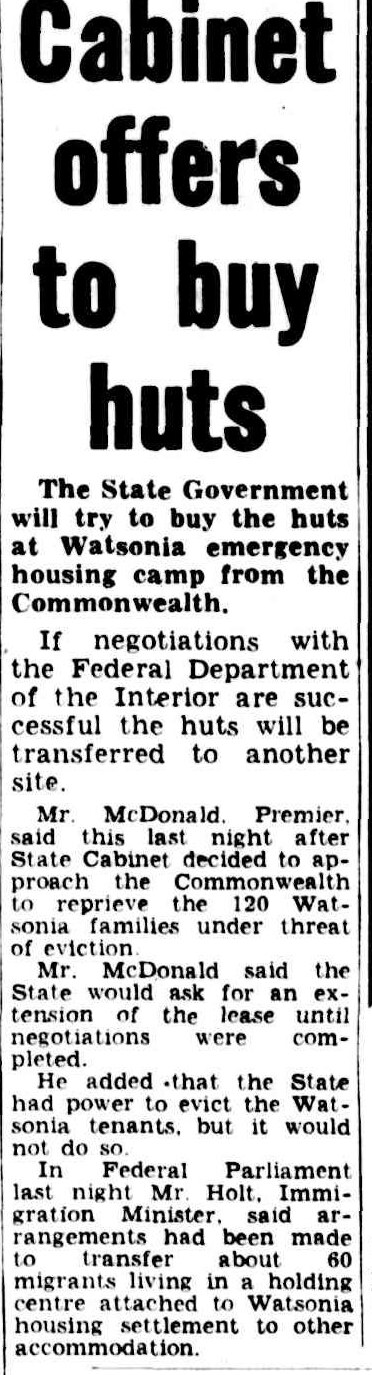
- Cabinet offers to buy huts
The Argus (Melbourne), page 5 · 27 February 1952
Report that the Victorian government would try to buy the huts at Watsonia emergency housing camp from the Commonwealth and move them to another site; that Cabinet had decided to ask for a reprieve for the 120 Watsonia families under threat of eviction; and that the Immigration Minister, Mr Holt, told Federal Parliament arrangements had been made to transfer about sixty migrants living in a holding centre attached to the Watsonia housing settlement to other accommodation. Digitised by the National Library of Australia with funding from State Library Victoria; Australian material published before 1955 is out of copyright.
- Middle Head, Mosman: former Ten Terminal Regiment barracks buildings and laundry, heritage impact assessment, supplementary report
Lucas, Stapleton, Johnson and Partners for the Sydney Harbour Federation Trust · 6 July 2023
Printed page 24, section 4.1.3, item 9, a comparative entry on Watsonia Military Base, consulted. Citing National Archives of Australia files MP927/1, items A259/18/11 and A259/18/49, it records the expansion of accommodation for the Regular Army 2 Brigade at Watsonia in 1951 and 1952.
Last researched 13 September 2026