Wentorf Resettlement Centre
Displacement in Europe
Wentorf bei Hamburg · Germany · 1945–1952
Two Wehrmacht barracks complexes east of Hamburg became the reception camp for displaced persons in southern Schleswig-Holstein, and then, as the IRO resettlement centre, the regional staging post for emigration overseas. The camp was overwhelmingly Polish at first; the Ukrainian group recorded there grew from 104 in December 1947 to 825 in August 1951, at the very end of the camp’s life.
Introduction
Wentorf, east of Hamburg, was both a large postwar displaced-persons camp and an important place of preparation for emigration. Ukrainians passed through its resettlement centre alongside Polish, Baltic and other families. Its former barracks contained schools, medical facilities and a radio station, while officials examined applications for journeys that could take residents to a new country.
A history in dates
- 22 October 1936Construction begins on the Bismarck and Bose-Bergmann barracks at Wentorf.
- May 1945British troops occupy the barracks and the military government orders a reception camp for displaced persons in southern Schleswig-Holstein.
- Early June 1945The first displaced people move in, mainly former forced labourers and prisoners of war.
- January 1946Ten thousand people are in the camp, about 7,500 of them Poles.
- 1946A detailed camp plan records schools, hospitals, kitchens and other shared facilities.
- December 1947A return records 104 Ukrainians at the resettlement centre.
- 1948–1951IRO emigration processing becomes the central function of the camp.
- August 1951The recorded Ukrainian population is 825, the largest in Schleswig-Holstein.
- January 1952The displaced-persons camp is dissolved; the barracks are empty from May.
- August 1952A transit camp for German refugees opens in the same barracks, a separate institution.
Barracks built for the Wehrmacht
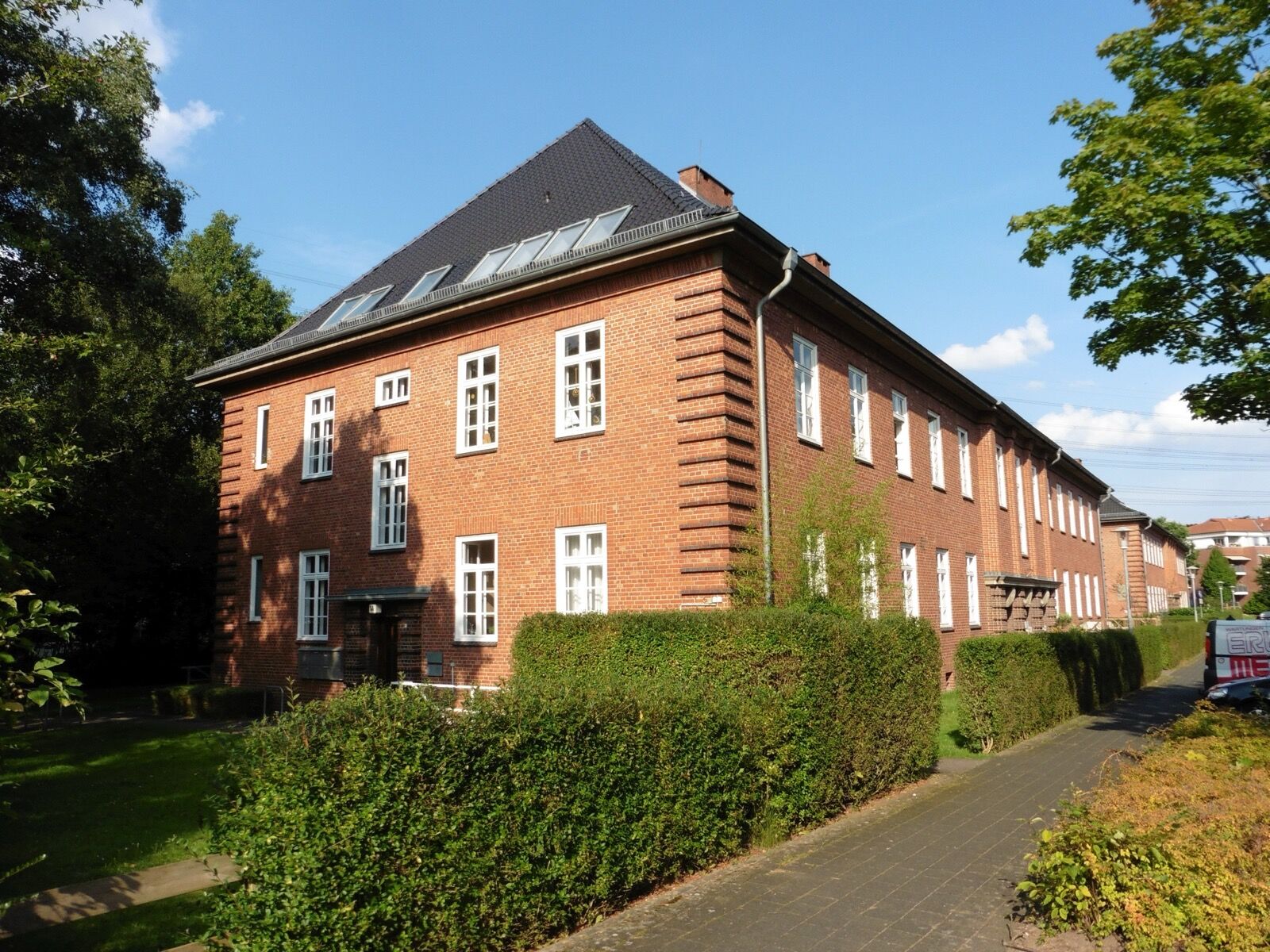
The buildings were new when the war began. Wentorf was chosen for barracks construction because it lay on the edge of Hamburg, close to a railway connection and to trunk roads towards Lübeck. Work started on 22 October 1936 on two complexes: the Bismarck-Kaserne, handed over in October 1937 and occupied by an artillery battalion from 1 November, and the larger Bose-Bergmann double barracks, formally occupied by an infantry regiment on 12 April 1938. Together they covered about 51 hectares.
During the Second World War the barracks were used in part as prisoner and forced-labour camps. British troops occupied them at the end of the war, on 3 May 1945.
Sources for this section
A camp spread across former barracks
Still in May 1945 the British military government ordered a reception camp at Wentorf for displaced foreigners from the whole of southern Schleswig-Holstein. The first arrivals came at the beginning of June, mainly former forced labourers and prisoners of war. Twenty thousand people registered there by the beginning of 1946. Seventeen thousand were present in November 1945 and ten thousand in January 1946, of whom about 7,500 were Poles. A contemporary Polish account dated February 1946 likewise records about 10,000 residents, some 7,500 of them Poles, and describes this as one of the largest Polish communities in Germany. British administration gave way to UNRRA and then to the IRO.
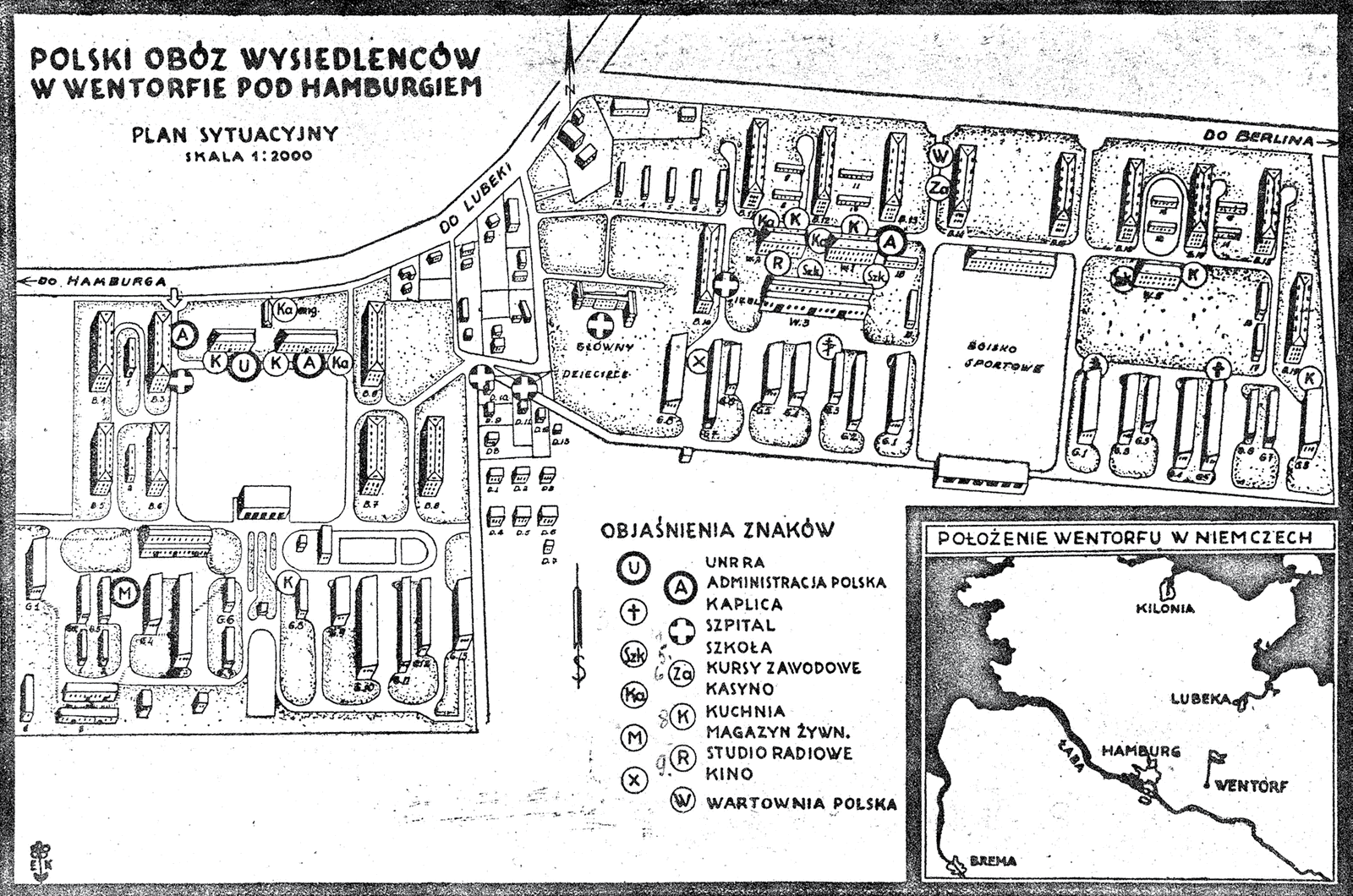
The original plan drawn in 1946 shows a substantial compound divided by roads and organised around long accommodation buildings. Its legend marks UNRRA and Polish administration separately, alongside kitchens, food stores, chapels, hospitals, schoolrooms, vocational courses, a radio studio and a cinema. A sports field occupies a large open area. A Polish artist’s portfolio of prints made in February 1946 records the same institutions from inside: the chapel and its new altar, the school, the kitchen, the hospital, the radio station, a handicraft workshop and an exhibition of vocational work.
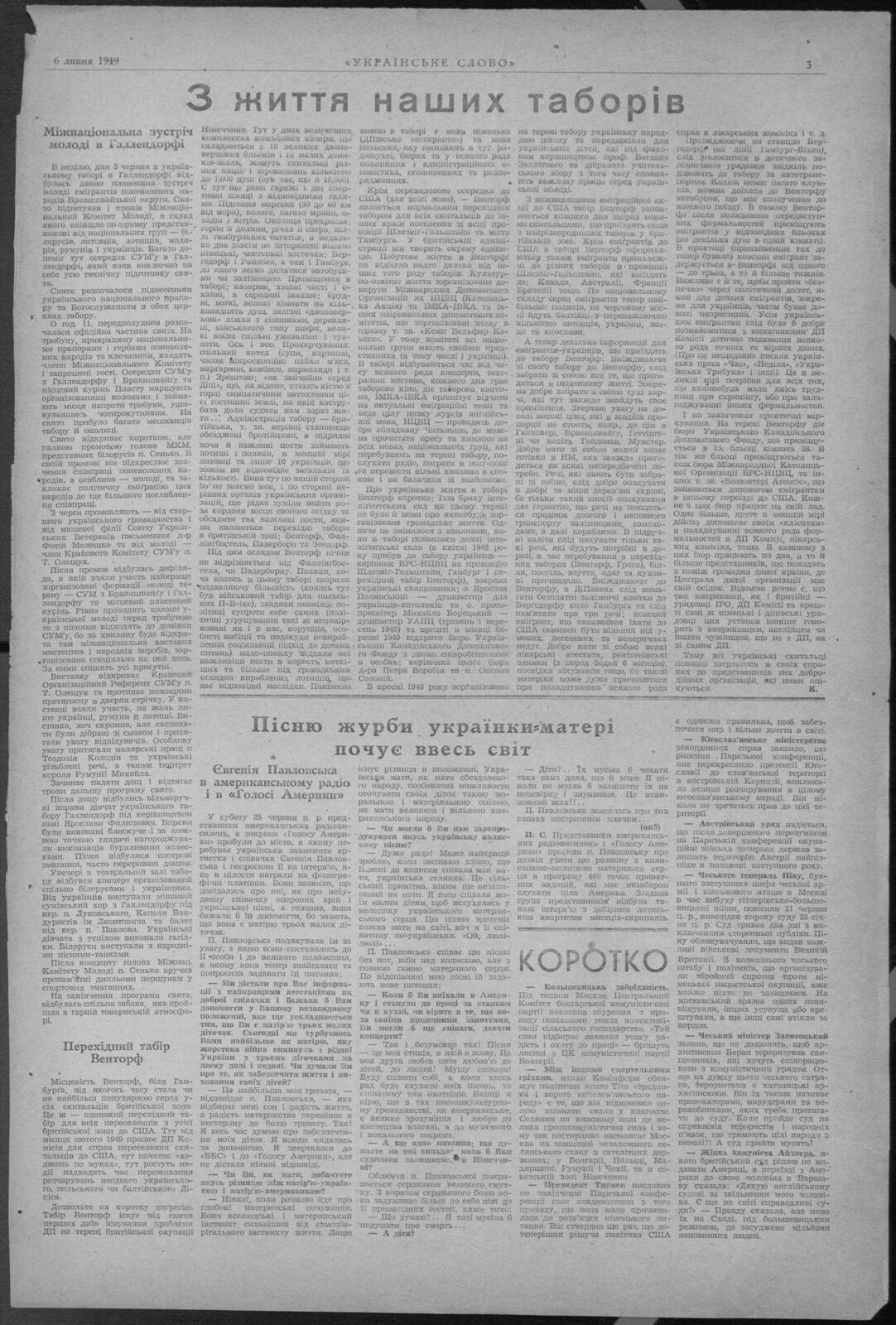
A description published in Ukrainske Slovo on 6 July 1949 sets out what the place had become. Wentorf, the writer began, had for some time been about the best known spot among all the displaced people of the British zone, because it was the single transit camp for every emigrant leaving that zone for the United States; the DP Commission for the resettlement of displaced persons to the United States had been working there since February 1949. The two enormous complexes of military barracks consisted of nineteen large two-storey blocks and eighteen small villa-like houses, with garages besides and two sports grounds with their own stands, and they then held displaced people of various nations and denominations to the number of about 7,000 — there had been a time when the figure was 15,000. The climate was maritime, fifty to sixty kilometres from the sea, damp, with much mist, rainfall and wind. The surroundings were splendid: hills and valleys, a river and lakes, the villas of wealthy Hamburg families, and not far off two clean little German towns quite untouched by the war, Bergedorf and Reinbek, with Hamburg itself easily reached by bus or railway.
Services shown on the 1946 plan
| Plan label | Service |
|---|---|
| UNRRA | Relief administration |
| Szpital | Hospital |
| Szkoła | School |
| Kursy zawodowe | Vocational courses |
| Studio radiowe | Radio studio |
| Kino | Cinema |
| Kuchnia | Kitchen |
The camp as a whole, all nationalities
| Date | People | Scope |
|---|---|---|
| November 1945 | 17,000 | Present in the camp |
| January 1946 | 10,000 | Present, about 7,500 of them Poles |
| By early 1946 | 20,000 | Cumulative registrations |
| To 1960 | 153,572 | German refugees through the later transit camp, a separate institution |
School, work and life in shared rooms
The camp developed institutions that made prolonged waiting more bearable. Local history describes Lutheran, Catholic and Orthodox churches, schools and a hospital. A radio-electrical school had forty-one students in the account it preserves, showing how learning a trade could become part of preparing for departure. Sports grounds and training workshops belonged to the same provision.
Former Polish soldiers who had fought under British command were also quartered in the barracks and were looked after by the Polish Combatants’ Association at Wentorf. The camp was never only a civilian refuge.
A firsthand Latvian recollection of Christmas 1950 describes five adults living together in a small room. To fit a Christmas tree inside, they piled the beds into one corner. The account conveys the crowded domestic reality behind the impressive range of buildings shown on a camp plan.
The same account described the quarters from the inside. The barracks were clean and tidy from without and otherwise within: dirty, damp, with large rooms for a dozen or more people, iron two-tier beds with straw mattresses, wooden wardrobes of military pattern, big windows and shared washrooms and lavatories — “and that is all”. Food came from a common cauldron: soups, potatoes, at times microscopic rations of meat, margarine, sausage and marmalade. The administration was British, the leading posts being held by Britons, while the subordinate but still important posts were filled by Latvians and Poles, to a lesser degree by Lithuanians, and by only ten Ukrainians, a share the writer thought wholly out of keeping with their numbers; he blamed both the Ukrainians’ want of languages and the leaders of their own organisations, who had rarely managed to reach beyond the place where they sat. He named the transit camps of the British zone as Wentorf, Fallingbostel, Paderborn and Seedorf, and recalled that Wentorf had once held an overwhelming Polish majority because the site had earlier been a military camp for Polish prisoners of war.
Preparing to leave Europe
Repatriation was the camp’s purpose until 1948. From 1948 to 1951 the preparation of emigration took its place, and Wentorf became the regional processing centre for the journey overseas. Moving here could be a step towards leaving Europe rather than a first arrival after wartime displacement. Applicants still had to meet the admission requirements of their destination countries, and many residents went to the United States, Canada or Australia.
A consular officer’s oral history describes interviews and screening at the former military barracks outside Hamburg. Health, background and sponsorship formed part of the process. The officer remembers issuing visas to complete families who subsequently joined Ukrainian, Polish, Estonian and Yugoslav communities in the United States.
Ukrainians at the resettlement centre
Published returns record 104 Ukrainians at Wentorf Resettlement Centre in December 1947 and 825 in August 1951. The compiler’s other columns for the centre are blank, which means no return was filed rather than that nobody was there. These figures concern the Ukrainian group within the centre, not the full multinational population and not the total number processed over several years.
The shape of the series says something about the institution. Ukrainians were a small minority in a heavily Polish camp in 1947, but by August 1951 Wentorf held more Ukrainians than any other camp in Schleswig-Holstein and more than Falkenberg in Hamburg, because a resettlement centre gathered people at the end as the residential camps emptied.
Regional figures give the scale around them. Schleswig-Holstein held 130,255 displaced persons of all nationalities on 18 July 1945, of whom 75,972 were Poles, and 54,247 remained in May 1947. None of these are Wentorf figures.
Ukrainians recorded at Wentorf Resettlement Centre
| Date | Ukrainians |
|---|---|
| 1946–1947 | no return |
| May 1947 | no return |
| December 1947 | 104 |
| July 1949 | no return |
| December 1950 | no return |
| August 1951 | 825 |
Sources for this section
A new refugee programme
The camp for displaced persons was dissolved in January 1952 and the barracks stood empty from May. In August 1952 a transit camp for German refugees opened in the Bose- and Bergmann-Kaserne on behalf of North Rhine-Westphalia, taking in people arriving from the German Democratic Republic; the Bismarck-Kaserne was brought into use as well from 1 January 1953. With 8,600 to 9,000 beds and 153,572 people passing through by 1960, it became the largest refugee camp in the Federal Republic.
That later camp is a different institution on the same ground, and its figures must not be read back into the displaced-persons years. Consular testimony separately remembers the American DP visa programme continuing until the end of 1952; that broader programme deadline is not the camp closure date either.
The surviving plan remains a particularly useful record of the earlier community: it locates daily services within the former military landscape and makes visible the infrastructure behind the work of rehabilitation and resettlement.
Sources
- Wentorf camp plan and school
Stiftung Hamburger Gedenkstätten und Lernorte / Offenes Archiv · Historical exhibition panel
Original 1946 plan shows UNRRA, Polish administration, kitchens, hospitals, school, vocational courses, radio studio and cinema. Plan visually inspected.
- Displaced Persons Camp, May 1945-January 1952
Wentorf im Blick · June 2020
Printed page 25 gives the local camp chronology and institutions. Large population estimate not used as a dated census. Personal names omitted.
- Germany: diplomatic oral histories
Association for Diplomatic Studies and Training · Oral history compilation
PDF page 522: firsthand consular description of Wentorf screening, sponsorship and Ukrainian, Polish, Estonian and Yugoslav families. End-of-programme date is not treated as the residential camp closure date.
- Ukrainians in Wentorf Resettlement Centre
Canadian Institute of Ukrainian Studies Press · 1992
Stebelsky table 6, printed pages 44-46: 104 Ukrainians in December 1947 and 825 in August 1951. Columns visually inspected.
- A room in Wentorf at Christmas
Latvians Abroad Museum and Research Centre, DP Albums · Recollection of Christmas 1950
Firsthand account describes five adults sharing a small room and moving beds to make space for a Christmas tree. No resident names reproduced.
- Displaced persons in Schleswig-Holstein
Gesellschaft für Schleswig-Holsteinische Geschichte / Karsten Dölger · Accessed September 2026
Regional historical account by Karsten Doelger. Identifies the Regional Processing Centre at Wentorf as for many the most important stage on the way overseas. Land figures read 13 September 2026: 130,255 DPs in Schleswig-Holstein on 18 July 1945, of whom 75,972 Poles, 11,986 Italians, 4,809 Yugoslavs, 4,629 Russians and 32,859 ‘others’; 54,247 in May 1947; 9,000 homeless foreigners still in camps on 1 July 1950; last camps cleared in spring 1962. No Ukrainian line in the 1945 breakdown.
- Bismarck-Kaserne (Wentorf)
Wikipedia DE · Accessed 13 September 2026
Wikitext read in full. Construction from 22 October 1936, handover October 1937, first recruits 1 November 1937, 17.97 hectares; barracks partly used as prisoner and forced-labour camps during the war; May 1945 British order for a reception camp; 20,000 registered by early 1946, 17,000 in November 1945, 10,000 in January 1946 including 7,500 Poles; British then UNRRA then IRO; repatriation to 1948, emigration preparation 1948–1951; schools, training workshops, medical centres, radio station, cinema, sports grounds and churches; Polish ex-soldiers and the Verband Polnischer Kaempfer Wentorf; camp dissolved January 1952; later German refugee transit camp with 153,572 people to 1960.
- Bose-Bergmann-Kaserne
Wikipedia DE · Accessed 13 September 2026
Wikitext read in full. The second Wentorf barracks, built from 1936 as a double barracks, formally occupied by Infantry Regiment 90 on 12 April 1938, 32.8 hectares, the two halves divided only by the road now called Zwischen den Toren. Carries the same postwar account as the Bismarck-Kaserne article.
- Zeichnungen von Edward Kwiatkowski aus dem DP-Lager Wentorf bei Hamburg, 1946
Jacek Barski, Porta Polonica, LWL-Industriemuseum · Accessed 13 September 2026
Read 13 September 2026. Camp formed at the beginning of June 1945; about 10,000 residents in February 1946, some 7,500 of them Poles, described as one of the largest Polish communities in Germany. The ten prints, dated 23 February 1946, show the chapel and its altar, school, kitchen, hospital, radio station, handicraft workshop, vocational exhibition, Polish guard unit and cinema. Drawings rather than photographs, and under Porta Polonica copyright, so not reproduced here.
- Wentorf, the former Bismarck-Kaserne
Reinhard Kraasch, via Wikimedia Commons · 28 August 2017
Photograph licensed CC BY-SA 4.0. Shows surviving buildings of the Bismarck-Kaserne, one of the two Wentorf barracks complexes used for the displaced-persons camp.
- “Перехідний табір Венторф”, Ukrainske Slovo (Українське Слово), 6 July 1949, page 3
Ukrainian Museum-Archives of Cleveland, DP Camp Periodicals Collection, via the Internet Archive · 6 July 1949
Marked in the collection as public domain or an orphan work and offered under CC BY-NC-ND 4.0. Ukrainske Slovo was published at Blomberg in Lippe by the Ukrainian Central Relief Committee for the British zone. The article, signed K., describes the Wentorf transit camp: its buildings, its climate and surroundings, its food, its administration and the national composition of its staff.
Last researched 13 September 2026