Warner-Kaserne
Displacement in Europe
Munich-Freimann, Germany · 1945–1951
A former SS barracks at Munich-Freimann became one of the largest displaced-persons centres in the American zone, with a Ukrainian community of more than two thousand people inside a multinational camp. It ran from December 1945 until the American army took the site back as Warner-Kaserne.
Introduction
Warner-Kaserne is the Munich barracks camp listed as Werner-Kaserne in the Encyclopedia of Ukraine. During the displaced-persons years it was also known as the SS-Kaserne or Munich-Freimann DP Center. Ukrainians formed a substantial community within a multinational settlement rather than a wholly Ukrainian camp.
A Ukrainian relief committee nevertheless counted Munich-Freimann, S. S. Kaserne among the fifteen main Ukrainian camps in the American zone in its report of 30 June 1948.
A history in dates
- 1934–1936The barracks complex is built for the SS to designs by Oswald Bieber.
- 30 April 1945SS units leave the barracks.
- 15 December 1945UNRRA formally takes over the DP centre from the US Army.
- 1947The reported total population exceeds 8,500.
- 31 October 1947The camp inventory records a capacity of 7,000 under assembly-centre number AC 95-351.
- January 1948The PCIRO summary records 3,250 Ukrainians, the highest of the four returns for the site.
- 30 June 1948A Ukrainian relief committee lists Munich-Freimann, S. S. Kaserne among its main camps in the American zone.
- 30 September 1948The inventory continues the same assembly-centre number under the name Warner-Kaserne.
- 1949A resident photograph records the barracks during the DP years.
- 1950The US Army takes over the complex as Warner-Kaserne.
- Between 31 March and 30 September 1951The inventory closes the assembly-centre record.
- 1968The complex returns to German control.
- 24 March 1980The site is inaugurated as the Ernst-von-Bergmann-Kaserne.
Sources for this section
- Die Kaserne München-Freimann von 1934–1970; Die wechselvolle Geschichte der heutigen Ernst-von-Bergmann-Kaserne
- DP camp inventory: München-Freimann SS-Kaserne and Warner-Kaserne
- Ihor Stebelsky, Table 8: Ukrainians in the UNRRA or IRO camps of the United States zone of Germany
- Report of the United Ukrainian American Relief Committee
- My Journey, Part II
From military barracks to refuge
Built for the SS in 1934–1936, the barracks were adapted for refugees after the war. UNRRA formally took over on 15 December 1945. A recent history reports more than 8,500 residents in 1947, across all nationalities.
The complex was designed by Oswald Bieber and held units of the SS-Standarte Deutschland until 30 April 1945. The album kept by the camp’s UNRRA field supervisor describes what the relief teams inherited: Block C and three blocks of the same size, an administrative block, wash houses and garages, more than seven hundred rooms in all, and a seven-storey entrance tower left empty because its blown-out windows could not be reglazed. Blocks A and B had been more heavily bombed and needed a great deal of repair.
The administrative labels can be confusing because Munich had several barracks camps. The nearby Funkkaserne was another transit and emigration facility. An archival research guide lists Funkkaserne and Warner-Kaserne separately; their records and populations should therefore not be combined.
Names used for the barracks
| Name | Context |
|---|---|
| Munich-Freimann / SS-Kaserne | Former military complex and DP-centre designation |
| Werner-Kaserne | Spelling in the Encyclopedia of Ukraine |
| Warner-Kaserne | American military name, also used retrospectively for DP history |
| Ernst-von-Bergmann-Kaserne | Later German military name |
Administration, capacity and the assembly-centre number
The Arolsen Archives camp inventory records the facility as Munich-Freimann, SS-Kaserne, opening on 15 December 1945 and closing between 30 January and 30 September 1948, with a capacity of 7,000 at the reporting date of 31 October 1947. It carried assembly-centre number AC 95-351 and was served by UNRRA Team 107 Munich within area team AT 1066 Munich, a number that also appears on handicraft made in the camp. A second entry carries the same assembly-centre number forward from 30 September 1948 under the name Warner-Kaserne, with a capacity of 5,200 and a closing interval between 31 March and 30 September 1951, so the two entries describe one continuous administration rather than two camps.
The inventory’s list of nationalities names Yugoslav, stateless, Lithuanian, Polish, Estonian and Jewish residents and does not name Ukrainians, although Ukrainian returns for the same site are among the largest in Munich. The omission is in the source and is left standing rather than corrected.
Administrative record in the camp inventory
| Field | SS-Kaserne entry | Warner-Kaserne entry |
|---|---|---|
| Opening | 15 December 1945 | 30 September 1948 |
| Closing | Between 30 January and 30 September 1948 | Between 31 March and 30 September 1951 |
| Capacity at 31 October 1947 | 7,000 | 5,200 |
| Assembly centre | AC 95-351 | AC 95-351, later OB 707 |
| UNRRA team | T 107 Munich; area team AT 1066 Munich | Area 7 Munich |
| Nationalities listed | Yugoslav, stateless, Lithuanian, Polish, Estonian, Jewish | None recorded |
How many Ukrainians
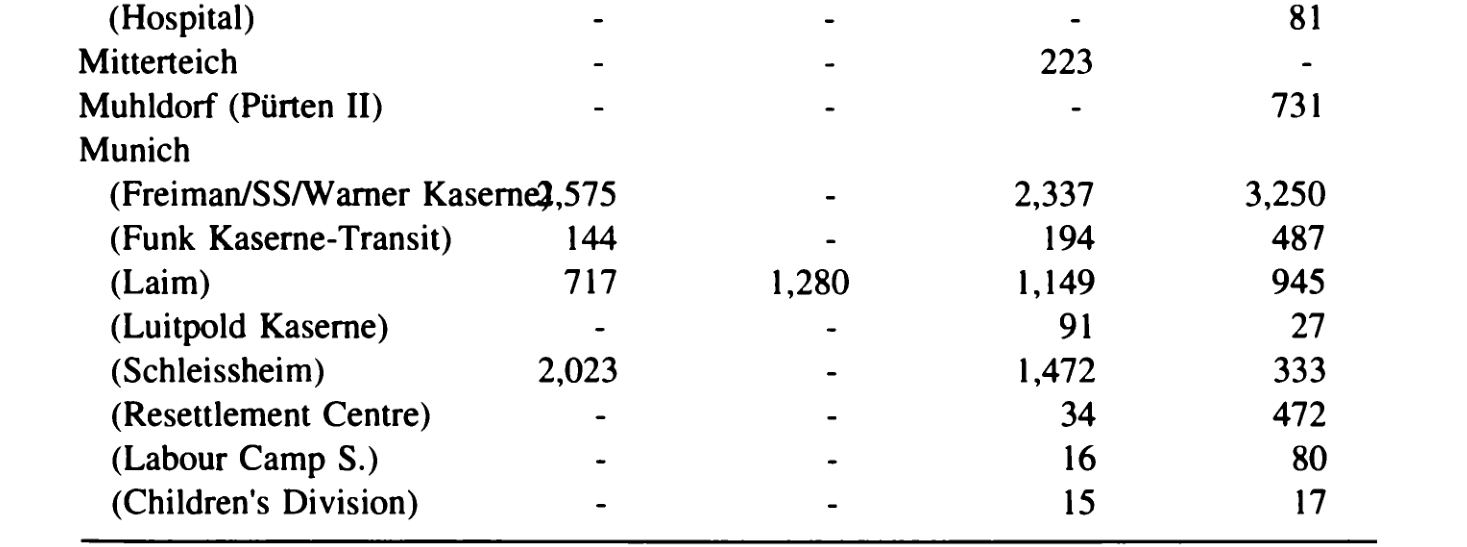
Ihor Stebelsky’s table of Ukrainians in the camps of the American zone gives four returns for Munich, Freimann S.S.-Kaserne, running from 2,575 in questionnaires collected during 1946 and 1947 to 3,250 in the PCIRO summary of January 1948. These count Ukrainians only, inside a camp reported at more than 8,500 of all nationalities in 1947. The Munich resettlement centre, the Funkkaserne, Laim, the Luitpold barracks and Schleissheim are separate lines in the same table.
Ukrainians recorded at Munich, Freimann S.S.-Kaserne
| Return | Ukrainians |
|---|---|
| Questionnaires collected during 1946 and 1947 | 2,575 |
| UNRRA summary, 24 August 1946 | No figure |
| UNRRA summary, 31 May 1947 | 2,337 |
| PCIRO summary, 2 January 1948 | 3,250 |
A multinational community
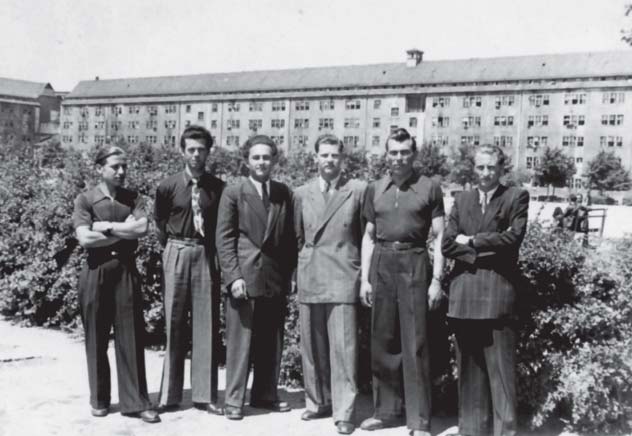
A published first-person memoir describes a resident administration drawn from different national communities, with camp police, churches, schools and a clinic. A photograph dated 1949 shows residents standing before one of the long barracks blocks. The recollection presents the camp as a functioning community within the damaged postwar city.
The memoir also records a small friction of shared living: late-night Ukrainian singing could keep children awake. Such details give a more domestic picture than the institutional title “DP Center”. Families lived alongside other refugees with their own languages, religious practices and expectations, while the camp’s services met needs that could not wait for emigration.
The field supervisor’s album puts pictures to those services: the Greek Orthodox church inside the barracks and a wedding procession, the camp police and the funeral of their chief, children queuing for the midday meal, the children’s bakery, vegetables grown outside and flowers indoors, two tailor shops and a machine shop, and Ukrainian women embroidering shirts, blouses and table coverings for sale. Three provisional prayer rooms served Greek Orthodox, Jewish and Catholic worshippers.
A second sequence records public life: a football team, assemblies and lectures in the big hall, a Girl Guide group, ballet danced by camp performers, an Americanisation discussion course, and visits by American officers and by General Eisenhower.
Services documented in the DP years
| Activity | Evidence |
|---|---|
| Resident administration and police | First-person memoir; field supervisor’s album |
| Schools, churches and clinic | First-person memoir |
| Greek Orthodox church inside the barracks | Field supervisor’s album |
| Three provisional prayer rooms, Greek Orthodox, Jewish and Catholic | 2025 barracks history |
| Vocational training, gardening, bakery | 2025 barracks history; field supervisor’s album |
| Tailor shops and machine shop | Field supervisor’s album |
| Ukrainian embroidery and handicraft for sale | Field supervisor’s album |
| Football team, ballet, lectures, Girl Guides | Field supervisor’s album |
| Ukrainian art exhibition | Hoover photographic collection guide |
Learning while awaiting departure
Schools, vocational training, a bakery, a garden and temporary prayer rooms served the crowded community.
A 2024 Ukrainian Weekly account describes the Ukrainian high school and the importance of learning another language before emigration. It recounts a departure for Canada in late 1948 to continue education at a Ukrainian Baptist institute. This is one documented route out of the camp, not a destination shared by every resident.
The camp sat inside a much larger Ukrainian Munich, where roughly 15,000 to 20,000 Ukrainians lived between 1945 and 1949 with three gymnasiums, a teachers’ seminary, four higher institutions and 74 newspaper and journal titles. Those were city institutions; none is documented as belonging to this camp.
Pressure to return, and leaving instead
Soviet repatriation officers visited the camp, and the album records one such visit: the visitors’ car surrounded, overturned and burned, their papers burnt in the road, and the dignitaries leaving with an American major and the heads of the national groups. A Hoover Institution curator, where the original prints are now held, described the sequence as a protest against a visit by a Soviet repatriation officer to the Freimann camp in 1948.
The album ends in departure rather than return: farewells, lorries drawn up before the tower, and people boarding trains for new countries in the same German railway freight wagons that had carried many of them into Germany as forced labour.
Sources for this section
Art and the public image of displacement
A Hoover Institution photograph guide identifies a Ukrainian group and Ukrainian art exhibition among its Warner-Kaserne material. Its separate folders cover camp views, children and visitors during 1946–1950. They show how the camp was documented through both daily life and public events.
The barracks were a location for The Search in 1947–1948. Its story of a displaced child separated from his mother brought the refugee experience to cinema audiences.
Other camps at Freimann
Freimann held more than one displaced-persons institution and the names overlap. The inventory also lists a Jewish settlement camp at Munich-Freimann and Neufreimann, assembly-centre number AC 95-396, UNRRA Team 560, capacity 1,620 and 2,012 residents at 31 October 1947, open from 24 January 1946 to 15 June 1949; it notes that the differing Freimann and Neufreimann entries describe that one Jewish institution under changing administrative names. It is not this camp.
A Munich museum exhibition describes the former SS barracks in Freimann as housing Polish displaced people after the war and, from spring 1948, serving as a transit and resettlement centre with a high proportion of Jewish residents awaiting emigration.
Military use returns
The DP camp closed in 1950 and the US Army took over as Warner-Kaserne. The site later passed to German military use and is now the Ernst-von-Bergmann-Kaserne.
The barracks history records that the main building became the second largest structure in American army use anywhere after the Pentagon, that the complex returned to German control in 1968, and that it took its present name on 24 March 1980.
The surviving complex and the dispersed archives tell different parts of the story: the memoir photograph records residents in 1949, institutional collections preserve other views, and later military records document the building’s changed purpose.
Sources
- Displaced persons camps
Internet Encyclopedia of Ukraine · 1984; online edition
Overview identifies this camp among the larger Ukrainian communities.
- Die Kaserne München-Freimann von 1934–1970; Die wechselvolle Geschichte der heutigen Ernst-von-Bergmann-Kaserne
Mirko Lange, CPM Military Medicine (Wehrmedizin und Wehrpharmazie) · 16 June 2025; companion article read 13 September 2026
Live location of the article previously cited from wehrmed.de; both parts read. General population includes all nationalities; erroneous film-award details and the claim that most residents repatriated are not repeated.
- My Journey, Part II
Litopys UPA, Events and People series · 2010
Original memoir printed p.5 and embedded 1949 camp photograph inspected. No resident names reproduced.
- Political Refugees and Displaced Persons, 1945–1954: research report
Canadian Institute of Ukrainian Studies · Research report No. 2
Printed p. 35, IROA 43/820/34/2/34 lists Funk and Warner separately.
- A Ukrainian educational route through Warner-Kaserne
The Ukrainian Weekly · 31 March 2024
Published retrospective education and emigration account; individual names omitted.
- A Research Guide to Photographs in the Hoover Institution Archives
Hoover Institution Library and Archives · 2025 guide
Printed p. 93: Warner views, children, visitors, Ukrainian art exhibition; underlying images not inspected.
- Von der Kaserne zum Stadtquartier
City of Munich · 2013
Official military-property history identifies former SS/Warner/Ernst-von-Bergmann site.
- DP camp inventory: München-Freimann SS-Kaserne and Warner-Kaserne
Arolsen Archives · 26 October 2023
Rows 1285 and 1288 read from the spreadsheet on 13 September 2026: opening, closing intervals, capacity 7,000 and 5,200 at the 31 October 1947 reporting date, AC 95-351, Team 107, area team AT 1066, Area 7. Rows 1284, 1319 and 1321 record the separate Jewish settlement camp AC 95-396. Archive reference ITS Dok-ID 82015481-82017888.
- Ihor Stebelsky, Table 8: Ukrainians in the UNRRA or IRO camps of the United States zone of Germany
Ukrainskyi Istoryk · 1986
Printed pp. 53 and 55 rendered and read visually on 13 September 2026. Column scopes: questionnaire returns collected during 1946 and 1947; UNRRA summary 24 August 1946; UNRRA summary 31 May 1947; PCIRO summary 2 January 1948.
- Report of the United Ukrainian American Relief Committee
United Ukrainian American Relief Committee · 30 June 1948
Printed p. 18, main camps in the US zone, read from the project’s cached transcription of the scan.
- DP Camp Warner Kaserne, pages 1 and 2: the album of the camp’s UNRRA field supervisor
dpcamps.org, Michigan Family History Network · Album captioned December 1946 to May 1950; pages read 13 September 2026
Photographs donated by D. L. Tibble, field supervisor at Warner Kaserne, now held at the Hoover Institution. Captions read in full; no photograph reproduced and no licence stated. The page’s claim that UNESCO took over the building in 1945 is wrong and is not used. Resident names appearing in visitors’ correspondence are not reproduced.
- Munich
Internet Encyclopedia of Ukraine · Accessed 13 September 2026
City-level Ukrainian population, schools, higher institutions and press. The article names no individual camp; its institutions are not attributed to this site.
- Ingolstädter Strasse: former SS barracks, Freimann
Jüdisches Museum München, online exhibition Munich Displaced · Accessed 13 September 2026
Polish displaced people in the former SS barracks, then a transit and resettlement centre from spring 1948 with a high proportion of Jewish residents. Used to state an unresolved overlap, not to merge institutions.
- Ukrainian Population Migration after World War II, Table 7
Ihor Stebelsky, in The Refugee Experience, Canadian Institute of Ukrainian Studies Press · 1992
Scan published by diasporiana.org.ua; no reuse licence is stated by the holder. Page image rendered from the digitised volume and the camp’s row read visually.
Last researched 13 September 2026