West Sale
Arrival and settlement
Fulham · Victoria · Australia · 1949–1953
A gunnery school built at Fulham in December 1941 became a holding centre for displaced families between 1949 and 1953, its former nurses’ station the director’s house. Only concrete foundations in paddocks now mark the site, listed as archaeological place H8221-0020.
Introduction
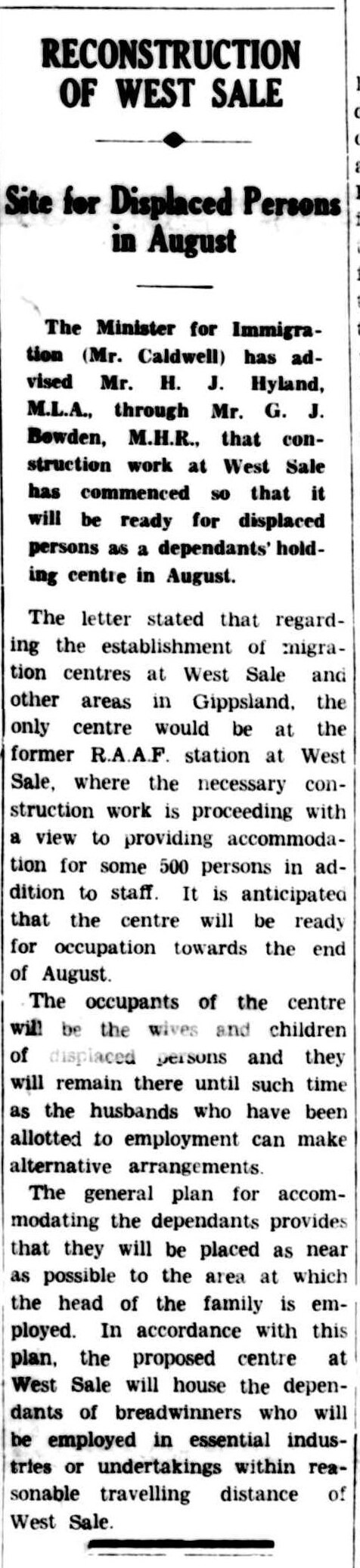
West Sale Migrant Holding Centre occupied the disused RAAF base at Fulham from 1949 to 1953. It housed women and children while husbands worked elsewhere in Gippsland. The Ukrainian community’s 1966 history includes Sale among the Victorian family camps, linking this rural centre to the wider dispersal of Ukrainian arrivals.
Sources for this section
A history in dates
- December 1941No. 3 Bombing and Gunnery School is formed at West Sale.
- March 1942Training begins; the school becomes the Air Gunnery School in 1943.
- December 1945The school ceases and West Sale closes as a military base.
- Early 1949The former camp is designated the West Sale Immigrant Holding Centre and the disposal of RAAF buildings is stopped.
- Late 1949The first group of migrant families arrives.
- 1951Daytime adult English classes are recorded at West Sale.
- 1953The last families move into Sale or transfer to Somers camp, and the holding centre is disbanded.
- 2002–2003A local book and radio oral-history project document camp lives and receive a Victorian history award.
- April 2026Council planning identifies archaeological recording and community history as important to the former site.
The gunnery school at Fulham
The land had been part of the 16,000-acre Fulham squatting run taken up in the 1840s. In December 1941 the No. 3 Bombing and Gunnery School was formed at West Sale and buildings went up quickly; training began in March 1942 and the school was renamed the Air Gunnery School in 1943. The Victorian Heritage Inventory record notes that 10 Williams Drive held the living quarters, the men’s and women’s bathroom blocks, mess halls and sports grounds, and that the house at the north of the property served as the nurses’ station.
The school ceased to function in December 1945 and West Sale closed as a military base, converting to a civil airfield. Sale Council pressed for approval as a commercial airfield, but in early 1949 the former RAAF camp was instead designated as the West Sale Immigrant Holding Centre and an instruction issued to stop disposing of further RAAF buildings. Some had already gone, so buildings were remodelled or rebuilt, and the first group of migrants arrived late in 1949.
Phases of the Fulham site
| Period | Use | Recorded detail |
|---|---|---|
| 1840s | Pastoral | Part of the 16,000-acre Fulham squatting run |
| December 1941 – 1943 | No. 3 Bombing and Gunnery School | Training began March 1942; renamed the Air Gunnery School in 1943 |
| 1943 – December 1945 | Air Gunnery School | Ceased December 1945; West Sale closed as a military base |
| 1945–1948 | Civil airfield | Sale Council sought approval as a commercial airfield |
| Early 1949 | Designation | Former RAAF camp designated the West Sale Immigrant Holding Centre; disposal of RAAF buildings stopped |
| Late 1949 – 1953 | Migrant Holding Centre | First families arrive late 1949; disbanded in 1953, remaining families to Sale or Somers camp |
| After 1953 | Airfield, then National Safety Council complex in the 1980s | The listed site at 10 Williams Drive is now paddocks with concrete foundations |
Families separated by work
The former air-force accommodation was refitted in 1949 for European displaced people. Men worked away during the week and returned for weekends. A school, shop, post-office branch and medical centre provided the basic services of the camp community.
Employment connected the centre to timber production around Heyfield, the Maffra milk factory, the Gippsland Base Hospital, railways and major water and electricity authorities. These were civilian jobs within Australia’s labour-shortage response, rather than work inside a European displaced-person camp.
For Ukrainian families, cheap camp accommodation did not remove the cost of separation. The 1966 account describes workers sometimes living 100–150 miles from their families, with distance, fares and transport preventing regular visits. It presents this as a wider Victorian experience, not a measured average for West Sale alone.
Work connected to the holding centre
| Sector | Gippsland workplaces |
|---|---|
| Timber | Heyfield industry |
| Food production | Maffra milk factory |
| Health | Gippsland Base Hospital |
| Transport | Victorian Railways |
| Water | State Rivers and Water Supply Commission |
| Electricity | State Electricity Commission, Latrobe Valley |
School and childhood
The camp school belonged to the Victorian education system as West Sale State School No. 4648, also called Migrant School West Sale. Its inspector’s report books survive in the state archive, covering school buildings, grounds, teaching and student activities.
One former child resident remembered entering Grade 3, a mother working as the school cleaner and a bus outing to a Cinderella performance in Sale. Bicycle rides near the airfield and outdoor play became lasting memories. The account later follows the family to Newborough, where rented accommodation became their own home.
Adults also had access to language education. AMES’s institutional history lists West Sale among six Victorian holding centres offering daytime English classes when the Commonwealth–state education agreement was signed in 1951. Learning English and schooling were therefore part of the centre’s everyday settlement work.
A self-contained village
The memorial project’s history describes the centre as a self-contained village with a dining room, a hall that also served for church services, a school, a medical centre, a canteen and a post office, but no public telephone. Fulham siding on the railway and the Princes Highway were part of the reason the site was chosen.
The heritage record adds what people did there: classes, a pre-school, dances, plays and sports facilities. It also records that the former nurses’ station, the house called Raeshaw, became the home of the centre’s director and headmaster, which is the only camp office identified in the sources read.
Facilities recorded at the holding centre
| Facility | Source |
|---|---|
| Dining room | Memorial project history |
| Hall, also used for church services | Memorial project history |
| School | Memorial project history and the state school records |
| Medical centre | Memorial project history |
| Canteen | Memorial project history |
| Post office, with no public telephone | Memorial project history |
| Classes, a pre-school, dances, plays and sports facilities | Victorian Heritage Inventory record |
| Director and headmaster’s house at Raeshaw, the former nurses’ station | Victorian Heritage Inventory record |
Moving into Gippsland communities
Many residents stayed in the region after leaving the holding centre. Jobs in public works and industry helped connect camp families to towns across Gippsland and the Latrobe Valley.
The Ukrainian retrospective describes the urgency of leaving family camps for rented rooms, small bungalows or partly built homes. By 1955 few of the Ukrainian families it discusses remained in camps. This is a community-wide observation, rather than a closing date or population count for West Sale.
The centre’s end is described as a winding down rather than a closure. By 1953 fewer families were coming under the scheme, many had worked off their two-year bonds and found accommodation in nearby towns, and the remaining families moved into Sale or were relocated to the Somers camp on the Mornington Peninsula before the holding centre was disbanded. A regional account names Ukrainians among the Dutch, Germans, Poles, Russians and Baltic people who arrived in Gippsland from the late 1940s and settled chiefly in the Latrobe Valley around Morwell.
The camp’s place in local memory
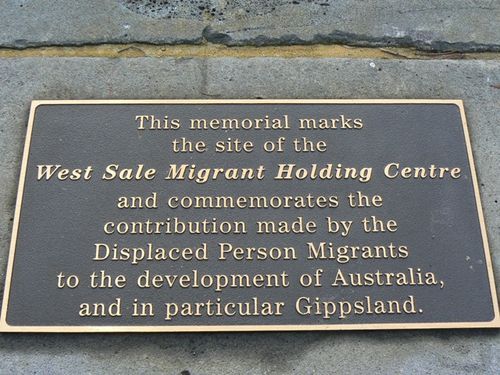
A memorial at Williams Drive, Sale Airport, commemorates the holding centre and migrants’ contribution to Gippsland. It marks the actual former base at Fulham.
The site also remains part of current heritage planning. An April 2026 council technical report identifies West Sale RAAF/Migrant Holding Centre as archaeological site H8221-0020. It recommends detailed recording and possible test excavation, with community oral histories helping identify former buildings and places.
The heritage listing describes what is left. The site is about 11 km west of Sale, immediately east of the West Sale Airport, and is now fenced paddocks with multiple concrete building foundations visible in the ground and in aerial photographs. Land west of the central driveway appears undisturbed since the 1950s apart from the removal of the structures themselves. That driveway was the main entrance for the RAAF living quarters and then for the holding centre. The statement of significance acknowledges the site’s value for its use as a displaced persons’ camp alongside its wartime significance.
Sources
- West Sale Migrant Memorial
Wellington Shire Council · Undated
Exact former RAAF site at Fulham, 1949–1953, and family holding function. The claim of 700 families is excluded because other sources describe 700 people or 600 women and children.
- Ukrainians in Australia, volume 1
Ukrainian community, Melbourne, 1966 · Undated
Original printed pages 83–84 visually read. Sale is identified as a family camp; the wider discussion of separation and private housing is kept at regional and community scope.
- Footprints in the Tar
Manna Media / Debbie Bye · Undated
Original radio-producer page and episode introductions read. Audio episodes are available but were not listened to; no claim to have reviewed the full oral histories or Ann Synan’s book.
- Preliminary Desktop Assessment: Historic Heritage
Biosis, 2022 / Victorian Government · Undated
Downloaded the 64-page original report. Its immigration section identifies West Sale holding centre and regional employment industries; relevant text read.
- VPRS20711: Inspector’s Report Books
Public Record Office Victoria · Undated
Original PROV catalogue reproduced by Research Data Australia; school 4648 identity and series contents. Individual inspection books were not read.
- A family recollection of West Sale
Immigration Place · Undated
Contributor’s childhood eyewitness account read via the search index; names omitted. Erroneous placement of Bonegilla in NSW is not repeated.
- AMES Australia: Where it all started
AMES Australia · Undated
Institutional excerpt from the former Director’s 1996 history: six holding centres with day classes in 1951.
- Ordinary Council Meeting agenda, 21 April 2026
Wellington Shire Council · Undated
Attachment 14.2.1, page 174 of 278: archaeological assessment and management plan summary read via indexed full text. The full original Alliance Archaeology report was not reviewed.
- Former West Sale RAAF Base Site, Victorian Heritage Inventory H8221-0020 (Victorian Heritage Database place 202800)
Heritage Victoria / Victorian Heritage Inventory · Undated
Full record read 13 September 2026: statement of significance, history and heritage inventory description. Supplies the December 1941 gunnery school, the 1949–1953 holding centre, the nationalities named, the Raeshaw director’s house, the listed activities, and the present condition of the site. The listing covers 10 Williams Drive only, not the whole former base or the adjoining airport.
- West Sale Site History
West Sale Migrant Memorial Project · Undated
The site is offline; read 13 September 2026 through an Internet Archive snapshot. A local memorial-project history covering the squatting run, the RAAF period and the holding centre. It gives the camp school as State School No 4649, where Public Record Office Victoria records Migrant School West Sale as No. 4648; the discrepancy is unresolved and the page keeps the archival number.
- Immigration Story
Gippsland Immigration Park · Undated
Read 13 September 2026. Confirms a holding centre for refugees and displaced people at West Sale and names Ukrainians among the northern European arrivals who settled in the Latrobe Valley around Morwell. A regional account with no West Sale figures or named residents.
- Reconstruction of West Sale: site for displaced persons in August
Gippsland Times (Sale, Victoria), page 1 · 18 July 1949
Report that the Minister for Immigration had advised that construction work at West Sale had begun so that the former RAAF station would be ready as a dependants’ holding centre in August 1949, that it was the only such centre planned in Gippsland, that it would accommodate some 500 people in addition to staff, and that its occupants would be the wives and children of displaced persons, who would remain until the husbands allotted to employment could make other arrangements. Digitised by the National Library of Australia with funding from State Library Victoria; Australian material published before 1955 is out of copyright.
Last researched 13 September 2026