Weyarn
Displacement in Europe
Weyarn, Kreis Miesbach · Germany · 1945–1949
A Ukrainian camp in a former monastery south of Munich whose artist-resident drew its organisation, its accounts, its food and its population for UNRRA, leaving one of the fullest self-portraits of any camp of its size.
Introduction
Weyarn’s Ukrainian displaced-persons camp occupied a former monastery complex south of Munich, in the Kreis of Miesbach. Its community left an unusually vivid record: an organisation chart, a cash report, and illustrated charts of food deliveries, clothing, medical care and population, alongside notices for a kindergarten display and a first-anniversary celebration. These documents show how an emergency place of refuge became a community with its own routines, worship and public culture.
They survive because one of the camp’s residents was an artist. Jacques Hnizdovsky, who had studied at the academy in Zagreb and could not return to a Soviet-occupied Ukraine, was documenting the Weyarn camp for UNRRA; he was given separate quarters and a large drawing table. He waited at Weyarn for sponsorship to the United States, which came through Professor Alexander Granovsky, and sailed for America in 1949.
Sources for this section
- Weyarn monastery: postwar uses
- Displaced persons camp: original Weyarn documents
- First anniversary of the Ukrainian camp
- Supply of victuals
- UNRRA clothing and equipment deliveries
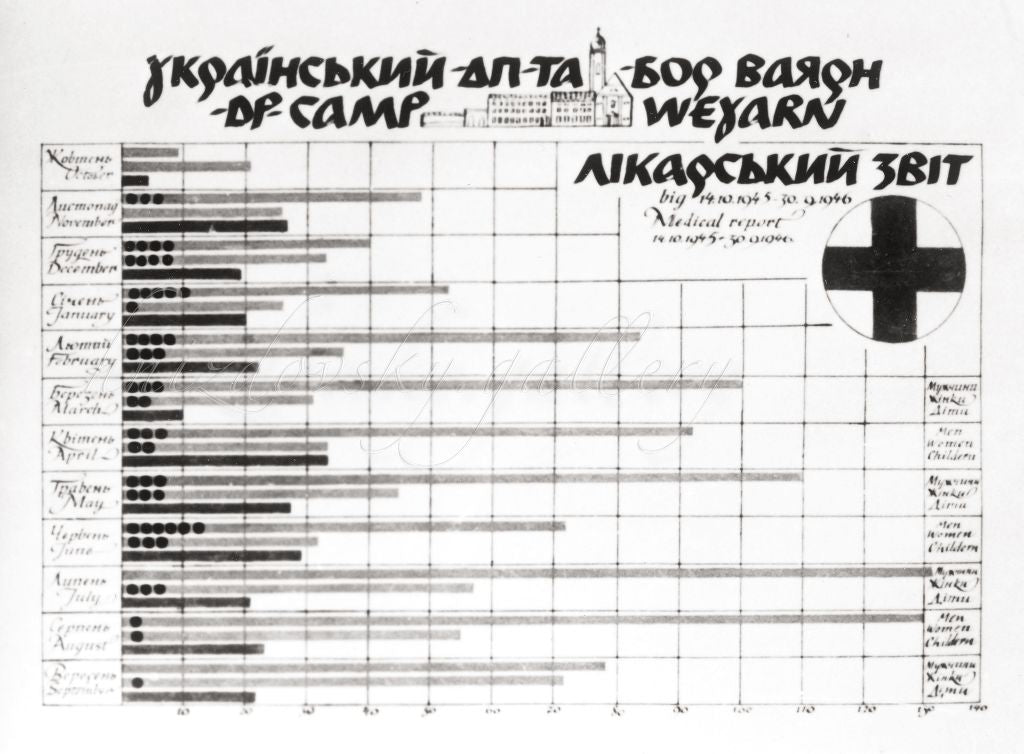
- Camp medical report
- Population chart
- Kindergarten display notice
- UNRRA administrative chart for the Weyarn DP camp
- Cash report, 14 October 1945 – 13 October 1946
A history in dates
- Early twentieth centuryThe city of Munich establishes an orphanage in the former monastery.
- 1930sThe complex becomes a leadership school of the Hitler Youth.
- Towards the end of the warThe buildings serve as a military hospital.
- October 1945The Ukrainian community begins the year later commemorated by its first-anniversary programme.
- 14 October 1945The camp’s food, supply and cash records open their first year.
- 24 January 1946The inventory records the camp as assembly centre AC 95-386 under UNRRA Team 188, Rosenheim.
- August 1946The UNRRA count records 269 Ukrainians at Weyarn.
- 11–13 October 1946A folk-art exhibition, religious services, the unveiling of a plaque and community gatherings mark the first anniversary.
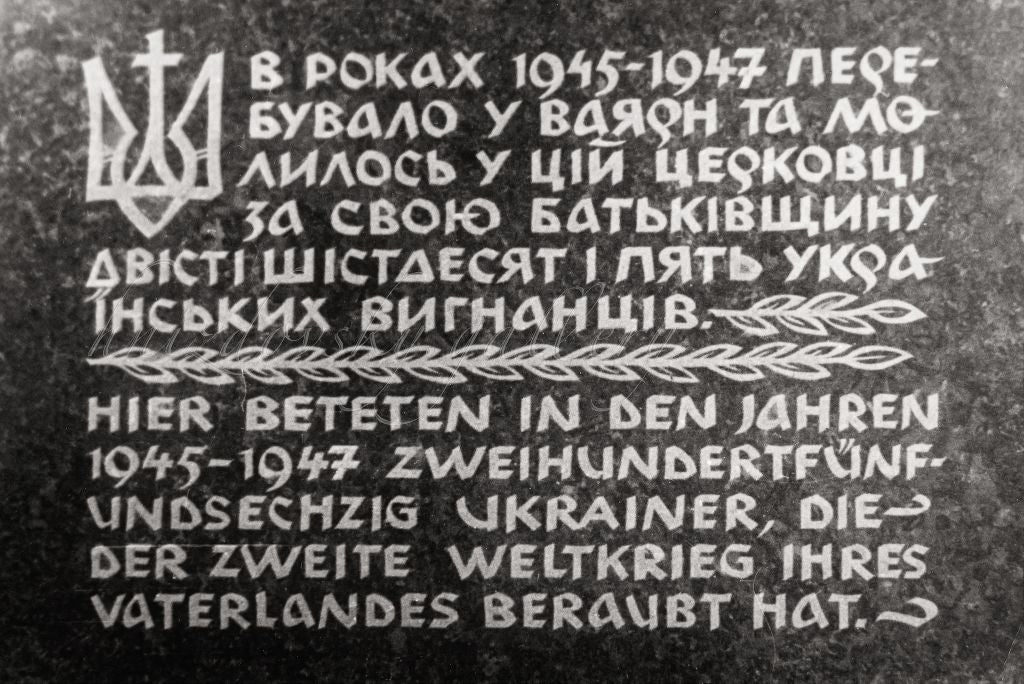
- 1945–1947The chapel inscription commemorates 265 Ukrainian displaced people praying for their homeland.
- May 1947The Ukrainian count at Weyarn is 208.
- 31 October 1947The administrative inventory records accommodation capacity of 280.
- December 1947The PCIRO count records 225 Ukrainians.
- 1949Jacques Hnizdovsky sails for America.
- March–September 1949The inventory places the camp’s closure within this interval.
- 1953Max Riel buys the complex from the city of Munich for a private school, which closes in 1984.
Sources for this section
- Weyarn monastery: postwar uses
- First anniversary of the Ukrainian camp
- Supply of victuals
- UNRRA clothing and equipment deliveries
- Cash report, 14 October 1945 – 13 October 1946
- DP camp inventory: Weyarn
- Ukrainians in UNRRA and IRO Camps of the American Zone of Germany, Table 7
- Chapel commemorative plaque
- Displaced persons camp: original Weyarn documents
A former orphanage becomes a camp
The accommodation belonged to the former monastery complex. At the beginning of the twentieth century the city of Munich established an orphanage there. In the 1930s it became a leadership school of the Hitler Youth, and towards the end of the war it served as a military hospital. UNRRA subsequently took it over as a transit home for displaced people.
The Ukrainian community celebrated its first anniversary on 13 October 1946. The programme states that a year had passed since 265 Ukrainian exiles came to stay at Weyarn, placing the community’s beginnings in October 1945, earlier than the inventory’s first administrative date of 24 January 1946. The distinction matters: a surviving administrative entry need not be the first day that people lived at a camp.
Sources for this section
The camp’s own organisation
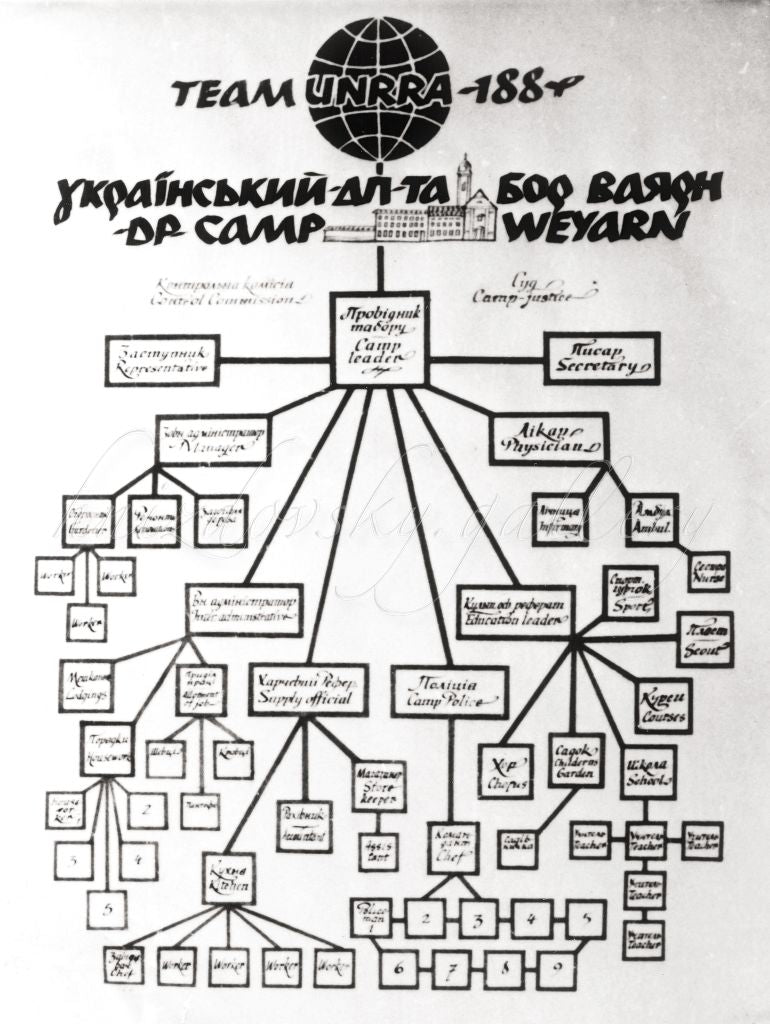
The camp drew its own organisation chart, and it is the clearest surviving account of how the place was run. It is headed ‘TEAM UNRRA-188’ — the relief team the inventory also names, based at Rosenheim — above the bilingual title ‘Ukrainian DP camp Weyarn’ and a small drawing of the monastery buildings.
At the centre stands the camp leader, flanked by a representative and a secretary, with a control commission and a camp court above him. Six branches descend: a manager, a physician, an inner administrator, a supply official, a camp police and an education leader. Under the physician are an infirmary, an outpatient clinic and a nurse. Under the inner administrator are lodgings and the allotment of work. Under the supply official are a storekeeper, an accountant and the kitchen with its own chief and workers. Under the education leader are a sports circle, a Plast scout troop, courses, a chorus, a children’s garden and a school with its teachers.
The inventory adds the administrative shell around that structure. Weyarn was assembly centre AC 95-386, renumbered OB 728 from September 1948; its nationality is recorded as Polish-Ukrainian; Team 188 at Rosenheim was directed by Carton, the area teams were at Rosenheim, Traunstein and Bad Reichenhall, and the whole sat in Area 7, Munich, under a field supervisor named Cagle. A second Weyarn entry records a rehabilitation centre numbered OB 766.
Branches of the camp administration
| Branch | Under it |
|---|---|
| Camp leader | Representative and secretary; a control commission and a camp court stand above him |
| Manager | Three sub-branches, each with its own workers |
| Physician | Infirmary; outpatient clinic; nurse |
| Inner administrator | Lodgings; allotment of work |
| Supply official | Storekeeper; accountant; kitchen with its own chief and workers |
| Camp police | A chief and numbered posts |
| Education leader | Sports circle; Plast scouts; courses; chorus; children’s garden; school with its teachers |
Sources for this section
Food, clothing and practical support
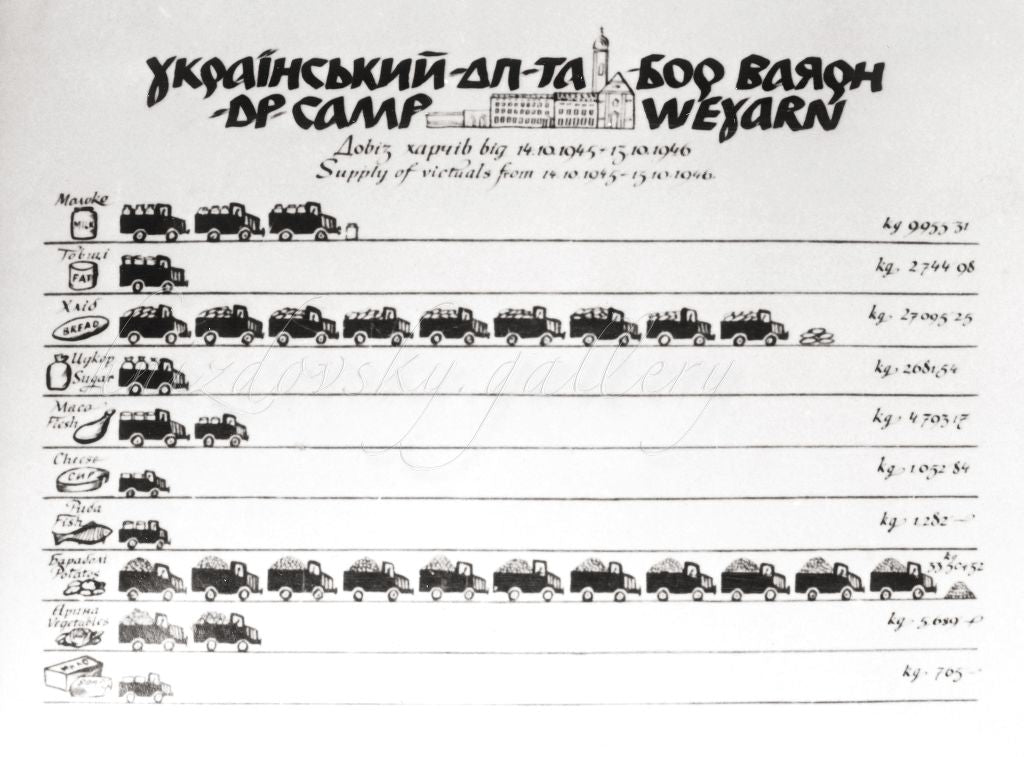
A year of deliveries was turned into an illustrated public account. Small lorries represent incoming food, with separate lines for milk, fats, bread, sugar, meat, cheese, fish, potatoes and vegetables, covering 14 October 1945 to 15 October 1946. Bread came to 27,095.25 kg, milk to 9,955.31 kg, meat to 4,703.17 kg, fats to 2,744.08 kg, cheese to 1,052.84 kg and fish to 1,282 kg; the potato and vegetable figures, the largest on the sheet, are partly obscured. These are supplies received across an entire year, rather than a calculation of what any one person ate.
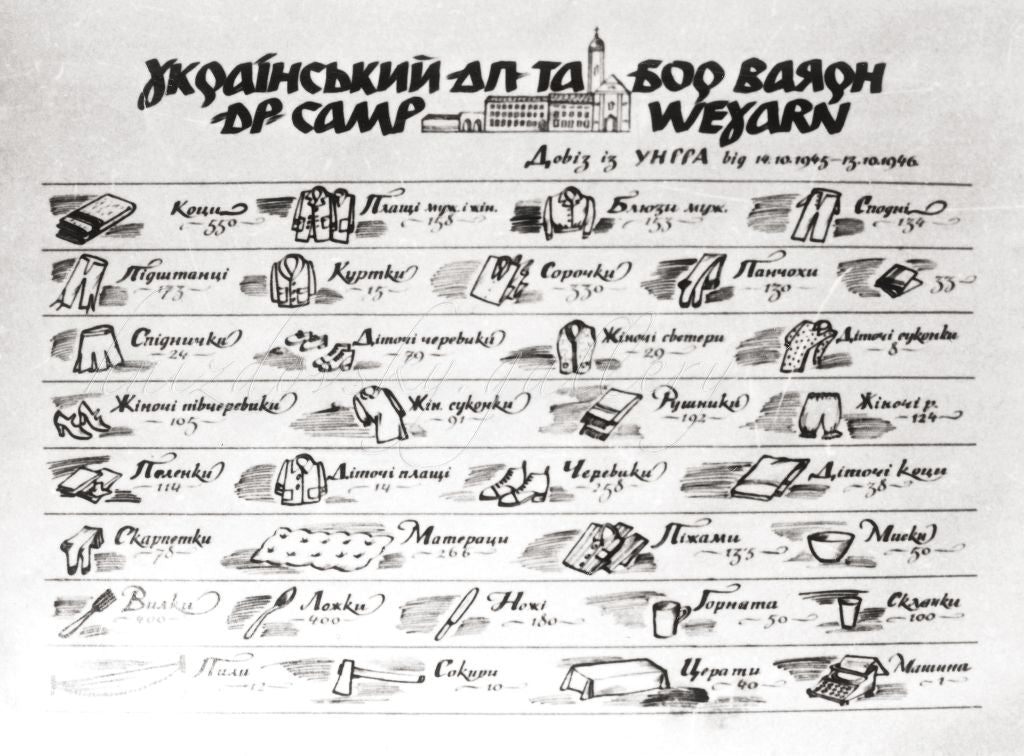
Another chart records the ordinary objects needed to make shared accommodation usable, delivered by UNRRA between 14 October 1945 and 13 October 1946. Thirty-four lines cover blankets, coats, shirts, underclothes, stockings and shoes; mattresses, towels and nappies; bowls, mugs, glasses, forks, spoons and knives; and saws, axes and oilcloths. Its illustrations make clear that relief involved both immediate necessities and the equipment of daily life.
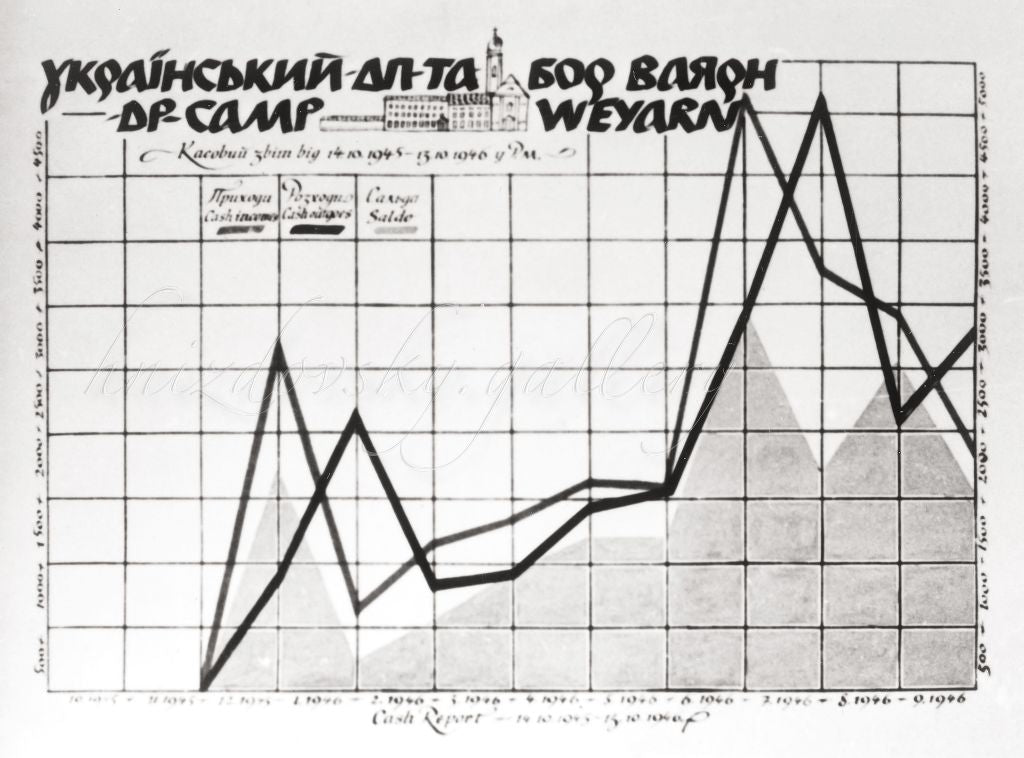
The camp also kept accounts. A bilingual line graph of income, expenditure and balance runs across the same first year on a scale reaching five thousand Reichsmark, month by month; the lines are drawn but the values are not written on them.
Selected supplies recorded during the first year
| Item | Quantity recorded |
|---|---|
| Blankets | 550 |
| Shirts | 330 |
| Mattresses | 266 |
| Shoes | 258 |
| Towels | 192 |
| Forks | 400 |
| Spoons | 400 |
| Knives | 180 |
| Mugs | 50 |
| Bowls | 50 |
| Glasses | 100 |
| Saws | 12 |
| Axes | 10 |
| Oilcloths | 40 |
| Machine | 1 |
Medical care and a changing population
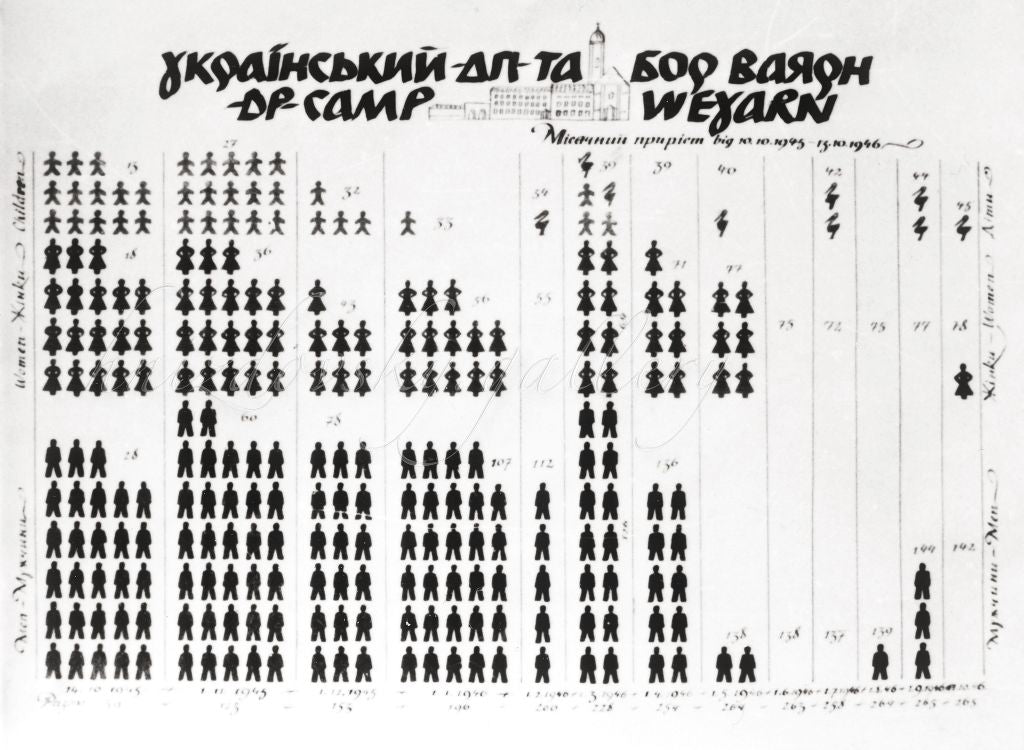
The medical report runs from October 1945 to September 1946 and separates men, women and children. Its monthly bars show continuing use of the camp’s medical service through the first year, though the counts are given only by the length of the bars. The accompanying population chart likewise distinguishes these three groups, presenting the community as families and individuals of different ages rather than a single undifferentiated total.
The population chart carries written figures above its columns. Men rise from 28 in the first month to 142 by the last; women from 18 to 78; children from 15 to 45. The growth is steepest in the first half-year and then levels off, which is what one would expect of a camp that filled quickly and then held steady.
Different records answer different population questions. The camp’s own monthly totals reach 265 by October 1946, and the chapel plaque commemorates 265 Ukrainians during 1945–1947. The published Ukrainian series counts 253 at Weyarn in the questionnaire returns of 1946 and 1947, 269 in the UNRRA count of August 1946, 208 in May 1947 and 225 in December 1947. The inventory’s figure of 280 on 31 October 1947 is a measure of accommodation capacity, not a count of people present on that day.
Three different measures of the community
| Record | What it measures |
|---|---|
| Monthly chart, October 1945 – October 1946 | The camp’s own count, separated into men, women and children, rising to 265 by October 1946 |
| Questionnaire returns, 1946–1947 | 253 Ukrainians |
| UNRRA count, August 1946 | 269 Ukrainians |
| Count of May 1947 | 208 Ukrainians |
| PCIRO count, December 1947 | 225 Ukrainians |
| Chapel plaque, commemorating 1945–1947 | 265 Ukrainian displaced people |
| 31 October 1947 inventory | Capacity of 280 places |
A kindergarten, worship and an anniversary
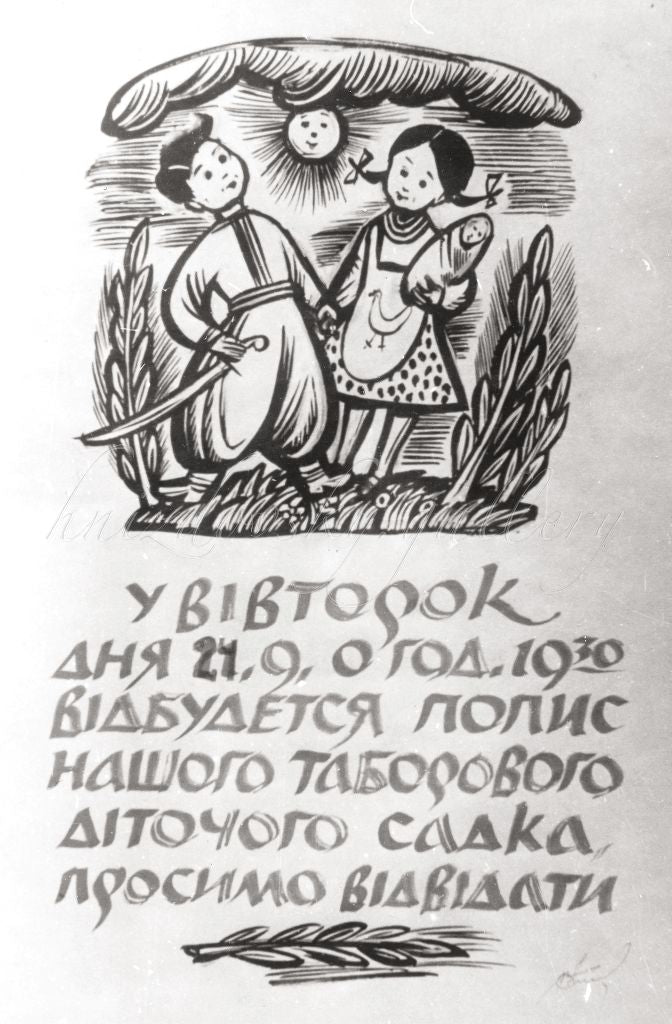
An illustrated notice, drawn with a Cossack and a girl above the lettering, invites the camp to a display by its kindergarten: ‘On Tuesday the 21st September, at 7.30 p.m. there will be a display by our camp kindergarten, please come.’ The year is not stated on the surviving notice.
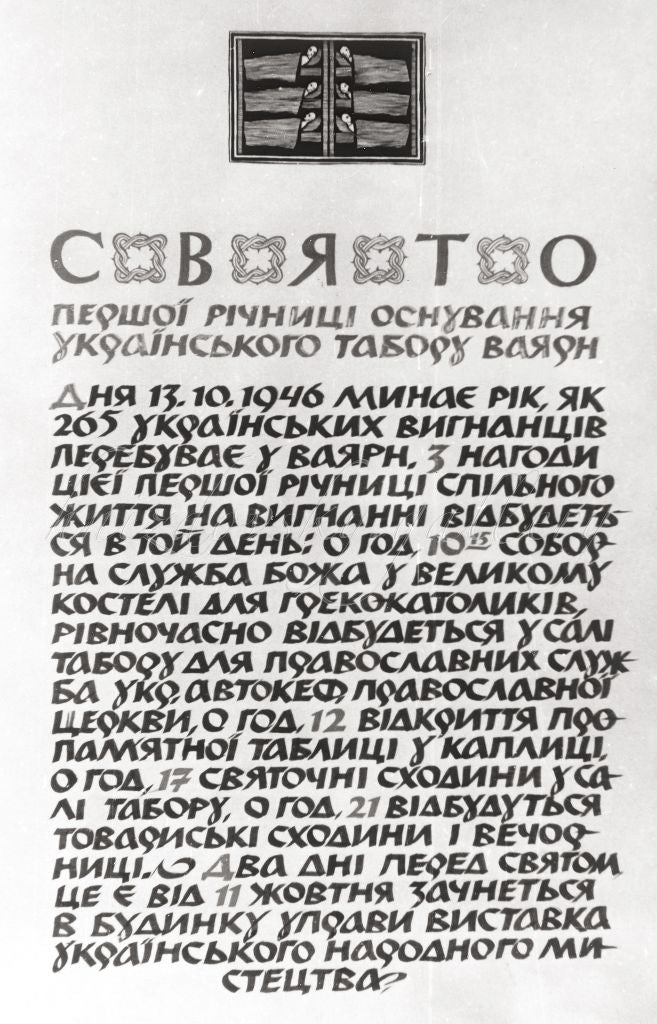
The anniversary programme organised 13 October 1946 around both religious traditions. At 10.15 a solemn liturgy was to be held in the large church for the Greek Catholics, while at the same hour the Ukrainian Autocephalous Orthodox Church served the Orthodox in the camp hall. At noon a commemorative plaque was to be unveiled in the chapel; a festive gathering followed at five and a social evening at nine. An exhibition of Ukrainian folk art opened in the administration building two days earlier, on 11 October.
A surviving bilingual chapel inscription remembers the same number as the anniversary poster: ‘In the years 1945–1947 two hundred and sixty-five Ukrainian exiles stayed at Weyarn and prayed in this little church for their homeland.’ The German half of the text describes them as Ukrainians whom the Second World War had robbed of their homeland. Alongside the practical charts and the children’s notice, it preserves a community’s own account of what connected its members during displacement.
Sources for this section
Departure and the building’s next chapter
The inventory places the camp’s closure between the end of March and the end of September 1949. Its earlier UNRRA administration had been associated with Team 188 at Rosenheim, and later records used the identifier OB 728. These identifiers distinguish the institution within the regional relief network.
The published Ukrainian series shows the community shrinking before that: 269 in August 1946, 208 in May 1947, 225 in December 1947. Hnizdovsky himself sailed for America in 1949, the year the camp closed.
In 1953 the educationist Max Riel bought the site from the city of Munich and founded a private school, which continued until 1984. That was a new chapter in the buildings’ history. The surviving camp notices, charts and plaque preserve the intervening years when this place housed Ukrainians waiting to rebuild their lives.
Sources
- Weyarn monastery: postwar uses
Haus der Bayerischen Geschichte · Accessed September 2026
Institutional history of the former monastery, read in full. Identifies the Munich orphanage, the Hitler Youth leadership school, the wartime military hospital, the UNRRA transit home for displaced persons, and the purchase of the site in 1953 by the educationist Max Riel for a private school that closed in 1984.
- Displaced persons camp: original Weyarn documents
Hnizdovsky Gallery / artist estate · Accessed September 2026
Estate collection of original camp charts, announcements and photographs, read in full. States that Jacques Hnizdovsky was documenting the Weyarn camp for UNRRA, that he was given separate quarters and a large drawing table, that he waited at Weyarn for sponsorship to emigrate with the help of Professor Alexander Granovsky, and that he sailed for America in 1949. The documents reproduced on it are cited individually below.
- First anniversary of the Ukrainian camp
Original camp announcement, preserved by the artist estate · 13 October 1946
Original Ukrainian programme states that the community marks one year at Weyarn and announces religious services, a plaque unveiling and an art exhibition.
- Supply of victuals
Weyarn camp / artist estate · 14 October 1945–15 October 1946
Original bilingual food-delivery chart. Quantities describe aggregate supplies, not individual rations.
- UNRRA clothing and equipment deliveries
Weyarn camp / artist estate · 14 October 1945–13 October 1946
Original illustrated supply record, inspected visually; table reproduces only clearly legible categories.
- Camp medical report
Weyarn camp / artist estate · 14 October 1945–30 September 1946
Original bilingual monthly chart separates men, women and children. No uncertain totals transcribed.
- Population chart
Weyarn camp / artist estate · October 1945–October 1946
Original chart separates men, women and children and carries written monthly totals, the last of them 265 in October 1946.
- Kindergarten display notice
Weyarn camp / artist estate · Tuesday 21 September, year unstated
Original Ukrainian notice invites attendance at a display by the camp kindergarten at 19:30. The weekday and date are retained without inventing a year.
- Chapel commemorative plaque
Weyarn community / artist estate · Commemorates 1945–1947
Bilingual Ukrainian and German inscription refers to 265 Ukrainian displaced people praying for their homeland.
- DP camp inventory: Weyarn
Arolsen Archives · 26 October 2023
Catalogue row 1607 read in full from the spreadsheet: Weyarn (Kreis Miesbach), US zone, District 5; opening 24 January 1946; closing between 31 March and 30 September 1949; nationality Polish-Ukrainian; capacity 280 on 31 October 1947; assembly centre AC 95-386, later OB 728; UNRRA Team 188 Rosenheim under director Carton; area teams AT 1069 Rosenheim, Traunstein and Bad Reichenhall; Area A 7 Munich; field supervisor Cagle. A second Weyarn row, 1608, records a Rehabilitation Center numbered OB 766. The closing interval does not establish a precise last departure.
- UNRRA administrative chart for the Weyarn DP camp
Weyarn camp record, preserved in the Jacques Hnizdovsky estate collection · Undated; first camp year
Original bilingual organisation chart inspected visually. Headed ‘TEAM UNRRA-188’ above ‘УКРАЇНСЬКИЙ ДП ТАБОР ВАЯРН / DP CAMP WEYARN’, with a drawing of the monastery buildings. Only the bilingual box labels are read here; the small numbered boxes at the foot of several branches are not interpreted.
- Cash report, 14 October 1945 – 13 October 1946
Weyarn camp record, preserved in the Jacques Hnizdovsky estate collection · 1946
Original bilingual line graph inspected visually. Titled ‘Касовий звіт від 14.10.1945 – 13.10.1946 у Рм.’ with a key for income, expenditure and balance and a vertical scale from 500 to 5,000 Reichsmark. The plotted values are not labelled and no figures are transcribed from it.
- Ukrainians in UNRRA and IRO Camps of the American Zone of Germany, Table 7
Ihor Stebelsky, in The Refugee Experience (CIUS Press, 1992) · 1992
Printed page 50, Bayern block, read from the page image: ‘Weyarn 253 269 208 225’. The four columns are the questionnaire returns collected during 1946 and 1947, the UNRRA count of August 1946, the count of May 1947 and the PCIRO count of December 1947; the column notes are on printed page 51.
Last researched 12 September 2026