Williamstown
Arrival and settlement
Altona–Williamstown · Victoria · Australia · 1949–1980s, with interruptions
A wartime army camp at the Williamstown racecourse became a migrant hostel in December 1949, moved across Kororoit Creek after a flood, and was rebuilt in brick as Wiltona in 1968. Ukrainians were among its residents, although the 1966 Ukrainian directory’s reference to Williamstown cannot be tied to this site alone.
Introduction
Ukrainian residents were among Williamstown’s postwar population: the Ukrainian community’s 1966 history names it as one of Melbourne’s important hostel concentrations. The name is not decisive on its own, because Victorian heritage records list both this Kororoit Creek Road hostel and a separate registered hostel at Monomeath in Williamstown proper, so the 1966 reference cannot be assigned to one site with certainty.
The hostel began beside the former racecourse and Kororoit Creek. Altona and Wiltona were other names used for the same accommodation complex.
A history in dates
- May 1949The federal government announces it will take over two hostels at the Williamstown racecourse.
- December 1949Migrant accommodation begins at the former racecourse, the first residents including Polish and Hungarian families.
- April 1950Flooding leads to a four-day evacuation of nearly a thousand people to Broadmeadows.
- 1951The hostel is moved to the old racecourse carpark across the creek, which had escaped the flood.
- October 1952The press describes it as the only hostel in Victoria housing both English-speaking and non-English-speaking residents.
- 1965A surviving Altona Hostel Christmas menu records communal celebrations.
- 1968Two stages of brick units replace much of the hut accommodation.
- 1978The hostel reopens for refugees.
- November 1986The former hostel site is offered for sale.
- 15 July 1987A government gazette announces industrial rezoning of the former Wiltona hostel.
- 2024Residential use of the former hostel estate becomes the subject of an eviction dispute.
Racecourse accommodation and the flood
In May 1949 the federal government announced that it would take over eighteen wool sheds at Braybrook and two hostels at the Williamstown racecourse, a wartime army camp. Importing Nissen and Quonset huts was expected to house a further two thousand or more people at the racecourse alone. Local people objected to losing a recreation area, although since the war the course had been used for horse training rather than racing.
The first residents arrived in December 1949. In April 1950 flooding forced nearly a thousand people to evacuate temporarily to Broadmeadows. Accommodation subsequently shifted to the old racecourse carpark across the creek.
A kiosk operator’s family remembers the racecourse grandstand kitchen being used for early camp meals. Their business served the migrant community during the 1950s, offering more than refreshments: clothing, bicycles, radios, toiletries and familiar continental foods such as sauerkraut and smoked sausage. Tables for tea and coffee made it a meeting place as well as a shop.
Recorded stages of the site
| Date | Recorded event | Source scope |
|---|---|---|
| May 1949 | Federal takeover of two hostels at the racecourse announced; a further 2,000 or more expected to be housed there | Announcement of intent, not a recorded population |
| April 1950 | Nearly 1,000 people evacuated for four days after Kororoit Creek flooded | People evacuated, not the hostel’s standing capacity |
| 1951 | Accommodation moved to the old racecourse carpark north of the creek | Site change |
| 1968 | Brick units completed in two stages | Building works |
Daily life and community connections
Each hut held three families with about three rooms each. Residents shared outside toilets, ate at long tables in a common dining area and used communal laundries. A prominent landscape designer, Emily Gibson, was engaged to soften the bare coastal site with salt-tolerant planting. In the early 1950s the hostel was described as the only mixed establishment in Victoria, the only one then accommodating both English-speaking and non-English-speaking residents.
Early accommodation consisted largely of military huts shared by several families. Toilets, washing and dining were communal. Families nevertheless adapted daily routines, sometimes cooking in rooms despite hostel rules.
The nearby Baptist church extended its work into the hostel through English classes and Sunday school. This connection placed language learning and children’s activities within a wider network of local organisations responding to new arrivals.
A preserved 1965 Christmas menu records a communal celebration at Altona Hostel. The family who kept it had stayed for two years while working in construction, pipeline work and a nearby factory. They eventually returned to Britain after finding that buying land did not resolve the difficulties of getting established. Their story shows that settlement did not always end in a permanent Australian home.
The hostel’s reputation troubled the district. By January 1951 a run of court cases involving residents had produced enough local concern that journalists were invited in to report instead on residents’ talents, good citizenship and sport. Williamstown councillors wanted the city’s name detached from the place; Werribee, Paisley and Altona were all proposed before the composite name Wiltona was settled on. Soccer grew quickly nearby: a district that struggled to raise one team in 1950 had two senior and two junior sides by 1954.
From huts to brick accommodation
Melbourne’s hostels were run by the Commonwealth Department of Labour and National Service and from 1951 by Commonwealth Hostels Limited. Through the 1950s and 1960s they held between 500 and 1,500 residents each, with a nominal maximum stay of twelve months, and rent often took a large share of a migrant’s income. Williamstown was one of the sites chosen for reconstruction in the late 1960s: the first brick units were finished by early 1968 and the second stage by the end of that year, to a design by the architect Reg Grouse that was nominated for a state architectural award in 1970.
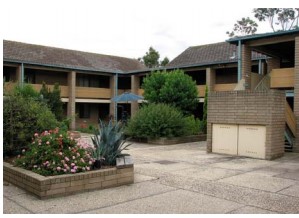
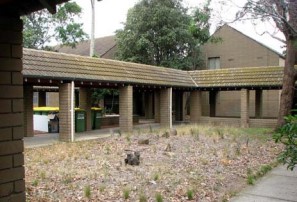
Major rebuilding during the late 1960s replaced much of the hut accommodation with two-storey brick units. Courtyards and covered walkways connected the blocks. The Wiltona name combined Williamstown and Altona.
The Melbourne Harbour Trust hostel at Monomeath on The Strand was a separate establishment, with a different location and purpose.
Names in the hostel’s history
| Name | Context |
|---|---|
| Williamstown | Early racecourse-area hostel, and the name used in the 1966 Ukrainian directory |
| Altona | Name on the 1965 Christmas menu |
| Wiltona | Composite name adopted after Williamstown councillors objected; used in the 1987 gazette |
| Monomeath | A separate registered hostel at 67 The Strand, Williamstown, not this site |
| Techno Park | Post-hostel industrial and commercial estate |
Closure, reuse and a continuing housing story
The hostel closed during the 1970s and reopened for refugees in 1978. Demand had fallen away by 1984, when the site was declared temporarily surplus while the Commonwealth said it would keep the hostel in case it was needed again. The following year it was earmarked for disposal after an audit of Melbourne’s hostel sites, and it was offered for sale in November 1986. A proposal to adapt the complex for emergency housing was dropped because Williamstown councillors opposed continued residential use.
A July 1987 government notice formally rezoned the former Wiltona hostel to general industrial use.
The buildings became Williamstown Techno Park. Residential use persisted alongside offices and industry. In 2024, ABC reporting documented a dispute over council eviction notices affecting people who had made homes in the estate. The former hostel remained connected to questions of affordable housing long after its Commonwealth migration role ended.
Seven of the original clusters of brick units survive, some with their courtyards filled in and one almost swallowed by later additions. The footbridge over Kororoit Creek has gone.
Sources
- Ukrainians in Australia, volume 1
Ukrainian community, Melbourne · 1966
Page 83 names Williamstown among the hostels with a substantial Ukrainian presence.
- Migrants: Williamstown, Altona and Wiltona hostel
Altona Laverton Historical Society · Undated
A local history of the hostel’s changing site, accommodation, names and later uses, drawing on the Hobsons Bay Heritage Study thematic history and on contemporary press reports it cites (Herald, 22 October 1952; Sun, 9 February 1968) and a 1987 Senate committee report. Illustrated with photographs of the surviving buildings.
- Williamstown Racecourse: 1950s images and kiosk recollections
Williamstown History · 2017
A family letter transcribed in 2015 recalls the kiosk serving residents and the use of the grandstand kitchen for early camp meals.
- Hobsons Bay Heritage Study: Newport Baptist Church
Hobsons Bay City Council · 2017
The church history on page 578 records English classes and Sunday school at Williamstown hostel.
- Christmas dinner menu, Altona Migrant Hostel
Museums Victoria · 1965
Item HT 13694 preserves a Christmas menu and a family history describing work, housing ambitions and eventual return to Britain.
- Hobsons Bay Heritage Study: Monomeath
Hobsons Bay City Council · 2017
The history of 67–68 The Strand identifies a separate Melbourne Harbour Trust hostel operating from 1951.
- Victoria Government Gazette
Government of Victoria · 15 July 1987
Page 1883 records Amendment 475, rezoning the former Wiltona hostel on Kororoit Creek Road for general industrial use.
- Techno Park housing dispute
ABC News · 8 February 2024
Original reporting on residential use of the former hostel buildings and council eviction notices.
- Migrant Hostels
eMelbourne: The Encyclopedia of Melbourne Online, University of Melbourne · July 2008
Entry by Sara Wills. Administration, hut types, resident numbers, maximum stay and rent for Melbourne’s hostels as a group; not figures for this hostel individually.
Last researched 13 September 2026