Winzer
Displacement in Europe
Winzer · Germany · 1945–1949
Former Reich Labour Service barracks beside the Danube took in survivors of Theresienstadt in the summer of 1945 and then held a Russian and Ukrainian camp until July 1949. Family photographs and published population returns show a Ukrainian community of roughly three hundred people with its own school, church and choir.
Introduction
Winzer, a small town on the Danube near Deggendorf, became a place of refuge for people with very different wartime experiences. Survivors of Theresienstadt arrived in former labour-service barracks in 1945. The inventory dates the camp from 7 July 1945 and records a Russian and Ukrainian population, and family photographs from 1946 to 1948 show a working Ukrainian community. The camp continued until July 1949.
A history in dates
- 1938Two Reich Labour Service sections are recorded at Winzer an der Donau, forming a double camp.
- June 1945A contemporary survivor’s account records arrival in barracks and UNRRA meals.
- 7 July 1945The inventory dates the opening of the camp.
- July 1945The same account records an onward move to Deggendorf.
- 1946–1948Family photographs record a school, kindergarten, church, choir, camp police and theatrical performances.
- 31 May 1947The UNRRA summary records 350 Ukrainians.
- 31 October 1947Inventory records capacity of 475 places.
- 2 January 1948The PCIRO summary records 268 Ukrainians.
- 1948A Ukrainian family account records a child’s birth during its stay at Winzer.
- June 1949One family reaches the United States through sponsorship.
- 13 July 1949The inventory records the camp’s closure; the IRO camp file ends the same month.
Sources for this section
- Reich Labour Service units and locations: Winzer an der Donau
- A survivor’s account of Winzer, June–July 1945
- DP camp inventory: Winzer
- Winzer German DP camp: family photographs and recollections
- Ukrainians in UNRRA and IRO camps of the American zone: Table 7
- A Ukrainian family’s route through Winzer
- IRO camp files: Winzer
Barracks beside a Danube town
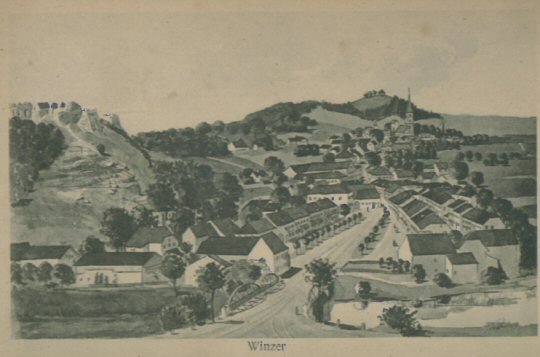
The postwar camp used former Reich Labour Service accommodation. A compilation of Reich Labour Service unit locations lists two sections at Winzer an der Donau under the Vilshofen group in 1938 and notes that the two together formed a double camp, which is consistent with the local account of a substantial barrack site. Local historical research describes fifteen barracks, some of which were cleared when a transport of roughly four hundred survivors from Theresienstadt could not immediately be received in Deggendorf. The accommodation was inadequate for people who were ill, exhausted and frightened; its substantial fence brought distressing reminders of confinement.
Winzer was a separate stopping place from the Alte Kaserne camp in Deggendorf, about seventeen kilometres away. Accounts of movement between them should not turn the two places into one camp. Several surviving testimonies describe only a relatively short stay at Winzer before onward transfer.
Meals, English lessons and news of relatives
One survivor’s account places an arrival in June 1945. Residents slept in barracks and received meals through UNRRA. English lessons began for beginners and people with some existing knowledge; the person teaching also learned from others who had lived in Britain. Language learning was already part of preparing for life beyond the camp.
Communication with relatives mattered just as much as material support. The same account describes sending a telegram through a relative so that children abroad learned their parents were alive. In July the couple moved to Deggendorf, where letters and parcels arrived. Their eventual journey continued through Bremen to the United States in May 1946.
Sources for this section
The later Ukrainian community
The administrative inventory identifies Ukrainians and Russians among Winzer’s residents and gives an accommodation capacity of 475 on 31 October 1947. This capacity is not a count of Ukrainians. The camp was attached to UNRRA Team 557 at Deggendorf and later used the IRO identifier NBO 417.
Ihor Stebelsky’s published table, which enters the camp as Deggendorf (Winzer), records 359 Ukrainians in the questionnaire returns collected during 1946 and 1947, 350 in the UNRRA summary of 31 May 1947 and 268 in the PCIRO summary of 2 January 1948. Winzer was therefore a small and remarkably stable community for two years before it began to thin out.
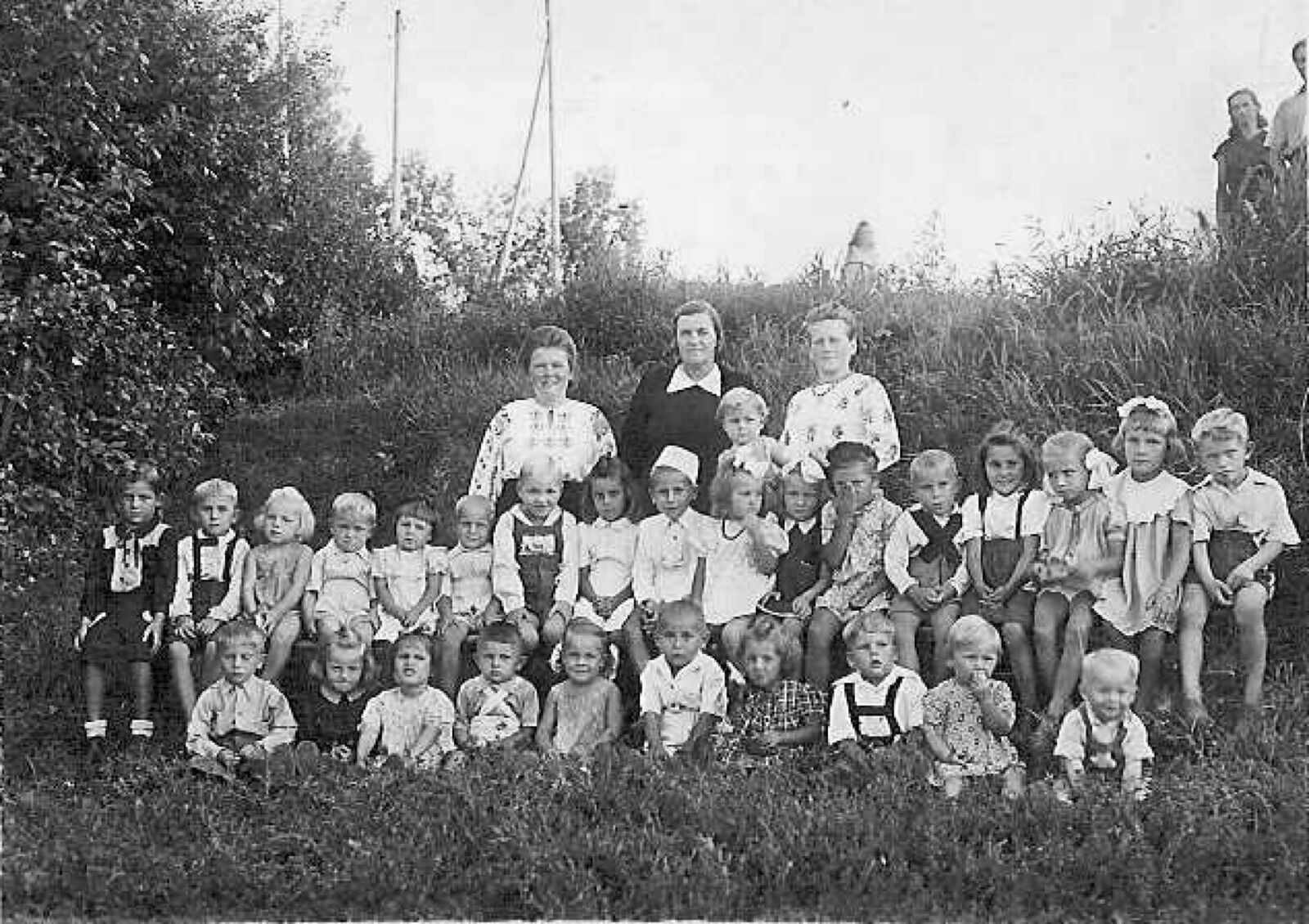
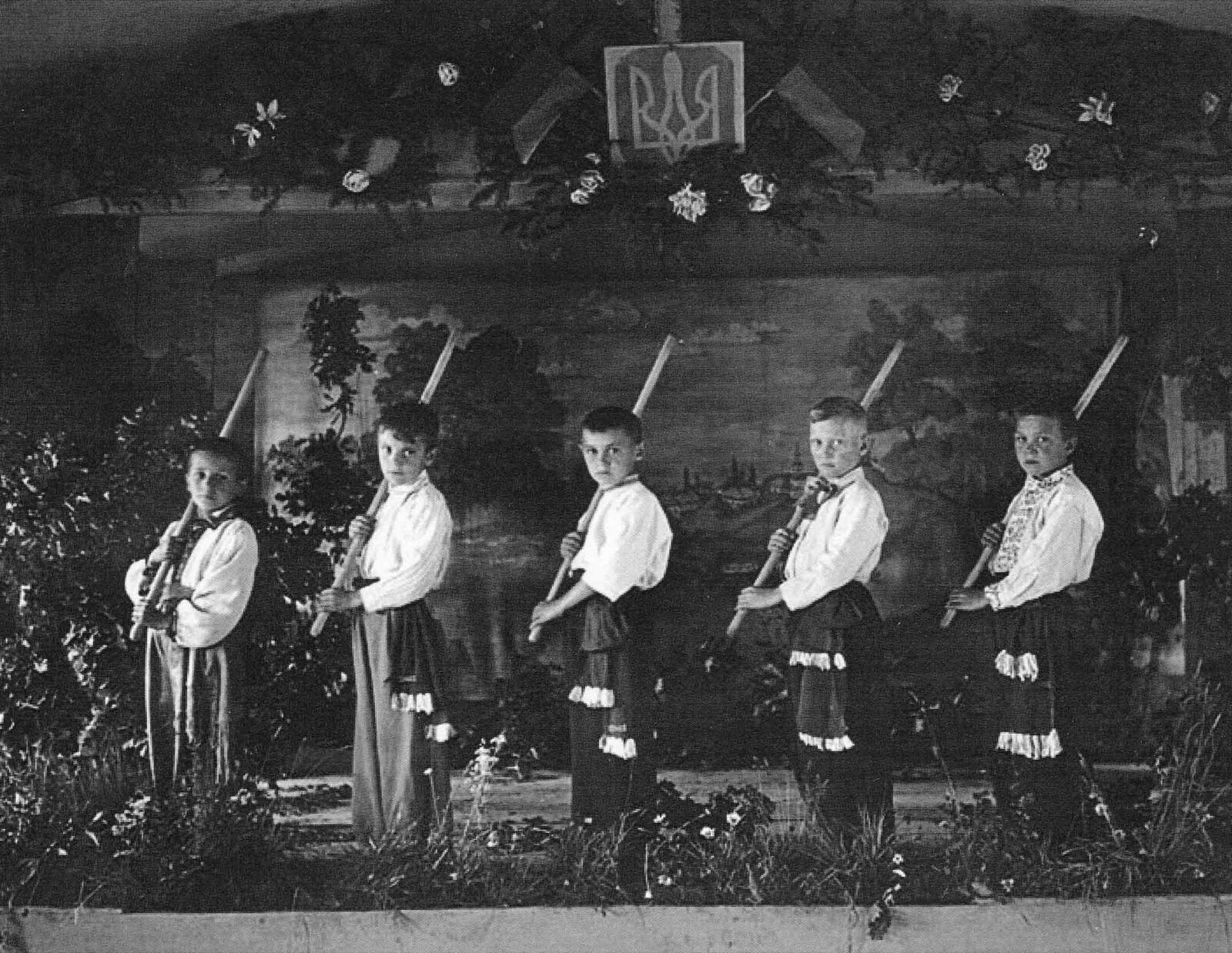
A page of family photographs and recollections assembled by former residents’ children shows what those few hundred people built. The images, dated by the contributors to 1946 to 1948, record a school and a kindergarten, a functioning church whose priest, A. Szczerban, appears in most of the wedding photographs, a choir, Christmas carollers, a camp police detachment, baptisms, theatrical performances and a stage commemoration at which a portrait of Taras Shevchenko was held up. One contributor’s only memory of her mother’s account of the camp is that they were always hungry.
A published Ukrainian family account describes reaching Winzer after forced labour and repeated fear of being sent back to Soviet territory. A child was born there in 1948. Family sponsorship eventually made emigration possible, and the family arrived in Boston in June 1949 before settling in New York. This is one documented route, rather than a claim that all Winzer residents left for the same country.
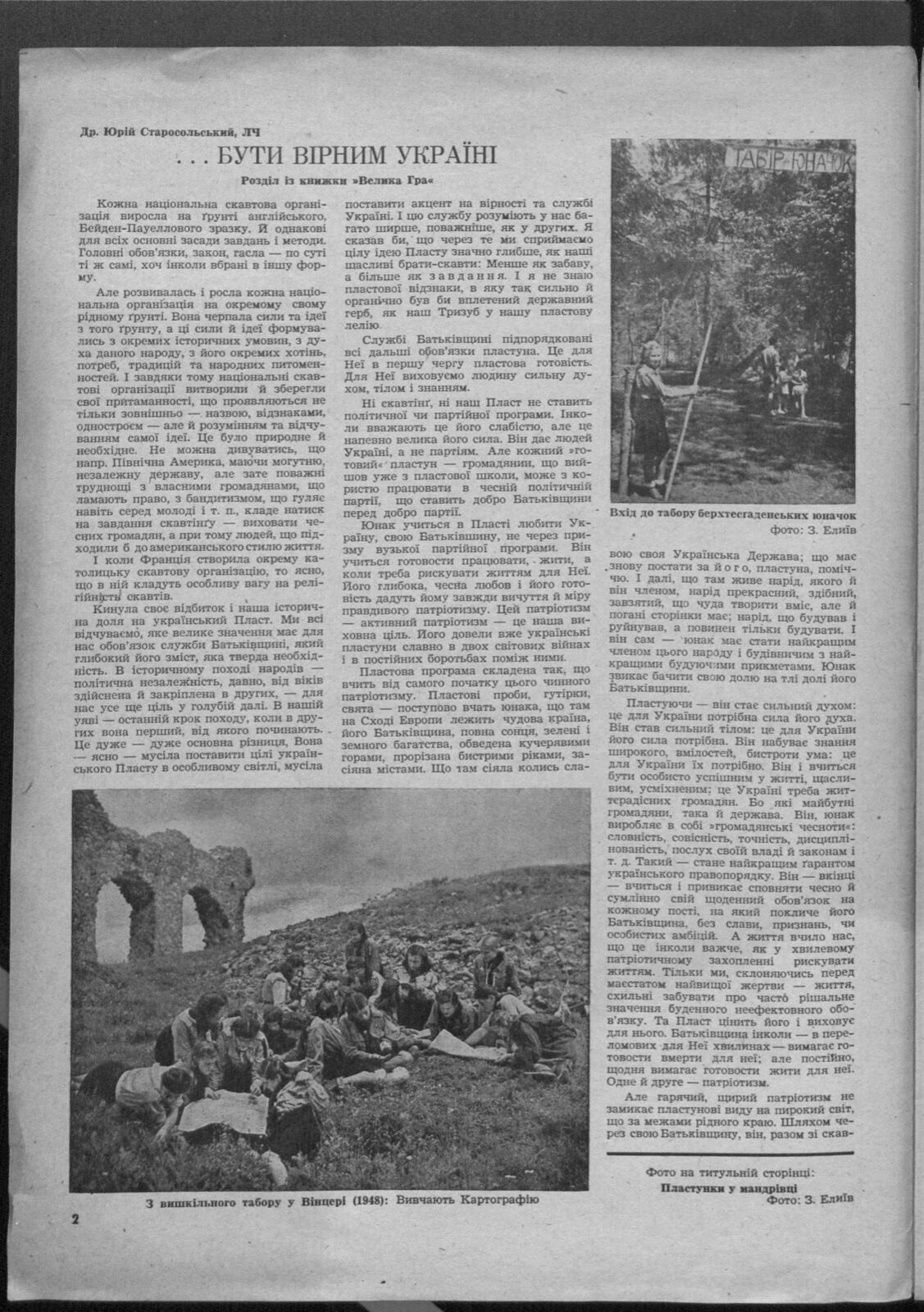
Winzer was also used for Ukrainian scouting. The Plast magazine Molode zhyttia for September 1948 lists the second training camp for cub and junior leaders of the Regensburg district as held at Winzer near Deggendorf from 4 to 14 July 1948, with twenty-three participants, and prints a photograph from it captioned “From the training camp at Winzer (1948): studying cartography”, showing the girls at work on a map in the open air below a ruined arcade.
Ukrainians recorded at Winzer
| Source and date | People |
|---|---|
| Questionnaire returns collected 1946–1947 | 359 |
| UNRRA summary, 24 August 1946 | not listed |
| UNRRA summary, 31 May 1947 | 350 |
| PCIRO summary, 2 January 1948 | 268 |
Community life recorded in family photographs, 1946–1948
| Activity | Evidence on the page |
|---|---|
| Schooling | Photographs of a school and of a kindergarten |
| Worship | Church groups, baptisms and weddings with the priest A. Szczerban |
| Music | A choir, and Christmas carollers |
| Theatre and commemoration | Stage performances, including one at which a portrait of Taras Shevchenko was held up |
| Camp administration | A camp police detachment |
Sources for this section
- DP camp inventory: Winzer
- Ukrainians in UNRRA and IRO camps of the American zone: Table 7
- Winzer German DP camp: family photographs and recollections
- A Ukrainian family’s route through Winzer
- Z vyshkilnoho taboru u Vintseri (1948): Vyvchaiut Kartohrafiiu (From the training camp at Winzer (1948): studying cartography), Molode zhyttia, series B, number 4, September 1948, page 2
Different routes out of Winzer
The testimony preserved by the Wiener Holocaust Library records another route: six weeks at Winzer, approximately a year in Deggendorf, then reunion with children in Britain in October 1946. One Ukrainian family recalled instead being moved in 1948 to the former SS Warner Kaserne in Munich, where they spent a year before leaving Germany, reaching the United States in 1949. Together, the accounts show that departure usually involved another camp and a further period of waiting before emigration.
The inventory records closure on 13 July 1949, and the IRO camp file for Winzer, AJ 43 820 item 31 in the French national archives, runs from October 1947 to July 1949. Family recollection that the camp was disbanded in 1948 describes when one household left rather than when the camp shut. The brief stay of the earliest Jewish survivors likewise should not be mistaken for the whole history of Winzer’s postwar camp.
Documented routes after Winzer
| Account | Onward camp or transit point | Later destination |
|---|---|---|
| Published survivor account | Deggendorf; Bremen | United States, May 1946 |
| Wiener Holocaust Library testimony description | Deggendorf | Britain, October 1946 |
| Ukrainian family recollection on dpcamps.org | Former SS Warner Kaserne, Munich, from 1948 | United States, 1949 |
| Ukrainian family account in an obituary | Intermediate departure route not fully stated | Boston, then New York, June 1949 |
Sources
- Winzer and the arrival of survivors from Theresienstadt
haGalil · 2011
Full passage on Winzer read: former RAD barracks, approximately 400 arrivals and subsequent movement to Deggendorf. Town illustration credited to Sammlung Westerholz; exact date unstated.
- A survivor’s account of Winzer, June–July 1945
Kortum-Gesellschaft Bochum, Zeitpunkte 41 · 2020
PDF page 44 reproduces a first-person account: barrack accommodation, UNRRA meals, English lessons, family contact and onward travel. Personal names omitted from this page.
- Winzer and Deggendorf eyewitness testimony
The Wiener Holocaust Library · 1 March 1960
Catalogue 106307; reference 1656/3/8/1190. Published institutional description records six weeks in Winzer, one year in Deggendorf and departure for Britain. Full five-piece testimony remains unread.
- A Ukrainian family’s route through Winzer
Family obituary / Brady Fallon Funeral Home · 2021
First-person family history published as an obituary: forced labour, fear of return to the Soviet Union, a child born at Winzer in 1948 and arrival in Boston in June 1949. Names omitted.
- DP camp inventory: Winzer
Arolsen Archives · 26 October 2023
Entry 1627: Russian and Ukrainian residents; opening 7 July 1945; capacity 475 on 31 October 1947; AC 93-428 / AC 93-426, later NBO 417; Team 557 Deggendorf; ITS documents 82042060-82042097. Closing date decodes to 13 July 1949.
- IRO camp files: Winzer
Canadian Institute of Ukrainian Studies, Research Report No. 2 · 1982
Printed page 34 read directly: AJ 43 820, item 31, Camp Winzer, Deggendorf, October 1947 to July 1949. File description is not a substitute for the original administrative reports.
- Ukrainians in UNRRA and IRO camps of the American zone: Table 7
Ihor Stebelsky, in The Refugee Experience, Canadian Institute of Ukrainian Studies Press, 1992 · 1992
Table 7, printed pages 47–51, row entered as Deggendorf (Winzer): 359 in the questionnaire returns collected during 1946 and 1947, 350 in the UNRRA summary of 31 May 1947, 268 in the PCIRO summary of 2 January 1948; no entry for 24 August 1946. Column assignment checked against the x-positions of the digits in the PDF text layer.
- Reich Labour Service units and locations: Winzer an der Donau
Forum Geschichte der Wehrmacht · Retrieved 13 September 2026
Sections 5/297 and 6/297 listed at Winzer an der Donau under Arbeitsgruppe 297 Vilshofen in 1938, with the note that the two together formed a double camp. An enthusiast compilation, not an archival source; used only to corroborate the labour-service origin of the barracks.
- Winzer German DP camp: family photographs and recollections
dpcamps.org, compiled by Olga Kaczmar from contributions by former residents’ families · Contributions 2006–2021; retrieved 13 September 2026
Page read in full and photographs viewed. Contributors describe a small camp of roughly three hundred people, a school and a kindergarten, a functioning church with the priest A. Szczerban, a choir, Christmas carolling, camp police, weddings, baptisms, theatrical performances and a Shevchenko commemoration, alongside constant hunger, and a move in 1948 to the former SS Warner Kaserne in Munich. Family recollection rather than an archival record; residents’ names on the page are not reproduced here, and the privately owned photographs carry no reuse licence, so none were copied.
- The kindergarten at Winzer DP camp
Maslihan family photographs, published on DPcamps.org, Michigan Family History Network · between 1946 and 1948
Group photograph of the camp kindergarten on a grass bank, about forty children with three women, captioned by the contributor as the kindergarten in which her mother taught. Published on the Winzer page of DPcamps.org; no reuse licence is stated.
- Boys performing on stage at Winzer DP camp
Family photographs published on DPcamps.org, Michigan Family History Network · between 1946 and 1948
Five boys in embroidered shirts and sashes hold scythes on a painted stage set, beneath a trident emblem worked into the backdrop. Published on the Winzer page of DPcamps.org; no reuse licence is stated.
- Z vyshkilnoho taboru u Vintseri (1948): Vyvchaiut Kartohrafiiu (From the training camp at Winzer (1948): studying cartography), Molode zhyttia, series B, number 4, September 1948, page 2
Union of Ukrainian Plast Scouts Abroad, Munich · September 1948
Digitised by the Ukrainian Museum-Archives of Cleveland with the United States Holocaust Memorial Museum in the Displaced Persons Camp Periodicals Collection; marked public domain or an orphan work and offered under Creative Commons Attribution-NonCommercial-NoDerivatives 3.0. A photograph taken at the Plast training camp at Winzer in 1948, printed at the foot of the page. The same issue lists the camp among the girls’ training camps of that summer.
Last researched 13 September 2026