DP-Camp Wolkering
Displacement in Europe
Wolkering · Germany · Displaced persons camp: 1945–1949
A Reich Labour Service barracks camp in the village of Wolkering, south of Regensburg, held Ukrainian, Polish, Belarusian and Russian displaced persons from the end of the war until July 1949. An American inspection early in 1946 counted 341 people there, 283 of them registered as Ukrainians.
Introduction
Wolkering is a village south of Regensburg, today one of the constituent villages of the municipality of Thalmassing. The Arolsen Archives inventory lists a DP-Camp Wölkering there, with Ukrainian, Polish and Russian nationalities recorded, an assembly centre number and a capacity of 450 at 31 October 1947. The village history and the Ukrainian population returns confirm a camp of several hundred people operating from the end of the war until 1949.
The camp was not improvised out of nothing. It used the barracks of a Reich Labour Service camp built in the village in the 1930s, it was run from Regensburg as one of the smaller units in a district network of more than forty entries, and it left records in three national archives. What it did not leave was a settled name: the inventory writes Wölkering, the municipal chronology writes Ausländerlager, the Ukrainian returns write Wolkering, and the French file writes Camp Wolkering.
A history in dates
- 1935A Reich Labour Service camp of sixteen barracks is built during the regulation of the Wolkeringer Bach.
- 1945The barracks become a camp for displaced persons after the end of Labour Service use.
- 24 January 1946First listing of DP-Camp Wölkering in the Arolsen inventory, under UNRRA Team 120 Regensburg.
- February 1946American inspections of the Team 120 camps record 341 people at Wolkering, 283 of them registered as Ukrainians.
- 24 August 1946UNRRA counts 343 Ukrainians at Wolkering.
- 28 August 1946Ukrainian pilgrims from Wolkering join those from Regensburg, Schwandorf, Dingolfing and Rosenheim on a pilgrimage to Altötting.
- November 1946The camp passes to Area Team 1046 Regensburg, in Area 4, Amberg.
- 31 May 1947A UNRRA assembly-centre summary again counts 343 Ukrainians.
- October 1947The IRO file on Camp Wolkering opens; it will close in July 1949.
- 31 October 1947The inventory records a capacity of 450.
- 2 January 1948A PCIRO summary counts 381 Ukrainians.
- 1948The municipality deals with the water supply of the DP camp.
- September 1948The assembly centre number AC 93-353 is replaced by the IRO designation NBO 406.
- 28 July 1949Closing date of the camp in the Arolsen inventory; the IRO file on Camp Wolkering ends in July 1949.
- 1 January 1972Wolkering, until then an independent municipality, merges into Thalmassing.
- April 2023The Historischer Arbeitskreis Wolkering leads a walk to the grounds of the former Labour Service camp.
Sources for this section
- Jubiläumsschrift 1200 Jahre Wolkering
- Gemeinde-Nachrichten April/Mai 2023: historical walk in Wolkering
- DP camp inventory: DP-Camp Wölkering, Wolkering (Kreis Regensburg)
- Die unbekannte Ukraine in der Ganghofer-Siedlung Regensburg
- Ukrainian Population Migration after World War II
- Новаки школярі в таборі (School cubs in camp), Українське слово, page 7
- Political Refugees and Displaced Persons, 1945–1954: Research Report No. 2
- Wolkering (Thalmassing)
The barracks before 1945
The camp buildings were not built for refugees. In 1935, when the Wolkeringer Bach was regulated, a Reich Labour Service camp was constructed in the village: sixteen barracks for up to 500 people. Labour Service men straightened the Mühlbach until 1939, and the camp remained in Labour Service use until the end of the war. The nearby military training ground was enlarged around 1936.
The camp was part of the village economy while it lasted. The Wolkering Raiffeisen bank paid out the wages of the Labour Service men, and the drainage of the Mühlbach valley that the camp existed to carry out had been asked for by the farmers of the Zullfeld and the Schmiedfeld as far back as 1915. Sixteen barracks for five hundred men were, by any measure, a large addition to a parish village whose baroque church of Mariä Himmelfahrt had been rebuilt in 1746 and which counts 377 inhabitants today.
The displaced persons camp
After the war the barracks passed to displaced persons. The village chronology records an Ausländerlager for displaced persons in Wolkering from 1945 to 1947, and a separate entry for the water supply of the DP camp in 1948. The local history group’s account has Labour Service use running to the end of the war and the accommodation of displaced persons and refugees following it.
The Arolsen inventory carries the camp from its first listing on 24 January 1946 to a closing date of 28 July 1949. The two datings are not in conflict: the village chronology describes the years in which the barracks were most visibly a foreigners’ camp, while the inventory records an administrative existence that ran on into 1949. The file the International Refugee Organisation kept on Camp Wolkering, now in the French national archives, likewise runs from October 1947 to July 1949.
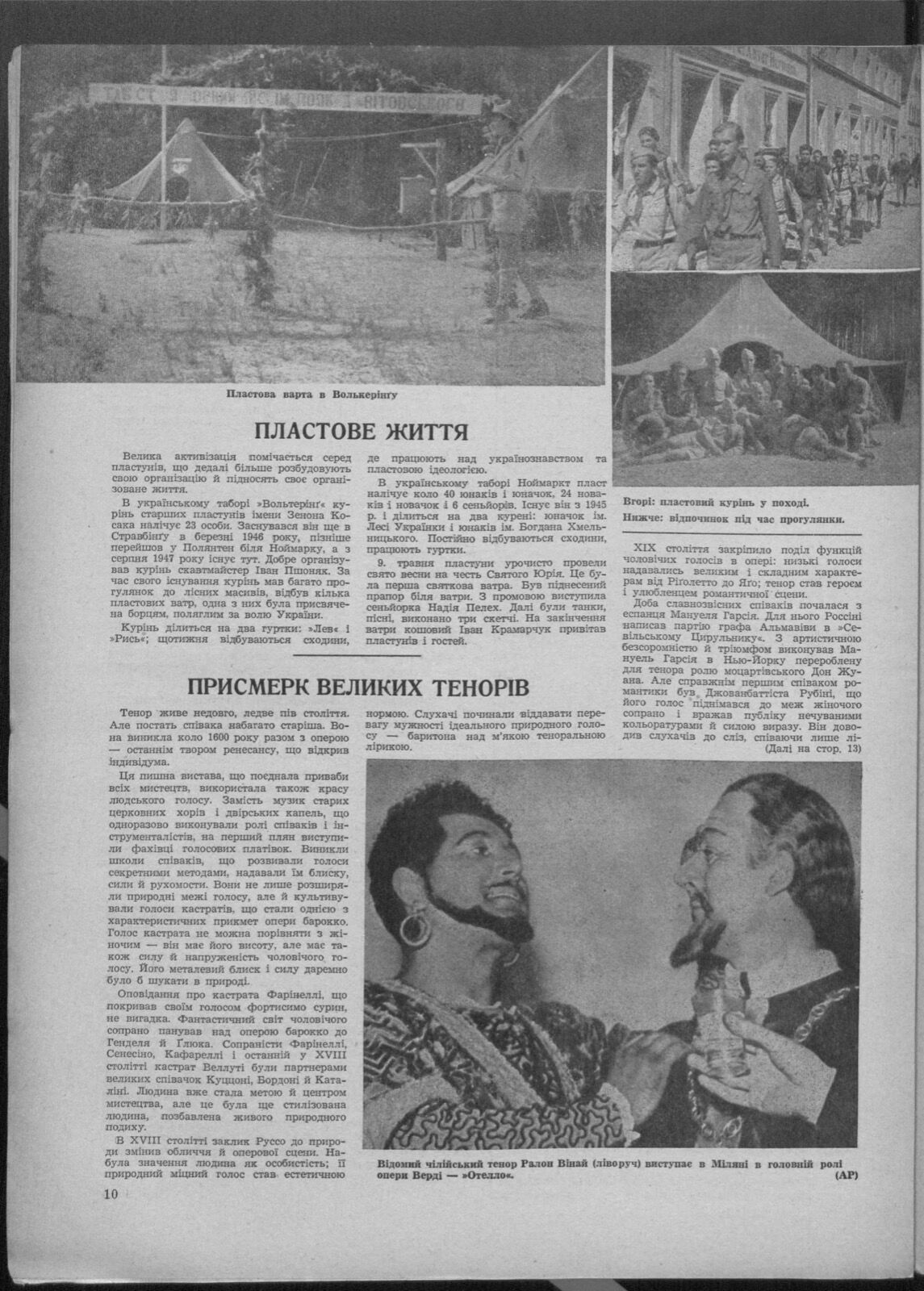
The illustrated Augsburg weekly Pu-hu printed a photograph captioned “Plast guard at Wolkering”: a scout on duty at the entrance to a tented camp beneath a painted banner. The report beside it describes the senior Plast kurin named after Zenon Kosak in the Ukrainian camp at Wolkering, twenty-three strong. It had been founded at Straubing in March 1946, had then moved to Polanten near Neumarkt, and had been at Wolkering since August 1947. The scoutmaster Ivan Pshoniak had organised it well; it had made many excursions into the forests and held several Plast campfires, one of them dedicated to those who had fallen for the freedom of Ukraine. The kurin was divided into two groups, Lev and Rys, and met weekly.
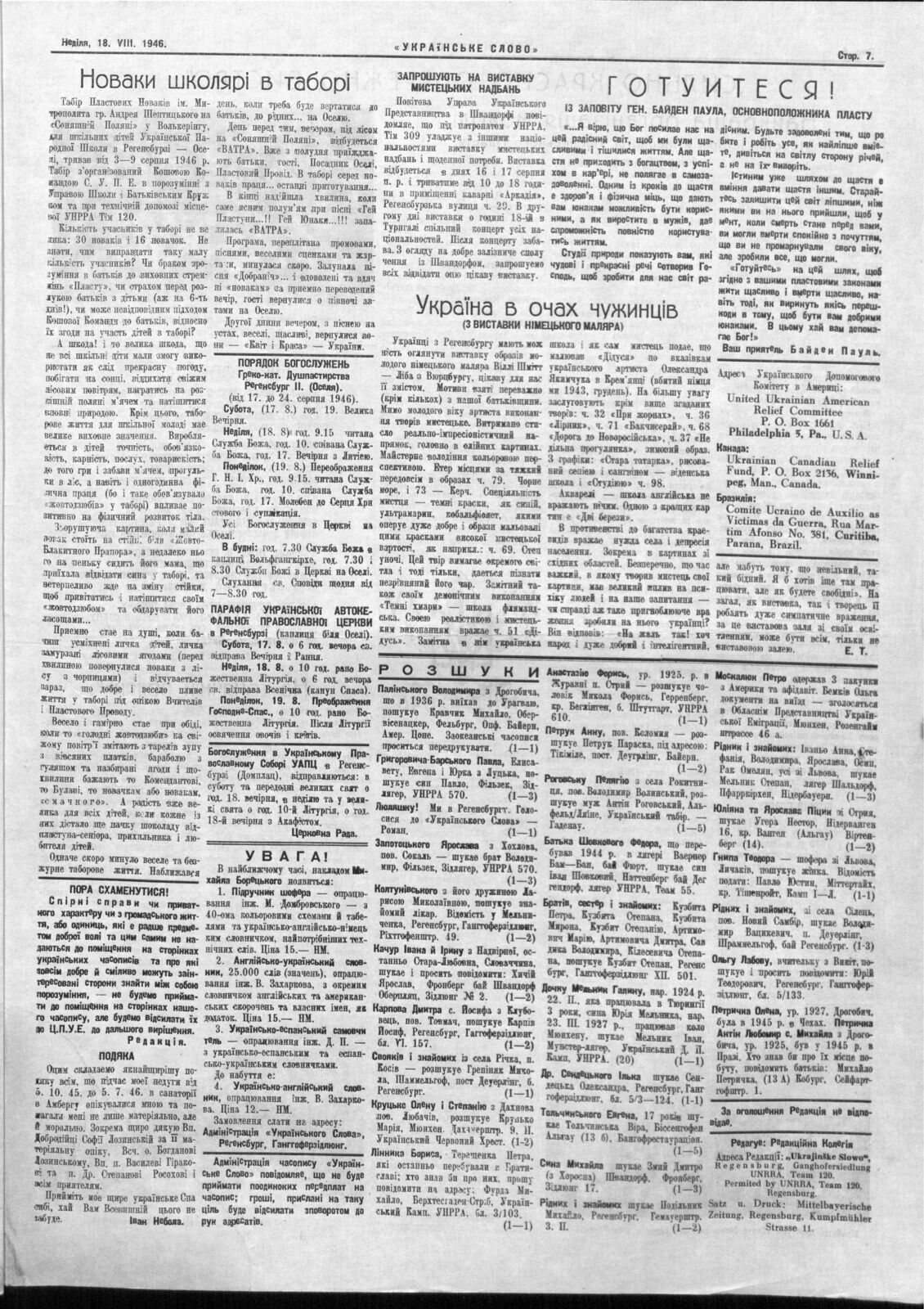
The report of the August 1946 Plast camp gives its numbers and its organisers. Thirty novice boys and sixteen novice girls took part. The camp was organised by the SUPE camp command in agreement with the school board and the parents’ circle, and with the technical assistance of the local UNRRA Team 120 — the same Regensburg team under which the Arolsen inventory lists the camp. A participant’s account on the following page describes the Plast leadership and the children’s parents coming out to them at the sunny glade in the Wolkering settlement.
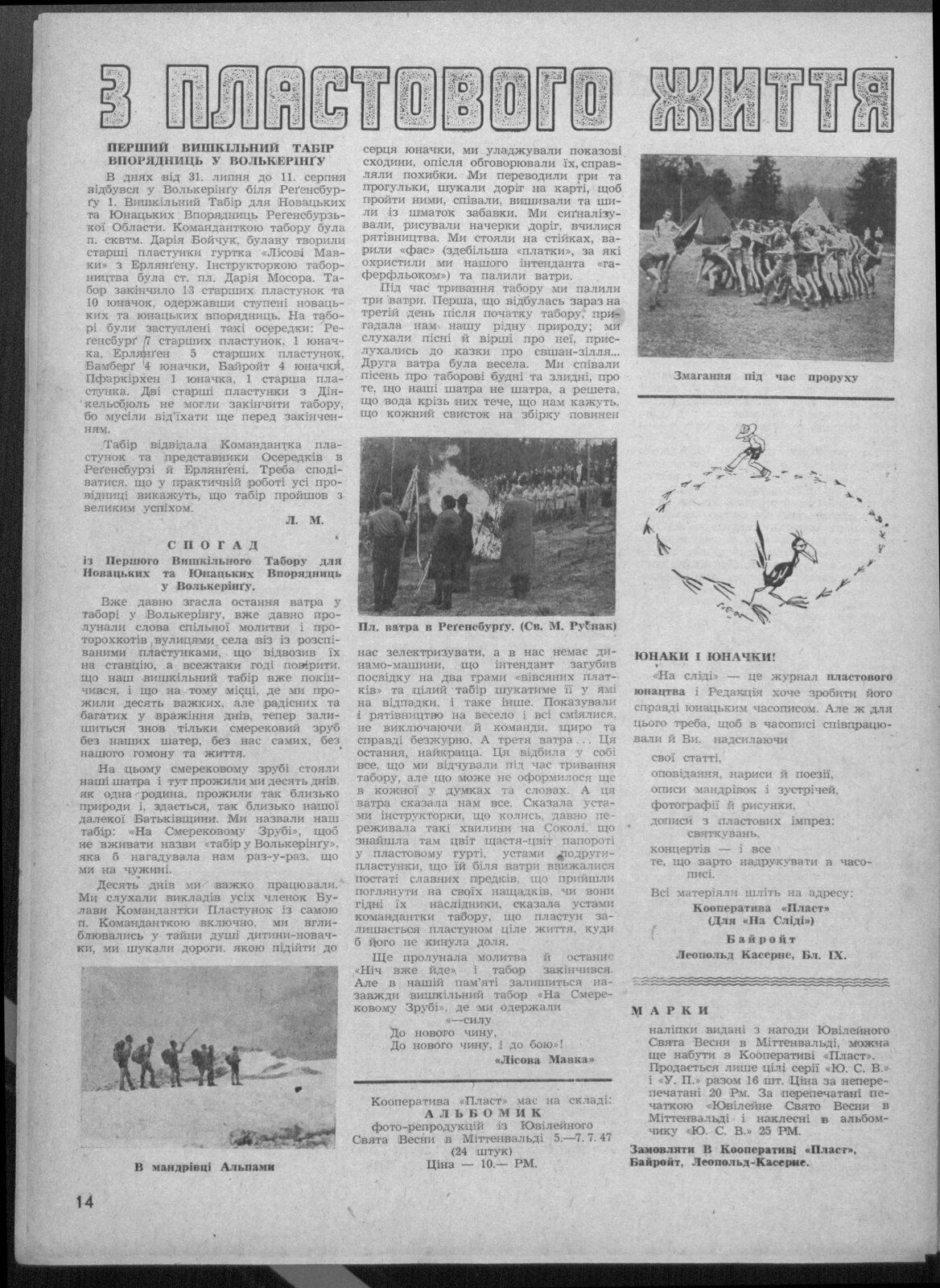
The 1947 leaders’ training camp left a note of how the participants thought about the place. A recollection printed beside the report explains that they named their camp Na Smerekovomu Zrubi, On the Spruce Felled Trunk, so as not to use the name “the camp at Wolkering”, which would have reminded them again and again that they were in a foreign land.
Wolkering also appears in reports of Ukrainian religious life in the district. Ukrainske slovo reported that Ukrainian pilgrim-emigrants from Regensburg, Schwandorf, Wolkering, Dingolfing and Rosenheim-Neubeuern-Schloss travelled together, led by their pastors, to the pilgrimage site at Altötting on the Inn on 28 August 1946, the feast of the Assumption.
Sources for this section
- Jubiläumsschrift 1200 Jahre Wolkering
- Gemeinde-Nachrichten April/Mai 2023: historical walk in Wolkering
- DP camp inventory: DP-Camp Wölkering, Wolkering (Kreis Regensburg)
- Political Refugees and Displaced Persons, 1945–1954: Research Report No. 2
- Plastova varta v Volkeringu (Plast guard at Wolkering) and Plastove zhyttia (Plast life), Pu-hu: universalnyi tyzhnevyi zhurnal, number 25, year II, page 10
- Новаки школярі в таборі (School cubs in camp), Українське слово, page 7
- Перший вишкільний табір впорядниць у Волькерінґу (The first training camp for leaders at Wolkering), На сліді, page 14
Run from Regensburg
Wolkering was administered from Regensburg throughout. The inventory places it under UNRRA Team 120 Regensburg, whose team director is recorded as Landstreet, and from November 1946 under Area Team 1046 Regensburg within Area 4, Amberg, with a field supervisor recorded as Barr. It carried the assembly centre number AC 93-353, replaced in September 1948 by the IRO designation NBO 406, and a capacity of 450 entered against 31 October 1947.
Team 120 also ran the Ganghofersiedlung in Regensburg, by far the largest centre in the district at a recorded capacity of 6,000, together with the von der Tann barracks, the district headquarters annexe, the general hospital and the Jewish community at Wörth an der Donau. Area Team 1046 reached much further out, over camps at Cham, Dingolfing, Ganacker, Hohenfels, Landshut, Michelsdorf, Straubing and Vilsbiburg among others. Set against these, Wolkering was a small unit: one village camp of a few hundred people in a district list of more than forty entries.
Arolsen Archives inventory entry for DP-Camp Wölkering
| Field | Value |
|---|---|
| Opening (first listing) | 24 January 1946 |
| Closing | 28 July 1949 |
| Capacity | 450 |
| Capacity date | 31 October 1947 |
| Assembly centre | AC 93-353; from September 1948 NBO 406 |
| UNRRA team | T 120 Regensburg; Area Team 1046 Regensburg from November 1946 |
| Team director | Landstreet |
| Area | A 4 Amberg |
| Field supervisor | Barr |
| Nationalities recorded | ukrainisch, polnisch, russisch |
| Archive references | ITS Dok-ID 82042369-82042377; Staatsarchiv Amberg 8913 (water supply 1948; camp with name lists 1945–1947) |
Sources for this section
Who was counted there
At the end of February 1946 two American officers inspected the camps of Team 120, and their reports were tabulated by nationality. Wolkering appears with 341 people: 283 registered as Ukrainians, 39 as Poles, eight as Belarusians, one as Latvian and ten as other. The Ganghofersiedlung in the same return held 5,729.
The contrast between the two columns is worth reading carefully. At Wolkering almost everyone was entered under a national heading. In the Ganghofersiedlung the single largest entry was 2,605 stateless people, ahead of 1,389 Lithuanians and 1,099 Poles, and the Ukrainian line stands empty. Ukrainians from western Ukraine and eastern Galicia had destroyed Soviet papers to avoid forced repatriation, so a return of this kind records the status a person could safely claim rather than the place they came from.
Later counts keep the Ukrainian figure at much the same level. Returns collected by the Central Representation of the Ukrainian Emigration during 1946 and 1947 counted 412 Ukrainians at Wolkering; UNRRA assembly-centre summaries gave 343 on 24 August 1946 and 343 on 31 May 1947, and the PCIRO summary of 2 January 1948 gave 381. Set against the inventory capacity of 450, these figures describe a camp in which Ukrainians were the great majority for its whole life, although the inventory also records Polish and Russian residents without a head count for any group.
Displaced persons of UNRRA Team 120 by reported nationality, early 1946
| Reported nationality | Wolkering | Siedlung Ganghofer |
|---|---|---|
| Poles | 39 | 1,099 |
| Belarusians | 8 | 380 |
| Stateless | — | 2,605 |
| Lithuanians | — | 1,389 |
| Ukrainians | 283 | — |
| Latvians | 1 | 198 |
| Other | 10 | 58 |
| Total | 341 | 5,729 |
Ukrainians recorded at Wolkering
| Date | Ukrainians | Source scope |
|---|---|---|
| 1946–47 | 412 | Central Representation of the Ukrainian Emigration questionnaire |
| 24 August 1946 | 343 | UNRRA assembly-centre summary |
| 31 May 1947 | 343 | UNRRA assembly-centre summary |
| 2 January 1948 | 381 | PCIRO assembly-centre summary |
The surviving record
The records of the camp survive in more than one archive. The Arolsen Archives hold lists and documents for Wolkering, among them strength and change reports, under document identifiers 82042369 to 82042377. The Staatsarchiv Amberg holds files from the Bezirksamt Regensburg on the water supply of the DP camp in 1948 and on the camp itself with name lists for 1945 to 1947.
The Boshyk and Balan research guide locates the third body of material precisely. Within the IRO series AJ 43 in the Archives nationales de France, one carton gathers documents on a run of American-zone camps, and its entry 46 reads “Camp Wolkering à Wolkering, octobre 1947 – juillet 1949”. Its neighbours in the same carton include the Wildflecken staging centre, the Northern Kaserne at Würzburg, the von der Tann barracks at Regensburg and Maierhof at Passau — the same Regensburg district company the camp kept in the UNRRA lists.
After the camp
The barracks were used for German refugees and expellees as well as displaced persons, according to the local history group. The camp site is still a known place in the village: in April 2023 the Historischer Arbeitskreis Wolkering led a walk along the regulated stream to the grounds of the former Labour Service camp, and the 2022 anniversary publication for 1,200 years of Wolkering included the camp in its chronology.
Wolkering itself remained an independent municipality until 1 January 1972, when it merged into Thalmassing, and had 377 inhabitants in April 2025 — fewer people than the camp on its edge was rated to hold. The camp survives in the village as a line in a chronology and a stop on a local history walk, and elsewhere as files in Bad Arolsen, Amberg and Paris.
Sources
- DP camp inventory: DP-Camp Wölkering, Wolkering (Kreis Regensburg)
Arolsen Archives · 26 October 2023
Entry 1633: dates, nationalities, capacity 450 at 31 October 1947, assembly centre numbers, UNRRA team and archive references. Serial dates converted from the Excel epoch.
- Jubiläumsschrift 1200 Jahre Wolkering
Gemeinde Thalmassing, hosted by Heimatforschung Regensburg · June 2022
Chronology on PDF pages 26 and 27: 1935 Labour Service camp of sixteen barracks for about 500 people; 1945 to 1947 Ausländerlager for displaced persons; 1948 water supply of the DP camp.
- Gemeinde-Nachrichten April/Mai 2023: historical walk in Wolkering
Gemeinde Thalmassing · April 2023
Page 15: the local history group’s summary of the stream regulation, the 1935 barracks camp, Labour Service use to the end of the war and subsequent accommodation of displaced persons and refugees.
- Ukrainian Population Migration after World War II
Ihor Stebelsky, in The Refugee Experience, Canadian Institute of Ukrainian Studies Press · 1992
Table 7, printed page 50, Wolkering row: 412 (1946–47 questionnaire), 343 (UNRRA, 24 August 1946), 343 (UNRRA, 31 May 1947), 381 (PCIRO, 2 January 1948). Column assignment checked against the PDF layout.
- Political Refugees and Displaced Persons, 1945–1954: Research Report No. 2
Yury Boshyk and Boris Balan, Canadian Institute of Ukrainian Studies · 1982
Printed page 36: the French national archives’ IRO series AJ 43 contains a file on Camp Wolkering, October 1947 to July 1949.
- Die unbekannte Ukraine in der Ganghofer-Siedlung Regensburg
Robert Werner, Regensburg Digital · 19 December 2025
Table 1, “Vertriebene des UNRRA-Teams 120 nach gemeldeter Nationalität Anfang 1946”, read in full: the Wolkering column gives 39 Poles, 8 Belarusians, 283 Ukrainians, 1 Latvian and 10 other, total 341, beside 5,729 at the Ganghofersiedlung. The author compiled the table from the displaced persons camp inspection reports of Lieutenant-Colonel Chauncey Brooks, 23 February 1946, and Major Robert B. Fulton, 25 February 1946.
- Wolkering (Thalmassing)
Wikipedia (German) · Accessed 14 September 2026
Village article read: 377 inhabitants at 8 April 2025; independent municipality until it merged into Thalmassing on 1 January 1972; the parish church of Mariä Himmelfahrt, a hall church with recessed choir and west facade tower, built 1746.
- Новаки школярі в таборі (School cubs in camp), Українське слово, page 7
Ukrainske slovo, Ukrainian weekly, Regensburg; digitised in the Ukrainian Museum-Archives of Cleveland Displaced Persons Camp Periodicals Collection with the United States Holocaust Memorial Museum · 18 August 1946
Report of the Plast cub camp named after Metropolitan Andrey Sheptytsky, held on the Soniashna Poliana at Wolkering from 3 to 9 August 1946 for the schoolchildren of the Ukrainian people’s school in the Regensburg settlement, organised by its Kosh command. Public domain or an orphan work as marked by the holding libraries, and offered on the Internet Archive under a Creative Commons Attribution-NonCommercial-NoDerivatives 4.0 licence; the page is reproduced whole and unaltered.
- Перший вишкільний табір впорядниць у Волькерінґу (The first training camp for leaders at Wolkering), На сліді, page 14
Na slidi, journal of Plast youth, Kooperatyva Plast, Bayreuth; digitised in the Ukrainian Museum-Archives of Cleveland Displaced Persons Camp Periodicals Collection with the United States Holocaust Memorial Museum · 1947
Report and signed recollection of the first training camp for cub and youth leaders of the Regensburg district, held at Wolkering near Regensburg from 31 July to 11 August, with thirteen cub leaders and four youth leaders qualifying. Public domain or an orphan work as marked by the holding libraries, and offered on the Internet Archive under a Creative Commons Attribution-NonCommercial-NoDerivatives 4.0 licence; the page is reproduced whole and unaltered.
- Plastova varta v Volkeringu (Plast guard at Wolkering) and Plastove zhyttia (Plast life), Pu-hu: universalnyi tyzhnevyi zhurnal, number 25, year II, page 10
Verlag “Pu-hu”, Augsburg · 1948
Digitised by the Ukrainian Museum-Archives of Cleveland with the United States Holocaust Memorial Museum in the Displaced Persons Camp Periodicals Collection; marked public domain or an orphan work and offered under Creative Commons Attribution-NonCommercial-NoDerivatives 4.0. A published photograph captioned as a Plast guard at Wolkering, with a report on the senior Plast kurin in the camp. The issue is undated on its cover; the following number is dated 20 September 1948.
Last researched 12 September 2026