Woodside Migrant Hostel
Arrival and settlement
Woodside, Adelaide Hills, South Australia · 1949–1963
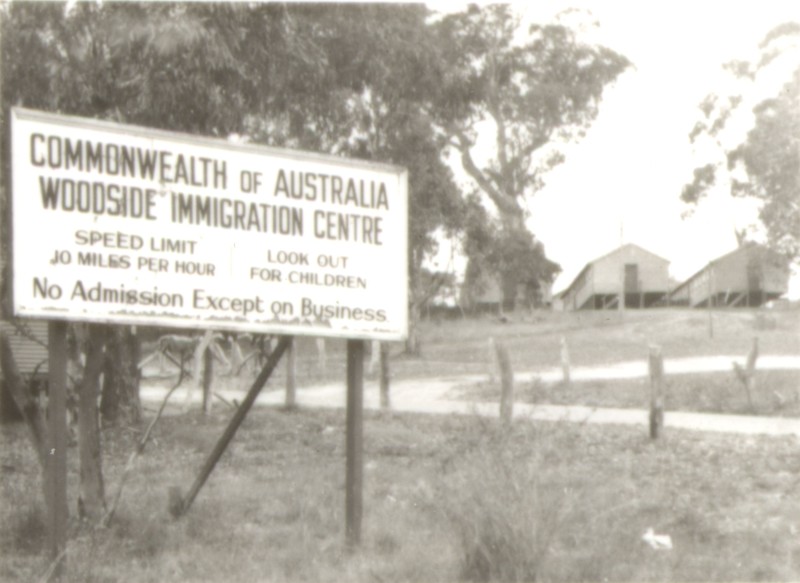
Woodside was a Commonwealth migrant hostel in converted army barracks in the Adelaide Hills, open from 1949 to 1963, through which about 26,000 displaced people and assisted migrants passed. Ukrainians were among its first residents, and the first Ukrainian organisation founded in Australia was formed in May 1949 to help them.
Introduction
Woodside received newcomers and also worked as a holding centre for women and children whose husbands and fathers had been sent to jobs elsewhere. Its international community included Ukrainians: they were among the first residents, alongside Estonians, Latvians, Lithuanians, Yugoslavs, Hungarians and a large group of Poles. German was the most widely shared language, and signs were posted in English and German. Later assisted migrants came from the Netherlands, Greece and Italy.
The Ukrainian Association of South Australia was formed in May 1949 specifically to help Ukrainians arriving at Woodside, and was the first Ukrainian organisation established in Australia. The Ukrainian-language newspaper Yednist began publication in Adelaide soon afterwards. A male choir, Homin, was founded on 8 June 1949 at a railway builders’ camp under the direction of J. Klish, and the dance ensemble Kolomyjka followed under A. Kravetskyj; both performed at the Adelaide Town Hall that October. These were bodies of the wider South Australian Ukrainian community rather than of the hostel itself.
Sources for this section
A history in dates
- 1927The army establishes Woodside Camp.
- May 1949The Ukrainian Association of South Australia forms to assist Ukrainians arriving at Woodside, the first Ukrainian organisation in Australia.
- June 1949An afternoon tea, concert and craft show arranged by residents launches the immigration reception and training centre, with 1,000 migrants present.
- 1949Woodside Camp School opens.
- Summer 1949–50An Estonian school is established at the hostel, teaching twelve children aged six to eleven.
- 1951A creche and baby clinic are established; more than half the 1,700 residents are children.
- 1959Numbers fall and a proposal to house British migrants at the site is rejected.
- 1960Children with enough English begin transferring to Oakbank Area School.
- 1962The camp school closes.
- 1963Migrant accommodation ends.
Army barracks become a migrant centre
The army camp had been established in 1927 and expanded during the Second World War. Its barracks and training facilities provided the existing infrastructure from which the reception centre developed. Migration and military activity later coexisted on the wider property.
Residents celebrated the opening in June 1949. The centre was run as five accommodation blocks, each with its own kitchen, while mess rooms and washing facilities were communal.
The plan was modest at first: two areas of the existing camp were to become a holding centre where women and children could stay when there was no accommodation where the men had been sent to work. As the intake of displaced people rose faster than the government could house them, Woodside was expanded. The army kept part of the camp, and children remembered collecting spent cartridge cases from the firing range. Sleeping quarters were converted barracks, some left as dormitories and some partitioned into bedrooms.
A South Australian heritage assessment places Woodside among the nine Commonwealth and four State government hostels established across the state between 1949 and 1950, alongside Finsbury and Pennington, Gawler and Willaston, Gepps Cross, Glenelg, Mallala, Rosewater, Smithfield, Whyalla, Elder Park, Hendon, Semaphore and Woodville.
Sources for this section
Work and family separation
For Ukrainians entering Australia under the displaced-persons programme, the first jobs were generally tied to two-year government contracts. In South Australia men worked on the railways, in water supply and factories; women commonly found domestic work in hospitals. These employment patterns help explain why a family’s housing and a parent’s workplace could be far apart.
A Dutch mother’s oral history describes her husband travelling to Adelaide during the working week and returning on Friday evenings. She recalled children attending school, walks among the flowers and friendships with other Dutch families, while also remembering Polish, Ukrainian, German and Czech neighbours. Her account captures both a multinational setting and the practical strain of living away from work.
Two residents interviewed in 1994 for the Boatload of Dreams project remembered the place very differently. Krystyna Pindral, at Woodside from 1950 to 1955, recalled a happy childhood even though her father was working elsewhere and her mother was out at work. Ryszard Kazimir Kobylinski, there from 1949 to 1954, said the accommodation was worse than the camps he had known in Europe, with no heating and no wooden floors, and that the difference was that at Woodside people were free and had enough to eat.
Shared spaces and different memories
The camp was run as five blocks, each with its own kitchen and supervisor. Mess rooms, laundries, linen stores, showers and toilets were shared, as at other hostels. There was a canteen, a recreation hall and cinema facilities, and a hospital with maternity, general and children’s sections; a creche and baby clinic were added in 1951.
The same oral history recalls large outdoor laundries and showers some distance from the family’s hut, without doors. The beauty of the surroundings and friendly company did not remove the discomfort of shared facilities. For someone accustomed to a private house, camp accommodation could feel like a sharp loss of independence.
A hospital, cinema, recreation hall, football and concerts supported community life. Camp footballers also played against local teams.
Films were shown regularly, and craft displays, a ball and other events raised money for amenities. The Good Neighbour Council, the Red Cross, the Young Women’s Christian Association, the Boy Scouts and the Girl Guides were all active on site. A Catholic chaplain was based at the hostel and visiting priests held services in several languages and for more than one denomination. The Woodside United soccer team, with players from six countries, was almost undefeated in its 1949 season against South Australian sides.
Lutheran services for Baltic South Australians were also held at the hostel, after the first such service at a migrant camp in Port Adelaide on 10 October 1948.
Facilities recorded at the centre
| Facility | Detail |
|---|---|
| Accommodation blocks | Five, each with its own kitchen and supervisor |
| Sleeping quarters | Converted army barracks, some dormitory style, some partitioned into bedrooms |
| Shared facilities | Mess rooms, laundries, linen stores, showers and toilets |
| Hospital | Three sections: maternity, general and children |
| Child care | Creche and baby clinic established 1951 |
| Schooling | Primary school on site; high school pupils attended Oakbank area school |
| Leisure | Canteen, recreation hall and cinema facilities |
School and language
Woodside Camp School opened in 1949 for migrant children and some children of camp staff. Many pupils initially knew little or no English. From 1960, children who had gained sufficient English transferred to Oakbank Area School; the camp school closed in 1962.
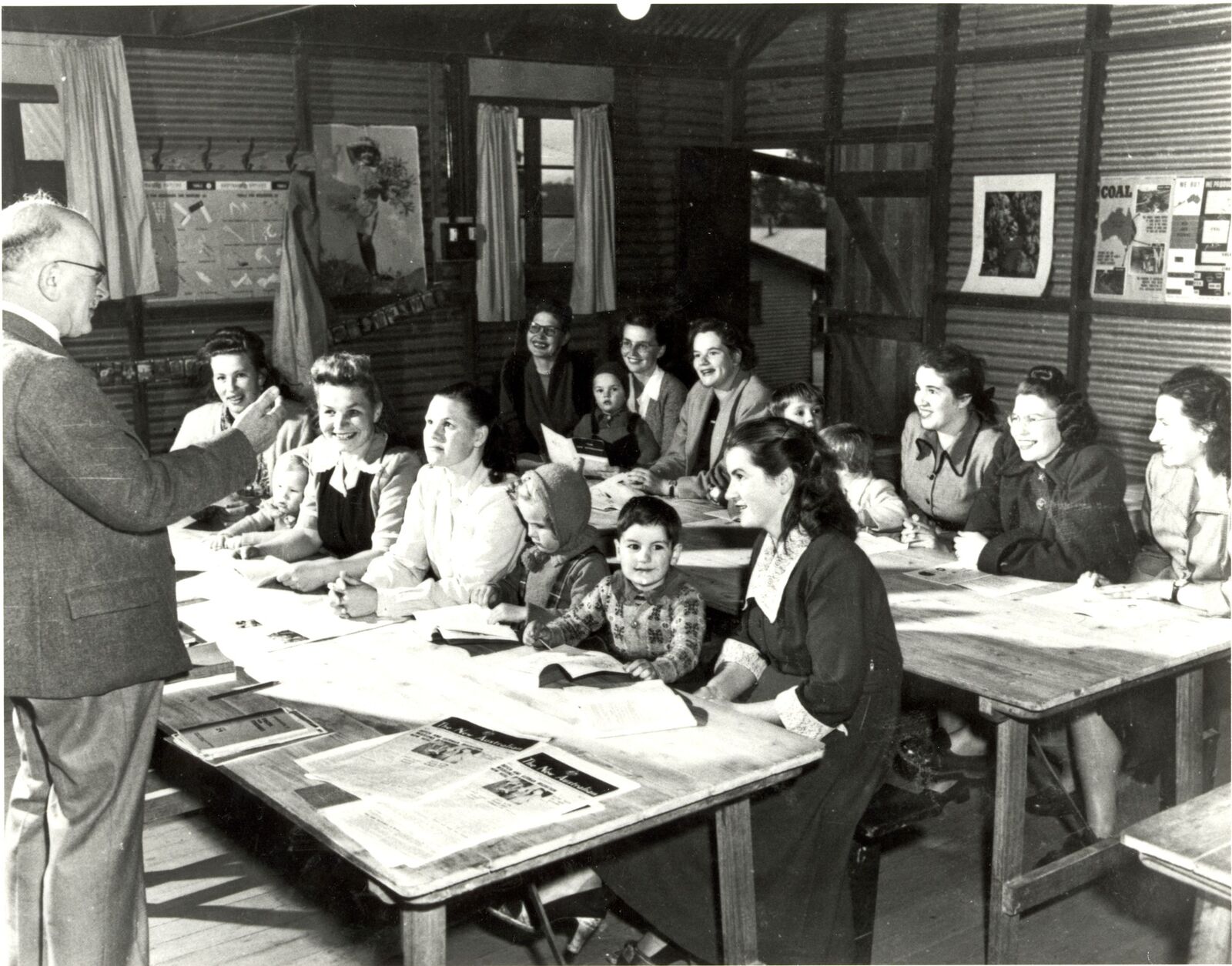
A 1952 photograph shows women and children attending an English class at the centre.
Communities also organised their own teaching. An Estonian school was established at the hostel in the summer of 1949–50; some of the Estonian displaced persons in the camp had been school teachers and had brought textbooks with them, and the school at first had twelve children aged from six to eleven.
Sources for this section
Closure and the later site
In 1951 The Advertiser reported that more than half of Woodside’s 1,700 residents were children and that the centre had one of the highest birth rates in Australia. By 1959 numbers at what was by then the Woodside Migrant Accommodation Centre were dwindling. The government considered housing British migrants there, decided the site was unsuitable, and carried on with European arrivals until 1963.
About 26,000 migrants passed through Woodside. The hostel continued until 1963, after numbers declined in the late 1950s. It was one of at least twelve migrant hostels operating in South Australia between 1947 and the mid-1980s, and was administered by the Commonwealth from 1949 to 1963.
The military property remained in use after the migrant hostel closed. Defence’s current account places it on Nairne Road and records the sale of the separate Inverbrackie married-quarters area in 2015. In 2026, the department identifies Woodside Barracks for divestment after most personnel moved to RAAF Base Edinburgh.
The heritage assessment records that the site continues in military use as the Woodside Army Barracks and that most of the early buildings were replaced with brick structures in about the 1980s.
Woodside in figures
| Date or period | Figure | What it describes |
|---|---|---|
| June 1949 | 1,000 | Migrants present at the opening event |
| 1951 | 1,700 | Residents reported by The Advertiser, more than half of them children |
| 1949–1963 | About 26,000 | Displaced people and assisted migrants passing through in total |
Sources
- Woodside Migrant Hostel
History Trust of South Australia / Migration Museum · 2013–2014 research
Karen Agutter and Catherine Manning; Hostel Stories exhibition research and photographic catalogue. Draws on Migration Museum research files, the Boatload of Dreams oral histories (1994) and the State Library of South Australia Hostel Stories oral history project, OH 948. Re-read in full on 13 September 2026.
- Ukrainians in South Australia
History Trust of South Australia · Undated
Ukrainian settlement, employment and community organisation.
- Woodside Camp School, GA2304
State Records of South Australia · 1949–1962
Agency history and school records.
- Preserving Memories: Catherina van der Linden oral history
City of West Torrens / West Torrens Historical Society · 2023
Page 24: first-person memories of Woodside; author named here for source attribution.
- Woodside Camp
Australian War Memorial · Undated
Military establishment and subsequent use; camp-wide military chronology distinguished from migrant hostel closure.
- Woodside Barracks
Australian Government Department of Defence · Accessed 12 September 2026
Current estate information and proposed divestment; Nairne Road site.
- Migrant Hostels and Work Camps
SA History Hub, History Trust of South Australia · Accessed 13 September 2026
Karen Agutter and Catherine Manning. Lists Woodside as a Commonwealth hostel operating 1949–1963 among at least twelve South Australian hostels, and describes how hostels were funded and run.
- Estonians in South Australia
SA History Hub, History Trust of South Australia
Section “Community Activities” read: an Estonian school established at Woodside Migrant Hostel in the summer of 1949–50, its first twelve children aged six to eleven taught by Estonian displaced persons who had been teachers and had brought textbooks with them; and Lutheran services for Baltic South Australians held at the hostel after the first such service at a migrant camp in Port Adelaide on 10 October 1948.
- Heritage Assessment Report: Glenelg North Migrant Hostel
Department for Environment and Water, Government of South Australia · 2019
Printed pages 12, 19 and 22 read: the nine Commonwealth and four State government hostels established in South Australia from 1949 to 1950, Woodside among them; the Woodside hostel opening in 1949 and closing in 1963; and the site continuing in military use as the Woodside Army Barracks, with most of the early buildings replaced by brick structures in about the 1980s.
Last researched 13 September 2026