Yallourn South
Arrival and settlement
Yallourn · Victoria · Australia · 1950–1953
A Commonwealth migrant hostel stood south of Yallourn Hospital, about four miles west of Morwell, operating from 1950 to 1953 with a state school in its recreation hut. It was one of at least six workers’ camps and hostels in the Yallourn area and must not be confused with them.
Introduction
Yallourn South was a short-lived Commonwealth migrant hostel in Victoria’s industrial Latrobe Valley. Operating from 1950 to 1953, it stood south of Yallourn Hospital and accommodated families in a district shaped by coal mining and electricity generation.
Yallourn appears in the Ukrainian community’s 1966 history among the Victorian camps where families lived after arrival in Australia. That account uses the town name. The documented South hostel provides a distinct family-accommodation history within the wider Yallourn settlement story.
Sources for this section
A history in dates
- 1949The Commonwealth migrant hostel is established south of Yallourn Hospital.
- 1950The hostel and its on-site school are operating.
- February 1952A newly arrived British family moves into the South camp before settling in Morwell.
- 1952The recorded operating period of the migrant-centre school ends.
- 1953The hostel closes.
- 11 September 1953Twenty-five Nissen huts are offered at auction on the instructions of the Department of the Interior.
A separate camp south of the town
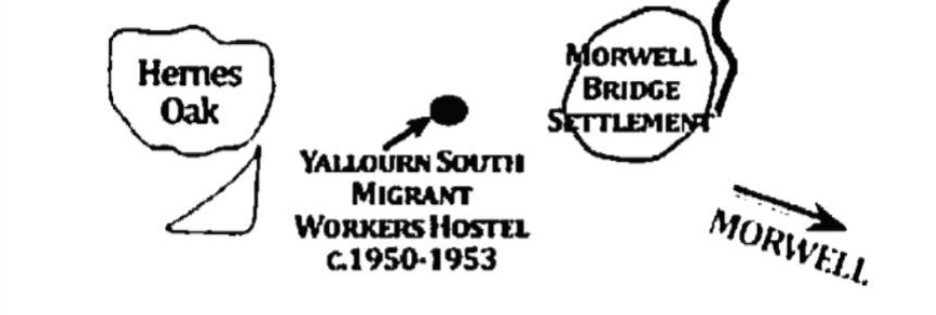
The South hostel was established in 1949. It was different from the older South Camp near the briquette factory, which had closed in 1939, and from the Eastern Road Hostel. These were separate sites with different operating periods, even though local memories and captions often use the broader name Yallourn.
A list compiled by Virtual Yallourn from Joseph Sestokas’s map sets out six accommodation sites in the district and their dates: the North Camp of 1887 to 1959, the East Camp of 1920 to 1928, the West Camp of 1921, the original South Camp of 1921 to 1939, the Eastern Hostel of 1949 to 1971 and the Yallourn South Migrant Workers Hostel of 1950 to 1953, besides married quarters towards the Latrobe River. Sestokas’s own book is a study of the North Camp, where displaced people were housed, so a reference to Ukrainians at Yallourn need not point to the South hostel at all.
Camps and hostels in the Yallourn area
| Name | Dates |
|---|---|
| North Camp | 1887–1959 |
| East Camp | 1920–1928 |
| West Camp | 1921 |
| South Camp (original) | 1921–1939 |
| Eastern Hostel | 1949–1971 |
| Yallourn South Migrant Workers Hostel | 1950–1953 |
| Married Quarters, towards the Latrobe River | Not dated |
Sources for this section
Children, school and everyday surroundings
Children could attend State School No. 4673 inside the migrant centre’s recreation hut. The school operated in 1950 to 1952 and averaged about thirty pupils. A building intended for leisure therefore also served as a classroom, bringing education into the temporary accommodation complex rather than requiring children to begin with an established school elsewhere.
A British family’s account gives a closer view of arrival. They reached Melbourne in February 1952 and moved to the Yallourn South migrant camp, where they lived in a curved metal hut. A young child remembered bush around the camp and the excitement of seeing kangaroos. Her father, a motor mechanic, found work in Morwell; the family later moved into a house there. For this household the camp was an initial foothold, followed by local employment and an ordinary residential street.
Sources for this section
The huts and their dispersal
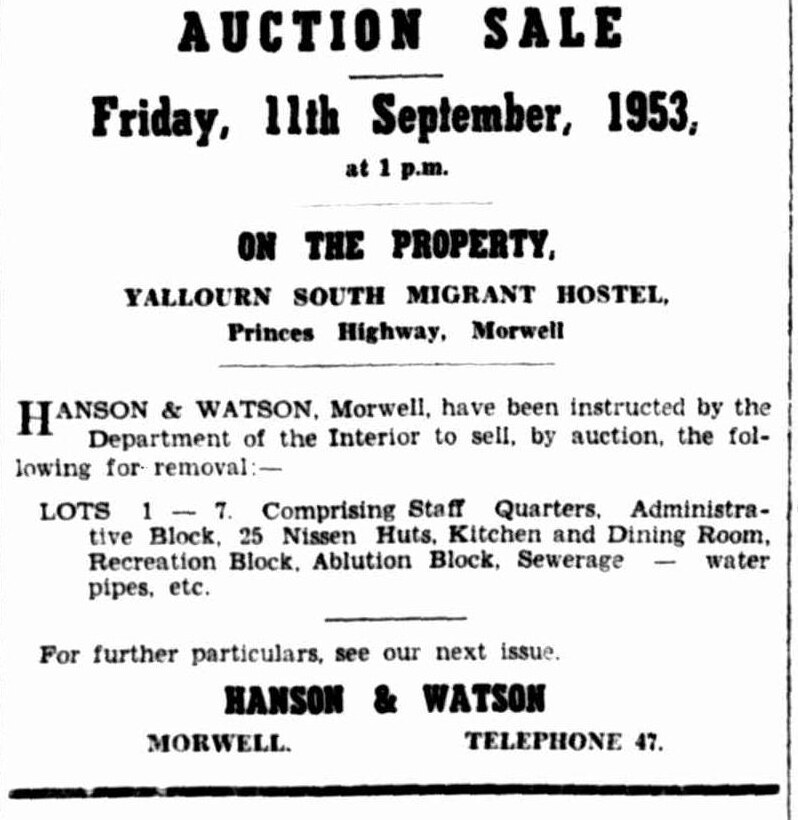
The accommodation did not remain intact after the hostel closed. An auction on 11 September 1953 offered twenty-five Nissen huts at the Yallourn South site. Their hardwood ends and floors could be moved with the structures, while internal partitions had divided some into smaller spaces. Buyers could purchase a whole hut or separate units. The sale turned temporary government accommodation into reusable building material.
The auction was held on the instructions of the Department of the Interior, the Commonwealth department responsible for such property, and conducted by the Morwell firm Hanson and Watson on a site described as about four miles west of Morwell. The Yallourn newspaper the Live Wire reported that the sale drew a large crowd of buyers and onlookers, that one well-known Morwell citizen paid about 240 pounds for the first hut, and that ten further huts then went for little more than 114 pounds each.
Accommodation offered at the 1953 auction
| Recorded feature | Detail |
|---|---|
| Nissen huts offered | 25 |
| Hut dimensions | 42 × 16 feet |
| Ends and floors | Hardwood |
| Internal divisions | Some huts had masonite partitions |
| Sale format | Whole huts or separate units |
| Prices reported | About 240 pounds for the first hut; ten further huts at little more than 114 pounds each |
Sources for this section
A lasting Ukrainian community in the valley
The region offered work beyond the camp gates. Ukrainian newcomers joined other migrants at the Latrobe Valley’s mines and power stations, including Yallourn, and many settled locally after completing their initial employment contracts. State Library Victoria’s account connects this continued settlement to the security of industrial work.
Community life subsequently developed around a Saturday school teaching Ukrainian language and culture, and a hall used for concerts, religious celebrations, folk dancing, weddings and meetings. Neighbours were invited to take part. These were institutions of the wider Latrobe Valley Ukrainian community: the South hostel was one temporary accommodation site within a much longer regional history.
The association that grew out of that settlement met in a hall which had been moved from Yallourn and rebuilt at Newborough. It closed in 2014, its president saying that the first generation of Ukrainian migrants had largely gone and that support and funds had run out; under an agreement with the Association of Ukrainians in Victoria the proceeds of the hall’s sale were to go towards a monument at the Immigration Park in Morwell. The president, who reached Australia by boat in 1949 as a two-year-old, described parents taken to Germany as forced labourers, then displaced persons camps, then three camps in Australia before the family settled at Sale, with his father returning at weekends from railway work at Moe. None of this is attached to the South hostel specifically.
Sources for this section
Sources
- Ukrainians in Australia, volume 1
Ukrainian community, Melbourne, 1966 · Undated
Printed page 84 visually read. Names Yallourn as a Victorian family camp; does not explicitly say South. National discussion of family separation is not assigned individually to this hostel.
- Welcome to Little Europe: Camps, chapter 1
Joseph Sestokas, 2010 · Undated
Printed page 17 separates original South Camp from Yallourn South Commonwealth Migrant Hostel, established 1949 and operating 1950–1953. Later chapter on South not available/read.
- School histories: Yallourn South State School
Morwell Historical Society, 10 November 1970 · Undated
Printed page 40, PDF page 59 visually read. Dates are 1950–1952; OCR mistakenly renders first year 1920. School in recreation hut, average about 30 pupils.
- A family’s arrival at Yallourn South
Churchill & District News, 13 April 2006 · Undated
Page 12 original biographical account. British family February 1952 arrival, South camp huts, local mechanic work, Morwell housing. No resident names reproduced.
- Looking Back: White City and Nissen Huts
Leo Billington, Churchill & District News, October 2025 · Undated
Original local research citing the September 1953 auction, the Department of the Interior’s instructions, the auctioneers, the hut dimensions and the prices reported by the Yallourn newspaper the Live Wire. White City houses distinguished from Nissen huts. The contemporary auction notice was not separately read.
- Velvet, Iron, Ashes: Ukrainian settlement in the Latrobe Valley
State Library Victoria · Undated
Original museum photo-essay captions read. Ukrainian work and cultural institutions concern the regional community, not exclusively South hostel.
- Images of Yallourn: The Yallourn Migrant Hostel
Virtual Yallourn · Undated
PDF page 2 reproduces Sestokas’s 2010 camp map; the accompanying page lists six camps and hostels in the Yallourn area with their dates, including the Yallourn South Migrant Workers Hostel, 1950–53. Southern detail only used for the image. Other photographs have uncertain South-hostel identity and were excluded.
- Closing pain for Ukraine
Latrobe Valley Express · 5 February 2014
Original reporting on the closure of the Latrobe Valley Ukrainian Association and its Newborough hall, with recollections from the association’s president. Concerns the regional Ukrainian community, not the South hostel.
- Advertising: Auction sale, Yallourn South Migrant Hostel
Morwell Advertiser (Morwell, Victoria), page 2 · 20 August 1953
Preliminary auction notice naming the Yallourn South Migrant Hostel on the Princes Highway, three and a half miles west of Morwell, instructed by the Department of the Interior, listing lots 1–7: staff quarters, administrative block, twenty-five Nissen huts, kitchen and dining room, recreation block, ablution block and sewerage and water pipes. Digitised by the National Library of Australia; Australian material published before 1955 is out of copyright.
Last researched 13 September 2026