Balt Cygnet
Germany to Britain·October 1946 to spring 1947
Balt Cygnet was the first British recruitment scheme to take displaced persons out of the German camps, bringing Baltic women to work in tuberculosis sanatoria and hospitals from October 1946. It was extended to Ukrainian women before it closed, and it set the pattern that the much larger Westward Ho scheme followed from the spring of 1947.
Introduction
Balt Cygnet was a labour scheme run by the British Ministry of Labour from the autumn of 1946. It recruited women from the displaced persons camps of the British zone of Germany for hospital and sanatorium work in Britain, and it was the first Allied scheme to move displaced people out of the camps into employment abroad. Everyone admitted under it was classified as a European Voluntary Worker, the same status later given to Westward Ho recruits.15
It should not be confused with Westward Ho, which was a separate and far larger scheme approved in 1946 and opened for recruitment in the spring of 1947. Balt Cygnet was small, single sex, confined to one part of the economy and effectively over by the middle of 1947. Westward Ho took men and women of many nationalities into agriculture, forestry, mining and textiles and ran until 1949.16
A history in dates
- Autumn 1946The British government introduces the Balt Cygnet labour scheme for Baltic women in the German camps.1
- 16 October 1946The first party of a hundred women leaves Lubeck displaced persons camp by sea for Tilbury.1
- 1946 to 1947Eligibility widens: nurse and midwife training, women up to fifty, and recruitment in the American zone.1
- By May 1947Almost 2,500 Latvian, Lithuanian, Estonian and Ukrainian women have arrived under the scheme, in twenty-three parties of about a hundred.1
- End of April 1947The first Westward Ho recruits arrive through Tilbury and Hull, and Balt Cygnet is superseded.1
- May 1947Balt Cygnet is merged with Westward Ho, and recruitment is extended to women of other nationalities, most notably Ukrainians.8
- End of May 1947Nearly 10,000 displaced persons have arrived under Westward Ho, 42 per cent of them women.1
Origins and purpose
Two pressures produced the scheme. British hospitals and tuberculosis sanatoria could not fill domestic posts that local applicants found unattractive, and the occupying powers were carrying a heavy cost for camps in Germany whose populations would not be repatriated. Recruiting camp residents into unfilled British jobs answered both problems at once.1
The choice of Baltic women was deliberate and was defended in terms that later readers find uncomfortable. British officials described them as scrupulously clean in their persons and habits and as the spirit and stuff of which Britons could be made; official papers rated them above rural Polish women and treated marriage to British men as a benefit. Balts were the most favoured category of displaced person in British policy, and Ukrainians stood well below them.23
A study of National Health Service staffing records the Attlee administration authorising the recruitment of 5,000 women from Estonia, Latvia and Lithuania in 1946, mostly to work in understaffed tuberculosis sanatoria. A French account of the Baltic displaced adds that the women were chosen on the basis of their moral values and because, in the eyes of the project's supporters, they could not be suspected of war crimes.1011
Sources for this section
- The beginning of refugee immigration (1946) and the early years (to about 1950)
- When the war was over: European refugees after 1945. Briefing Paper 6, Coming to Britain
- 'Betweenness': The Lives of Latvian Women Migrants
- The making of 'NHS staff' as a worker identity, 1948-85
- Hitler's Accomplices or Stalin's Victims? Displaced Baltic People in Germany from the End of the War to the Cold War
How it worked in practice
Ministry of Labour officials visited the camps with leaflets setting out the terms. The first phase sought unmarried women aged eighteen to forty who were in good health, not pregnant and free of dependants, for work as cleaners, ward maids, kitchen hands and laundry workers. Applicants with nursing experience could ask to be trained as nurses, but no request was guaranteed. Placement in a sanatorium or a mental hospital required the worker's explicit consent.51
The contract fixed the worker to a designated employer. Wages matched those of British women doing the same work, and board and lodging came with the post, along with an identity card, a ration card and a clothing coupon allowance. Sickness pay was available for temporary illness only; repeated or prolonged sickness meant return to a camp in Germany. Recruits could not change employment or residence without Ministry of Labour approval, and as aliens they had to register with the police whenever they changed job or address.52
Transport went by sea across the North Sea. The first party of a hundred women left Lubeck on 16 October 1946 and reached Tilbury a few days later. Reception was organised: members of the Women's Royal Voluntary Service met the parties with tea and a hot meal, and the women went on to registration centres for further medical checks, money, clothing and their placement instructions before travelling singly, in pairs or in small groups to hospitals across the country. Accommodation was in the hospital grounds or in nearby lodgings, which often left a recruit isolated from other camp companions.15
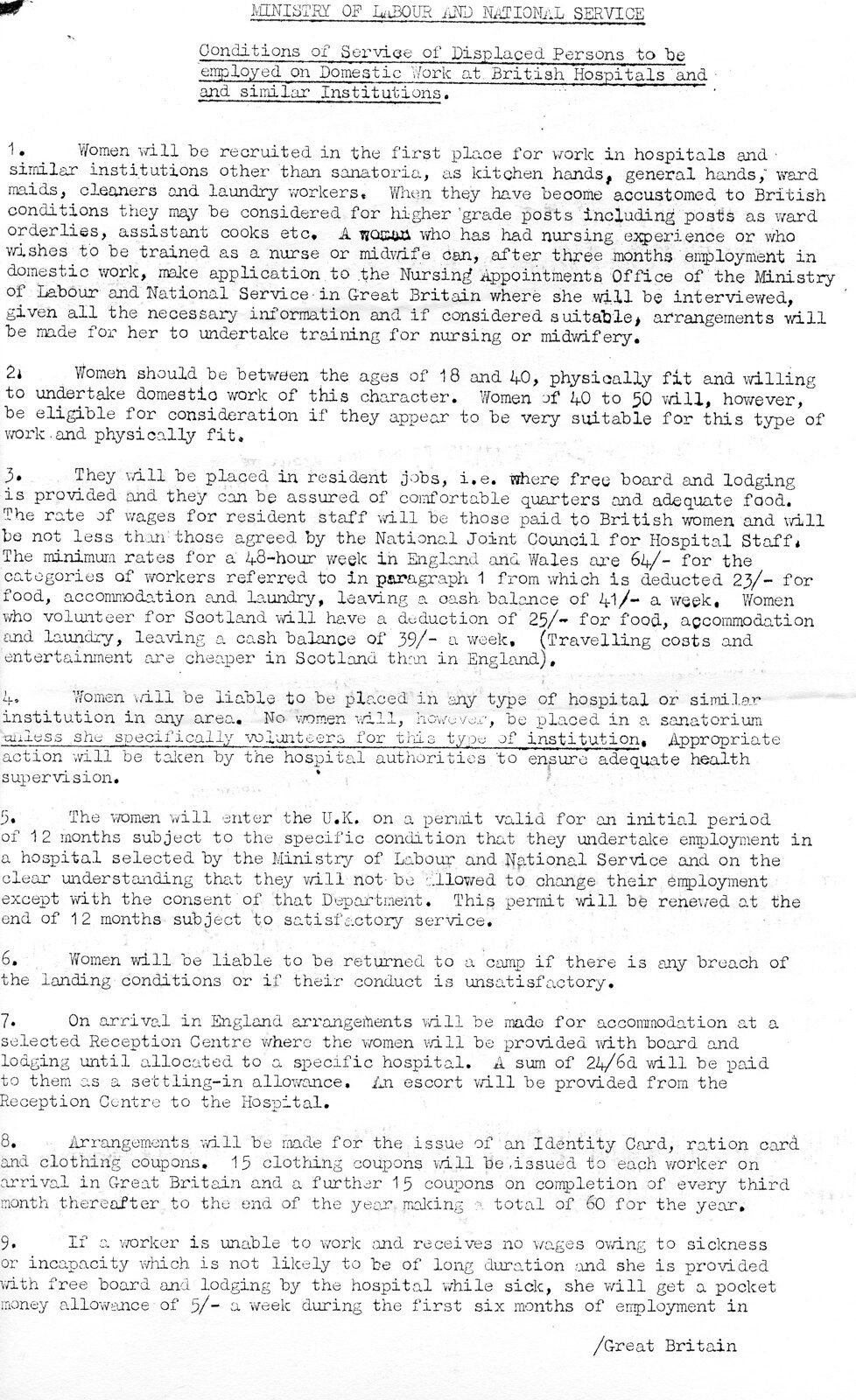
The scheme widened as it went on. Nurse and midwife training was opened up, the upper age limit was raised to fifty, and recruitment was extended beyond the British zone into the American zone. A Conditions of Service document for the extension to women aged forty to fifty survives in a British archive file cited by researchers as HO 1052/445, item 169.14
Recruits knew their jobs before they travelled. A doctoral study of the Estonian community in Scotland contrasts Balt Cygnet, under which people were recruited for particular jobs known before they entered the United Kingdom, with the later Westward Ho, which was freer to redistribute workers as shortages moved; one Estonian recruit interviewed for that study remembered going from Lubeck by ship to Tilbury knowing throughout that she was bound for Scotland rather than England. The same study records that the Baltic Cygnets who ended up in Scotland received a great deal of extra help from the head of the Scottish League for European Freedom, John F. Stewart, who offered language tuition and helped them to get their previous education acknowledged.9
Terms of service as advertised in the camps
| Term | Provision |
|---|---|
| Eligibility, first phase | Unmarried women aged 18 to 40, in good health, not pregnant, without dependants |
| Eligibility, extension | Women up to 50; nurse and midwife training opened; recruitment extended to the American zone |
| Work | Cleaners, ward maids, kitchen hands and laundry workers in hospitals and tuberculosis sanatoria |
| Consent required | Placement in a sanatorium or mental hospital |
| Wages | The same as British women in the same jobs |
| Provided | Board and lodging at the hospital, identity card, ration card, sixty clothing coupons a year |
| Sickness | Weekly payment for temporary illness; prolonged or repeated illness meant return to a camp in Germany |
| Movement | No change of employment or residence without Ministry of Labour approval; police registration on any change of job or address |
Sources for this section
- Recruitment schemes of Displaced Persons in Great Britain
- The beginning of refugee immigration (1946) and the early years (to about 1950)
- When the war was over: European refugees after 1945. Briefing Paper 6, Coming to Britain
- Balt Cygnet EVW scheme in Britain 1946-47, Conditions of Service document
- Estonians in Scotland. From isolation to transnational ways of living?
How Ukrainians related to the scheme
Balt Cygnet began as a Baltic scheme and the name says so. Ukrainian women were admitted later, during the widening of eligibility, and the Latvian national archives account of the scheme records that by May 1947 almost 2,500 Latvian, Lithuanian, Estonian and Ukrainian women had arrived in Britain under it, sent in twenty-three parties of about a hundred each. No separate Ukrainian subtotal for Balt Cygnet has been traced, and the encyclopaedia of the Ukrainian community in Britain, which gives 20,912 Ukrainian European Voluntary Workers in all, does not name the scheme.16
Where Ukrainian women were taken into hospital work, they were not treated on the same footing as Baltic recruits. The nursing training route opened for Baltic workers was not available to them, and they were used in the less regarded posts, as cleaners and kitchen hands. The general policy ranking that placed Balts first and Ukrainians well behind them ran through the placements as well as the recruitment.52
For Ukrainians the significant scheme was the one that followed. Westward Ho opened in the spring of 1947 with Ukrainians among the first nationalities sought, and it carried the great majority of Ukrainian arrivals in Britain. Balt Cygnet matters to the Ukrainian story chiefly because it established the machinery Westward Ho used: recruitment inside the camps, medical selection, the undertaking to work as directed, and reception and placement on arrival.61
Recorded arrivals under Balt Cygnet
| Measure | Figure | Source scope |
|---|---|---|
| First party from Lubeck | 100 women | Departed 16 October 1946, arrived Tilbury a few days later |
| Women arrived by May 1947 | almost 2,500 | Latvian, Lithuanian, Estonian and Ukrainian together; no national breakdown given |
| Parties sent | 23, of about 100 women each | Whole scheme |
| Ukrainian women under Balt Cygnet | not separately recorded | No source traced gives a Ukrainian subtotal |
What happened afterwards
Balt Cygnet closed as Westward Ho opened. The first Westward Ho recruits reached Britain at the end of April 1947 through Tilbury and Hull, over a thousand in a single week, and by the end of May nearly 10,000 displaced persons had come under the new scheme, 42 per cent of them women. Women continued to be recruited for hospitals as well as for the textile industry, so the demand Balt Cygnet had been created to meet was simply absorbed into the bigger operation.1
The Baltic recruitment as a whole was substantial. Almost 30,000 Estonians, Latvians and Lithuanians entered Britain under the two schemes together, and by December 1950 Latvian arrivals under both numbered 12,919 with 1,322 dependants. The women who stayed remained bound by the employment restriction until the general relaxation from 1 January 1951, and many of those who had arrived as young single workers spent the rest of their lives in Britain in communities that continued to organise around a homeland they could not return to.31
A study of migration to Scotland dates the merger to May 1947 and records that it led to recruitment being extended to women of other nationalities, most notably Ukrainians. The doctoral study of the Estonian community puts the scheme's recruitment at around 2,500 women, among them 700 Estonians.89
The two schemes compared
| Measure | Figure | Source scope |
|---|---|---|
| Baltic arrivals under both schemes | almost 30,000 | Estonians, Latvians and Lithuanians, 1946 to about 1950 |
| Latvian arrivals under both schemes to December 1950 | 12,919 plus 1,322 dependants | Latvians only |
| Displaced persons under Westward Ho by end of May 1947 | nearly 10,000, 42 per cent women | All nationalities |
| Ukrainian European Voluntary Workers, all schemes | 20,912 | Ukrainians only, 1947 to 1949 |
Sources
- The beginning of refugee immigration (1946) and the early years (to about 1950)
Latvians in the United Kingdom, online exhibition of the National Archives of Latvia, citing Emily Gilbert, Rebuilding Post-War Britain (Pen and Sword, 2017) · Accessed 13 September 2026
Full exhibition page read: the autumn 1946 introduction of Balt Cygnet, the age range eighteen to forty, the first party of a hundred leaving Lubeck on 16 October 1946 for Tilbury, work in TB sanatoria, the extension to Ukrainian women, nurse training and women up to fifty, recruitment in the American zone, almost 2,500 women by May 1947 in twenty-three parties, WRVS reception and registration centres, and the Westward Ho arrival figures for April and May 1947.
- When the war was over: European refugees after 1945. Briefing Paper 6, Coming to Britain
AHRC project, Universities of Manchester and Nottingham · 2012
Both pages read: the Balt Cygnets programme as targeted at young single Baltic women for hospitals and domestic service, the officials' language quoted, wage parity with the ban on changing jobs, police registration, and the ranking that placed Balts above Ukrainians.
- 'Betweenness': The Lives of Latvian Women Migrants
Linda McDowell, British Academy Review · Accessed 13 September 2026
All three pages read: almost 30,000 Estonians, Latvians and Lithuanians entering under the two schemes, the 1946 scheme's purpose and sectors, the signed contract for a designated industry, just over 2,000 Latvian women, and the eugenicist official framing.
- Balt Cygnet EVW scheme in Britain 1946-47, Conditions of Service document
Emily Gilbert, Changing Identities: Latvians, Lithuanians and Estonians in Britain · 1 October 2016
Post read in full: recruitment of Baltic women from German camps for British hospitals, and the archival reference given for the Conditions of Service document covering the extension to women aged forty to fifty. The scanned document itself was not legible in the retrieved page.
- Recruitment schemes of Displaced Persons in Great Britain
Tommaso Bonomo, University of Pisa · April 2022
All six pages read: the October 1946 launch under the Ministry of Labour, the leaflets, the eligibility rules, the jobs, wage parity, board and lodging with identity card, ration card and clothing coupons, sickness provisions, the twelve month visa and the restriction on changing work or residence, consent for sanatoria and mental hospitals, and the statement that Ukrainians were given the less regarded posts and denied nurse training.
- European Voluntary Workers
Roman Krawec, Ukrainians in the United Kingdom: online encyclopaedia · Published 12 February 2010, updated 27 March 2016
Full entry read for the relationship between the schemes: Westward Ho approved in 1946 as the largest of several, recruitment beginning in spring 1947 with Ukrainians among the first nationalities sought, and the total of 20,912 Ukrainian EVWs. The entry does not name Balt Cygnet.
- Conditions of Service of Displaced Persons to be employed on Domestic Work at British Hospitals and similar Institutions
Ministry of Labour and National Service; The National Archives, Kew, FO 1052/445 (169) · 1946
Facsimile of the first page of the printed conditions of service issued for the Balt Cygnet scheme, scanned from the file at Kew and published by the Changing Identities project. Crown copyright material held by The National Archives and reusable under the Open Government Licence version 3.0.
- Migration to Scotland in the Age of Total War
Stephen Roberts, University of Glasgow (M.Litt. thesis); digitised by Enlighten: Theses · September 1995
Page 107 read: the recruitment of female labour for domestic work in sanatoriums and tuberculosis hospitals, the first arrivals in October 1946, and the merger with Westward Ho in May 1947 extending recruitment to women of other nationalities, most notably Ukrainians. The repository permits personal non-commercial research use only, so nothing beyond a short quotation has been reproduced.
- Estonians in Scotland. From isolation to transnational ways of living?
Lea Kreinin, University of Glasgow (PhD thesis); digitised by Enlighten: Theses · September 2017
Printed pages 86 to 88, 131 to 132 and 151 to 152 read: about 700 Estonians among the roughly 2,500 women recruited, the contrast between Balt Cygnet's fixed placements known before entry and Westward Ho's flexibility, an Estonian recruit's sea passage from Lubeck to Tilbury, and the help given in Scotland by John F. Stewart of the Scottish League for European Freedom.
- The making of 'NHS staff' as a worker identity, 1948-85
Jack Saunders, Vital Signs magazine · Accessed 13 September 2026
Section 'The changes in migration' read: the Attlee administration's authorisation in 1946 of the recruitment of 5,000 women from Estonia, Latvia and Lithuania, mostly for understaffed tuberculosis sanatoria.
- Hitler's Accomplices or Stalin's Victims? Displaced Baltic People in Germany from the End of the War to the Cold War
Juliette Denis, Le Mouvement Social 244, pp. 81–98, via Cairn.info · 2013
Section 'Easily Assimilated Nations: Baltic DPs and Emigration' read: the selection of the Balt Cygnet women on the basis of their moral values and because, in the eyes of the project's supporters, they could not be suspected of war crimes, and their eventual employment in sanatoriums.
Last researched 13 September 2026