Westward Ho
Germany and Austria to Britain·Recruitment 1947–1949; directed employment to 1951
Westward Ho was the British recruitment scheme that took displaced persons from the camps in Germany and Austria into directed employment in Britain from the spring of 1947. Ministry of Labour statistics to 31 July 1949 count 72,797 people recruited under it, of whom 21,991 were Ukrainian, the largest national group in the scheme, and official statistics count 20,912 Ukrainian European Voluntary Workers in all. They were housed in hundreds of hostels across Britain and held to the jobs chosen for them until 1 January 1951.
Introduction
Westward Ho was the largest of the several schemes under which the British government invited people from continental Europe to work in Britain between 1946 and 1951. Everyone admitted under those schemes was classified as a European Voluntary Worker. The scheme was approved in 1946, recruitment began in the spring of 1947 in the displaced persons camps of Germany and Austria, and Ukrainians were among the first nationalities from which recruits were sought. Applicants signed an undertaking to work only as directed by the Ministry of Labour.1
It was an answer to a labour shortage rather than an offer of asylum. Ministry of Labour officials went to the camps to fill vacancies in agriculture, forestry, coal mining and cotton textiles, and the terms they offered bound the worker to a job chosen for him. The programmes were justified mainly on economic grounds, and the project historians of postwar refugee resettlement record that the wish to protect Baltic, Polish or Ukrainian displaced persons from Soviet rule was a secondary consideration. The smaller Balt Cygnet recruitment of Baltic women for hospital work had run since October 1946 and was folded into Westward Ho in May 1947.510
The scale was large by any measure of postwar British immigration. A Ministry of Labour table of recruitment by nationality, compiled to 31 July 1949 and reproduced from Home Office file HO 213/1001, counts 72,797 people recruited under Westward Ho, 57,036 men and 15,761 women. Ukrainians were the largest single national group in that table, 21,991 people, ahead of Poles, Latvians and Yugoslavs. Between October 1946 and December 1949 about 85,000 eastern European refugees and displaced persons reached Britain under the European Voluntary Worker scheme as a whole.22
The workers were housed communally in hostels close to their work, and hundreds of those hostels were spread across Britain, many of them former prisoner of war camps cleared only weeks before. This page follows the scheme from the Cabinet committee that proposed it, through selection in the zones of occupation and the hostel system in Britain, to the lifting of the employment restriction on 1 January 1951.21
A history in dates
- 14 March 1946The Labour government's Foreign Labour Committee meets for the first time and favours bringing workers in from Europe to relieve Britain's labour shortages.25
- 16 October 1946The first party of 100 Baltic women leaves the Lübeck camp for Tilbury under the Balt Cygnet scheme, the forerunner of Westward Ho.24
- 1946The Westward Ho scheme is approved.1
- January 1947A national agreement between the National Union of Mineworkers and the National Coal Board opens the pits to Polish ex-servicemen, but local branches resist.6
- 1 April 1947The British Cabinet decides to transfer the former soldiers of the Galicia Division from Italy to the United Kingdom.29
- 21 April 1947The first batch of 63 male European Voluntary Workers reaches Britain, about half of them Ukrainian.23
- May 1947The Balt Cygnet scheme, which has recruited 2,575 women, is merged into Westward Ho, and hospital recruitment is extended to women of other nationalities, Ukrainians most notably.10
- 27 May 1947A party of 1,440 Ukrainians arrives in Britain.23
- 3 June 1947Ness Edwards tells the Commons that approximately 10,000 European volunteer workers have arrived, almost entirely Balts and Ukrainians.23
- 1 July 1947Recruitment is confined to single persons, and recruits must declare that they have no dependent relatives.23
- 24 July 1947Nine holding camps are in operation with room for about 10,000 people, and 9,500 workers have been placed in employment; the Minister of Education asks local authorities to arrange English classes in all holding hostels.13
- September 1947A scheme to recruit eastern European displaced persons for the British pits begins and meets fierce opposition from local mining unions.6
- 31 October 1947Administration of Westward Ho has cost about £780,000, roughly £29 a head.3
- 31 December 194734,688 people have been brought to Britain under Westward Ho during the year, 25,115 men and 9,573 women, besides 1,800 women admitted earlier in the year under Balt Cygnet.11
- February 1948About 2,000 European volunteer workers are housed in 26 hostels across Scotland as camps vacated by German prisoners of war become available.10
- 6 April 1948A Ministry of Labour report on Operation Westward Ho records demands of 20,000 men for agriculture and 30,000 for the mines, the extension of recruitment to Volksdeutsche in Austria, and zone by zone progress in the British, French and American zones and in Denmark.9
- 20 April 1948Ministers state that over 50,000 European Voluntary Workers have been brought to Britain, about 15,000 of them in the first quarter of 1948, and that 23 have been returned to continental camps as unsatisfactory.4
- 27 April 1948The Ministry of Labour hopes to bring about 100,000 workers during 1948, some 35,000 for agriculture, about 30,000 for coal and at least 20,000 for textiles.14
- July 1948Recruitment of European Voluntary Workers into coalmining is suspended in the face of hostility from local branches of the National Union of Mineworkers.23
- August to October 1948
- 11 November 1948The government states in the Commons for the first time that the settlement of the European volunteer workers is to be permanent.10
- 18 November 1948Approximately 75,000 workers have been placed in employment in Great Britain; during October only 630 men and 900 women were brought over and none was placed in coalmining.15
- 28 December 1948A general strike of Ukrainian European Voluntary Workers protests against the decision to deport about 300 former members of the Galicia Division; two days later the Home Office announces that only 81 will leave.29
- April 1949Polish residents attack the quarters of Jamaican workers at the Ministry of Labour hostel at Causeway Green near Oldbury; the Ministry and the National Service Hostels Corporation agree to disperse some of the men.21
- 19 May 1949The Home Secretary confirms that no time limit is imposed on the stay of European Volunteer Workers, but that a worker who persistently refuses the conditions is liable to be deported.16
- 31 July 1949Ministry of Labour statistics count 72,797 people recruited under Westward Ho, 57,036 men and 15,761 women, of whom 21,991 are Ukrainian.22
- Autumn 1949County agricultural executive committees begin moving away from gang labour after union objections, and a high proportion of the workers made unemployed are European Voluntary Workers.23
- 29 November 1949Full Sutton camp, described by the Parliamentary Secretary as a holding camp for workers who have failed to make the grade, holds 776 people; 244 refused agricultural work during the previous three months.17
- 1949The last Ukrainian arrivals under the scheme.1
- July 1950The Ministry of Labour decides on release from directed employment for workers of three years' residence.1
- 1 January 1951
- 1 January 1951The Association of Ukrainians in Great Britain has 201 branches and 84 groups.23
- Mid-1950s
Origins and policy
The scheme grew out of a Cabinet committee. The newly elected Labour government's Foreign Labour Committee met for the first time on 14 March 1946 and favoured bringing in workers from Europe to relieve shortages in industries that could not fill their vacancies from the British labour market. Britain faced shortages in coal mining, agriculture and domestic work at the same time as skilled labour was leaving for the older Commonwealth countries, and the displaced persons held in camps in the British zones were identified as a reserve that could be drawn on.2510
The first experiment was cautious. Balt Cygnet began in October 1946 with the recruitment of women from Latvia, Lithuania and Estonia for residential domestic work in tuberculosis sanatoria, an initial target of 1,000 later raised to 5,000 for general hospitals. The first party of 100 women left the Lübeck camp on 16 October 1946 and crossed the North Sea to Tilbury. The scheme ended in early 1947 with 2,575 women recruited, and in May 1947 it was merged into Westward Ho, which extended hospital recruitment to women of other nationalities, Ukrainians most notably.2410
Westward Ho was designed for every sector that Balt Cygnet did not cover. It was intended to bring displaced persons into agriculture, forestry, coal mining and cotton textiles, with steel, transport, energy and other trades added later, and it took men and women alike. The target was ambitious: a parliamentary question of June 1947 described it as the Ministry of Labour's scheme for the employment of at least 100,000 displaced persons in industry by the end of that year, and in April 1948 Ness Edwards said it was hoped to bring about 100,000 workers during 1948, some 35,000 for agriculture, about 30,000 for coal and at least 20,000 for textiles.581914
The political argument was frankly economic, and it was not applied evenly. Officials graded the displaced persons they were recruiting: Balts were treated as highly desirable, Ukrainians much less so, and European Jews were not eligible at all. In private discussion inside the Ministry of Labour, Ukrainians were described as essentially peasant and therefore thought less suited to settling in Britain than the preferred Balts.523
Costs were reported to Parliament at intervals and rose steeply. Administering Westward Ho had cost about £780,000 to the end of October 1947, roughly £29 a head, covering selection in Germany and Austria, transport from the German frontier and maintenance until placement; the figure excluded camp maintenance on the continent, borne by the Preparatory Commission of the International Refugee Organisation. The running total stood at £1,290,000 to the end of February 1948 and at £2,750,000 by the end of October 1948.31223
Sources for this section
- European Voluntary Workers
- Migration to Scotland in the Age of Total War
- The beginning of refugee immigration (1946) and the early years (to about 1950)
- When the war was over: European refugees after 1945. Briefing Paper 6, Coming to Britain
- Recruitment schemes of Displaced Persons in Great Britain
- European Volunteer Workers, HC Deb 19 June 1947 vol 438 cc230-1W
- European Volunteer Workers, HC Deb 27 April 1948 vol 450 c21W
- Sympathy, antipathy, hostility. British attitudes to non-repatriable Poles and Ukrainians after the Second World War and to the Hungarian refugees of 1956
- European Volunteer Workers, HC Deb 18 November 1947 vol 444 cc959-60
- European Volunteer Workers, HC Deb 25 March 1948 vol 448 cc359-61W
Eligibility and exclusion
Selection was a filter, and it was designed to be one. Every applicant completed a medical form before the examination. It required a statement that the applicant had never had epilepsy, mental illness or a breakdown and was fit to live communally, and it listed the conditions that made a person unsuitable: mental disease, chronic alcoholism, deafness that made communication difficult, disease of the lungs, heart or abdomen liable to cause frequent incapacity, loss of a substantial part of a limb, incontinence and evident pregnancy.823
Age limits were set at 50 for men and 40 for women, and women were not normally selected for the textile industry if they were over 35. The limits were not always kept to, and some workers over 50 were admitted. Tuberculosis, venereal disease and pregnancy were the main worries about physical health, and interviewers were also asked to look for signs of good character, since those thought to be bad types were regarded as undesirable long-term settlers.2312
Preference went to applicants willing to take unskilled manual work, to those with experience of certain skilled trades or the aptitude to be trained, and to those who had no dependants with them in the camps or were willing to leave them behind. The preference hardened into a rule. Dependants were admitted during the first six months, about 1,500 people, but from 1 July 1947 recruitment was confined to single persons and recruits had to sign a declaration that they had no dependent relatives.123
Marriage was not an absolute bar, and the figures show how many married people came all the same. Some 7,500 married men and women arrived during 1947. About 1,500 of them had non-working dependants who were to follow later as accommodation became available, and some 600 of the children under 16 among those dependants had arrived by March 1948, their average age six and a half. From July 1947 married couples had to sign an undertaking to live apart if work could not be found for both of them in the same area.1223
Two groups were shut out for reasons of policy rather than health. European Jews were not eligible under the schemes. Poles were at first not recruited either, because the government wished to settle the large numbers already in the Polish Resettlement Corps before taking more, and they became eligible for European Voluntary Worker status only as the demand for labour went on outrunning the supply.523
Sources for this section
- Recruitment schemes of Displaced Persons in Great Britain
- Sympathy, antipathy, hostility. British attitudes to non-repatriable Poles and Ukrainians after the Second World War and to the Hungarian refugees of 1956
- European Volunteer Workers, HC Deb 25 March 1948 vol 448 cc359-61W
- European Voluntary Workers
- When the war was over: European refugees after 1945. Briefing Paper 6, Coming to Britain
Recruitment in the zones
Recruitment was restricted at the start by both nationality and zone. A study of migration to Scotland records that only men and women of Baltic and Ukrainian nationality were sought, and only from the displaced persons camps inside the British zones of Germany and Austria. The scheme was later extended to displaced persons of all nationalities and to all three western zones, and Poles came in large numbers once the bar on them was lifted.1023
Selection teams worked inside the camps. Ministry of Labour officials distributed leaflets, printed in English and in German, which described the work on offer and the conditions attached to it, then interviewed applicants and put them through the medical inspection. The opening paragraph of the recruitment document was blunt about what was wanted: men mainly for manual work in agriculture, coal mining and the iron and steel industries, women for the cotton, wool and rayon industries and also for laundries, certain kinds of domestic work and nursing. Those selected were to be transferred free of charge and given free meals, accommodation and pocket money of five shillings a week until employment was found.822
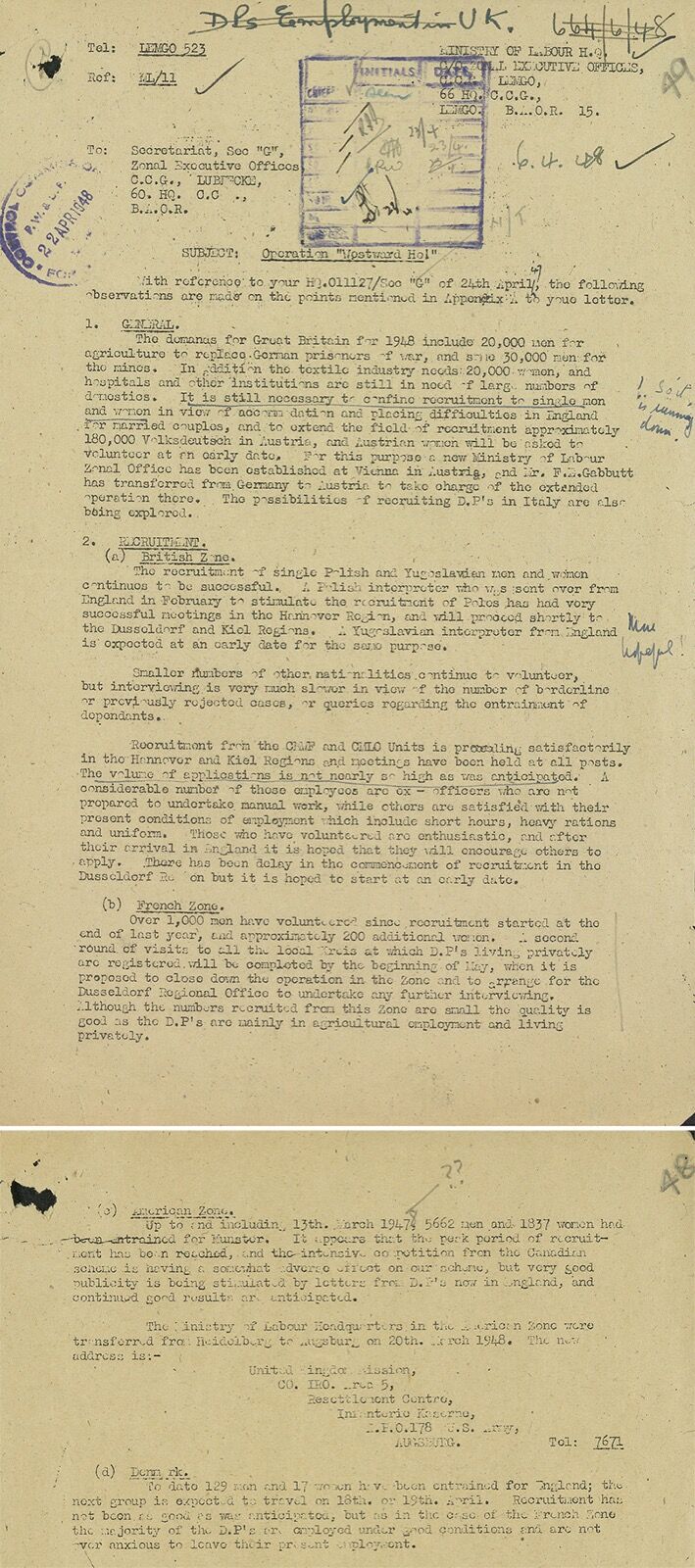
A Ministry of Labour report on Operation Westward Ho of 6 April 1948 shows how far the search had spread by the second year. The demands for Great Britain for 1948 included 20,000 men for agriculture to replace German prisoners of war and some 30,000 men for the mines, while the textile industry needed 20,000 women and hospitals and other institutions were still short of domestic staff. Recruitment was still confined to single men and women because of the difficulty of accommodating married couples in England, the field was being widened to roughly 180,000 Volksdeutsche in Austria, a new zonal office had been opened in Vienna, and the possibilities of recruiting displaced persons in Italy were being explored.9
The same report goes through the zones one by one. In the British zone the recruitment of single Polish and Yugoslav men and women continued to be successful, helped by a Polish interpreter sent from England who held meetings in the Hannover region, while other nationalities came forward slowly because of borderline or previously rejected cases. In the French zone over 1,000 men and about 200 more women had volunteered since recruitment started at the end of 1947, and the operation was to close there at the beginning of May 1948. In the American zone 5,662 men and 1,837 women had been entrained by 13 March 1948, the peak was judged to have passed, and the Canadian scheme was competing hard for the same people.9
Recruitment reached beyond the occupation zones. From Denmark, where many displaced persons were already in reasonable employment and reluctant to move, 129 men and 17 women had been entrained for England by early April 1948. The competition for the fit and the young was by then general across every resettlement scheme operating in the camps, and letters home from those already in England were used deliberately as publicity.9
Sources for this section
- Migration to Scotland in the Age of Total War
- Sympathy, antipathy, hostility. British attitudes to non-repatriable Poles and Ukrainians after the Second World War and to the Hungarian refugees of 1956
- Recruitment schemes of Displaced Persons in Great Britain
- In which ways is the Ukrainian community in Scotland a diaspora?
- 'Westward Ho' scheme: Ministry of Labour report on Operation Westward Ho, FO 1052/487
The crossing and the holding camps
The first men arrived in the spring of 1947. A batch of 63 male European Voluntary Workers reached Britain on 21 April 1947, roughly half of them Ukrainian, and much larger parties followed: 1,440 Ukrainians arrived on 27 May 1947. By 3 June 1947 Ness Edwards was able to tell the Commons that approximately 10,000 European volunteer workers had arrived, consisting almost entirely of Balts and Ukrainians.23
The North Sea crossings ran to two ports. The Latvian national archives record that the first Westward Ho recruits reached Britain at the end of April 1947, that over 1,000 came in a single week through Tilbury in the south and Hull in the north east, and that by the end of May nearly 10,000 displaced persons had been brought over under the scheme, 42 per cent of them women recruited for hospitals and for the textile industry. From the end of 1947 dependants of recruits were allowed to follow them.24
Arrivals went first into holding camps. By late July 1947 nine holding camps had been set up in Britain with room for approximately 10,000 people, and 9,500 European volunteer workers had by then been placed in employment. The largest was at Full Sutton near York, which accommodated about 1,000 people and from which workers could be moved to jobs anywhere in Yorkshire; elsewhere the Ministry of Labour had to rely on lodgings and vacancies in existing hostels.1319
English teaching began in the holding camps and was never as thorough as the leaflets implied. Classes and social activities were organised by the workers themselves with the help of resident welfare officers and local volunteers, and in July 1947 the Minister of Education asked local education authorities to arrange systematic instruction in English in all holding hostels at the Ministry of Labour's expense. Practice could fall well short. One Ukrainian recruit from Camp Ohio near Burgdorf, who signed his contract expecting four to eight weeks at an English training centre before going to a mining training centre, crossed in April 1948 and was sent instead to Scotland to lift potatoes; he never received the language training.1326
Sources for this section
- Sympathy, antipathy, hostility. British attitudes to non-repatriable Poles and Ukrainians after the Second World War and to the Hungarian refugees of 1956
- The beginning of refugee immigration (1946) and the early years (to about 1950)
- European Volunteer Workers, HC Deb 24 July 1947 vol 440 cc166-7W
- European Volunteer Workers, HC Deb 19 June 1947 vol 438 cc230-1W
- Leaving Camp Ohio For Great Britain Under The Westward Ho! Program
The numbers, year by year
For 1947 the figure was given to Parliament directly. Asked how many European voluntary workers had been permitted to enter the United Kingdom in 1947, Ness Edwards replied that 34,688 had been brought to the country under the Westward Ho scheme, 25,115 men and 9,573 women, and that in the earlier part of the year a further 1,800 women had come under the earlier Balt Cygnet scheme for essential domestic work. The figure excluded people who came on an individual permit.11
The peak came in 1948. About 15,000 European volunteer workers arrived in the first quarter alone, of whom 6,300 were placed in agriculture, and by 20 April 1948 more than 50,000 had been brought to Britain. On 18 November 1948 George Isaacs told the Commons that approximately 75,000 had been placed in employment in Great Britain. By then the intake was falling sharply: during October 1948, 630 men and 900 women were brought over, about half of the monthly intake of men went into agriculture, and the coal mining industry was not recruiting European Voluntary Workers at all.415
Recruitment closed during 1949. The Ministry of Labour table compiled to 31 July 1949 gives the scheme's yield as 72,797 people, and the last Ukrainian arrivals came that year. Counting the whole European Voluntary Worker scheme rather than Westward Ho alone, and running from October 1946 to December 1949, Tannahill's figure of about 85,000 arrivals is the one most often quoted in the later literature.221
The totals in circulation differ, and the differences are worth stating plainly. A study of migration to Scotland, following Isaac and Tannahill, gives the Westward Ho yield as 57,104 men and 17,308 women. The Ministry of Labour table to 31 July 1949 gives 57,036 men and 15,761 women. Kay and Miles's table of arrivals at 31 December 1950 gives 57,104 men and 19,883 women, 76,987 in all, of whom 3,322 had returned to Europe by that date. The closing dates differ, and so does the treatment of the women recruited for hospitals under Balt Cygnet.1022255
Scale and cost reported to Parliament
| Measure | Figure | Date and source scope |
|---|---|---|
| Cost of administering Westward Ho | about £780,000 | To the end of October 1947; excludes continental camp maintenance |
| Estimated cost per head | about £29 | To the end of October 1947 |
| EVWs brought to Britain | over 50,000 | Stated 20 April 1948; all nationalities and both schemes |
| EVWs arriving in the first quarter of 1948 | about 15,000 | All nationalities |
| Placed in agriculture in that quarter | 6,300 | All nationalities |
| Returned to continental camps as unsatisfactory | 23 | Out of over 50,000, stated 20 April 1948 |
| EVWs in total under all schemes | more than 80,000 | Project summary figure for 1946–1951, all nationalities |
Arrivals and placements, year by year
| Period | Figure | What the figure counts |
|---|---|---|
| October 1946 to early 1947 | 2,575 women | Balt Cygnet recruitment in total, before the merger into Westward Ho; figure from Isaac as cited in the Glasgow thesis |
| 1 January to 30 June 1947 | 6,330 placed in employment | European volunteer workers of all nationalities placed, not arrivals: 564 textiles, 2,268 agriculture, 1,836 hospitals |
| By 3 June 1947 | about 10,000 arrived | All European volunteer workers arrived to that date, described in the Commons as almost entirely Balts and Ukrainians |
| By 24 July 1947 | 9,500 placed in employment | Cumulative placements; nine holding camps then open with room for about 10,000 people |
| Calendar year 1947 | 34,688 arrived | Westward Ho only, 25,115 men and 9,573 women; a further 1,800 women came earlier in the year under Balt Cygnet |
| First quarter of 1948 | about 15,000 arrived | All European volunteer workers; 6,300 of them placed in agriculture |
| By 20 April 1948 | over 50,000 brought to Britain | Cumulative arrivals, all nationalities and both schemes |
| By 18 November 1948 | approximately 75,000 placed in employment | Cumulative placements in Great Britain, all nationalities |
| October 1948 | 630 men and 900 women arrived | Monthly intake; about half the men went into agriculture and none into coalmining |
| To 31 July 1949 | 72,797 recruited | Westward Ho only, 57,036 men and 15,761 women, from Ministry of Labour statistics in HO 213/1001 |
| October 1946 to December 1949 | approximately 85,000 arrived | The European Voluntary Worker scheme as a whole, after Tannahill |
| To 31 December 1950 | 76,987 arrivals | Kay and Miles's table of European Voluntary Workers, 57,104 men and 19,883 women, with 3,715 dependants; 3,322 had returned to Europe by that date |
Sources for this section
- European Volunteer Workers, HC Deb 13 April 1948 vol 449 c66W
- European Volunteer Workers, HC Deb 20 April 1948 vol 449 cc1600-2
- European Volunteer Workers, HC Deb 18 November 1948 vol 458 cc561-2 and c59W
- In which ways is the Ukrainian community in Scotland a diaspora?
- European Voluntary Workers
- Migration to Scotland in the Age of Total War
- European Voluntary Workers
- When the war was over: European refugees after 1945. Briefing Paper 6, Coming to Britain
The hostel system
Accommodation, not recruitment, was the binding constraint on the whole scheme. The Ministry of Labour set up the National Service Hostels Corporation to organise hostel accommodation near the workplace for migrant workers, and the Corporation administered hostels on the Ministry's behalf; a list it provided in 1950 ran to 97 hostels across the country. Asked in April 1948 whether he was satisfied with progress, Ness Edwards replied that he was getting all the people for whom accommodation could be provided.214
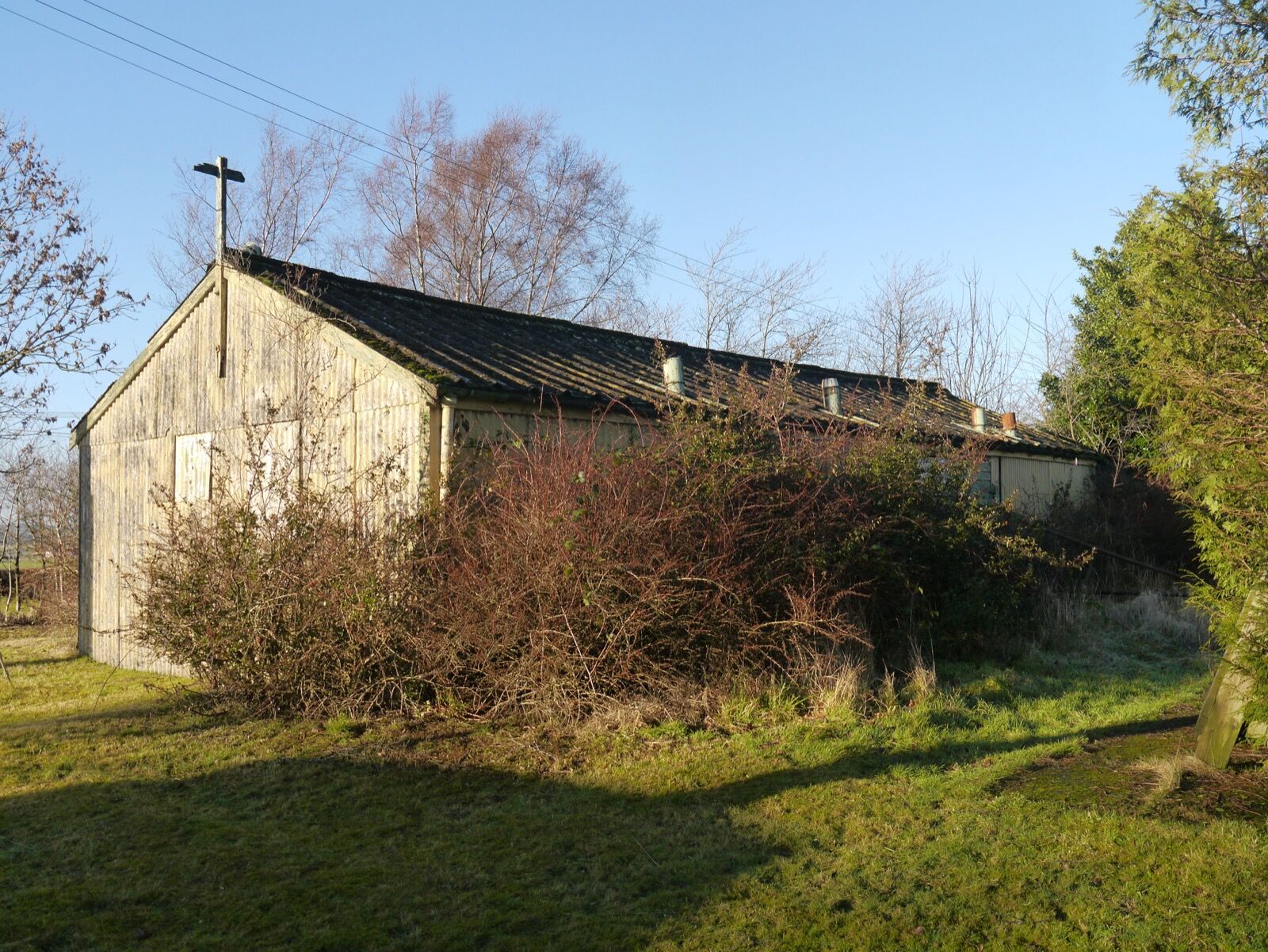
Responsibility was shared out among several bodies. From 1947 the administration of the camps began to pass from the War Office to the National Assistance Board, the National Service Hostels Corporation and other civilian bodies, and the camps were officially redesignated as hostels. The hostels themselves were run by the National Service Hostels Corporation, the Ministry of Agriculture, the National Coal Board, the YMCA, local authorities and private industrial firms. They were of every kind: former military and prisoner of war camps, wartime industrial and agricultural hostels, and buildings converted or newly put up after the war.2
Most were reused prisoner of war camps, many of them cleared of prisoners only shortly before the displaced persons moved in, and the wartime lists of those camps show the range of buildings involved, from former Royal Air Force stations to large country houses and old textile mills and weaving sheds. Since the government tried to move women into private billets as a priority, it was usually the men who spent long periods in the larger rural camps. Men and women lived in separate hostels at first; married couples were later able to live together, or as near to each other as could be managed.282
Welfare was organised from above and from within. Doctors appointed by the National Service Hostels Corporation looked after the health of residents in its hostels and supervised camp hygiene, and sports and concerts were arranged to relieve the boredom of a life that many workers led for years. Residents ran their own English classes, lectures and entertainments. Officials were uneasy about the result: Kay and Miles record official concern at the tendency of some hostels to become self-contained communities with little contact with the surrounding population, and Home Office wariness about independent communities speaking a foreign language.231322
Scotland shows how tight the accommodation bottleneck was. Only 150 European volunteer workers were employed in Scottish agriculture by late September 1947, and 785 by the end of that year. It was not until hostels vacated by German prisoners of war became available in early 1948 that the numbers moved: by late February 1948 some 2,000 workers were housed in 26 hostels across Scotland, accommodation was ready for only 2,500 of the 3,000 wanted for agriculture in March, and the number of hostels was expected to rise from just over 30 to 90 by June. By mid-June there were 3,858 workers in Scottish agriculture, and about 4,500 by the end of November.10
Sources for this section
- Causeway Green hostel riot 1949: Evening Despatch cutting, LAB 26/198
- European Volunteer Workers, HC Deb 20 April 1948 vol 449 cc1600-2
- Post-war camps and hostels
- Latvian, Lithuanian and Estonian European Volunteer Workers in Britain: initial accommodation experiences in camps and hostels in Britain, 1946-1951
- Sympathy, antipathy, hostility. British attitudes to non-repatriable Poles and Ukrainians after the Second World War and to the Hungarian refugees of 1956
- European Volunteer Workers, HC Deb 24 July 1947 vol 440 cc166-7W
- In which ways is the Ukrainian community in Scotland a diaspora?
- Migration to Scotland in the Age of Total War
Hostels and camps in Britain
The hostels can be named because the Ukrainians who lived in them left records of their own. An appendix to a study of the Ukrainian community in Scotland lists 41 Scottish and northern English hostels which held significant numbers of ethnic Ukrainians, compiled from the membership database of the Association of Ukrainians in Great Britain and from the daybook of an itinerant Ukrainian Greek Catholic priest, Father Alexander Babij, who travelled to 44 camps and hostels collecting subscriptions towards a church house in Edinburgh. Across Britain the association's records show 284 formal camp and hostel sub-groups, of which 43 were in Scotland.22
The densest cluster lay around Edinburgh and the Lothians. Amisfield Park at Haddington, East Fortune, the Ukrainian hostel at Macmerry near Tranent, Mortonhall in Edinburgh and Deer Park at Dalkeith all appear on the list, together with the Newbattle Miners' Hostel, also at Dalkeith, and the Miners' Hostel at Armadale in West Lothian. Fife is represented by Annsmuir at Ladybank and Perthshire by Ballado near Kinross, the hostel at Crieff, Dunning and Balhary near Alyth.22
A second group followed the woollen towns and the farms of the Borders and Dumfriesshire. Victoria Park at Peebles, Thorncroft at Selkirk, Burnbrae at Galashiels, the Wilton hostel at Hawick, Springwood Park at Kelso and the ICI hostel at St Boswells stand within reach of the tweed and hosiery mills, while Winfield Camp near Berwick, Barony at Parkgate, Hallmuir near Lockerbie, the RAOC camp at Kirtlebridge and Creca near Annan served the surrounding farmland. One first generation Ukrainian remembered that the Galashiels and Selkirk hostels existed because of the textile industry, and that his mother was a weaver.22
Westward Ho reached the west and the north east of Scotland as well. In Ayrshire there was a hostel near Girvan, Kingencleugh at Mauchline and an industrial hostel at Beith that was a Ukrainian women's hostel. Castle Rankine at Denny stood in Stirlingshire, North Hill Camp at Laurencekirk in Kincardineshire, the YMCA hostel at Tannadice near Forfar in Angus, and further north the YMCA hostel at Sandyhillock near Craigellachie in Banffshire, Brackla near Nairn, the hostel at Monymusk in Aberdeenshire, Munlochy in Ross-shire and the YMCA hostel at Kildary. Reves House at Broughty Ferry served Dundee, and a hostel at Inverlochy stood beside the aluminium works at Fort William.22
Five of the hostels on the list lie in the north of England. YMCA Hostel No. 2 at Ponteland in Northumberland and the YMCA hostel at Raylees near Elsdon stood on the Northumberland moors, the Ryton Miners' Hostel at Ryton-on-Tyne housed a coalfield workforce, the YMCA hostel at Windlestone near Ferryhill occupied an Eden family mansion in County Durham, and the YMCA hostel at Bela River near Milnthorpe in Westmorland took agricultural workers. The compiler notes that the list may not be complete and that other camps may have existed outside it.22
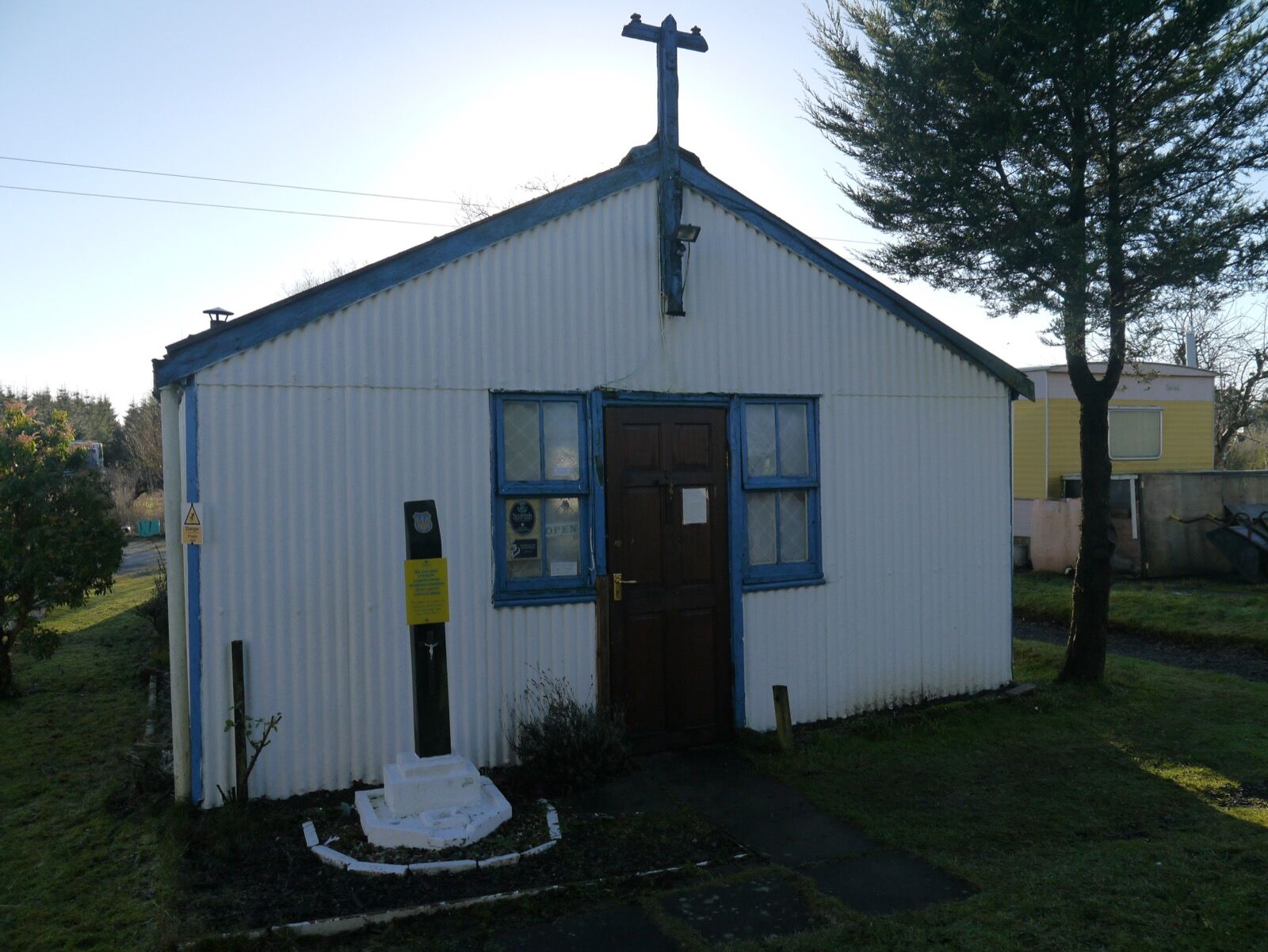
Life in these places has left small, specific traces. Creca, near Annan, was Hostel 83, a former wartime training camp whose barracks were better built than most, and about 150 Ukrainians were still living there in its closing years under a warden appointed to wind it up. In 1949 some 60 of the Ukrainian residents of Hallmuir were moved just over the border to Smalmstown near Longtown in Cumberland, where they stayed until 1956. The men at Macmerry gave a shilling a week out of their wages towards the purchase of the church house at Mansionhouse Road in Edinburgh. The hostel at Mortonhall is remembered in Scotland for its protest against government plans to send those unfit for work back to Germany.22
Sources for this section
Employment and sectors
The industries the scheme served were set out on the recruitment form itself, and the division of labour was drawn along lines of sex. Men were wanted mainly for manual work in agriculture, coal mining and the iron and steel industries; women for the cotton, wool and rayon industries, and also for laundries, certain kinds of domestic work and for nursing. In some occupations workers would not be accepted unless they were willing to join a trade union, and those transferred for anything other than residential employment would normally be housed communally in a hostel or camp.22
A Ministry of Labour return of first placings of foreign workers brought in under the official recruitment schemes, drawn up at 5 February 1949, gives the balance in detail. Of 77,652 first placings, 56,218 men and 21,434 women, agriculture took 29,363, domestic work 11,824, coal mining 10,967, cotton spinning, doubling and weaving 7,793, the woollen industry 4,297, the brick and allied industries 2,504 and the National Service Hostels Corporation itself 2,372.25
Below those came a long list of smaller trades. Army and Air Force depots took 1,435, rayon 1,417, iron and steel 1,307, quarrying 685, nursing 627, laundries 391, hosiery 299, cement 259, the Scottish hydro-electric schemes 250, jute 191 and pottery 167, with gypsum mining, clay pits, flax spinning and the gas industry accounting for the rest. The hydro-electric work was dangerous: one Ukrainian worker interviewed many years later had lost a leg while boring tunnels for the Highland dams.2522
Official statistics on the initial placements of workers of all nationalities recruited from Germany and Austria give the same picture in percentages. Men worked mainly in agriculture, 52 per cent, coal mining, 19 per cent, and domestic service in hostels, hospitals and other premises, 9 per cent; women were employed mainly in cotton mills, 38 per cent, domestic service, 34 per cent, and woollen mills, 16 per cent. Agriculture stayed the largest single destination to the end: in November 1948 about half the monthly intake of men was still being placed on the land.115
The textile mills absorbed workers slowly, and the reason was accommodation. Approximately 3,500 workers had been placed in textile work in Lancashire by March 1948, probably fewer than five per cent of them with any previous experience; training on the spinning side took twelve to fifteen weeks and the introduction of foreign workers into weaving was only just beginning. Of the 6,330 workers placed in employment in the first half of 1947, 564 went into textiles, 2,268 into agriculture and 1,836 into hospital work; of the 5,283 women brought over by late July 1947, 2,694 had been placed in hospitals and sanatoria.1213
Coal was the sector that failed. A national agreement between the National Union of Mineworkers and the National Coal Board in January 1947 opened the pits to Polish ex-servicemen, but local resistance meant that by the end of May 1947 there were trained Poles and no collieries willing to take them. A scheme to recruit other eastern European displaced persons began in September 1947 and met fierce opposition from local union branches, so that recruitment into coalmining had to be suspended in July 1948 and no worker at all was placed there during October of that year. By 1951 only 10,000 of the 18,000 foreign workers taken on remained in the mines.62315
Initial placement of European Voluntary Workers recruited from Germany and Austria
| Sector | Share of men | Share of women |
|---|---|---|
| Agriculture | 52% | not given |
| Coal mining | 19% | not given |
| Domestic service in hostels, hospitals and other premises | 9% | 34% |
| Cotton mills | not given | 38% |
| Woollen mills | not given | 16% |
First placings in employment of foreign workers under the official recruitment schemes, at 5 February 1949
| Industry or service | Men | Women | Total |
|---|---|---|---|
| Agriculture | 29,298 | 65 | 29,363 |
| Domestic | 3,690 | 8,134 | 11,824 |
| Coal mining | 10,967 | none | 10,967 |
| Cotton spinning, doubling and weaving | 1,042 | 6,751 | 7,793 |
| Woollen industry | 1,077 | 3,220 | 4,297 |
| Brick and allied industries | 2,502 | 2 | 2,504 |
| National Service Hostels Corporation | 1,455 | 917 | 2,372 |
| Army and Air Force depots and installations | 1,435 | none | 1,435 |
| Rayon | 540 | 877 | 1,417 |
| Iron and steel | 1,306 | 1 | 1,307 |
| Quarrying | 685 | none | 685 |
| Nursing | 166 | 461 | 627 |
| Laundries | 2 | 389 | 391 |
| Hosiery | 24 | 275 | 299 |
| Cement | 259 | none | 259 |
| Scottish hydro-electric schemes | 250 | none | 250 |
| Jute | 18 | 173 | 191 |
| Pottery | 136 | 31 | 167 |
| Home-grown timber | 107 | none | 107 |
| Refractories | 97 | none | 97 |
| Boot and shoe manufacture | 63 | 11 | 74 |
| Wholesale clothing | 4 | 57 | 61 |
| Gas industry | 57 | none | 57 |
| Clay pits | 57 | none | 57 |
| Gypsum mining | 49 | none | 49 |
| Flax spinning and weaving | 39 | 7 | 46 |
| Textiles | 17 | none | 17 |
| Flax processing | 15 | none | 15 |
| Miscellaneous | 861 | 63 | 924 |
| Total | 56,218 | 21,434 | 77,652 |
Sources for this section
- In which ways is the Ukrainian community in Scotland a diaspora?
- European Voluntary Workers
- European Voluntary Workers
- European Volunteer Workers, HC Deb 18 November 1948 vol 458 cc561-2 and c59W
- European Volunteer Workers, HC Deb 25 March 1948 vol 448 cc359-61W
- European Volunteer Workers, HC Deb 24 July 1947 vol 440 cc166-7W
- Scattered by war and revolution
- Sympathy, antipathy, hostility. British attitudes to non-repatriable Poles and Ukrainians after the Second World War and to the Hungarian refugees of 1956
Conditions of service
The contract was the heart of the scheme. Every applicant signed an undertaking to work only as directed by the Ministry of Labour and not to change that employment without approval, and entry for an initial period of twelve months was subject to good behaviour. As aliens the workers had to register with the police whenever they changed job or address. They were recorded on arrival as being of uncertain nationality and issued with registration booklets whose inner pages had to be stamped at local police stations if they made long journeys.110522
Pay was deliberately kept level with British rates. Ministers repeated in the Commons that the workers were employed at the same rate of wages and under the same conditions as comparable British workers, and accommodation was supplied through the National Service Hostels Corporation in camps or hostels for a small charge. The terms had been negotiated with the Trades Union Congress and then with the individual unions, and the usual provisions were three: that workers would be placed only where no suitable British labour was available; that they would be the first to be dismissed in a redundancy; and that their wages and conditions would follow the existing agreements covering British workers. Men placed in jobs usually done by women were to be paid the higher male rate.152310
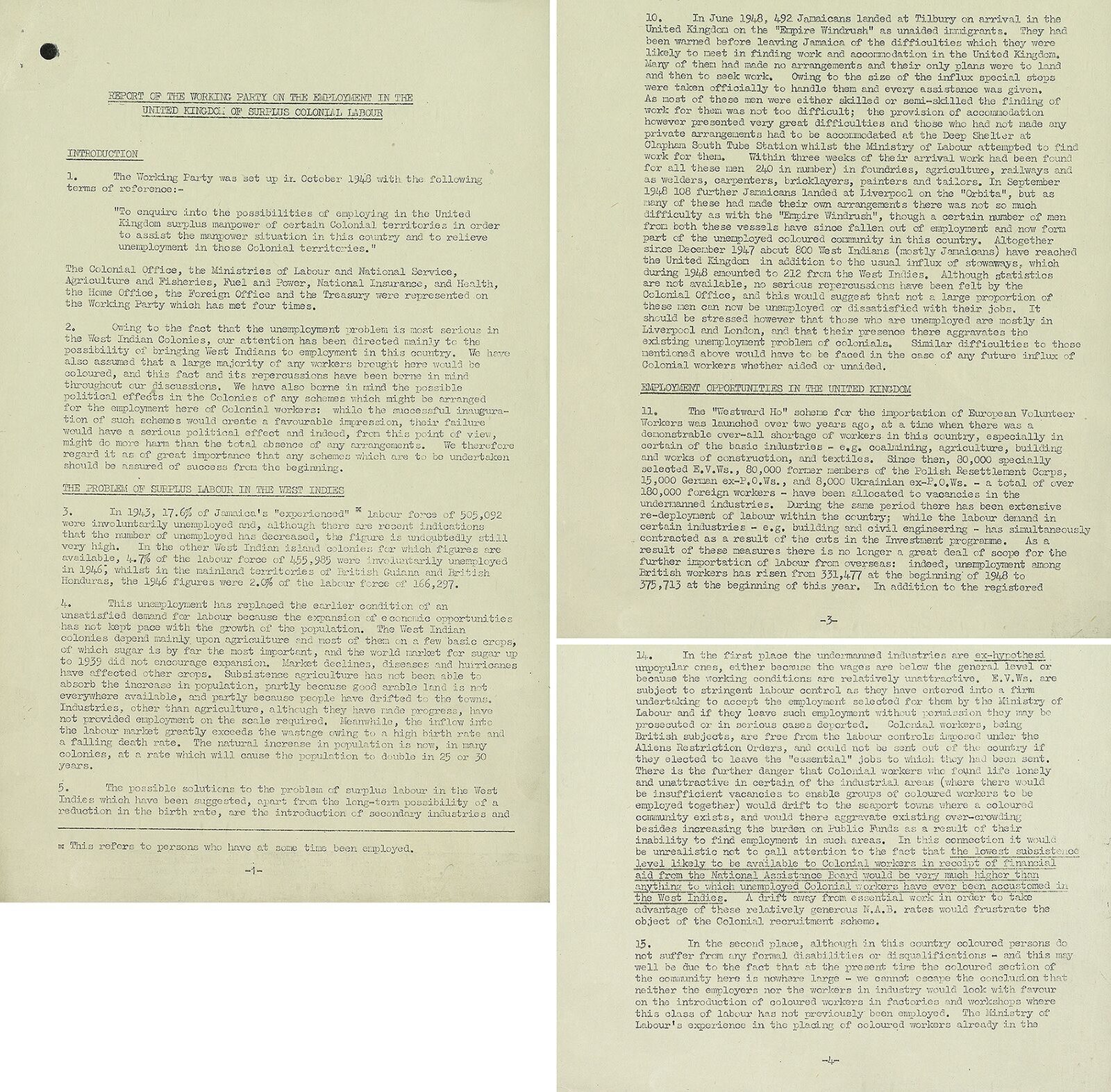
There was no time limit on the stay, and no right to leave the job either. In May 1949 the Home Secretary told the Commons that no time limit was imposed on the stay of European Volunteer Workers, that they were required to enter employment specified by the Ministry of Labour and not to change it without approval, that those unwilling to continue were free to leave the country, and that a worker who persistently refused to comply was liable to be deported. A Colonial Office working party put it more bluntly in 1949: European Voluntary Workers were subject to stringent labour control and could be prosecuted or in serious cases deported if they left their employment without permission, whereas colonial workers, being British subjects, were free of that control.1620
Removal was used sparingly but it was used. In April 1948 the Commons was told that there had been only 23 cases in which a worker's return to a displaced persons camp on the continent had been arranged, out of over 50,000 brought to the country. The other end of the system was the holding camp for those who could not be placed. Full Sutton became, in the Parliamentary Secretary's own words, a holding camp for misfit, sick, disabled, unemployed and other workers who had failed to make the grade: it held 776 people in November 1949, 244 of whom had refused agricultural work during the previous three months, the reasons being judged unacceptable in 175 cases.417
Family separation was written into the design. Dependants could not at first join their relatives in Britain, and communication was left to the post; the restriction to single people from July 1947 followed from the shortage of accommodation and transport. Kay and Miles record 3,724 dependants admitted during an early phase of the scheme. Sickness was treated by the same logic: those who were ill or pregnant before arrival were returned to Germany, except for pregnant women whose husbands were already in Britain, while those who fell ill afterwards were cared for and maintained until they qualified for benefit.81023
Sources for this section
- European Voluntary Workers
- Migration to Scotland in the Age of Total War
- When the war was over: European refugees after 1945. Briefing Paper 6, Coming to Britain
- In which ways is the Ukrainian community in Scotland a diaspora?
- European Volunteer Workers, HC Deb 18 November 1948 vol 458 cc561-2 and c59W
- Sympathy, antipathy, hostility. British attitudes to non-repatriable Poles and Ukrainians after the Second World War and to the Hungarian refugees of 1956
- European Volunteer Workers, HC Deb 19 May 1949 vol 465 cc592-3
- Treatment of European workers and colonial citizens: Colonial Office working party report, LAB 26/226
- European Volunteer Workers, HC Deb 20 April 1948 vol 449 cc1600-2
- European Volunteer Workers, Full Sutton Camp, HC Deb 29 November 1949 vol 470 cc934-5
- Recruitment schemes of Displaced Persons in Great Britain
Criticism, the press and screening
Organised labour was consulted first, and agreed at the top. The government negotiated the terms of employment with the Trades Union Congress, the British Employers' Confederation and the individual unions, and there was little opposition among the TUC leadership to the general use of volunteer labour from the camps. Objections came from below. A study of contemporary trade union periodicals found the National Union of Mineworkers and the Amalgamated Engineering Union the two most openly hostile to the admission of foreign labour, and the most outspoken journal on the subject was The Land Worker of the National Union of Agricultural Workers.23
The agricultural unions objected less to the workers than to the way they were used. They opposed the gang labour administered by the county agricultural executive committees, which they said undermined the wages and conditions regular farm workers were fighting for. The committees gave way to that view in the autumn of 1949, and a high proportion of the workers made unemployed in the process were European Voluntary Workers. In Scotland the Department of Agriculture had been discharging workers routinely from at least April 1948, and Tannahill used Scotland to illustrate a tendency to dismiss them on trivial grounds without giving them another chance in the industry.2310
Press comment could be brutal, and it fell hardest on Ukrainians. The New Statesman called for rigid selection of Ukrainians in order to exclude the illiterate, the mentally deficient, the sick, the aged, the politically suspect and the behaviourally disruptive, and urged that the rubbish among those who had already come should be cleared out. Resentment at foreign workers taking British jobs surfaced in Parliament as well; in March 1952 Cyril Osborne warned the Commons that there was already fear of redundancy in many industries.523
Parliamentary criticism also fastened on the hostels. In November 1949 Mr Odey asked the Minister of Labour to consider closing Full Sutton, citing its record and widespread damage being done to adjacent farms by the workers in their leisure hours. Ness Edwards resisted the inference, pointing out that the camp held 776 of the 180,000 foreign workers recruited for British industry and saying that he hoped no smear would be cast on the vast body of foreign workers who were doing an excellent job. A Colonial Office working party broke that 180,000 down as 80,000 European Voluntary Workers, 80,000 former members of the Polish Resettlement Corps, 15,000 German former prisoners of war and 8,000 Ukrainian former prisoners of war.1720
Hostel life produced its own conflicts. In April 1949 Polish residents of the Ministry of Labour hostel at Causeway Green near Oldbury attacked the quarters of the 65 Jamaicans living there; about 50 police were sent to quell the disturbance, three Poles and a Jamaican were hurt, and the Ministry of Labour, the National Service Hostels Corporation and the police met the next day and decided to disperse some of the men.21
Screening was the criticism that outlasted all the others. The government held that the political screening carried out in the camps by the United Nations Relief and Rehabilitation Administration was sufficient, but those interviews were often conducted without a competent translator, sometimes using displaced persons who gave translations favourable to fellow refugees, and effective screening was in practice sacrificed to the speed with which labour was wanted. Men rejected by National Coal Board doctors because tattoos identifying them as former Waffen SS members would be visible in the pit-head showers were allowed into other industries. Questions were still being asked in April 1950, and the issue returned in the 1980s with the war crimes inquiry conducted by Thomas Hetherington and William Chalmers.23
Sources for this section
- Sympathy, antipathy, hostility. British attitudes to non-repatriable Poles and Ukrainians after the Second World War and to the Hungarian refugees of 1956
- Migration to Scotland in the Age of Total War
- When the war was over: European refugees after 1945. Briefing Paper 6, Coming to Britain
- European Volunteer Workers, Full Sutton Camp, HC Deb 29 November 1949 vol 470 cc934-5
- Treatment of European workers and colonial citizens: Colonial Office working party report, LAB 26/226
- Causeway Green hostel riot 1949: Evening Despatch cutting, LAB 26/198
The Galicia Division and the hostels of eastern England
In the autumn of 1948 the scheme absorbed a second Ukrainian group who had reached Britain by a different road. The British Cabinet decided on 1 April 1947 to transfer to the United Kingdom the former soldiers of the Galicia Division who had surrendered to the British near Spittal in May 1945 and had since been interned in Italy, first near Bellaria and then near Rimini. During May and June 1947, 8,570 Ukrainians were shipped from Venice to Britain, reclassified from surrendered enemy personnel to prisoners of war, and set mostly to agricultural labour.29
Their prisoner of war camps were in the farming districts. A Ukrainian return of July 1948 counted the men in camps at or near Hempton in Norfolk, 1,682; Mildenhall in Suffolk, 1,401; Allington in Lincolnshire, 1,319; Moorby in Lincolnshire, 1,264; Botesdale in Suffolk, 1,010; Dalkeith in Scotland, 958; Lockerbie in Scotland, 463; and 300 in other locations, including hospitals where invalids were held.2
Their transfer into the scheme was decided by the demand for labour. In November 1947 the Ministry of Agriculture began to consider including some of the former soldiers in the European Voluntary Worker scheme and was at first prepared to take 4,700, the remainder, including those in poor health or disabled, to be sent to the British zone of Germany. The Association of Ukrainians in Great Britain and several British charities protested, and as the demand for labour rose it was decided that almost all of them would be released from prisoner of war status. The process was carried out between August and October 1948, and 8,128 men passed into the scheme, continuing mainly in agriculture. Their camps were taken over by civilian authorities and redesignated hostels.2912
One threat of removal remained, and it produced a general strike. In December 1948 a decision was taken to deport about 300 former members of the division to Germany at the end of the month. In protest, a general strike of Ukrainian European Voluntary Workers took place on 28 December 1948. Two days later the Home Office announced that only 81 persons would leave, 45 who chose to go, mainly to rejoin relatives, and 36 with records of unsatisfactory behaviour as prisoners of war, so that over 8,000 former soldiers stayed in Britain as workers under the scheme.29
Sources for this section
Release and dispersal
The prospect of permanent settlement was not made officially explicit until a government announcement in the House of Commons on 11 November 1948. There was at first no limit on the time for which workers were obliged to work as directed. In July 1950 the Ministry of Labour decided that from 1 January 1951 those who had lived in the United Kingdom for at least three years could apply to be released from the restriction on choice of employment. Release was by application rather than automatic, and it applied to the former Galicia Division personnel as well.1012
Most residents could leave the hostels only after that date. The Scottish camps and hostels closed in the early 1950s and by the middle of the decade most hostels in Britain had closed. The dispersal almost emptied the Scottish camps: chain migration carried Ukrainians to the textile towns and cities of England, above all to Manchester and Bradford, while others moved within Scotland in search of further contracts and others again emigrated to Canada, the United States and Australia.222
Not everyone left. Some residents were content enough in these small communities to stay on in the barracks and Nissen huts for decades, which was not what a government hoping for rapid assimilation had wanted. Elsewhere the men moved into private lodgings as soon as they could, and groups of friends clubbed together to buy a house for joint occupation; multiple occupation declined from the mid-1950s as more of them saved a deposit of their own. In rural districts, where private accommodation was scarce, the prospect of another long stay in a hostel was itself a reason to leave the land.2223
The shape of the settlement that resulted can be reconstructed from the community's own membership records. About 45 per cent of the Ukrainians in England settled in the north, particularly in Lancashire and Yorkshire with their cotton and wool mills, some 30 per cent in the Midlands, where the largest community was at Nottingham, and about 25 per cent in the south and east, the largest of these being London. Probably fewer than 1,000 remained in Scotland; several hundred settled in Wales, mainly in the south; and only an insignificant number settled in Northern Ireland.27
Sources for this section
- Migration to Scotland in the Age of Total War
- European Voluntary Workers
- Post-war camps and hostels
- In which ways is the Ukrainian community in Scotland a diaspora?
- Sympathy, antipathy, hostility. British attitudes to non-repatriable Poles and Ukrainians after the Second World War and to the Hungarian refugees of 1956
- Geographical distribution
Legacy and historiography
The institutions were built in the hostels before they were built in the towns. Residents ran English classes, lectures on Ukrainian history and current affairs, libraries and reading rooms, news sheets, choirs, folk dance, drama and instrumental groups, embroidery and wood carving, and sport. By the end of 1949 there were 242 branches of the Association of Ukrainians in Great Britain, each of twelve or more members, and a further 116 smaller groups. At the end of the 1940s there were approximately 350 organised Ukrainian communities in Britain.227
The association had been formed in January 1946, before most of its future members arrived, and it took on Saturday schools, grants for Ukrainian students, welfare advice and free legal advice, paid for by voluntary contributions and available to Ukrainians whether or not they were members. By 1 January 1951 it had 201 branches and 84 groups, and returns for 1953 show 18,720 active members. A Federation of Ukrainians in Great Britain was formed in 1948 for the Orthodox, an Association of Ukrainian Women had sixteen branches by 1954, and an Association of Ukrainian Former Combatants formed in September 1949 had 2,833 members in 89 branches by 1954.23
Religion divided the community and also held it together. Ukrainians from the west were mainly Greek Catholic and those from the east Orthodox, in a proportion estimated at about 65 per cent to 35 per cent, and by 1952 fourteen Ukrainian Catholic priests were serving the community in Britain. Until parishes could buy their own churches the Greek Catholics borrowed local Roman Catholic churches and the Orthodox borrowed Anglican ones. The house at Mansionhouse Road in Edinburgh, bought with subscriptions collected hostel by hostel, gave the Scottish community a base, a manse for the priest and a small chapel furnished in the byzantine rite.2322
The numbers who stayed were smaller than the numbers who came. About 8,000 to 10,000 of the postwar Ukrainian immigrants moved on from the United Kingdom to other countries, mainly in the first half of the 1950s, leaving between 22,000 and 27,000 in Britain, and the number of places with an organised Ukrainian community fell from about 350 at the end of the 1940s to about 100 by the late 1950s. In 1954 the Association of Ukrainians in Great Britain described its purpose as the material, cultural, moral and spiritual welfare of the 30,000 Ukrainians in this country.2723
The scheme has been written about almost since it ended. The contemporary studies are Stadulis's article on the resettlement of displaced persons in the United Kingdom, published in Population Studies in 1952; Maud Bulbring's report on postwar refugees for the British Council for Aid to Refugees in 1954, based on visits to the camps and hostels; Isaac's British Post-War Migration of 1954; and, above all, European Volunteer Workers in Britain, published in 1958 by J. A. Tannahill, a Ministry of Labour civil servant. The standard modern account is Kay and Miles's Refugees or Migrant Workers? of 1992, whose tables are the ones most often reproduced.221
The administrative record survives in the archives. The National Archives at Kew holds LAB 9/191, European Volunteer Workers: Westward Ho scheme, covering 1946 to 1948, and HO 213/1005, covering 1948; the Ministry of Labour statistics of recruitment by nationality come from HO 213/1001, and the Ministry of Labour report on Operation Westward Ho of 6 April 1948 is FO 1052/487. There are no known surviving registers of the Ukrainian occupants of the Scottish camps in any archive in Scotland.7229
Sources for this section
- Post-war camps and hostels
- Geographical distribution
- Sympathy, antipathy, hostility. British attitudes to non-repatriable Poles and Ukrainians after the Second World War and to the Hungarian refugees of 1956
- In which ways is the Ukrainian community in Scotland a diaspora?
- European Voluntary Workers
- European Volunteer Workers: Westward Ho scheme (LAB 9/191) and European Volunteers Workers: discussion of Westward Ho scheme (HO 213/1005)
- 'Westward Ho' scheme: Ministry of Labour report on Operation Westward Ho, FO 1052/487
Sources
- European Voluntary Workers
Roman Krawec, Ukrainians in the United Kingdom: online encyclopaedia · Published 12 February 2010, updated 27 March 2016
Full entry re-read 15 September 2026: scheme approval in 1946, the spring 1947 start, selection by interview and medical inspection, the undertaking to work as directed, the preference rules, the 20,912 Ukrainian total with its sex breakdown and dependants, the roughly 700 who left, the initial placement percentages for all nationalities, the autumn 1948 absorption of 8,128 former Galicia Division soldiers, the July 1950 decision effective 1 January 1951, and the closing sections on the 220,000 to 250,000 Ukrainians remaining in Western Europe and on the displaced persons camps, together with the bibliography naming Stadulis, Isaac, Tannahill and Kay and Miles.
- Post-war camps and hostels
Roman Krawec, Ukrainians in the United Kingdom: online encyclopaedia · Accessed 13 September 2026
Full entry read: the 1947 transfer of the camps from the War Office to the National Assistance Board, the National Service Hostels Corporation and other civilian bodies and their redesignation as hostels, the administering organisations, the hostel population of about 21,000 Ukrainian workers and 860 dependants, separate hostels for men and women and the later provision for married couples, the July 1948 return of former Galicia Division soldiers by camp, hostel cultural and educational activity, the AUGB branch counts to the end of 1949, departure from the hostels after 1951 and closure by the mid-1950s.
- European Volunteer Workers, HC Deb 18 November 1947 vol 444 cc959-60
Hansard, UK Parliament · 18 November 1947
Full text read: Mr Vane's questions and Ness Edwards's answer giving the £780,000 administrative cost to the end of October 1947, the £29 per head estimate, the elements included, and the exclusion of continental camp maintenance borne by the Preparatory Commission of the International Refugee Organisation.
- European Volunteer Workers, HC Deb 20 April 1948 vol 449 cc1600-2
Hansard, UK Parliament · 20 April 1948
Full text read: the Radcliffe and Warth Mill accommodation plans and Ness Edwards's statement that he was getting all the people for whom accommodation could be provided, the statement that 23 workers out of over 50,000 had been returned to continental camps, and the first quarter 1948 arrival figure of about 15,000 with 6,300 placed in agriculture.
- When the war was over: European refugees after 1945. Briefing Paper 6, Coming to Britain
AHRC project, Universities of Manchester and Nottingham · 2012
Both pages read: the sectors Westward Ho was designed for, the contrast with Balt Cygnet, the total of more than 80,000 European Voluntary Workers, wage parity alongside the ban on changing jobs, police registration on any change of job or address, the ranking of nationalities in which Balts were highly desirable, Ukrainians much less so and European Jews not eligible, and the New Statesman's demand for rigid selection of Ukrainians as quoted from Kay and Miles.
- Scattered by war and revolution
Amgueddfa Cymru, Museum Wales · 12 June 2007
Full article read: the January 1947 agreement between the National Union of Mineworkers and the National Coal Board on Polish ex-soldiers, the position by the end of May 1947 when trained Poles had no collieries willing to take them, the September 1947 start of recruitment of other eastern European displaced persons for the pits, local union opposition, and the figure of 10,000 of 18,000 foreign workers remaining in the mines by 1951.
- European Volunteer Workers: Westward Ho scheme (LAB 9/191) and European Volunteers Workers: discussion of Westward Ho scheme (HO 213/1005)
The National Archives, Kew, Discovery catalogue · Records dated 1946–1948 and 1948; catalogue consulted 13 September 2026
Catalogue records read through the Discovery API for reference, description and covering dates. The files themselves were not consulted.
- Recruitment schemes of Displaced Persons in Great Britain
Tommaso Bonomo, University of Pisa · April 2022
All six pages read: the division of labour between Balt Cygnet and Westward Ho, the 1947 start and the sectors covered, the bilingual leaflets describing the work and the conditions, the twelve-month permit, hostel accommodation through the National Service Hostels Corporation with a charge, the postal contact allowed to dependants who could not follow, the medical form listing the disqualifying conditions, and the statement that Ukrainian women were given the less prestigious hospital jobs and refused nurse training.
- 'Westward Ho' scheme: Ministry of Labour report on Operation Westward Ho, FO 1052/487
The National Archives, Kew, Education, Commonwealth migration since 1945 · Document dated 6 April 1948; page read 15 September 2026
Full transcript read: the 1948 demands of 20,000 men for agriculture and 30,000 for the mines, 20,000 women for textiles and domestics for hospitals; the continued confinement of recruitment to single men and women; the extension to about 180,000 Volksdeutsche in Austria and the new Vienna office under Mr F. E. Gabbutt; the exploration of Italy; and the zone reports for the British, French and American zones and for Denmark, including the French zone figures of over 1,000 men and about 200 women, the American zone figures of 5,662 men and 1,837 women entrained by 13 March 1948, the competition from the Canadian scheme, the move of headquarters from Heidelberg to Augsburg on 20 March 1948 and the Danish figures of 129 men and 17 women. All content on the site is available under the Open Government Licence version 3.0 except where otherwise stated.
- Migration to Scotland in the Age of Total War
Stephen Roberts, University of Glasgow (M.Litt. thesis); digitised by Enlighten: Theses · September 1995
Pages 107 to 112 read: the initial limitation of recruitment to Baltic and Ukrainian nationals in the British zones and the later extension to all nationalities and all western zones; the Balt Cygnet targets, the 2,575 women recruited and the May 1947 merger into Westward Ho; the scheme totals of 57,104 men and 17,308 women following Isaac and Tannahill; the 3,724 dependants admitted in an early phase after Kay and Miles; the two forms of restriction on entry and employment and the three usual provisions of the collective agreements; the 11 November 1948 announcement on permanent settlement and the lifting of employment restrictions from January 1951; and the Scottish accommodation figures of 150 workers in agriculture by late September 1947, 785 by the end of the year, 2,000 in 26 hostels by late February 1948, the expected rise from just over 30 to 90 hostels, 3,858 by mid-June and about 4,500 by the end of November 1948, together with Tannahill's comment on dismissal on trivial grounds.
- European Volunteer Workers, HC Deb 13 April 1948 vol 449 c66W
Hansard, UK Parliament (Written Answers) · 13 April 1948
Full item read: Mr Prescott's question on how many European voluntary workers entered the United Kingdom in 1947 and Ness Edwards's answer giving 34,688 under the Westward Ho scheme, 25,115 men and 9,573 women, with 1,800 women earlier in the year under Balt Cygnet, excluding those entering on an individual permit.
- European Volunteer Workers, HC Deb 25 March 1948 vol 448 cc359-61W
Hansard, UK Parliament (Written Answers) · 25 March 1948
Full item read: the average ages of 32 for men and 25 for women in the Lancashire textile industry, the approximately 3,500 workers placed in Lancashire textiles with probably fewer than five per cent having previous experience and a training period of twelve to fifteen weeks on the spinning side, the rule that women were not normally selected for textile work over the age of 35, the cost of £1,290,000 to the end of February 1948, and the figures of some 7,500 married workers arriving in 1947 with about 1,500 having non-working dependants and some 600 children under 16 since arrived at an average age of six and a half.
- European Volunteer Workers, HC Deb 24 July 1947 vol 440 cc166-7W
Hansard, UK Parliament (Written Answers) · 24 July 1947
Full item read: 5,283 female European volunteer workers brought over, of whom 2,694 were placed in hospitals and sanatoria, 965 in other domestic service including staff for the National Service Hostels Corporation and 956 in industry; nine holding camps with room for approximately 10,000 people and 9,500 workers placed in employment; and the answer on social activities and English classes organised by the workers with resident welfare officers and local volunteers, and the Minister of Education's request to local education authorities to arrange systematic instruction in English in all holding hostels at the Ministry of Labour's expense.
- European Volunteer Workers, HC Deb 27 April 1948 vol 450 c21W
Hansard, UK Parliament (Written Answers) · 27 April 1948
Full item read: Mr Swingler's question and Ness Edwards's answer that it was hoped to bring about 100,000 European volunteer workers to Britain during 1948, of whom about 35,000 would be for agriculture, about 30,000 for coal and at least 20,000 for textiles.
- European Volunteer Workers, HC Deb 18 November 1948 vol 458 cc561-2 and c59W
Hansard, UK Parliament · 18 November 1948
Both items read. The oral answer by George Isaacs gives approximately 75,000 workers placed in employment in Great Britain, 143 of them in Denbighshire, and states that they were employed at the same rate of wages and under the same conditions as comparable British workers and that their general conduct was satisfactory. The written answer of the same day gives the October 1948 intake of 630 men and 900 women, states that about half the monthly intake of men was placed in agriculture, and records that the coal-mining industry was not then recruiting and that no worker was placed in coalmining in October.
- European Volunteer Workers, HC Deb 19 May 1949 vol 465 cc592-3
Hansard, UK Parliament · 19 May 1949
Full item read: Mr H. Hynd's question and the Home Secretary's answer that no time limit was imposed on the stay of European Volunteer Workers, that they had to enter employment specified by the Ministry of Labour and could not change it without approval, that anyone no longer needed was found other work in an undermanned industry, that those unwilling to continue were free to leave the country, and that a worker who persistently refused to comply was liable to be deported.
- European Volunteer Workers, Full Sutton Camp, HC Deb 29 November 1949 vol 470 cc934-5
Hansard, UK Parliament · 29 November 1949
Full item read: Mr Odey's question, Ness Edwards's description of Full Sutton as a holding camp for misfit, sick, disabled, unemployed and other workers who had failed to make the grade, the figures of 776 workers in the camp, 244 refusals of agricultural work in August, September and October, 175 refusals judged unacceptable with benefit disallowed and £2,696 11s. 8d. paid in unemployment insurance benefit, Mr Odey's complaint about damage to adjacent farms and his call to close the camp, and Ness Edwards's reply about 776 out of 180,000 foreign workers and his hope that no smear would be cast on the rest.
- European Voluntary Workers, HC Deb 8 July 1947 vol 439 c2024
Hansard, UK Parliament · 8 July 1947
Full item read: George Isaacs's answer that of the 6,330 European volunteer workers placed in employment from 1 January to 30 June 1947, 564 were placed in textiles, 2,268 in agriculture and 1,836 in hospital work, together with his remarks on the difficulty of placing workers in cotton because of training and the availability of camps within reach of the mills.
- European Volunteer Workers, HC Deb 19 June 1947 vol 438 cc230-1W
Hansard, UK Parliament (Written Answers) · 19 June 1947
Full item read: Major Beamish's reference to the Ministry's scheme for the employment of at least 100,000 displaced persons in industry by the end of 1947 and the answer that the scheme was confined to Germany and Austria; the answer on the West Riding of Yorkshire recording accommodation for approximately 1,000 workers at the holding camp at Full Sutton near York and reliance elsewhere on lodgings and existing hostels; and the table distributing 3,800 workers, 3,061 men and 739 women, across industries including 794 in pottery and earthenware, 467 in engineering, 271 in national government service, 140 in building and 78 in coalmining.
- Treatment of European workers and colonial citizens: Colonial Office working party report, LAB 26/226
The National Archives, Kew, Education, Commonwealth migration since 1945 · File dated 1948–1949; page read 15 September 2026
Full transcript read: the working party's terms of reference of October 1948; the passage stating that since the launch of the Westward Ho scheme 80,000 specially selected European Voluntary Workers, 80,000 former members of the Polish Resettlement Corps, 15,000 German former prisoners of war and 8,000 Ukrainian former prisoners of war, a total of over 180,000 foreign workers, had been allocated to vacancies in the undermanned industries; the rise in unemployment among British workers from 331,477 at the beginning of 1948 to 375,713 at the beginning of 1949; and the statement that European Voluntary Workers were subject to stringent labour control and could be prosecuted or in serious cases deported if they left their employment without permission, whereas colonial workers as British subjects were not. All content on the site is available under the Open Government Licence version 3.0 except where otherwise stated.
- Causeway Green hostel riot 1949: Evening Despatch cutting, LAB 26/198
The National Archives, Kew, Education, Commonwealth migration since 1945 · Cutting dated 15 April 1949; page read 15 September 2026
Full page and transcript read: the editorial note stating that the Ministry of Labour set up the National Service Hostels Corporation to organise hostel accommodation near the workplace for migrant workers and that the Corporation provided a list of 97 hostels across the country in 1950; and the newspaper report of the attack by Poles on the quarters of 65 Jamaicans at Causeway Green Hostel near Oldbury, the fifty police sent to quell it, the three Poles and one Jamaican hurt, the meeting of Ministry of Labour officials, National Service Hostels Corporation representatives and police, and the decision to disperse some of the men. All content on the site is available under the Open Government Licence version 3.0 except where otherwise stated.
- In which ways is the Ukrainian community in Scotland a diaspora?
Peter David Kormylo, University of Glasgow (PhD thesis); digitised by Enlighten: Theses · Deposited 11 December 2020, revised 23 June 2021
Read in the passages bearing on the scheme: Figure 7-1, 'Recruitment by nationality, Westward Ho!, up to 31 July 1949', Ministry of Labour statistics from HO 213/1001, giving 57,036 men, 15,761 women and 72,797 in all, with the full nationality breakdown; the statement, following Tannahill and Kay and Miles, that approximately 85,000 eastern European refugees and displaced persons arrived between October 1946 and December 1949 of whom approximately 21,000 were ethnically Ukrainian; the quotation of paragraphs 1 to 4 of the Westward Ho recruitment document on the work offered, free transfer, meals, accommodation, five shillings a week pocket money, trade union membership and communal accommodation; the alien registration booklets stamped at police stations; appendix xii, the list of 41 Scottish and northern English hostels which held significant numbers of ethnic Ukrainians, with its note that the list may not be complete; the 43 Scottish and 284 British camp and hostel sub-groups of the Association of Ukrainians in Great Britain and Father Babij's visits to 44 camps and hostels; the Tunnel Tiger interview; the Galashiels and Selkirk textile testimony; Creca as Hostel 83 with about 150 Ukrainians and a closing warden; the move of 60 Hallmuir residents to Smalmstown until 1956; the Macmerry shilling a week towards Mansionhouse Road; the Mortonhall protest; the closure of the Scottish hostels in the early 1950s and chain migration to Manchester and Bradford; and the summary of the historiography from Stadulis, Bulbring and Tannahill to Kay and Miles. The thesis states that it cannot be reproduced or quoted extensively from without the author's written permission, so only short quotations are used.
- Sympathy, antipathy, hostility. British attitudes to non-repatriable Poles and Ukrainians after the Second World War and to the Hungarian refugees of 1956
Janine Hanson, University of Sheffield (PhD thesis); White Rose eTheses Online · June 1995
Read in the chapters on the labour schemes and on the Ukrainians in Britain: the description of Westward Ho as the largest scheme, initially of Balts and Ukrainians in the British zones and later of any nationality in the British, American and French zones, with Poles admitted once the Polish Resettlement Corps had been settled; the costs of £780,000 to October 1947 and £2,750,000 to October 1948; the £1 allowance on arrival, five shillings a week pocket money and clothing coupons; the age limits of 50 for men and 40 for women and 35 for textiles, the X-ray for tuberculosis and the search for good character; the admission of about 1,500 people with dependants before the restriction to single persons from 1 July 1947 and the undertaking that married couples would live apart; the arrival of 63 male workers on 21 April 1947 about half of them Ukrainian, the 1,440 Ukrainians of 27 May 1947 and Ness Edwards's statement of 3 June 1947; the Ministry of Labour's private view of Ukrainians as essentially peasant; the consultations with the Trades Union Congress and the individual unions and the terms agreed; the hostility of the National Union of Mineworkers and the Amalgamated Engineering Union, the suspension of coalmining recruitment in July 1948, The Land Worker's objection to gang labour and the move away from it in autumn 1949; Cyril Osborne's remarks of March 1952; the National Service Hostels Corporation doctors and camp hygiene, recreation and the return to Germany of those ill or pregnant on arrival; the screening chapter on UNRRA interviews, translators, the National Coal Board doctors and Waffen SS tattoos, the June 1947 exchange between Mr Bramall, Mr Janner and Hector McNeil, the Refugee Screening Commission under Brigadier Fitzroy Maclean, the Home Secretary's assurances of April 1950 and the war crimes inquiry of the 1980s; and the chapter on the Ukrainian community giving the formation of the Association of Ukrainians in Great Britain in January 1946, its welfare work and the National Assistance Board's 1949 report, 201 branches and 84 groups at 1 January 1951, 18,720 active members in 1953, the Federation of Ukrainians in Great Britain of 1948, the Association of Ukrainian Women with sixteen branches by 1954, the Association of Ukrainian Former Combatants of September 1949 with 2,833 members in 89 branches by 1954, the fourteen Ukrainian Catholic priests by 1952, the estimate of 65 per cent Catholic and 35 per cent Orthodox, the borrowing of local churches, employers' tolerance of the Julian calendar, the 1954 exhibition statement about the 30,000 Ukrainians in the country, and the account of housing and multiple occupation. The scanned text carries optical character recognition errors.
- The beginning of refugee immigration (1946) and the early years (to about 1950)
Latvians in the United Kingdom, online exhibition of the National Archives of Latvia, citing Emily Gilbert, Rebuilding Post-War Britain (2017) · Retrieved 13 September 2026, re-read 15 September 2026
Full page read: the introduction of Balt Cygnet in the autumn of 1946, the departure of the first party of 100 women from the Lübeck camp on 16 October 1946 and their arrival at Tilbury, the extension of the scheme to Ukrainian women and to older women and to the American zone, the 23 parties of about 100 women each, the two motivations of cost and labour shortage, the arrival of the first Westward Ho recruits at the end of April 1947, over 1,000 in a single week through Tilbury and Hull, nearly 10,000 by the end of May of whom 42 per cent were women, and the admission of dependants from the end of 1947.
- European Voluntary Workers
English Wikipedia, citing Diana Kay and Robert Miles, Refugees or Migrant Workers? (Journal of Refugee Studies, 1988, and Routledge, 1992) · Wikitext read 15 September 2026
Full wikitext read, with the two statistical tables attributed there to Kay and Miles. Used for: the first meeting of the Foreign Labour Committee on 14 March 1946 and its preference for bringing in workers from Europe, quoted from Kay and Miles; the table of nationality and gender of European Voluntary Workers at 31 December 1950, giving among others 12,893 Polish-Ukrainians and 8,019 Ukrainians, 12,919 Latvians, 13,632 Poles, total arrivals of 57,104 men and 19,883 women, 3,715 dependants and 3,322 who had returned to Europe; and the table of first placings in employment of foreign workers under the official recruitment schemes at 5 February 1949, totalling 77,652 placings with agriculture 29,363, domestic 11,824, coal mining 10,967, cotton 7,793, woollen 4,297, brick 2,504 and the National Service Hostels Corporation 2,372, and the smaller trades below them. The Hansard answers quoted in the article's footnotes were checked independently against Hansard and are cited here from Hansard.
- Leaving Camp Ohio For Great Britain Under The Westward Ho! Program
Daria Valkenburg, Camp Ohio Research Project · 1 July 2021
Full post read: the account of one Ukrainian recruit from the Camp Ohio displaced persons camp at Burgdorf who signed a Westward Ho contract expecting four to eight weeks at an English training centre followed by a mining training centre, crossed to Britain in April 1948, was sent instead to Scotland to lift potatoes and never received the language training, then lived in a miners' hostel and worked near Cardiff, Bolton and Manchester before emigrating to Canada in 1951 after being refused permission to take a better paid supervisory post.
- Geographical distribution
Roman Krawec, Ukrainians in the United Kingdom: online encyclopaedia · Published 16 April 2019, updated 29 November 2024
Full entry read: the accommodation of almost all the 21,000 Ukrainian European Voluntary Workers and their 860 dependants in several hundred hostels throughout the United Kingdom in 1947 to 1950; the approximately 350 organised communities at the end of the 1940s falling to about 100 by the late 1950s; the progressive lifting of the employment restriction from 1951 and the migration from agricultural areas to industrial towns; the regional shares of about 45 per cent in the north of England, 30 per cent in the Midlands and 25 per cent in the south and east; probably fewer than 1,000 remaining in Scotland, several hundred in Wales and an insignificant number in Northern Ireland; and the onward emigration of about 8,000 to 10,000 people leaving between 22,000 and 27,000 in the United Kingdom.
- Latvian, Lithuanian and Estonian European Volunteer Workers in Britain: initial accommodation experiences in camps and hostels in Britain, 1946-1951
Emily Gilbert, Changing Identities: Latvians, Lithuanians and Estonians in Britain · 9 October 2017
Full post read: the observation that many of the camps and hostels used to house European Volunteer Workers were former prisoner of war camps, many cleared of prisoners only shortly before, set up in buildings ranging from former Royal Air Force camps to large country houses and former textile mills and weavers' sheds; that the camps in the countryside housed agricultural and forestry workers; that the government tried to rehouse women into private billets or houses as a priority so that it was usually men who spent long periods in the larger camps; and that some camps were single nationality while many housed a mixture.
- Former soldiers of the Galicia Division
Roman Krawec, Ukrainians in the United Kingdom: online encyclopaedia · Updated 2014; consulted September 2026
Full entry read: the surrender near Spittal in May 1945, internment near Bellaria and then near Rimini, the Cabinet decision of 1 April 1947 to transfer the division to the United Kingdom and the reclassification from surrendered enemy personnel to prisoners of war, the transport of 8,570 Ukrainians by sea from Venice during May and June 1947 and their accommodation in prisoner of war camps mainly in eastern England and southern Scotland, the Ministry of Agriculture's consideration from November 1947 of taking 4,700 of them into the European Voluntary Worker scheme with the remainder to go to the British zone, the protests by the Association of Ukrainians in Great Britain and British charities, the release of almost all of them between August and October 1948, the December 1948 decision to deport about 300 men, the general strike of Ukrainian European Voluntary Workers on 28 December 1948 and the Home Office announcement two days later that only 81 would leave, 45 by choice and 36 for unsatisfactory behaviour.
Last researched 15 September 2026