Amisfield Park Hostel
Arrival and settlement
Haddington, East Lothian, Scotland · Ukrainian hostel documented 1948; camp 1944 to 1949
A camp built in Haddington’s parkland for a thousand German prisoners became, in 1947 and 1948, a hostel for several hundred Ukrainians who worked on East Lothian farms. A Red Cross inspector found it clean but bare, expected it to close within six months, and noted the men’s choir and their wish for an Orthodox priest.
Introduction
Amisfield Park, on the outskirts of Haddington, became a temporary home for Ukrainian men after the Second World War. The park’s local history records their postwar residence and the decision of some to settle nearby. A British inspection report independently confirms a Ukrainian hostel at Amisfield in April 1948, and a Haddington History Society account of the camp describes the Ukrainian phase from Red Cross inspection reports.
A history in dates
- First World WarThe grounds became a training camp for the Lothian and Borders Horse, with huts, parade grounds and a practice trench system.
- Second World WarThe Sherwood Foresters and the Polish 10th Mounted Rifles were accommodated in the park.
- 1944Amisfield became a prisoner-of-war camp, numbered in turn 188, 16A as a satellite of Gosford, and 243.
- 8 February 1946An International Red Cross inspection counted 792 prisoners and called it a very good camp.
- 28 March 1946Aerial photographs recorded the perimeter fence, accommodation huts and guards’ quarters.
- 1947A dispersal list shows 965 Ukrainian former prisoners sent to Haddington; a Prosvita reading society was formed in the camp.
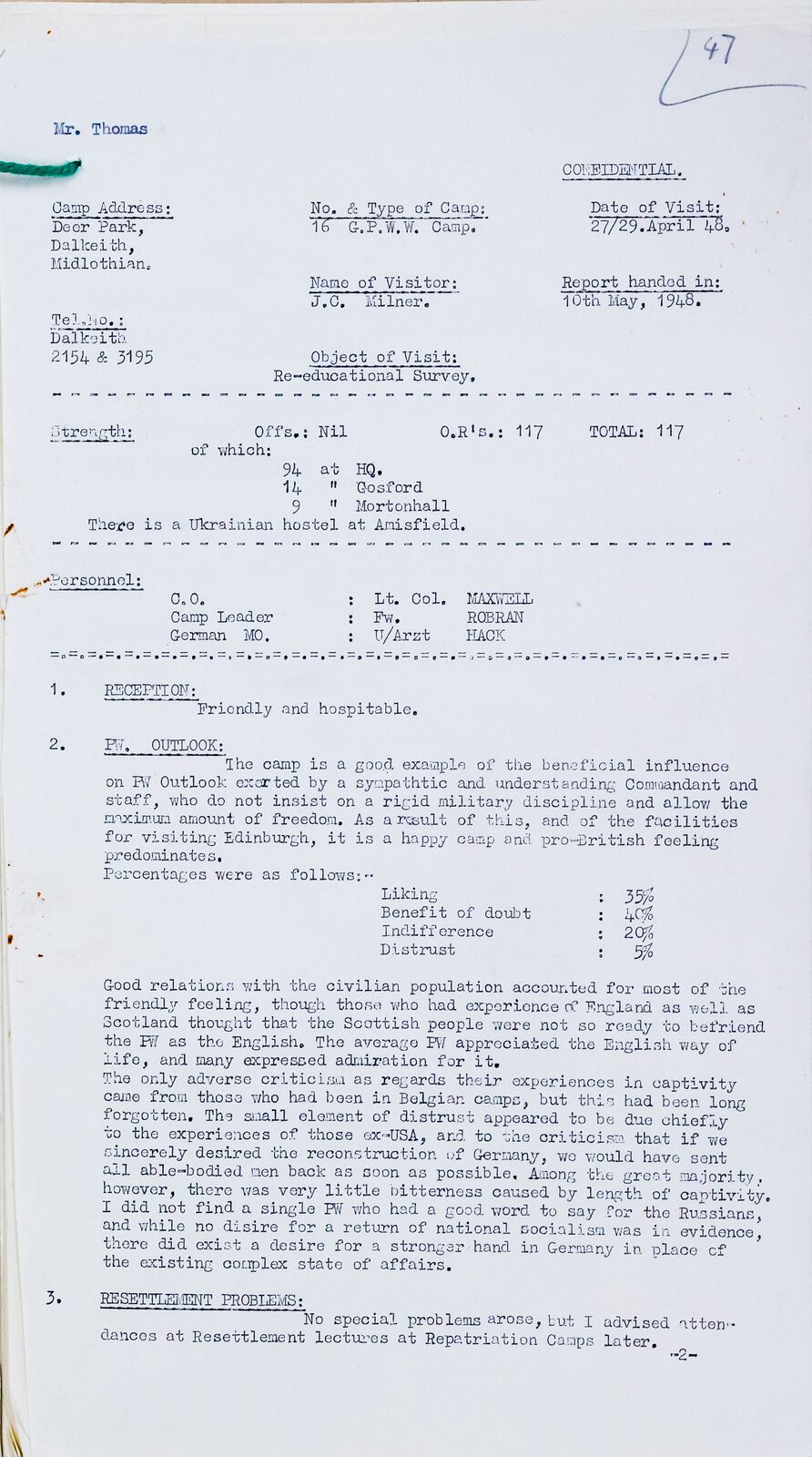
- 27 to 29 April 1948A British survey explicitly recorded the Ukrainian hostel at Amisfield.
- August to September 1948Hubarzhevsky’s newsletter thanked the managers of Haddington Camp after a recent visit.
- September 1948A Red Cross report found sanitation spotlessly clean but of the most primitive order, and expected the hostel to be abandoned within six months.
- 1949The camp’s life as a prisoner-of-war camp ended; a photograph of the entrance gate carries this date.
- 14 August 1960A vellum presented to Archbishop Gordon Gray lists Haddington among Scotland’s Ukrainian communities.
Sources for this section
- Haddington, Amisfield Park, Camp 243, NRHE 222940
- Amisfield Preservation Trust, Amisfield Park history
- Home Front: PoW Camps, Amisfield (Camp 16A / 243)
- Peter David Kormylo, In which ways is the Ukrainian community in Scotland a diaspora?, PhD thesis, University of Glasgow, 2021
- J. C. Milner, re-educational survey of Deer Park, 27–29 April 1948
- Ihor Hubarzhevsky, Thanks, Brotherhood’s Letter, No 4–5, August–September 1948, p 22
From estate parkland to a military camp
The camp occupied a landscape already shaped by farming and the former Amisfield estate of the Earls of Wemyss. Its military use began in the First World War, when the grounds became a training camp for the Lothian and Borders Horse: the house accommodated officers, wooden huts were built in the park, and football fields, parade grounds and a large practice trench system were laid out on the low ground by the river. During the Second World War the park held the Sherwood Foresters and the Polish 10th Mounted Rifles.
A prisoner-of-war camp was established in 1944 at the western end of the park, about 250 metres north-east of the West Lodge, with the guards’ and staff accommodation between the camp gate and the lodge. Its perimeter fence and huts were photographed from the air on 28 March 1946. Built to hold a thousand men, it was renumbered during its life as a prisoner-of-war camp, from No 188 to 16A, a satellite of Gosford Camp 16, and finally to No 243. When the International Red Cross inspected on 8 February 1946 there were 792 prisoners, of whom 381 were German, 409 Czech and Sudeten and two Austrian; the inspector called it a very good camp and passed on a single request, for more books. Many of the German prisoners worked on surrounding farms.
A Ukrainian hostel in April 1948
When J. C. Milner surveyed the Deer Park POW organisation on 27 to 29 April 1948, he listed prisoners at Deer Park, Gosford and Mortonhall, then separately noted a Ukrainian hostel at Amisfield. The distinction locates the Ukrainian accommodation within the region’s changing postwar camp network without treating those prisoners as an Amisfield population.
The Ukrainians had arrived from the Rimini camp in Italy. A handwritten breakdown of the 1947 dispersal of Ukrainian prisoners through Britain, reproduced in Kormylo’s thesis, shows 965 men sent to Haddington, the largest Scottish allocation and more than twice the 462 sent to Dumfriesshire. That is a figure for the locality at the moment of dispersal. The Haddington History Society account records that after the war Amisfield became home to over 400 Ukrainian former prisoners, and that an International Red Cross report set out findings from a visit in September 1948.
The September 1948 inspector described spare conditions. The sanitary arrangements were spotlessly clean but of the most primitive order, the huts were in urgent need of a new coat of paint, and the men had four blankets but no pillow slips, no sheets, no floor mats, no wardrobes and no curtains. He recorded a minimum wage of £4 10s a week for work in the fields on the farms, of which £1 10s went on accommodation and food, and he expected that the hostel would probably be abandoned within the next six months.
Contemporary records and later recollections
| Date | Evidence |
|---|---|
| First World War | Training camp of the Lothian and Borders Horse in the park |
| 1944 | Prisoner-of-war camp established, numbered 188, then 16A, then 243 |
| 8 February 1946 | 792 prisoners recorded by the International Red Cross |
| 1947 | 965 Ukrainian former prisoners sent to Haddington in the dispersal list |
| 27 to 29 April 1948 | Milner explicitly records a Ukrainian hostel at Amisfield |
| August to September 1948 | Orthodox newsletter lists a recent visit to Haddington Camp |
| September 1948 | Red Cross report on the Ukrainian hostel: sanitation spotlessly clean but of the most primitive order |
| 1949 caption | Photograph of Amisfield Park Camp entrance |
The September 1948 Red Cross report on the Ukrainian hostel
| Item | Recorded |
|---|---|
| Residents | Over 400 Ukrainian former prisoners of war |
| Sanitation | Spotlessly clean, but of the most primitive order |
| Bedding and furnishing | Four blankets each; no pillow slips, sheets, floor mats, wardrobes or curtains |
| Work | In the fields on the farms |
| Minimum weekly wage | £4 10s, of which £1 10s for accommodation and food |
| Community life | Amisfield Ukrainian choir; men free to attend local churches and asking for a Greek Orthodox priest; English lessons proposed for the winter |
| Inspector’s expectation | The hostel will probably be abandoned within the next six months |
Choir, reading room and church
In the August to September 1948 Brotherhood’s Letter, Orthodox church leader Ihor Hubarzhevsky thanked the managers of hostels he had recently visited. Haddington Camp appears among the named stops. His bilingual message praised the care given to displaced Ukrainians. Alongside the precisely named Amisfield record from April, it adds a contemporary view of Ukrainian religious contact in Haddington that year.
The same Red Cross report notes an Amisfield Ukrainian choir, records that the men wanted the services of a Greek Orthodox priest and were free to attend local churches, and mentions English lessons proposed for the winter months. Organised life had begun earlier, in the prisoner-of-war phase: Kormylo describes a Prosvita reading society formed in the Haddington camp in 1947 and 1948, whose surviving membership book lists men from each of the camp’s 56 barracks, paying fourpence a month for use of the reading room library. The barrack count is the clearest surviving measure of the camp’s scale.
Sources for this section
- J. C. Milner, re-educational survey of Deer Park, 27–29 April 1948
- Ihor Hubarzhevsky, Thanks, Brotherhood’s Letter, No 4–5, August–September 1948, p 22
- Peter David Kormylo, In which ways is the Ukrainian community in Scotland a diaspora?, PhD thesis, University of Glasgow, 2021
- Home Front: PoW Camps, Amisfield (Camp 16A / 243)
The entrance and the years that followed
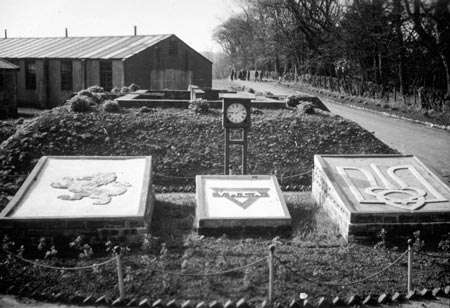
A photograph reproduced in Peter Kormylo’s thesis shows Amisfield Park Camp’s entrance gate, captioned 1949. Decorative emblem panels stood in a landscaped bed beside the camp road and a hut. The Haddington History Society account gives the camp’s life as a prisoner-of-war camp as 1944 to 1949 and records that Amisfield was the first of the linked Deer Park, Gosford and Amisfield camps to close as a main camp, while the preservation trust’s history dates camp closure to 1948.
These accounts leave the final transition uncertain, but the outcome is clear enough. The trust records that some Ukrainian residents established homes in the surrounding area, and the vellum presented to Archbishop Gordon Gray in August 1960 lists Haddington among the Scottish towns with a formal Ukrainian community. The parkland returned to open ground and is now largely occupied by Haddington golf course.
Sources for this section
Sources
- Amisfield Preservation Trust, Amisfield Park history
Full relevant PDF page 24 visually checked by parent; retrospective local history.
- Peter David Kormylo, In which ways is the Ukrainian community in Scotland a diaspora?, PhD thesis, University of Glasgow, 2021
University of Glasgow · 2021
Original figure 2-8 page 61 (entrance gate, captioned 1949), map page 100 and appendix xii page 322 reviewed earlier. Full text re-read 13 September 2026: printed page 140 on Figure 4-14, the handwritten 1947 dispersion list, gives 965 men sent to Haddington, 462 to Barony and 1,427 in Scotland in total, excluding EVWs already in the camps; footnote 35 describes the Haddington camp Prosvita reading society of 1947 to 1948, whose membership book names men from each of 56 barracks who paid fourpence a month; printed page 208 lists Haddington among the Ukrainian communities on the 1960 vellum. No names from these lists are published here.
- J. C. Milner, re-educational survey of Deer Park, 27–29 April 1948
Complete photographed original visually read. Explicit sentence about the Ukrainian hostel at Amisfield is separate from the total of 117 POWs. FO 939/100 supplied by the reproducer.
- Ihor Hubarzhevsky, Thanks, Brotherhood’s Letter, No 4–5, August–September 1948, p 22
Original bilingual page 22 visually read. Lists Haddington Camp among recent visits. Linked cautiously by locality alongside evidence independently naming Amisfield; no exact day, service or parish establishment asserted.
- Home Front: PoW Camps, Amisfield (Camp 16A / 243)
East Lothian at War; © 2020 D Haire, Haddington History Society · 2020
Page read in full. Camp numbering 188, 16A, 243; built for 1,000 men; life as a POW camp 1944 to 1949; Red Cross inspection of 8 February 1946 with 792 prisoners; September 1948 Red Cross report on the Ukrainian hostel with over 400 men, sanitation spotlessly clean but of the most primitive order, bedding and furnishing shortages, wages of £4 10s less £1 10s for board, the Amisfield Ukrainian choir, the wish for a Greek Orthodox priest and proposed English lessons. Drawn from Red Cross reports, the camp newsletter Der Spatz and former prisoners’ recollections. Individual Ukrainian names on the page are not reproduced, because these men came from Rimini.
- Haddington, Amisfield Park, Camp 243, NRHE 222940
Historic Environment Scotland, National Record of the Historic Environment · Archaeology note October 2002; activity note 20 October 2014
Full record read in browser (direct requests return 403). NT 5260 7400. First World War camp of the Lothian and Borders Horse with officers in the house, huts, football fields, parade grounds and a practice trench system; Sherwood Foresters and Polish 10th Mounted Rifles in the Second World War; POW camp at the west end of the park, about 250m north-east of the West Lodge, with guards’ accommodation between the gate and the lodge; huts and perimeter visible on RAF 106G/UK 1319, frames 5196-7, flown 28 March 1946. Also known as Haddington Golf Course.
Last researched 13 September 2026