Rimini Camp
Displacement in Europe
Miramare, Rimini, Italy · October 1945–June 1947
Thousands of Ukrainians were held at Rimini after surrendering to British forces. Inside the wire they built schools, workshops and a theatre, while campaigning against forced return and preparing for an uncertain move to Britain.
Introduction
Rimini was a British-controlled internment camp for former soldiers of the Ukrainian Galicia Division. Its Ukrainian compound formed part of the much larger Rimini–Bellaria network on Italy’s Adriatic coast. The men arrived after military surrender, rather than through the civilian displaced-persons resettlement system. Their captivity became an important stage in the formation of Britain’s postwar Ukrainian communities.
The division had been raised in 1943 as a formation of the Waffen-SS. In the closing weeks of the war it was redesignated the 1st Ukrainian Division of the Ukrainian National Army, while remaining under German operational control. That history is essential to understanding why British authorities held its members as surrendered enemy personnel and debated their future.
Sources for this section
A history in dates
- May–June 1945Former division members are transferred from Austria to Bellaria.
- 17 October 1945The remaining Ukrainian group moves from Bellaria to the Rimini camp.
- 30 October 1945A surviving photograph records a Ukraine–Germany football match.
- 12 May 1946The twice-weekly camp newspaper records an established programme of sport, cinema, visits and camp administration.
- 6 July 1946An order sets out provisions for correspondence, recreation, clothing and movement.
- 21 November 1946A collective appeal describes hunger, winter accommodation, interrupted education and separated families.
- 1 April 1947The British Cabinet approves transfer to the United Kingdom.
- 20 April 1947A surviving six-page issue of the weekly Batkivshchyna combines camp news with international affairs.
- May–June 19478,570 people are transported from Venice to Britain.
- August–October 1948Most former division members move from prisoner status into civilian employment under the EVW scheme.
Sources for this section
- Former soldiers of the Galicia Division
- In the Maelstrom: The Waffen-SS Galicia Division and Its Legacy, chapter 11 Rimini 1945–47
- Enklave Rimini Bellaria, 1945–1947
- Life in Camp (Zhyttia v tabori), 12 May 1946, no. 26 (39), pp. 1, 9–10 and 12
- Order concerning treatment and privileges of prisoners
- Collective appeal from Ukrainian SEP Camp, Rimini
- Museum Fund of Ukraine: Batkivshchyna, 20 April 1947, no.14/76
From Austria through Bellaria
After Germany’s defeat, most surviving members of the division surrendered to British forces in Austria. They were taken to Bellaria in May and early June 1945. In October the remaining group moved south to the camp near Rimini. Bellaria was therefore an earlier stop in the same journey, not an alternative name for the later Ukrainian compound at Miramare.
The opening of the Rimini chapter in the 2023 study In the Maelstrom gives 17 October 1945 as the move from Bellaria, after five months in Camp 5 C. It places the following eighteen months within continuing resistance to deportation and efforts to publicise conditions in Ukraine. This supplies a more precise date for the change of camp, while preserving the distinction between Bellaria and the later Miramare enclosure.
The camp sequence
| Stage | Place | Period |
|---|---|---|
| Military surrender | Austria | May 1945 |
| Initial Italian internment | Bellaria | May/June–October 1945 |
| Later Ukrainian compound | Rimini / Miramare | October 1945–May/June 1947 |
| Further captivity and work | Britain | From May/June 1947 |
A camp within a coastal network
The Ukrainian camp occupied a particular part of a much larger landscape of captivity. The first Ukrainian enclosure was Camp 5 C at Bellaria; the later one was Cage No. 1 at Miramare. The winter complex stood on the airfield and adjoining land. Its national compounds, communal halls, churches and cinema made it resemble a temporary town, although the Ukrainian population was only one of the groups held there. Neither a photograph of the wider Miramare complex nor an Enklave population total necessarily describes the Ukrainian enclosure.
The regional system included more than ten camps and supporting services needed to keep them functioning. Prisoners differed in nationality, military background and wartime role; women were also among those interned across the network. The camp newspaper Die Brücke became one setting for British-supported attempts to encourage democratic discussion among German prisoners. This was an activity of the wider Enklave and should be distinguished from the Ukrainian-language press produced within the Ukrainian community.
Sources for this section
Who administered the camps?
British supervision initially worked through a layer of retained German administration. The 21st Armoured Brigade oversaw the coastal camps, while the German Headquarters at Bellaria organised much of their management and welfare. The Ukrainian command operated within this wider structure of Allied captivity.
The structure changed as captivity continued. From August 1945, work detachments were sent to sites around Italy and releases began. In autumn 1946 the German Headquarters became a liaison office as direct British administration replaced its earlier role. The Bundesarchiv dates the dissolution of that Enklave administration to late April 1947. Ukrainian departures continued afterwards: an administrative closure date is therefore different from the date when the last Ukrainian prisoners left Italy.
Sources for this section
Why birthplace became a matter of survival
Fear of forced return was already shaping the prisoners’ relationship with British authority before the move to Rimini. On 26 June 1945, the Ukrainian commander at Camp 50 asked to be excused from preparing a British-requested list of officers and soldiers born within the Soviet Union’s pre-war boundaries. He understood classification by birthplace as a possible first step towards a handover to Soviet custody. His letter also raised the position of Ukrainian women serving as clerks and medical sisters. The document records the prisoners’ fear and protest; it is not itself a British decision to deport them.
A petition dated 29 June spoke on behalf of 10,207 officers and men. Its central argument separated Ukrainian national identity from the successive citizenships imposed by changing borders. The petitioners asked to be recognised as stateless Ukrainian political emigrants, granted asylum within the British Empire and protected from return to either the Soviet Union or Poland. They wanted Britain to consider them as one national group, rather than divide them according to where they had lived before 1939. These were requests made during the earlier Italian captivity, not rights already granted to Rimini’s residents.
Sources for this section
Life under canvas
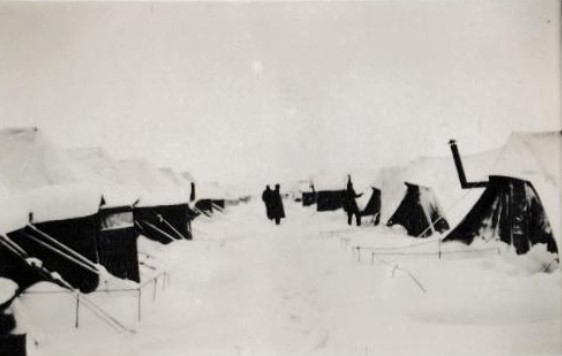
An English-language collective appeal dated 21 November 1946 describes about 9,000 men in No. 1 Cage at Rimini. After eighteen months in captivity, its writers complained that their future remained unresolved. They reported inadequate rations, increasing tuberculosis and another winter in canvas tents, with too few beds and little straw. These are the prisoners’ contemporary claims in an appeal for intervention.
The same appeal makes family separation tangible: roughly 1,000 men were said to have wives, children or elderly parents elsewhere in the occupation zones of Germany. Several hundred reportedly had relatives overseas and immigration documents but could not depart. The writers sought release, useful work and the opportunity to reunite with their families.
The appeal of 21 November 1946 connected poor living conditions with the absence of a settled future. Besides the hunger, tuberculosis and inadequate bedding it described, the document drew attention to approximately 100 disabled men unable to work, living in the camp or in prisoner-of-war hospitals at Cesena and Cesenatico. About fifty reportedly had families in Germany. The writers said their requests for reunion had not been approved and that they lacked the convalescent arrangements available to disabled German prisoners.
The appeal also alleged two serious incidents involving guards: a prisoner was killed while trying to pass into a neighbouring compound on 18 October 1946, and shots fired two days later struck a tent used as living accommodation. Together with continued uncertainty, the writers said these experiences produced despair and encouraged escapes. The document called for release and an opportunity to earn a living. It was a collective intervention, endorsed by the camp leadership, an editorial commission and one representative for each hundred men.
What the November 1946 appeal reported
| Measure | Reported figure | Scope |
|---|---|---|
| Men represented | About 9,000 | Ukrainian residents of No. 1 Cage at Rimini |
| Time in British captivity | 18 months | From surrender in 1945; not eighteen months at the later Rimini site |
| Men with close relatives in Germany | About 1,000 | Wives, children or elderly parents in the British, American and French zones |
| Disabled men unable to work | About 100 | Camp and POW hospitals at Cesena/Cesenatico together |
| Disabled men with families in Germany | About 50 | Subset of the approximately 100 |
| Men with relatives and entry documents for countries in the Americas | Several hundred | An approximate statement; no exact count supplied |
Sources for this section
Schools and preparation for civilian work
Prisoners organised practical training to relieve inactivity and prepare for employment. Research drawing on surviving family papers records instruction in wireless operation, driving, motor mechanics, bricklaying, carpentry and hairdressing. A basic English-learning booklet was reworked and printed at Rimini in 1947: conversational phrases, grammar and phonetic spellings offered tools for life beyond the camp.
This educational activity did not mean conditions were comfortable. The November appeal says schools and courses were organised for younger men whose education had been interrupted and older men learning a civilian occupation. It reports exhaustion among teachers and students, including cases of students fainting during lessons from undernourishment. Books and stationery depended heavily on limited relief donations from Ukrainian supporters in Canada and Rome.
Practical training recorded at Rimini
| Area | Examples |
|---|---|
| Technical work | Wireless operation; motor mechanics |
| Transport | Driving |
| Building trades | Bricklaying; carpentry |
| Personal services | Hairdressing |
| Language | English conversation, grammar and pronunciation |
Building a community inside the wire
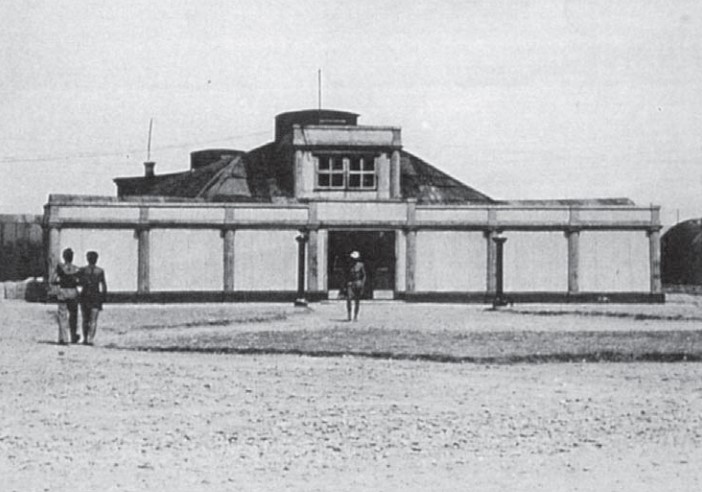
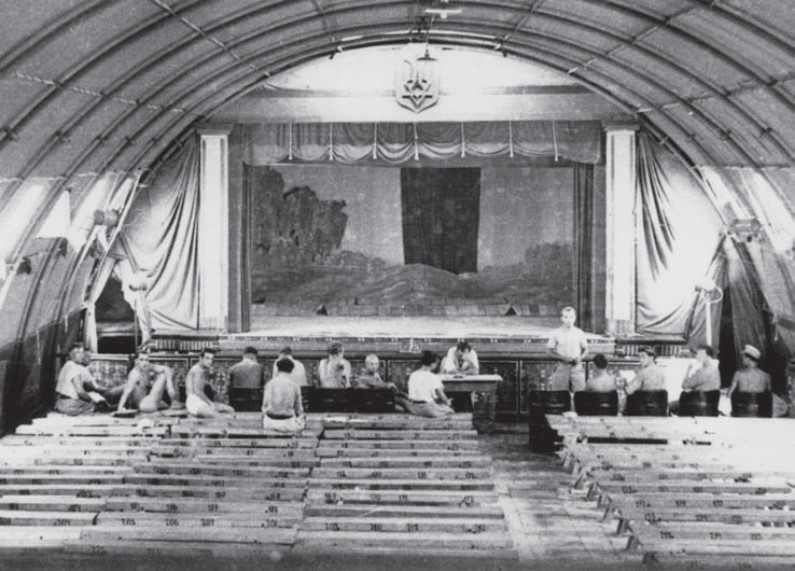
The camp’s technical unit constructed roads and communal facilities, including kitchens, canteens, toilets, a school and a theatre. These buildings supported a more organised settlement than the image of a field of tents alone suggests. Photographs preserve the theatre’s substantial frontage and its interior, with rows of benches facing a stage beneath a curved roof.
Theatre, sport and small publications gave prisoners ways to occupy their time and sustain a shared cultural life. A surviving photograph is captioned as a Ukraine–Germany football match on 30 October 1945. It records organised contact between national groups within the camp system. The buildings and activities should be understood alongside the continuing confinement and material shortages.
A newspaper made inside the camp
The camp newspaper, Zhyttia v tabori—Life in Camp—made a record of captivity as it happened. Its issue of 12 May 1946 identifies Rimini as its place of publication and states that it appeared twice a week. The illustrated masthead places a tent behind barbed wire. Inside, readers moved between memories of the end of the war, arguments about Ukrainian identity, international news, sports results and brief announcements from the camp. The newspaper joined these different parts of life together: the uncertainty of the men’s political future sat alongside the next match and the latest clothing issue.
This was an organised publication, with a press office and editorial board identified in its imprint. It also operated under censorship. The chronicle records that the Ukrainian camp command appointed three press censors on 4 May, including a censor responsible for the month of May. The paper therefore gives a contemporary view of camp life while also showing the supervision under which that view was produced.
Publishing continued into the following year. A surviving copy of the weekly Batkivshchyna dated 20 April 1947 is held by Lviv Historical Museum. Its six pages include an article on Finland’s reconstruction, international news and camp news on pages five and six. The last page carries an Easter chick illustration. The museum identifies it as a publication of the camp’s Cultural and Educational Department.
Sport, evenings and visitors
Sport had become a substantial part of the camp’s social life by May 1946. The newspaper’s sports page compared the current season with the previous year and described the growth of activities and participation. Its message went beyond fitness: it stressed endurance, determination, comradeship and fair play. Football received particular attention because Ukrainian teams sometimes met foreign opponents. Players and spectators were urged to treat opponents and referees properly, since their behaviour helped shape outsiders’ impressions of Ukrainians.
The printed results show competition between units, including the sanitary company, infantry regiments, the technical regiment and other camp groups. Basketball, football and volleyball all appear in the May chronicle. Athletics had its own organised programme: on 8 May the paper recorded the formation of a club to prepare for spring competitions, encourage wider participation and arrange meetings with other camps. Training took place on the sports ground at seven in the evening every Tuesday, Thursday and Saturday.
The same short notices bring other routines into view. After a visit by two British generals and headquarters officers on 6 May, the chronicle records that the whole camp received summer uniforms. On 8 May Ukrainian soldiers serving in the Polish 2nd Corps presented a Ukrainian flag. A cinema showing and a visit by two priests are recorded for 10 May. These entries describe organised recreation and outside contact within a community whose members were still awaiting decisions about their future.
A week in Rimini, May 1946
| Date | What the camp newspaper recorded |
|---|---|
| 3 May | Basketball: sanitary company beat the 1st Regiment 16–7; 2nd Battalion beat the 3rd Regiment 34–0. |
| 4 May | Three camp-press censors appointed; further basketball results published. |
| 5 May | British commandant gave an assurance concerning repatriation commissions. |
| 6 May | Two British generals and headquarters officers visited; summer uniforms issued to the camp. |
| 8 May | Ukrainian soldiers of the Polish 2nd Corps presented a flag; an athletics club was formed. |
| 10 May | Cinema showing and a visit by two priests. |
Athletics: the previous season’s results printed in May 1946
| Event | Reported result |
|---|---|
| 60 metres | 9 seconds |
| 100 metres | 13.2 seconds |
| 400 metres | 61.1 seconds |
| 4×100-metre relay | 54.9 seconds |
| High jump | 1.52 metres |
| Long jump | 5.49 metres |
| Shot put | 9.93 metres |
| Discus | 26.50 metres |
Sources for this section
Language and an uncertain future
An article on page nine objected to a visiting German variety-show announcer addressing the camp in Russian. The writer wanted foreigners to recognise Ukrainian as a distinct language, and also criticised divisions between eastern and western Ukrainians within the camp. The argument shows that national identity was debated in everyday encounters as well as in formal petitions.
Fear of forced return remained close to the surface. For 5 May 1946, the newspaper records the British commandant’s assurance that the camp was not threatened by repatriation commissions. That announcement belongs in the same week as the sports results and cinema notice: everyday routines continued while the question of where the men could safely live remained unresolved.
Sources for this section
A postal system inside the camp
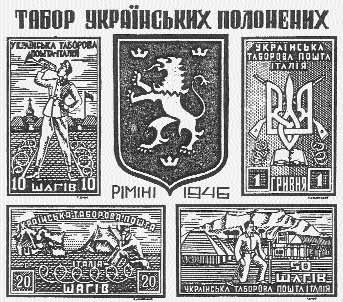
Rimini had an internal postal service as well as the correspondence allowed beyond the wire. A philatelic study records 29 stamps, one souvenir sheet and four postcards produced for use within the camp. These small printed objects show another aspect of its organised daily life: messages could circulate through a local service while external letters remained subject to the camp rules.
An August 1946 souvenir sheet brought together the first four stamp designs around a central lion emblem. The study gives a print run of 2,000 sheets. The designs show figures, the Ukrainian trident and a tented camp, alongside the inscription identifying Ukrainian prisoners. Surviving sheets preserve the camp’s visual identity as well as its internal communications.
Camp postal issues
| Item | Quantity reported |
|---|---|
| Stamp designs | 29 |
| Souvenir-sheet issue | 1 |
| Postcard designs | 4 |
| Copies of the August 1946 souvenir sheet | 2,000 |
Sources for this section
Rules, correspondence and movement
The camp had a Ukrainian command within a British-controlled system. A Ukrainian-language order dated 6 July 1946 relayed changes in treatment and privileges from British headquarters. Ukrainian commanders were to be informed about disciplinary action against their men, and commanders or their representatives could attend investigations and hearings when appropriate. The order envisaged designated areas in which Ukrainians could move freely outside working hours, increased opportunities for sport, and protection of personal possessions except where military necessity required otherwise.
Small administrative changes mattered in a life organised by confinement. Large prisoner markings on clothing were to give way to a coloured circle on the left arm. The correspondence allowance was two letters and one postcard a week. Books, periodicals and cinema were to be supplied where possible. Implementation was not promised immediately, and the privileges could be withdrawn for disciplinary reasons. Questions including the Ukrainians’ position under the Geneva Convention and provision for men unable to work remained under consideration in the order.
Everyday provisions in the July 1946 order
| Area | Provision | Scope |
|---|---|---|
| Correspondence | Two letters and one postcard weekly | Stated allowance |
| Movement | Freedom outside work hours in designated zones | Local commanders defined the areas |
| Discipline | Ukrainian representatives could attend appropriate investigations/hearings | British custody continued |
| Personal property | Protection except for military necessity | Order also envisaged a recording/control system |
| Reading and recreation | Books, periodicals, sport and cinema | Subject to availability and local circumstances |
| Legal and welfare questions | Geneva Convention position and support for men unable to work under consideration | Listed as unresolved matters |
Sources for this section
A campaign reaching beyond Italy
This was an organised international campaign. A distribution list dated 23 November contains 27 numbered recipients, spanning church leaders, British officials, humanitarian bodies and Ukrainian organisations abroad. It included the Vatican, the Archbishop of Canterbury, the YMCA, the International Red Cross and relief networks in Europe and the Americas. The list shows how the prisoners tried to turn distant religious and diaspora connections into practical pressure on the authorities controlling their future.
Sources for this section
Transfer to Britain
By May 1947, correspondence was dealing with the practical paperwork of departure as well as appeals for release. A letter dated 13 May, addressed to the camp chaplain at Rimini, accompanied International Red Cross passports and requested a report on their handling. It asked how many residents had received passports, what notices and seals were used, how many people worked on issuing them and what journeys had been made. The letter shows an organised document-distribution process; possession of such papers was separate from permission to leave British custody.
The British Cabinet approved transfer to the United Kingdom on 1 April 1947. During May and June, 8,570 people travelled from Venice to Britain, including 17 nurses, clergy and some civilian relatives. They entered British prisoner-of-war accommodation, mainly in eastern England and southern Scotland; many subsequently worked in agriculture.
Transfer did not immediately bring civilian freedom. Most former division members were released from prisoner-of-war status into European Volunteer Worker employment between August and October 1948. The path from Rimini therefore continued through another camp system before employment and settlement. These stages help explain why the same family history may connect an Italian camp with several British hostels.
Beyond the wire: Rimini and the camps
For local residents, the camps prolonged the disruption of war. The first postwar municipal administration opposed their establishment, while requisitioned space and the continual movement of supply vehicles affected reconstruction. Relations nevertheless involved daily contact, rather than complete separation. Agnoletti describes considerable movement outside the compounds and tensions between the apparent resources of the camp system and the hardship experienced in the damaged town. That local view contrasts with Ukrainian appeals describing hunger and illness inside their own enclosure; each describes a different position within the same postwar landscape.
The scale of the occupation remained central to the city’s 2025 historical research programme. Its account places the network from Riccione to Cervia and describes Miramare airfield becoming its central hub from autumn 1945. The camps occupied a coastal region still recovering from bombardment and fighting. Their eventual removal was consequently part of local civilian recovery as well as a turning point in the prisoners’ journeys.
Sources for this section
The surviving record
The Shevchenko Scientific Society holds a collection of administrative papers, correspondence, publications, photographs and maps relating to the division at Rimini. These preserve both the structures of camp life and the arguments prisoners made about their future. The Wiener Holocaust Library separately catalogues British-side papers and six photographs connected with the Rimini–Bellaria camps and a prisoner handover. Their different origins offer complementary views of internment.
Camp records also helped families seek answers long after captivity ended. A letter written in New York on 30 March 1955 describes a numbered casualty list compiled at Rimini from sworn eyewitness statements. It explains how that list could be compared with photographs of graves in Austria to answer a bereaved family’s enquiry. The correspondence preserves evidence of this work, although the underlying list, witness statements and photograph album are not included in the supplied scans.
Sources
- Former soldiers of the Galicia Division
Roman Krawec, Ukrainians in the United Kingdom online encyclopaedia · Updated 2014; consulted September 2026
Full article read: division origins, Bellaria–Rimini chronology, legal classification, Cabinet decision, transfer totals and release into EVW employment.
- Enklave Rimini: la guerra continua
Rimini Turismo / Comune di Rimini · 15 May 2025
Official local-history programme: wider network, geography, planned population and effect on civilian reconstruction.
- Collective appeal from Ukrainian SEP Camp, Rimini
Shevchenko Scientific Society Archives, Collection 034 · 21 November 1946
Same collection, Camp documents, PDF pp. 65–66 and 59 (English version); pp. 57–58 (Ukrainian version).
- Home from Home: the history of an émigré Ukrainian community in Huddersfield, 1948–2018
Michael Drapan, University of Huddersfield · 2019
Pages 65–66, 77 and illustration 34: technical-unit construction, courses, English booklet and theatre. Personal histories and inmate names not reproduced.
- Enklave Rimini Bellaria, 1945–1947
Claudio Pasolini, Storie Bellariesi · Updated 27 March 2026
Full page and original images inspected; theatre, interior, January 1946 snow and October 1945 football captions. Wider Enklave images not asserted to identify individual prisoners.
- Order concerning treatment and privileges of prisoners
Shevchenko Scientific Society Archives, Collection 034 · 6 July 1946
Same collection, Camp documents, PDF pp. 39–40.
- Collection on Divizia “Halychyna” in Rimini (Italy)
Shevchenko Scientific Society Archives · Finding aid edited 2026
Collection 034; papers 1945–1955. Collection description is provisional; supplied administrative pages independently inspected for cited claims.
- Photographs of POW Camp in Rimini and of prisoner exchange
Wiener Holocaust Library · Photographs dated circa 1946
Catalogue 1033/2 describes four camp images and two handover images. Catalogue only; images not reproduced.
- Letter concerning List B, 26 June 1945
Shevchenko Scientific Society Archives
Shevchenko Scientific Society Archive, Archive of the Division Galizien, Rimini, Italy, 1945–1947, Camp documents, PDF p. 12. Scans supplied July 2026.
- Collective petition to British camp command, 29 June 1945
Shevchenko Scientific Society Archives
Same collection, Camp documents, PDF pp. 13–14 (Ukrainian original).
- Appeal distribution list, 23 November 1946
Shevchenko Scientific Society Archives
Same collection, Camp documents, PDF pp. 60–61; duplicate pp. 62–63.
- Letter accompanying International Red Cross passports, 13 May 1947
Shevchenko Scientific Society Archives
Same collection, Camp documents, PDF p. 64.
- Correspondence on casualty documentation, 30 March 1955
Shevchenko Scientific Society Archives
Same collection, Correspondence, PDF p. 5.
- Enklave Rimini, in …Pur l’avvenir siam noi. Ricostruire Rimini
Biblioteca civica Gambalunga
Relevant chapter, printed pp. 111–114, read in full. Ukrainian enclosure identified separately from the wider camp network.
- Deutsches Hauptquartier Bellaria (SEP-Enklave Rimini) und unterstellte Einrichtungen
Bundesarchiv, BArch RW64; Deutsche Digitale Bibliothek · Catalogue updated 24 April 2026
Full finding-aid institutional history read; archival files not inspected
- Rimini Enklave 1945–1947
CLUEB · 2005
Publisher description read; full monograph NOT accessed
- In the Maelstrom: The Waffen-SS Galicia Division and Its Legacy, chapter 11 Rimini 1945–47
McGill-Queen’s University Press/JSTOR · 2023
Accessible opening of chapter 11, Rimini 1945–47, pp. 177–196: 17 October 1945 transfer date. Full chapter not accessed.
- Enklave Rimini, la guerra continua
Comune di Rimini · 14 May 2025
Full official announcement read; podcast audio not listened
- Life in Camp (Zhyttia v tabori), 12 May 1946, no. 26 (39), pp. 1, 9–10 and 12
Shevchenko Scientific Society Archive, Collection on Divizia Halychyna in Rimini, Box 1 Folder 5; supplied PhotosMisc PDF pp. 107, 115–116, 118. Facts paraphrased from private research copy; scans not reproduced.
- Museum Fund of Ukraine: Batkivshchyna, 20 April 1947, no.14/76
Lviv Historical Museum object catalogue; six pages, 30 × 21 cm.
- Philatelic vestiges of the Galicia Division
The Ukrainian Weekly; Ingert Kuzych · 5 March 2000
Printed p. 12, Rimini postal issues and figure 2. Used for camp-post issues only.
Last researched 12 September 2026