Atlit Detention Camp
Arrival and settlement
Atlit · Israel · 1939–1948
The British Mandate government built a detention camp at Atlit in 1939 to hold Jewish immigrants who reached Palestine without permits, and more than 40,000 people passed through its wire before 1948. Survivors from places now in Ukraine were among them, although the camp records no Ukrainian community as such.
Introduction
Atlit was a British Mandate detention camp south of Haifa. Jewish refugees who reached Palestine without authorised immigration papers could find themselves confined here after escaping Europe. A testimony preserved by the Tennessee Holocaust Commission records this experience for a survivor born in then-Polish territory now in Ukraine. This is a documented connection to Jewish displacement from Ukraine, rather than evidence of an ethnic-Ukrainian camp community.
What remains unknown is how many of the people held at Atlit came from the territory of present-day Ukraine. The published histories count arrivals by voyage.
A history in dates
- May 1939The British White Paper limits Jewish immigration; the Mandate government builds the camp at Atlit.
- 8 January 1940The first detainees, 728 passengers from the Orion, are brought to the camp.
- June 1940About 2,000 people are held, including 300 women and 30 children.
- Second half of 1942The last of the wartime detainees are released and the camp ceases to hold them.
- 10 October 1945A Palmach operation releases the 208 detainees then held.
- January to July 194610,200 people are interned from eleven intercepted vessels.
- August 1946Britain begins deporting intercepted immigrants to Cyprus.
- November 1946The camp empties of detainees and becomes a staging point for people released from Cyprus.
- 1948The site enters a new phase of immigrant reception.
- 1970The camp’s use as a temporary shelter for the absorption of new immigrants comes to an end.
- 1987The camp becomes a national heritage site.
- June 2010A museum of clandestine immigration opens aboard a former fishing boat on the site.
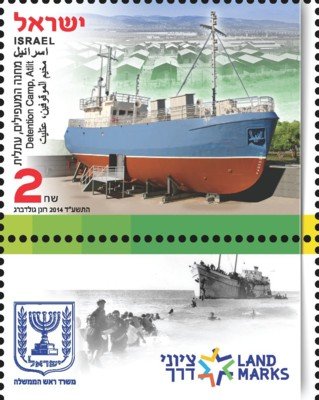
- 2014A stamp of the camp is issued in Israel’s National Heritage Landmarks series.
- 31 March 2022Survivors and family members of the ship Moledet gather at the camp for the seventy-fifth anniversary of its arrival, and a monument is unveiled.
From survival to another detention camp
The survivor describes liberation in 1944 followed by travel through Romania, Hungary, Bulgaria and Turkey before entering Palestine. British authorities then detained the family at Atlit. The account establishes the route and destination, but does not supply an unambiguous arrival date. It conveys how escape from Nazi persecution could be followed by another period of confinement under a different authority.
Jack Fried, interviewed for the commission’s archive, was born in June 1938 in a town in eastern Poland now in Ukraine, near the Dniester, with a Jewish population of a little over 2,200 in 1938. He remembered German troops crossing the bridge into the town a month after his third birthday. He and his family were liberated by Soviet forces at the end of 1944 and travelled out with the Red Army; reaching Palestine without papers, they were, in his words, put in a prisoner-of-war camp.
Sources for this section
Immigration restrictions and arrivals
The camp operated within the restrictions established by Britain’s 1939 immigration policy. Release depended on immigration quotas. After the war, arrivals increased sharply: the Palyam history records 10,200 people interned from eleven intercepted vessels between January and July 1946. In August, British policy shifted towards deporting intercepted arrivals to Cyprus. Atlit subsequently formed part of the release process for people brought back from those camps.
The White Paper of May 1939 limited Jewish immigration to 75,000 over five years, and the Mandate government built Atlit to hold those caught entering outside that quota; everyone released from the camp was counted against it. The first detainees were the passengers of the Orion, 728 people, on 8 January 1940, followed that month by the Hilda and in February by the Sakarya with 2,400. In June 1940 about 2,000 people were held, among them 300 women and 30 children; by October only 356 remained. The camp filled again after the sinking of the Patria in November 1940, whose survivors were held at Atlit instead of being deported to Mauritius. The last of them were released in December 1941, and the roughly 800 who remained, mostly from the Darien, were let go during the second half of 1942, after which the camp closed in that form.
Between those phases Atlit served as a transit station for immigrants who did hold certificates, among them the Tehran Children, a group from Algiers and 585 people from Yemen who arrived by train. It reopened for detention in 1945. After the deportations to Cyprus began the camp emptied of detainees in November 1946, and the Jewish Agency then agreed with the British that those due for release from Cyprus would spend the remainder of their time at Atlit. The agency ran the camp internally, Hadassah provided the medical service and the British kept external control; through 1946 about 750 people a month arrived and stayed on average three months.
Not everyone held at Atlit was released against the quota. The Palyam stamp history records that 1,750 ma‘apilim were deported from the camp for a lengthy detention on the remote island of Mauritius.
Arrivals recorded for January–July 1946
| Measure | Number |
|---|---|
| People interned from intercepted vessels | 10,200 |
| Vessels concerned | 11 |
Inside the camp
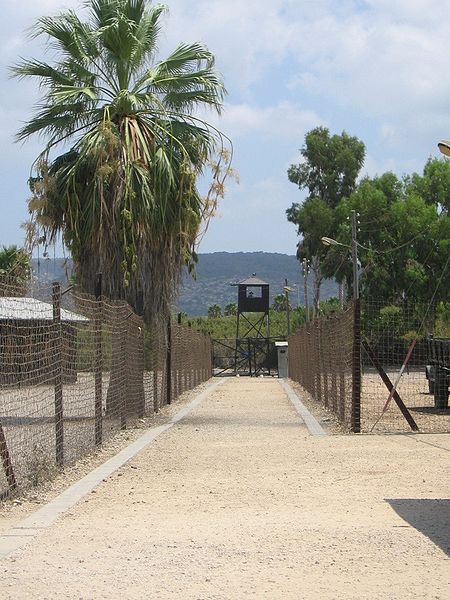
The compound included barracks, a disinfection building, medical facilities, kitchens and dining rooms behind wire fences. In October 1945, a Palmach operation released the detainees then held there. During 1946–1948, the British also confined members of Jewish underground organisations at the site. These overlapping uses should not be mistaken for a single refugee population.
About a hundred wooden huts were built, of which eighty-six housed detainees; the maximum capacity is estimated at some 4,000, and when the huts filled people were put in army tents at the northern end. Men and women were separated by wire. Reception meant registration, separation and disinfection with DDT. Stays ranged from a few days to twenty-three months. Yishuv institutions worked for the detainees’ welfare and organised the teaching of Hebrew. British policy was to release against the certificate quota in order of arrival, with priority for women, children, the sick and men enlisting in the British army.
The raid of 10 October 1945 freed all 208 detainees then held. It was planned and commanded by Nahum Sarig with Yitzhak Rabin as his deputy, and formed part of the Hebrew Resistance Movement. To forestall another attack the authorities allocated an extra 1,500 certificates a month for three months from 15 December 1945.
The camp as built and occupied
| Measure | Figure |
|---|---|
| Wooden huts built | About 100 |
| Huts used to house detainees | 86 |
| Estimated maximum capacity | About 4,000 |
| Shortest and longest recorded stays | A few days to 23 months |
| People held over the camp’s Mandate life | More than 40,000 |
Sources for this section
Reception and remembrance
After Israel’s establishment in 1948, the camp accommodated new immigrants. Later phases included military captivity as well as civilian reception. The surviving heritage site contains restored and reconstructed buildings and an exhibition vessel illustrating clandestine immigration journeys. Its designation as a national heritage site in 1987 helped preserve a place where arrival and detention had become closely connected.
The sequence after 1948 ran from Egyptian prisoners of war, released in March 1949, to an immigrants’ camp that in 1950 received arrivals from Yemen and also held 1,200 families in a transit settlement. When immigration from Iraq grew the families were moved out and the site became a sorting and absorption camp known as Sha’ar Aliya Bet. It should not be confused with the Sha’ar Ha’aliya reception camp at Haifa. Prisoners were again held after the wars of 1956 and 1967; the place was abandoned in the 1970s and used once more during the Lebanon war.
Preservation began in 1986. President Chaim Herzog declared the camp a national heritage site of clandestine immigration in 1987, and it now carries the name of Moshe Sneh. Restored huts and the original disinfection building stand inside the wire. An old Latvian fishing boat bought in 2006 was opened as a museum of clandestine immigration in June 2010, and a research centre established in 2001 documents the voyages and the names of those who made them.
The Palyam stamp history dates the immigrant-shelter phase more closely than the heritage summaries: after the state was established the camp became a temporary shelter for the absorption of new immigrants and served as such until 1970. The same article records the issue in 2014 of a stamp in Israel’s National Heritage Landmarks series.
The camp also figures in later commemoration of the voyages. An account published in April 2022 records that the escorts of the immigrant ship Moledet were captured and sent to the Atlit Detention Camp, that survivors and family members gathered at the camp on 31 March 2022 to mark the seventy-fifth anniversary of the ship’s arrival at Haifa, and that a monument co-funded by Love Never Fails and the Atlit Museum was unveiled after the ceremony.
Sources
- Survivor testimony describing detention at Atlit
Tennessee Holocaust Commission · Transcript published 2021
Original transcript A53, page 1, connects birth in then-Polish territory now in Ukraine with later detention at Atlit. The speaker names his birth year, the Dniester and the town’s prewar Jewish population; the place name is marked unintelligible in the transcript. No arrival year is inferred.
- The Atlit Detention Camp
Palyam and Aliya Bet historical website
Camp history, the 1939 White Paper quota, the January to July 1946 admission figure, Cyprus policy, the 1945 release operation and the museum entrance image. Figures concerning all voyages are not treated as camp population.
- מחנה המעצר בעתלית (The Atlit detention camp)
Hebrew Wikipedia, citing Yehoshua Caspi, Cathedra 32 (1984), Mordechai Naor (1990) and the Mandate-period daily Davar · Accessed September 2026
Framework article read in Hebrew: layout and capacity, reception routine, arrival and release figures by ship and year, the Jewish Agency arrangement of 1946, the postwar sequence of uses and the heritage site. Treated as a secondary summary of the works it cites.
- Atlit detainee camp
English Wikipedia · Accessed September 2026
Used only where it agrees with the Hebrew article and the Palyam account: the site, the separation of men and women, the DDT disinfection, the Patria and Darien, the 1948 use as a prisoner-of-war and internment camp, and the restored barrack display.
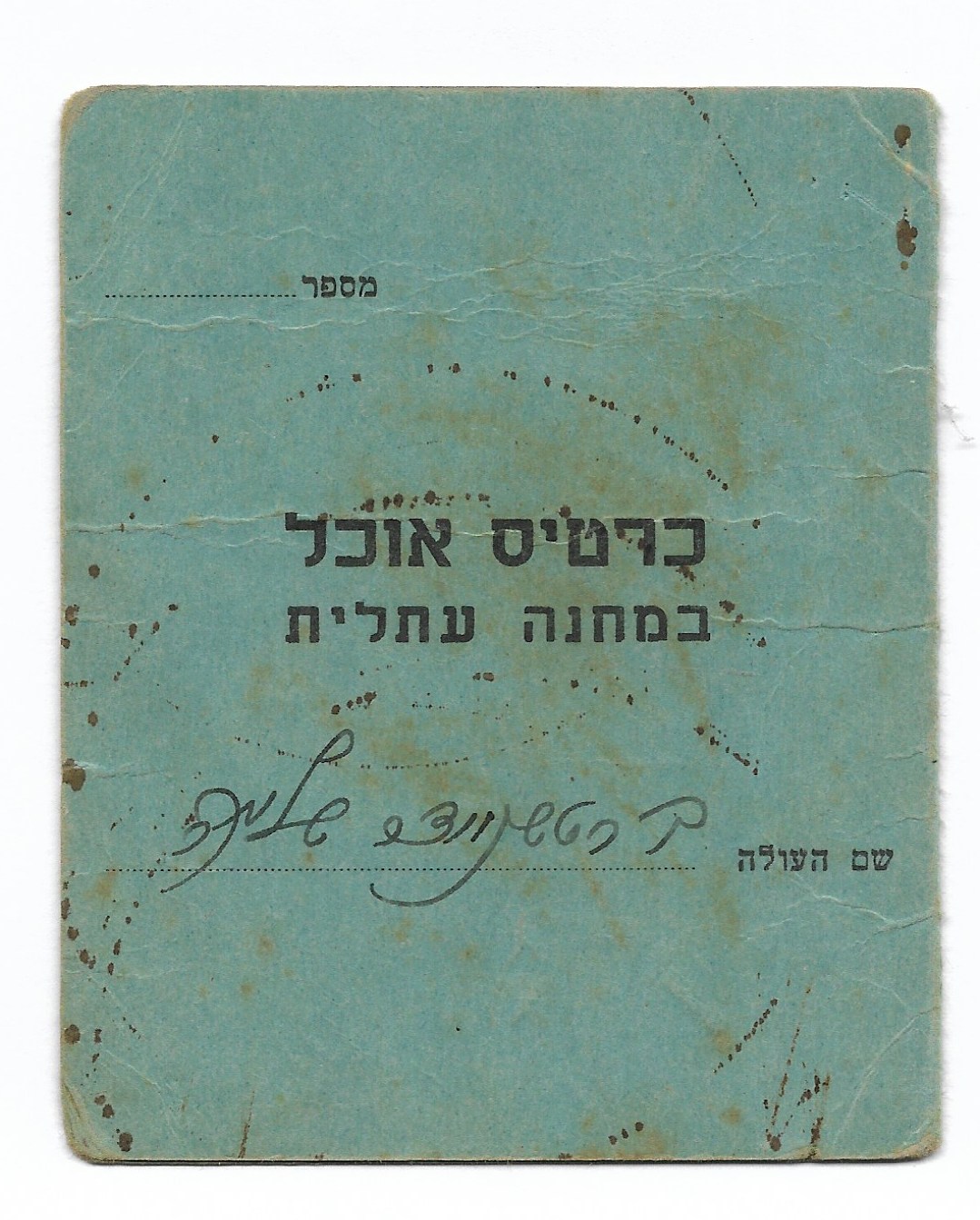
- Atlit detention camp meal-ration card, circa 1947
Government of the British Mandate for Palestine; private collection, via Wikimedia Commons · circa 1947
Public domain. A printed ration card issued to a detainee at Atlit, with numbered meal squares to be punched or clipped.
- The Atlit Detention Camp
Palyam.org, ‘Stamp of History’ collection · Undated
English web article read in full: the deportation of 1,750 ma‘apilim from the camp to Mauritius, the camp’s use as a temporary shelter for new immigrants until 1970, and the issue of a National Heritage Landmarks stamp in 2014. A separate article from the Palyam camp history already cited as source 2.
- The 75th anniversary of the immigrant ship Moledet arriving in Haifa Port, hosted at the Atlit Detention Camp
hhcoalition.info · 11 April 2022
Commemorative article read in full: the capture of the Moledet’s escorts and their despatch to the Atlit Detention Camp, the gathering of survivors and family members at the camp on 31 March, and the unveiling of a monument co-funded by Love Never Fails and the Atlit Museum.
Last researched 13 September 2026