Bagnoli
Displacement in Europe
Naples, Campania, Italy · 1946–1952
A transit camp in an unopened Fascist boarding college on the western edge of Naples, where a Ukrainian parish, choir and school took shape while families waited for ships and aircraft to take them overseas.
Introduction
Bagnoli was a large transit camp in the western suburbs of Naples. Ukrainians arrived from Germany and Austria and passed through it on their way to South America and other destinations. For families already moved between several camps, this was another temporary home before an uncertain departure.
The camp was run by the International Refugee Organisation and stood in the grounds of a boarding college that had been finished but never used. Its residents came from across eastern and central Europe, and from Istria; Ukrainians formed one community among many, with their own priest, choir and school.
A history in dates
- 2 January 1939Demolition of the Rione Castellana begins to clear the site.
- 1939–1940The college is built to Francesco Silvestri’s design across about thirty hectares.
- 9 May 1940The Collegio Costanzo Ciano is inaugurated but never opens to pupils.
- Late 1942The Italian War Ministry’s occupation of the complex ends; after the German takeover in 1943 the site serves as an officer training school.
- September 1943Italian and German occupation of the complex ends.
- October 1943Anglo-American forces requisition the buildings.
- 1946Refugee accommodation is documented at Bagnoli.
- Autumn 1946A Ukrainian chaplain arrives from Trani to serve the transit camp.
- 26 April 1947An Italian police report lists 2,225 people at Camp 2, Bagnoli.
- Lent 1947A week-long Ukrainian mission is preached in the camp church.
- 1947A Ukrainian school opens under Colonel Farion, and refugees from Austria and Germany embark at Naples.
- July 1947The heritage inventory ends the Anglo-American military occupation.
- 2 December 1949An airlift of mothers and young children leaves Naples for Australia.
- 1951Families continue to wait here for overseas processing.
- January 1952Refugee use ends according to the Italian heritage inventory.
- 1954–2013The complex serves as NATO’s southern headquarters.
Sources for this section
- La base NATO di Bagnoli: da collegio fascista a sede degli Alleati a Napoli
- Ex Base NATO – Parco San Laise: la storia
- Edifici dei dormitori maschili e femminili nell’ex Collegio Costanzo Ciano della GIL (area NATO di Bagnoli)
- Crossroads in Cairo, 1942: 19, rue Hawayati where three empires met
- Stalin Reaches Out for Expatriates
- Спогади польового духовника, chapter twenty-one
- Per una storia dei profughi stranieri e dei campi di accoglienza e di reclusione nell’Italia del secondo dopoguerra
- Belongings: Brunhilde Srejic
- IRO Refugee Camp Bagnoli, Naples
A college that never opened
Demolition of the crowded Rione Castellana began on 2 January 1939 to clear ground for an institution funded by the Banco di Napoli for poor and abandoned children of Naples. Built on the San Laise hillside to the design of the engineer Francesco Silvestri between 1939 and 1940, alongside the neighbouring Mostra delle Terre d’Oltremare, the complex covered about thirty hectares overlooking the Gulf of Pozzuoli.
It was laid out as a small town: five dormitory blocks divided into a male and a female section, two schools, two gymnasia, two infirmaries, a Catholic church, a theatre, a stadium and sports ground, workshops, laundries and bakeries, internal roads and squares, playing fields and ground set aside for cultivation. There were places for 2,000 boys and 500 girls aged between six and eighteen. Originally called the Istituto per i figli del popolo di Napoli, it was renamed for the Fascist politician Costanzo Ciano and inaugurated on 9 May 1940 in the presence of Victor Emmanuel III.
Italy entered the war a month later and the college never took its pupils. A doctoral thesis on the site records that the Italian War Ministry occupied the complex until late 1942, that after the German takeover in 1943 it became one of their officer training schools, and that a United States Air Squadron then occupied the site for about a year. The national heritage inventory records Italian and German troops in occupation until September 1943; after the four days of Naples and the Allied entry into the city it was requisitioned by Anglo-American forces, whose occupation the inventory dates to July 1947. Bombing damaged the buildings during those years.
The Ukrainian chaplain who moved here after serving at Trani described several large, multi-storey blocks, built, as he understood it, for the Fascist youth movement. Naples could be reached by tram or on foot; from one window of his room he could see Capri and from another Vesuvius. His account places refugee life inside a substantial institutional complex, rather than a settlement of temporary tents.
What the college contained
| Element | Detail |
|---|---|
| Dormitories | Five C-plan blocks, one for girls and four for boys |
| Places | 2,000 boys and 500 girls aged 6 to 18 |
| Teaching and health | Two schools, two gymnasia, two infirmaries |
| Communal buildings | Catholic church, theatre, stadium and sports ground |
| Service buildings | Workshops, laundries, bakeries |
| Grounds | About thirty hectares of roads, squares, playing fields and cultivated ground |
Sources for this section
- Edifici dei dormitori maschili e femminili nell’ex Collegio Costanzo Ciano della GIL (area NATO di Bagnoli)
- La base NATO di Bagnoli: da collegio fascista a sede degli Alleati a Napoli
- Ex Base NATO – Parco San Laise: la storia
- Crossroads in Cairo, 1942: 19, rue Hawayati where three empires met
- Спогади польового духовника, chapter twenty-one
The camp and who ran it
The heritage inventory records refugee occupation of the complex by the International Refugee Organisation until January 1952. The chaplain’s memoir places Ukrainians there earlier still: he left Trani in the autumn of 1946 on the last lorry out and became chaplain of what he called a large transit camp. Military occupation and refugee accommodation therefore overlapped on the same site.
The commandant was an English colonel whom the memoir names as Salomon, described as a sensible and even-tempered man who enjoyed the sympathy of the camp’s inhabitants. At their first meeting he told the chaplain that his office would be open at any hour and that he would welcome suggestions for the residents’ good. He walked round the camp himself to show which blocks the Ukrainians occupied and asked for a copy of the list of Ukrainian families and single residents, which made the chaplain’s first weeks of work much easier.
An Italian police report of 26 April 1947 recorded 2,225 people at Camp 2, Bagnoli. Local accounts of the complex give a much larger figure for the camp as a whole across its life, describing the site as holding thousands of displaced people, mostly from eastern Europe and in particular from Istria, who were being processed for Argentina, Australia, Canada and the United States.
A recorded population snapshot
| Date | Recorded number | Scope |
|---|---|---|
| 26 April 1947 | 2,225 | People at Camp 2, Bagnoli; all nationalities combined |
Who held the complex
| Period | Occupant |
|---|---|
| 9 May 1940 | Inaugurated as the Collegio Costanzo Ciano; no pupils admitted |
| 1940 – September 1943 | Italian and German troops |
| October 1943 – July 1947 | Anglo-American forces |
| 1946 – January 1952 | International Refugee Organization camp |
| 1954 – 2013 | NATO southern command |
Sources for this section
- Спогади польового духовника, chapter twenty-one
- Edifici dei dormitori maschili e femminili nell’ex Collegio Costanzo Ciano della GIL (area NATO di Bagnoli)
- Per una storia dei profughi stranieri e dei campi di accoglienza e di reclusione nell’Italia del secondo dopoguerra
- La base NATO di Bagnoli: da collegio fascista a sede degli Alleati a Napoli
- Ex Base NATO – Parco San Laise: la storia
The Ukrainian parish, choir and school
A spacious church stood in the middle of the camp. It was being used by a Croatian priest, Fr Dr Tot, and the two men agreed between them the hours of Sunday worship, so that the Ukrainian congregation had the building for its own liturgy. A choir was formed at once under the direction of Kryveshko, and the Divine Liturgy was sung every Sunday.
The memoir names singers as well as clergy: a soprano from the Poltava region called Lena, and the baritone Mykhailo Burchak, a signals NCO of the 29th regiment whom the chaplain had last seen under fire at Gleichenberg. The choral society Soborna Ukraina sang in the camp. During Lent in 1947 the chaplain invited the Redemptorist missioner Fr Mykhailo Shchudlo from Pagani, near Naples, who gave a week-long mission that the memoir credits with renewing religious life in the camp.
In Holy Week Fr Dr Ivan Prashko, later a bishop in Australia, came to hear confessions and to celebrate the services in the old Ukrainian rite. The chaplain remembered the two of them singing the Easter matins hymn “Plotiiu usnuv”, with Burchak taking the third part. A Ukrainian school was founded in the camp under the direction of Colonel Farion, and many Ukrainian children made their first communion that year.
The memoir estimates that some two thousand young Ukrainians were at Bagnoli recovering their balance after hard years and preparing to leave for overseas. The chaplain also married many former Division soldiers to Ukrainian women in the camp, so that they would sail as families rather than as single men.
Sources for this section
Living while waiting
A separate account of an Istrian family’s stay in spring and summer 1951 describes tiny rooms with cots, tables and chairs. Partitions stopped below the ceiling, carrying sound between neighbouring rooms and giving families little privacy. Washing facilities and toilets were shared at the end of the floor.
Children spent much of the day outside. A snack bar near the central steps sold pastries and orange drinks, and loudspeakers played Neapolitan music. At mealtimes, residents queued with metal trays while cafeteria workers served their food. These details describe one family’s experience of the wider mixed camp.
Sources for this section
Separation and illness
Conditions could be much harsher. A woman who reached Bagnoli late in 1949 with her husband and ten-month-old daughter recalled two hundred women and children housed in double bunks on each floor, the men accommodated elsewhere in the large complex with visiting rights between two and four in the afternoon, and strict curfews enforced by locking up couples found in the grounds at night. Meals came three times a day.
She remembered an epidemic of typhoid fever, children dying daily, and having to bring her child to the medical quarters every morning for a check-up. If a child was kept there, she wrote, it was most likely the last the parents saw of it; a priest would come to tell them that the child had died and had already been buried. This is a personal account of the fear surrounding illness, rather than a verified camp-wide mortality count.
Sources for this section
Forced return and insecurity
Overseas migration was not the only possible outcome. A contemporary June 1947 report stated that people in Bagnoli’s Russian section had been moved to Rimini on 14 August 1946, where former Soviet citizens were segregated. The report described subsequent forced repatriation. This concerned a particular group and must be distinguished from the Ukrainian civilian journeys through Bagnoli.
A doctoral thesis on the history of the site records that hundreds of the displaced people at Bagnoli were forcibly repatriated to the Soviet Union as putative Soviet citizens, under the American Operation Keelhaul. The figure of hundreds is the thesis’s own; no separate count of those removed from Bagnoli has been established here, and the thesis does not say how many of them were Ukrainian.
From Naples to new homes
The Ukrainian memoir explicitly records refugees arriving from Austria and Germany during 1947 before boarding ships at Naples. The camp therefore formed part of an onward route through Europe; arrival here did not mean that resettlement had been completed.
Destinations could change while a family waited. The chaplain was first registered for Paraguay by Fr P. Diachyshyn, who acted as a kind of ambassador for that country in Rome, then put his name down for Argentina; in the end, after Pius XII allowed married priests to go to the United States, an affidavit arrived and the family sailed there instead.
Other testimonies show the range of routes out. The Istrian family in the 1951 account was being processed for the United States. The 1949 account follows an airlift arranged for mothers with young children, whose husbands were at first expected to travel by sea; the family left Naples on 2 December 1949 and reached Sydney on 12 December after a four-day flight by way of Nicosia, Tehran, Karachi, Singapore and Darwin, before being taken by bus through the Blue Mountains to Bathurst Reception Camp. Their luggage went to Venezuela by mistake.

The complex after the camp
The Italian heritage inventory records refugee use continuing until January 1952. After a heavy looting of the empty buildings the complex was requisitioned for the armed forces of the United States and given over to NATO’s southern command, which the inventory dates on the site from 1954 to 2013. A heliport was added, buildings were turned into offices and a bunker was built.
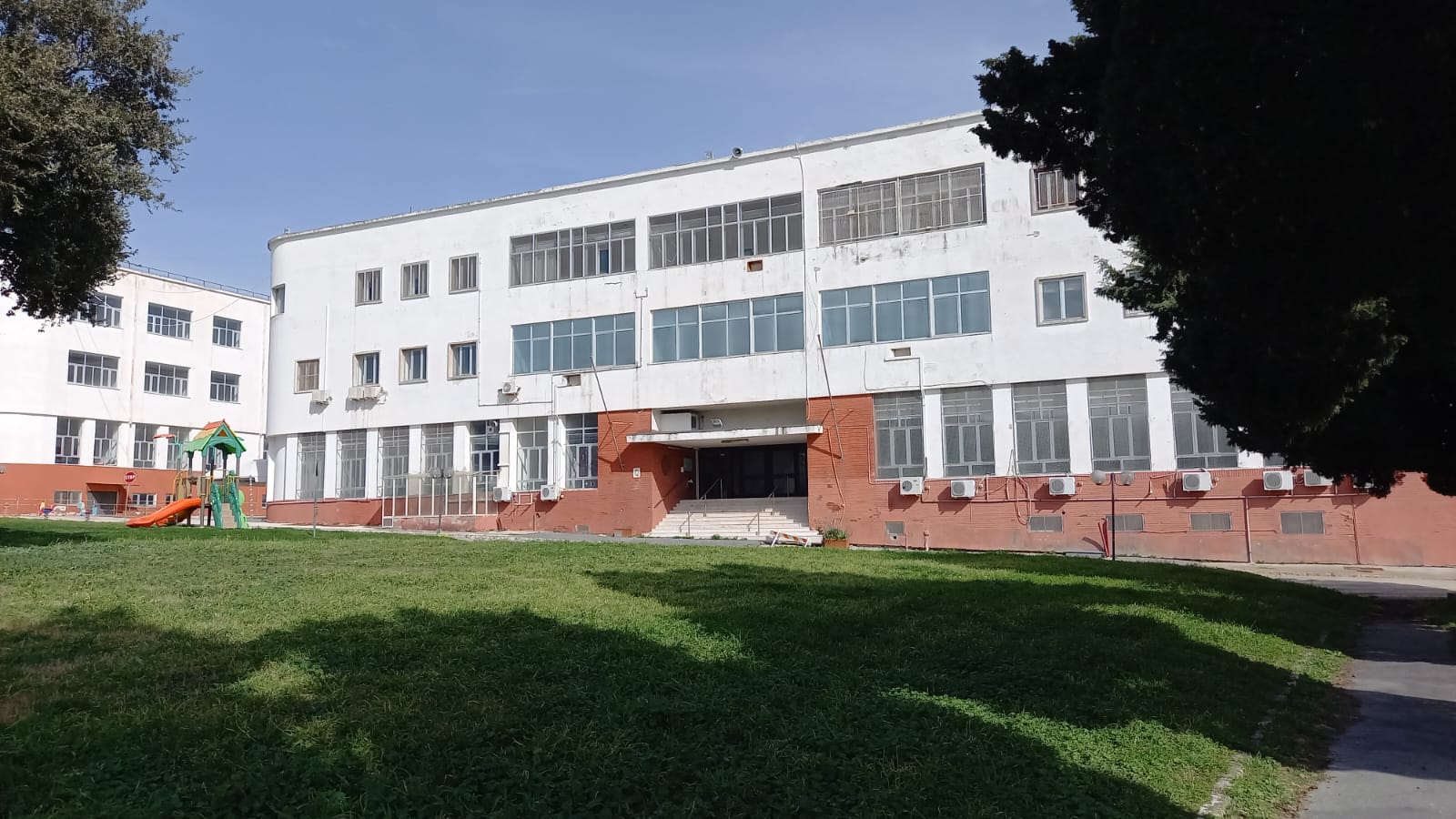
Five C-shaped dormitory blocks survive from the original design. One, which held the girls’ accommodation, is partly in use for film work; the other four stand disused around the central square, each with a semi-basement, a raised ground floor and two upper storeys with wide loggias looking towards Nisida. The grounds reopened to the city as the Parco San Laise and are managed by the Fondazione Banco di Napoli per l’Assistenza all’Infanzia, the body that paid for the college in the first place.
Sources
- Спогади польового духовника, chapter twenty-one
Isydor Nahayewsky / Toronto · 1985
Original scanned memoir, printed pp. 180–182. The Bagnoli chapter read in full in Ukrainian: arrival from Trani in autumn 1946, Colonel Salomon, the camp church shared with Fr Dr Tot, the choir under Kryveshko, the Lenten mission by Fr Mykhailo Shchudlo, Holy Week with Fr Dr Ivan Prashko, the Ukrainian school under Colonel Farion, and the onward emigration.
- Edifici dei dormitori maschili e femminili nell’ex Collegio Costanzo Ciano della GIL (area NATO di Bagnoli)
Direzione Generale Archeologia Belle Arti e Paesaggio, Ministero della Cultura · Archived 11 November 2024
Full inventory entry read in Italian: San Laise, Francesco Silvestri, 1939–1940, about thirty hectares, 2,000 boys and 500 girls, inauguration 9 May 1940, Italo-German occupation to September 1943, Anglo-American occupation October 1943 to July 1947, IRO refugee camp to January 1952, NATO 1954–2013, and the five C-plan dormitory blocks. The live ministry URL refused connections when this entry was checked; the archived copy is cited.
- Per una storia dei profughi stranieri e dei campi di accoglienza e di reclusione nell’Italia del secondo dopoguerra
Matteo Sanfilippo, Studi Emigrazione, XLIII, no. 164 · 2006
Published transcription of the Italian police report of 26 April 1947. The publisher’s PDF returns HTTP 403 and the passage could not be re-read directly; the open-access introduction to the same issue was read and does not carry the table.
- IRO Refugee Camp Bagnoli, Naples
Giuliano Ghersi / IstriaNet · 2008
First-person recollection of spring and summer 1951.
- Belongings: Brunhilde Srejic
NSW Migration Heritage Centre / Orange City Council · Interviewed by Elizabeth Edwards; archived copy
Full oral history read: conditions at Bagnoli in late 1949, the typhoid epidemic, departure from Naples on 2 December 1949, arrival in Sydney on 12 December and Bathurst Reception Camp. The museum site is offline; the Internet Archive copy is cited.
- Stalin Reaches Out for Expatriates
Arthur Stein / Labor Action · 16 June 1947
Contemporary report reproducing a Refugee Defense Committee account.
- La base NATO di Bagnoli: da collegio fascista a sede degli Alleati a Napoli
Leonardo Quagliuolo, Storie di Napoli · 12 December 2021
Full article read in Italian: the demolition of the Rione Castellana on 2 January 1939, the Banco di Napoli funding, the buildings and their uses, the inauguration before Victor Emmanuel III, bomb damage, British occupation to 1947, the IRO camp for refugees mainly from Istria, and the later NATO alterations.
- Ex Base NATO – Parco San Laise: la storia
Fondazione Banco di Napoli per l’Assistenza all’Infanzia / Parco San Laise · Accessed September 2026
Site history read in full in Italian: 2,500 intended places, five dormitories, two schools, two infirmaries, church, theatre, stadium, workshops, laundries and bakeries; the IRO camp; and the return of the grounds to public use in 2012.
- Edifici dei dormitori maschili e femminili nell’ex Collegio Costanzo Ciano della GIL (area NATO di Bagnoli)
Direzione generale Archeologia, belle arti e paesaggio, Ministero della Cultura, Italy · Record consulted in an Internet Archive capture of 11 November 2024
Photograph accompanying the ministry’s abandoned-heritage record for the male and female dormitory buildings of the former Collegio Costanzo Ciano at San Laise, Bagnoli, designed by the engineer Francesco Silvestri and built between 1939 and 1940. The record states that the complex was inaugurated on 9 May 1940 but never entered service, that it was occupied by Italian and German troops until September 1943 and by Anglo-American forces from October 1943 to July 1947, and that it then held the displaced people of the IRO refugee camp until January 1952. The live site refused connections and the record was recovered from the Internet Archive. The ministry states no reuse licence for the photograph.
- Crossroads in Cairo, 1942: 19, rue Hawayati where three empires met
Patricia Azarias, University of Technology Sydney doctoral thesis · 2016
Printed pages 67 to 69 read in English: the Italian War Ministry in occupation of the Bagnoli complex until late 1942, its use as a German officer training school after 1943, an occupation of about a year by a United States Air Squadron, and the post-war displaced-persons camp from which hundreds were forcibly repatriated to the Soviet Union under Operation Keelhaul.
Last researched 14 September 2026