Genoa and Naples embarkation
Genoa and Naples, Italy·1947–1952
Genoa and Naples were the Mediterranean ports through which the International Refugee Organisation shipped displaced people to Australia, South America and other destinations, with the staging camp at Bagnoli near Naples supplying many of the passengers. Ukrainians travelled on these sailings as one nationality among many, while the interned men of the Rimini camp left Italy by a different route altogether.
Introduction
For displaced people in the western occupation zones, the last European stage of resettlement was a port. The Arolsen Archives summarise the pattern plainly: people left Europe either through Genoa in Italy or through Bremen in northern Germany. A second Arolsen guide adds Naples and Bari to the Italian list. Genoa and Naples were therefore not alternatives to the German route so much as the southern half of a two-ended shipping system, and the destination usually decided which end a family used.12
This page concerns the embarkation itself: the camps that fed the quaysides, the selection and screening that had to be completed before a berth was allocated, and the sailings that can be dated from surviving manifests. The camp at Bagnoli, on the western edge of Naples, has its own page on this site and is referred to here rather than described again.3
A history in dates
- May–June 19478,570 people from the Rimini camp travel by sea from Venice to Britain, a British military movement separate from the IRO shipping through Genoa and Naples.7
- 11 February 1949The Protea leaves Genoa; 733 people are recorded disembarking at Fremantle on 18 March.8
- 18 February 1949The Castel Bianco leaves Naples and reaches Melbourne on 20 March.9
- 2 May 1949The Skaugum leaves Naples and reaches Melbourne on 31 May.10
- 1 December 1949The Anna Salen leaves Naples, breaks down beyond Aden and transfers her passengers to the Skaugum, which lands them at Fremantle on 6 January 1950.13
- 19 January 1950A nominal roll records emigrants leaving Genoa on the Star of Suez for Karachi.18
- 7 February 1950The Fairsea leaves Naples with people from Bagnoli camp and reaches Fremantle on 2 March.12
- October 1951The General Migration Conference at Naples fails, but agrees that the IRO's vessels and auxiliary services should be preserved.16
- 1952 onwardsThe Intergovernmental Committee for European Migration takes over the shipping and moves over 406,000 people from Europe during the decade.17
Origins and purpose
The International Refugee Organisation took over resettlement from UNRRA in 1947 and, by the time it closed, had moved over 600,000 refugees from Europe to the New World. That figure covers all nationalities and all routes. Italy mattered to this operation for a practical reason: Australia and South America lay beyond Suez or across the South Atlantic, and a Mediterranean departure removed a long and expensive passage down the coast of western Europe.5
The organisation ran the Italian end through a small number of camps rather than through the ports directly. An account of Giulian and Dalmatian emigration to Australia records that anyone intending to go there had to leave the refugee camp where they were living and reach one run by the IRO, mostly Bagnoli near Naples or Cinecittà in Rome. Selection and enrolment happened there. Departure, the same account states, was from Naples, Genoa or Bremerhaven.3
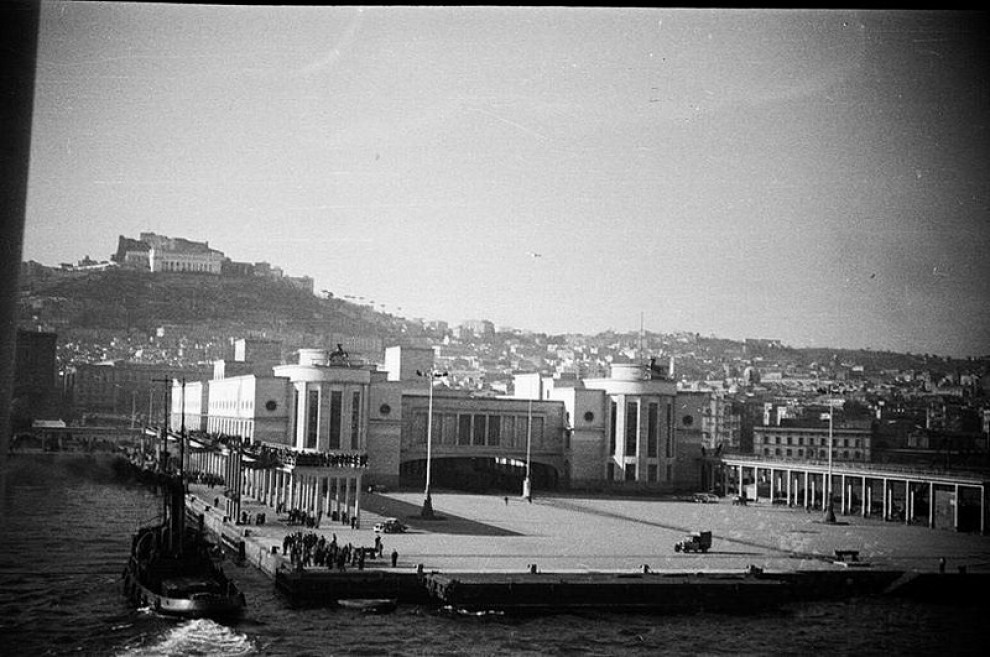
Federica Bertagna, writing on post-war transit through Italy, states that until the ports of Germany and Holland returned to operation the port of Genoa was the first option for leaving Europe, and that it was to Genoa that the International Refugee Organisation directed the thousands upon thousands of displaced persons. The same account records that before they could embark the refugees were lodged in structures and camps previously occupied by prisoners of war and set up across the whole of the national territory, and that the Italian press in 1947 spoke of 1,000,000 displaced persons in transit in Italy. That figure is a contemporary press estimate rather than an official count.20
How it worked in practice
Selection came first and was made by the receiving country, not by the IRO. For Australia the condition was a labour contract: adults signed an agreement to work for two years wherever the government directed. The Encyclopedia of Ukraine describes the same terms from the migrants' side, adding that changing residence or occupation during those two years was forbidden, that permanent residency followed automatically at the end of the period and that citizenship became possible after five years.34
Medical screening was the second gate, and tuberculosis was the disease that most often closed it. The examinations were carried out in the staging camp before travel, so a family could reach Bagnoli and still not sail. Because selection and screening were done at the camp rather than the quayside, the port was the shortest part of the process: people were moved to Genoa or Naples once a berth on a named sailing had been allocated to them.3
Transport was arranged by voyage, and the ships were not tied to a single route. The IRO chartered commercial vessels and also borrowed military transports; American correspondence of November 1948 discusses three United States Army Transport Service ships on loan to the IRO being put on the Australian run for one round trip each. The same hull could therefore appear at Naples on one voyage and at Bremerhaven on the next, and a ship's name says nothing on its own about where its passengers boarded.1514
The voyages themselves could go wrong. Passengers who left Naples aboard the Anna Salen on 1 December 1949 got no further than Aden, where the ship developed engine trouble and turned back into port. They were transferred to the Skaugum, which was returning empty from Australia, and reached Fremantle on 6 January 1950. One group of people, one journey, two ships.13
Reception was the receiving country's responsibility. Australian arrivals were taken from the disembarkation port to a reception and training centre, most often Bonegilla, and dispersed from there in small groups to meet demand for unskilled labour. Bonegilla, Bathurst and Benalla all have pages on this site, and the Bagnoli page follows one family from Naples to Bathurst.34
Ordinary commercial liners continued to call at both ports alongside the chartered resettlement voyages. An index of Naples passenger lists maintained by the GG Archives records the SS Saturnia of the Italia Line sailing from Genoa to New York via Naples on 22 July 1949, the SS Conte Biancamano sailing from Genoa to Halifax and New York via Naples on 12 August 1951, and the SS Constitution and SS Independence of American Export Lines sailing from Naples to New York via Genoa on 1 March and 27 October 1952. These were scheduled transatlantic services rather than IRO group resettlement voyages, and the index does not identify who among their passengers were displaced persons.21
Sailings from Genoa and Naples verified from transcribed manifests
| Ship | Left | Departure date | Arrived | Arrival date | People on the transcribed list |
|---|---|---|---|---|---|
| Protea | Genoa | 11 February 1949 | Fremantle | 18 March 1949 | 733 |
| Castel Bianco | Naples | 18 February 1949 | Melbourne | 20 March 1949 | 867 |
| Skaugum | Naples | 2 May 1949 | Melbourne | 31 May 1949 | about 1,619 |
| Fairsea | Naples | 3 December 1949 | Sydney | 31 December 1949 | about 1,772 |
| Anna Salen, passengers landed by the Skaugum | Naples | 1 December 1949 | Fremantle | 6 January 1950 | not stated |
| Fairsea, ex Bagnoli camp | Naples | 7 February 1950 | Fremantle | 2 March 1950 | not stated |
| Castel Bianco | Bremerhaven | 22 April 1950 | Fremantle | 17 May 1950 | not stated |
Sources for this section
- Giuliani e dalmati in Australia
- Australia
- The Under Secretary of the Army to the Assistant Secretary of State for Occupied Areas, 30 November 1948
- Passenger list, Castel Bianco, Bremerhaven to Fremantle, 1950
- Passenger list, Anna Salen passengers landed by the Skaugum, 1950
- Naples, Italy Passenger Lists 1894-1954
The Ukrainian experience within it
Ukrainians appear on these sailings as one nationality among many rather than as a distinct scheme. The transcribed manifests of the Italian departures list passengers from Poland, Latvia, Lithuania, Hungary, Yugoslavia, Ukraine, Czechoslovakia and Romania together on the same ship. No published breakdown gives the Ukrainian share of any individual Genoa or Naples voyage.810
The destination figures are better documented, although they cover every route rather than the Italian ports alone. About 21,500 Ukrainians emigrated to Australia in 1948 to 1951, and about 6,000 Ukrainian displaced persons reached Argentina between 1946 and 1950, the latter drawn from the camps in Germany and Austria. Both totals include people who sailed from Bremerhaven, so neither can be read as a count of Ukrainians embarking at Genoa or Naples.46
Italian ports also served destinations that had nothing to do with the great resettlement countries. A nominal roll of emigrants leaving Genoa on the Star of Suez for Karachi on 19 January 1950 records a movement eastwards, and the Arolsen guide notes journeys through Genoa, Naples and Bari as far as China and Afghanistan. Genoa was a general-purpose exit from Europe, not solely an Australian one.182
Published totals and what each one covers
| Figure | Number | Scope |
|---|---|---|
| Ukrainians emigrating to Australia, 1948 to 1951 | about 21,500 | Ukrainians only; all routes and all ports, not Genoa and Naples alone |
| Ukrainian displaced persons reaching Argentina, 1946 to 1950 | about 6,000 | Ukrainians only; drawn from camps in Germany and Austria; port of embarkation not stated |
| Refugees resettled by the IRO in the New World by 1952 | over 600,000 | All nationalities; all ports; the whole IRO period |
| People moved from Europe by ICEM during the 1950s | over 406,000 | All nationalities and all categories, including economic migrants; the whole decade |
| People moved from the Rimini camp to Britain, May and June 1947 | 8,570 | A British military movement from Venice, not an IRO sailing from Genoa or Naples |
The men of the Rimini camp
The former Galicia Division internees held near Rimini left Italy by a different route and under a different authority. They were surrendered enemy personnel in British hands, not civilians in the IRO resettlement system, and their departure was a British Cabinet decision rather than a migration selection. During May and June 1947, 8,570 people travelled by sea from Venice to Britain, among them nurses, clergy and some civilian relatives. Venice, not Genoa or Naples, was their port.7
Direct overseas emigration from Italy was considered for them and did not happen. The possibility of transferring groups of the men to Canada, the United States and Argentina was investigated but proved unrealistic at the time. Those who eventually reached those countries did so later and from Britain, after release from prisoner-of-war status into European Volunteer Worker employment. The Rimini Camp page on this site covers the Italian years, and the British camp pages, among them Hallmuir and Amisfield, cover what followed.7
Sources for this section
What happened afterwards
The IRO wound up at the end of 1951, and the question of what would replace its shipping was argued over at length. A General Migration Conference held at Naples in October 1951 failed, chiefly because the United States, Australia and Canada rejected the plan put to them, but it produced one clear point of agreement: the vessels and auxiliary services the IRO was about to relinquish should be preserved within a new framework.16
That framework became the Intergovernmental Committee for European Migration, which inherited the fleet and the embarkation machinery and arranged the emigration of over 406,000 refugees, displaced persons and economic migrants from Europe during the 1950s. Genoa and Naples continued to serve as its Mediterranean ports. Bagnoli's own refugee use is dated by the Italian heritage inventory to January 1952, as the site's Bagnoli page records, so the port traffic outlasted the camp that had supplied so much of it.17
Sources for this section
Sources
- Bremen Emigrant Staging Area card
Arolsen Archives e-Guide · Accessed 2026
Read in the project's source cache (retrieved 12 September 2026). States that displaced persons left Europe either via the port of Genoa in Italy or via Bremen in northern Germany, and describes the Bremen staging area.
- Registration card, DP camp Mittenwald
Arolsen Archives e-Guide · Accessed 2026
Read in the project's source cache (retrieved 12 September 2026). Records travel through the Italian ports of Genoa, Naples and Bari to destinations as distant as China and Afghanistan, alongside repatriation to Yugoslavia, Italy and Greece.
- Giuliani e dalmati in Australia
Centro Studi sulle migrazioni Aletheia · Accessed 2026
Read for the emigration process: transfer to an IRO camp, mostly Bagnoli near Naples or Cinecittà in Rome, for selection and enrolment; the two-year contract with the Australian government to do whatever work was required; departure from Naples, Genoa or Bremerhaven; arrival at Bonegilla.
- Australia
Internet Encyclopedia of Ukraine · Accessed 2026
Read for the figure of about 21,500 Ukrainians emigrating to Australia in 1948 to 1951, the obligation to work for two years at government-assigned locations, the ban on changing residence or work, automatic permanent residency afterwards, and dispersal in small groups after a short stay in transfer camps.
- Displaced persons
Internet Encyclopedia of Ukraine · Accessed 2026
Read for the transfer of resettlement from UNRRA to the IRO in 1947, the statement that the IRO had resettled over 600,000 refugees from Europe to the New World by 1952, and the figure of over 200,000 Ukrainians remaining in Germany and Austria after the 1946 repatriations.
- Argentina
Internet Encyclopedia of Ukraine · Accessed 2026
Read for the third period of Ukrainian immigration to Argentina, about 6,000 people between 1946 and 1950, made up of displaced persons from the camps in Germany and Austria.
- Former soldiers of the Galicia Division
Roman Krawec, Ukrainians in the United Kingdom online encyclopaedia · Accessed 2026
Read for the transport of 8,570 people by sea from Venice to Britain during May and June 1947, including nurses, priests and civilian relatives; for the statement that transferring groups of the men to Canada, the USA and Argentina was investigated but proved unrealistic at the time; and for later emigration from Britain after reclassification as European Volunteer Workers.
- Passenger list, Protea, Genoa to Fremantle, 1949
Immigrant Ships Transcribers Guild, transcribed from National Archives of Australia records · Accessed 2026
Header read: departure Genoa 11 February 1949, arrival Fremantle 18 March 1949, IRO group resettlement to Australia, 733 passengers listed, transcription believed to cover only those disembarking at Fremantle.
- Passenger list, Castel Bianco, Naples to Melbourne, 1949
Immigrant Ships Transcribers Guild, transcribed from National Archives of Australia records · Accessed 2026
Header read: departure Naples 18 February 1949, arrival Melbourne 20 March 1949, 867 passengers listed, with the transcriber's note that the list may be incomplete.
- Passenger list, Skaugum, Naples to Melbourne, 1949
Immigrant Ships Transcribers Guild, transcribed from National Archives of Australia records · Accessed 2026
Header read: departure Naples 2 May 1949, arrival Melbourne 31 May 1949, IRO group resettlement to Australia, about 1,619 passengers listed, nationalities including Ukraine, Latvia, Poland, Hungary, Czechoslovakia and Romania.
- Passenger list, Fairsea, Naples to Sydney, 1949
Immigrant Ships Transcribers Guild, transcribed from National Archives of Australia records · Accessed 2026
Header read: departure Naples 3 December 1949, arrival Sydney 31 December 1949, about 1,772 passengers listed, IRO group resettlement to Australia.
- Passenger list, Fairsea, Naples to Fremantle, 1950, ex Bagnoli camp
Immigrant Ships Transcribers Guild, transcribed from National Archives of Australia records · Accessed 2026
Header read: departure Naples 7 February 1950, arrival Fremantle 2 March 1950, described as IRO group resettlement to Australia ex Bagnoli Camp, Italy.
- Passenger list, Anna Salen passengers landed by the Skaugum, 1950
Immigrant Ships Transcribers Guild, transcribed from National Archives of Australia records · Accessed 2026
Explanatory note read: the passengers left Naples aboard the Anna Salen on 1 December 1949, the ship developed engine trouble after leaving Aden and returned there, and the passengers were embarked on the Skaugum, which was returning from Australia, reaching Fremantle on 6 January 1950.
- Passenger list, Castel Bianco, Bremerhaven to Fremantle, 1950
Immigrant Ships Transcribers Guild, transcribed from National Archives of Australia records · Accessed 2026
Header read: departure Bremerhaven 22 April 1950, arrival Fremantle 17 May 1950, IRO group resettlement ex Delmenhorst. Read to confirm that the same ship worked both the German and the Italian routes.
- The Under Secretary of the Army to the Assistant Secretary of State for Occupied Areas, 30 November 1948
Foreign Relations of the United States, 1948, volume VIII, document 887 · 30 November 1948
Read for the loan of three United States Army Transport Service ships to the IRO, their scheduling for one round trip each from Europe to Australia, and the requirement that two of the three remain available in the Atlantic.
- IOM from 1951 to 1953: the creation of PICMME/ICEM
International Organization for Migration · 2010
Text extracted and read. Records the ILO General Migration Conference at Naples in October 1951 as a failure, rejected by the United States, Australia and Canada, and the agreement that the vessels and auxiliary services about to be relinquished by the IRO should be preserved in a new framework.
- IOM in the Fifties
International Organization for Migration · Accessed 2026
Read for the statement that ICEM arranged the processing and emigration of over 406,000 refugees, displaced persons and economic migrants from Europe to overseas countries during the 1950s.
- Beyond Europe: findings on the International Refugee Organization
Christian Höschler, Arolsen Archives Jahrbuch · Accessed 2026
Text extracted and read. Cites a nominal roll of emigrants departing from Genoa on the Star of Suez for Karachi on 19 January 1950, and records a family following by ship from Genoa, alongside IRO recruitment of nurses in Italy.
- Stazione Marittima e porto di Napoli (1938)
Photographer unknown, via Wikimedia Commons · 5 May 1938
Photograph of the Stazione Marittima and the passenger quays of the port of Naples, taken on 5 May 1938. Marked on Wikimedia Commons as public domain in Italy, where the term for a simple photograph has expired, and public domain in the United States.
- El exilio de nazis, fascistas y colaboracionistas (1945-2014)
Federica Bertagna, Università degli Studi di Verona; Consello da Cultura Galega · 2017
Printed page 207 read: Genoa as the first option for leaving Europe until the German and Dutch ports returned to operation, the IRO's direction of displaced persons there, the lodging of refugees before embarkation in structures and camps previously occupied by prisoners of war across the national territory, and the Italian press estimate of 1,000,000 displaced persons in transit in Italy in 1947.
- Naples, Italy Passenger Lists 1894-1954
GG Archives (Gjenvick-Gjønvik Archives), Milwaukee · Accessed 13 September 2026
Index page read for its listings of commercial liner passenger lists calling at Naples and Genoa: the SS Saturnia of 22 July 1949, the SS Conte Biancamano of 12 August 1951, the SS Constitution of 1 March 1952 and the SS Independence of 27 October 1952, with their departure dates and routes. The index gives routes and dates only and does not state the status of the passengers.
Last researched 13 September 2026