Bathurst Migrant Reception and Training Centre
Arrival and settlement
Kelso, Bathurst, New South Wales, Australia · 1948–1952
In the barracks at Kelso, Ukrainian newcomers organised choirs, classes, exhibitions and family celebrations while preparing for work and new homes across Australia.
Introduction
Bathurst was a first Australian home for Ukrainian families and single migrants arriving after the Second World War. Its reception centre stood in former army grounds at Kelso, outside the town. Many people stayed only weeks before employment and available accommodation took them elsewhere. Others helped sustain the camp’s schools, administration and cultural life.
The Ukrainian story here includes a women’s branch, art exhibitions, religious gatherings and choirs. Personal accounts follow residents from Bathurst to Parkes, Orange, Newcastle and Wallangarra, showing how the search for a settled home continued after leaving the camp.
Sources for this section
- NSW Migration Heritage Centre, Bathurst Migrant Camp
- Anna and Kate Babij, Belongings oral history; interview by Elizabeth Edwards
- John Bojko, Belongings oral history; interview by Sandy Minter
- Robin McLachlan, The New Country: A Thematic History of the Bathurst Regional Council Local Government Area, 22 March 2007
- Союз Українок Австралії, organisational history, 2001: Відділ у Батгурсті
- Encyclopedia of Ukrainian Diaspora, volume 4, Bathurst entry, pp 41–42
- Ivan Shevtsiv, St Andrew’s Parish in Sydney 1948–1998, Sydney–Lviv 1999: reprinted recollections
A history in dates
- May 1948First migrant intake
- January 1949–May 1952Bathurst Holding Centre school
- 21 November 1949Ukrainian women’s branch elects new committee.
- April 1952Centre closure
- May 1985Reunion and memorial plaque
- 2018Memorial to migrant-camp children
Sources for this section
- Robin McLachlan, The New Country: A Thematic History of the Bathurst Regional Council Local Government Area, 22 March 2007
- Museums of History NSW, Teaching English to post-WWII migrants
- Союз Українок Австралії, organisational history, 2001: Відділ у Батгурсті
- Bathurst Family History Group, Migrant Camp 1948–1952
A temporary home at Kelso
The migrant centre occupied former army grounds on Limekilns Road at Kelso. The first intake arrived in May 1948. Some newcomers eventually settled around Bathurst, but most moved towards work and housing elsewhere.
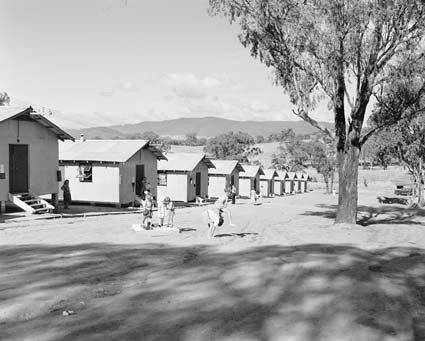
From army huts to family quarters
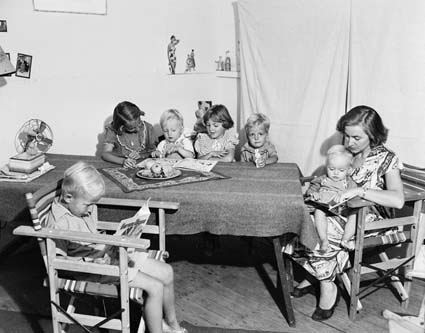
The Migration Heritage Centre describes accommodation adapted from the 1940 army camp: iron sheds and timber barracks, with dormitories for single residents and partitioned spaces for families. The buildings offered little protection from seasonal heat and cold. Housing shortages made this improvised accommodation important despite its shortcomings. Arrivals travelled from Sydney by train to Kelso, then continued by bus to the camp.
Sources for this section
Six weeks in Block B
For the Babij family, Bathurst was a short but precisely remembered stage in a longer journey. Kate Babij’s published family account records arrival in Sydney aboard Marine Jumper on 7 September 1949, followed by about six weeks at the reception centre. Their address was Hut 5, Building 15, Block B. The family’s next move divided them: her father Nikola received employment papers for the Emmco factory at Orange in October, while Anna and Kate went to Parkes.
Two Ukrainian journeys through Bathurst
| Resident account | Bathurst stay | Accommodation or onward destination |
|---|---|---|
| Babij family | About six weeks after Sydney arrival, 7 September 1949 | Hut 5, Building 15, Block B; father to Orange, mother and daughter to Parkes |
| John Bojko | 6–19 December 1949 | Single men’s BC barracks; onward to Mayfield West via Broadmeadow |
Sources for this section
Reuniting at Orange
The Babij family spent another six months apart. Nikola lived in Orange’s tent accommodation while working at the factory. In April 1950, Anna and Kate joined him in a packing shed on an orchard. They later moved into a house he was building. Their story connects the reception centre to the slower work of finding a home: departure from Bathurst did not mean the end of temporary accommodation.
Sources for this section
A single man’s route to Newcastle
John Bojko’s account offers another Ukrainian route through Bathurst. He recalls reaching Sydney on 5 December 1949 and entering the camp the next day after travelling by train. He stayed in the single men’s BC barracks. On 19 December, another train took him to Broadmeadow, followed by a bus to the hostel at Mayfield West. His memories distinguish the railway destination from the accommodation itself. Bojko later worked at Goninans Engineering and the Mayfield hostel, before a long career at Rankin Park Hospital. The published account identifies his cultural background as Ukrainian; his recollections of Bathurst concern a stay of roughly two weeks.
Sources for this section
School during a short stay
Children’s education continued even as families arrived and left. The State Archives guide lists Bathurst Holding Centre school from January 1949 to May 1952. Commonwealth authorities provided buildings, while the State Education Department established schools for children in migrant centres. The guide identifies file 14/7287, covering 1948–1950, about equipping and running Bathurst’s primary school and continuation classes in the area. Adult teaching also formed part of reception-centre life. The Migration Heritage Centre describes evening classes in English and Australian culture in the schoolrooms.
Surviving records
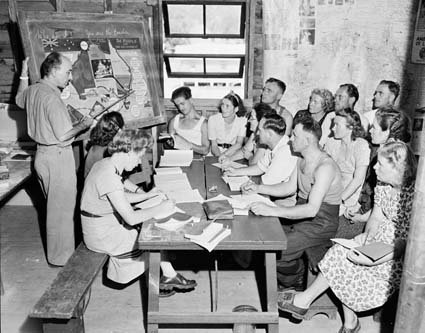
Keeping Ukrainian in the classroom
Ukrainian classes developed alongside Australian schooling. Bathurst was among the arrival camps where Ukrainian ethnic schools emerged around 1949, helping children keep their language during a period of repeated moves. These early classes preceded the more permanent schools later established in towns and cities.
Ukrainian women organised camp life
The Ukrainian women’s organisation records a Bathurst branch founded in 1949 by Nina Denysenko. A new committee elected on 21 November 1949 was headed by E. Kozolkovska. The branch brought people together through talks on Lesia Ukrainka and Taras Shevchenko, a Saint Nicholas celebration and a shared Christmas Eve meal for 150 newly arrived Ukrainians. A Ukrainian evening included a choir conducted by V. Ostrovskyi.
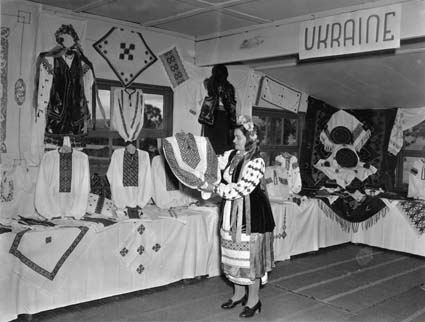
The women also organised two exhibitions of Ukrainian art, featuring N. Ohrynovska’s embroidery collection, for Australian women’s groups and other visitors. Their work extended to people still in Europe: the 1966 account records 42 parcels sent to those remaining in Germany; the 2001 history gives 43. It dates the branch’s activity to 1949–1952 and explains that it ended as members moved to permanent homes.
Activities recorded by the Ukrainian women’s branch
| Date or reporting period | Activity | Recorded scale |
|---|---|---|
| 1949 | Branch founded by Nina Denysenko | Membership total not given |
| 21 November 1949 | New committee elected | E. Kozolkovska became chair |
| During 1949–1952 | Shared Christmas Eve meal | 150 newly arrived Ukrainians |
| During 1949–1952 | Ukrainian art exhibitions | Two exhibitions |
| During 1949–1952 | Aid sent to Germany | 43 in the 2001 history; 42 in the 1966 account |
Artists and community organisers
Denysenko’s work at Bathurst was part of a longer career in Ukrainian cultural education. The choreographer arrived in Australia in 1949 and initially lived at Bathurst, participating in camp life and organising a Ukrainian folk-art exhibition in 1950.
A local Ukrainian community branch formed in early 1950, working with the New South Wales community council. Ukrainians also worked in the camp administration. These accounts show residents helping to organise both their own associations and the wider reception centre.
An Easter remembered
Writing as O. Mykhailiv, Orest Pytliar remembered Easter worship in Bathurst’s camp chapel, decorated with eucalyptus flowers. His recollection, reprinted from Vilna Dumka in 1962, describes residents gathering near the administrative block and Father Kolomyitsiv trying to shoo a possum from the altar. Pytliar also remembered English classes and sociable walks through the camp while awaiting work assignments.
Sources for this section
Taras Figol’s camp choir
In recollections recorded in February 1996, Taras Figol described reaching Sydney aboard Skaugum on 29 September 1949 and travelling by train to Bathurst. He organised a men’s choir in the camp, which performed alongside other national groups.
Figol later left Bathurst in a group of 20 Ukrainians assigned to work at Wallangarra near the Queensland border. There he again organised a choir, alongside a volleyball group. His recollection follows cultural activity across successive temporary homes rather than ending at the camp gate.
Taras Figol’s onward journey
| Stage | What his recollection records |
|---|---|
| 29 September 1949 | Arrived in Sydney aboard Skaugum |
| Bathurst | Travelled by train to the reception centre and organised a men’s choir |
| Wallangarra | Left with a work party of 20 Ukrainians; worked in the kitchen and organised music and volleyball |
Sources for this section
Culture beyond the barracks
Bathurst’s cultural life reached beyond its gates. Residents performed Tosca for fellow migrants and the Bathurst public. A Polish club and the Polish Catholic weekly Tygodnik Katolicki were further expressions of the different communities living at the centre.
Sources for this section
Closure and remembrance
The centre closed in April 1952; the school’s record continues to May. Families moved on, but Bathurst remained part of their shared history. A reunion in May 1985 brought former residents back and marked the unveiling of a memorial plaque. In 2018, Bathurst Family History Group erected a memorial to children from the migrant camp in the Catholic section of Bathurst Cemetery.
Sources
- NSW Migration Heritage Centre, Bathurst Migrant Camp
NSW Migration Heritage Centre
Full institutional article read; conflicting population/throughput formulations omitted.
- Anna and Kate Babij, Belongings oral history; interview by Elizabeth Edwards
NSW Migration Heritage Centre
Full indexed original oral-history page read; explicit Ukrainian metadata and Bathurst hut address. Original recording not accessed.
- John Bojko, Belongings oral history; interview by Sandy Minter
NSW Migration Heritage Centre
Full published oral-history page read; dated Bathurst stay independently documented. Original recording not accessed.
- Robin McLachlan, The New Country: A Thematic History of the Bathurst Regional Council Local Government Area, 22 March 2007
Bathurst Regional Council
Original downloaded PDF, printed/PDF page 17 visually inspected; introduction/title metadata read. Not full 215-page history.
- Museums of History NSW, Teaching English to post-WWII migrants
Museums of History NSW
Full indexed guide excerpt read including school table and 14/7287 description; original school file not read.
- Bathurst Family History Group, Migrant Camp 1948–1952
Bathurst Family History Group
Complete short institutional community-history page read; memorial and closure details attributed.
- Союз Українок Австралії, organisational history, 2001: Відділ у Батгурсті
Ukrainian Women’s Association of Australia
Original printed 110/PDF 119 visually read in full. Bathurst paragraph separated from adjacent Scheyville account. Retrospective organisational history, not contemporary minutes.
- P. V. Odarchenko, Nina Denysenko, Encyclopedia of Modern Ukraine, 2007
Encyclopedia of Modern Ukraine
Complete original institutional biographical article read. Bathurst residency explicit; 1951 touring exhibition not assumed held at camp.
- Encyclopedia of Ukrainian Diaspora, volume 4, Bathurst entry, pp 41–42
Encyclopedia of Ukrainian Diaspora
Original continuation printed 42/PDF 47 visually checked and full entry text read; location/date generalisations not used to override municipal history.
- M. Danylak, An Overview of Ukrainian Secondary Education in NSW, in Ukrainian Settlement in Australia, Macquarie University, 1989
Macquarie University
Original printed page 19/PDF 22 visually read by parent; retrospective education overview.
- Ukrainians in Australia, volume 1, Melbourne 1966
Ukrainian community in Australia
Parent visually read printed 495, Bathurst continuation; earlier paragraph 494 reviewed by research agent. Original retrospective source, not branch minutes.
- Ivan Shevtsiv, St Andrew’s Parish in Sydney 1948–1998, Sydney–Lviv 1999: reprinted recollections
St Andrew’s Ukrainian Catholic Parish
Original printed pages 84–86 visually read; relevant Bathurst passage on printed page 85/PDF page 86. The account ending on printed page 87 dates the recollection to Sydney, February 1996. Retrospective account; cited 1949 Vilna Dumka issue unread. Printed pages 74 and 76–77 also visually read: Roman Olesnytskyi and O. Mykhailiv, identified by the editor as Orest Pytliar. Original newspaper issues unread.
- Bathurst reception-centre photographs, Parts 1–2
The Complete Peter; reproducing National Archives of Australia photographs · March 2009
Original published images and all four captions visually inspected. Copies attributed to Commonwealth collections A12111 and A8139. Item references retained below; archive catalogue originals could not be retrieved during this pass.
- Migrants learn English at Bathurst Reception Centre
National Archives of Australia · 1951 photograph
Official educational record independently identifies a Bathurst English-class photograph.
- The Immigration Photographic Archive
National Archives of Australia
Official archive overview identifies Bathurst reception centre 1951, A12111,51/22/31.
Last researched 12 September 2026