Skaugum
IRO fleet·Displaced-person service: 1949–1951
Skaugum was an unfinished German liner, sister to the ship that became the raider Kormoran, taken as a British prize in 1945 and sold in 1948 to the Norwegian owner Isak M. Skaugen, who rebuilt her at Kiel to carry displaced persons under contract to the International Refugee Organisation. She sailed from Naples and Bremerhaven to Melbourne, Sydney, Newcastle and Fremantle, and Ukrainians were a documented share of her passengers.
Introduction
Skaugum is the Norwegian ship in the Australian displaced-person story. She was large by the standards of the chartered fleet, carrying up to about 1,700 people at a time, and she made the run often enough between 1949 and 1951 to appear repeatedly in Ukrainian family records in Victoria and Western Australia.12
She is also the ship that rescued another ship's passengers. In December 1949 she was ordered to Aden to take on 1,570 people from the disabled Anna Salen and carry them to Australia in their place, and the roll of that improvised voyage is one of the few surviving lists from the period that records each passenger's nationality.12
A history in dates
- January 1940Launched at the Germaniawerft, Kiel, as Ostmark, sister to the Steiermark that became the raider Kormoran; never completed and laid up for the war.1
- May 1945Claimed by the British as a prize of war at Kiel and placed under the Ministry of Transport.1
- 1948Sold to the Norwegian owner Isak M. Skaugen.1
- April 1949Rebuilt at Kiel for displaced-person work under an IRO contract and renamed Skaugum.1
- 31 May 1949First Australian arrival, at Melbourne, having left Naples on 2 May.2
- 28 July 1949Second Melbourne arrival, having left Naples on 4 July.2
- 28 September 1949Arrives at Sydney from Naples.2
- November 1949Leaves Naples for Newcastle with 1,700 passengers.1
- 6 January 1950
- 1950
- 1964Sold to Ocean Shipping and Enterprises, renamed Ocean Builder and registered in Liberia.1
An unfinished German hull
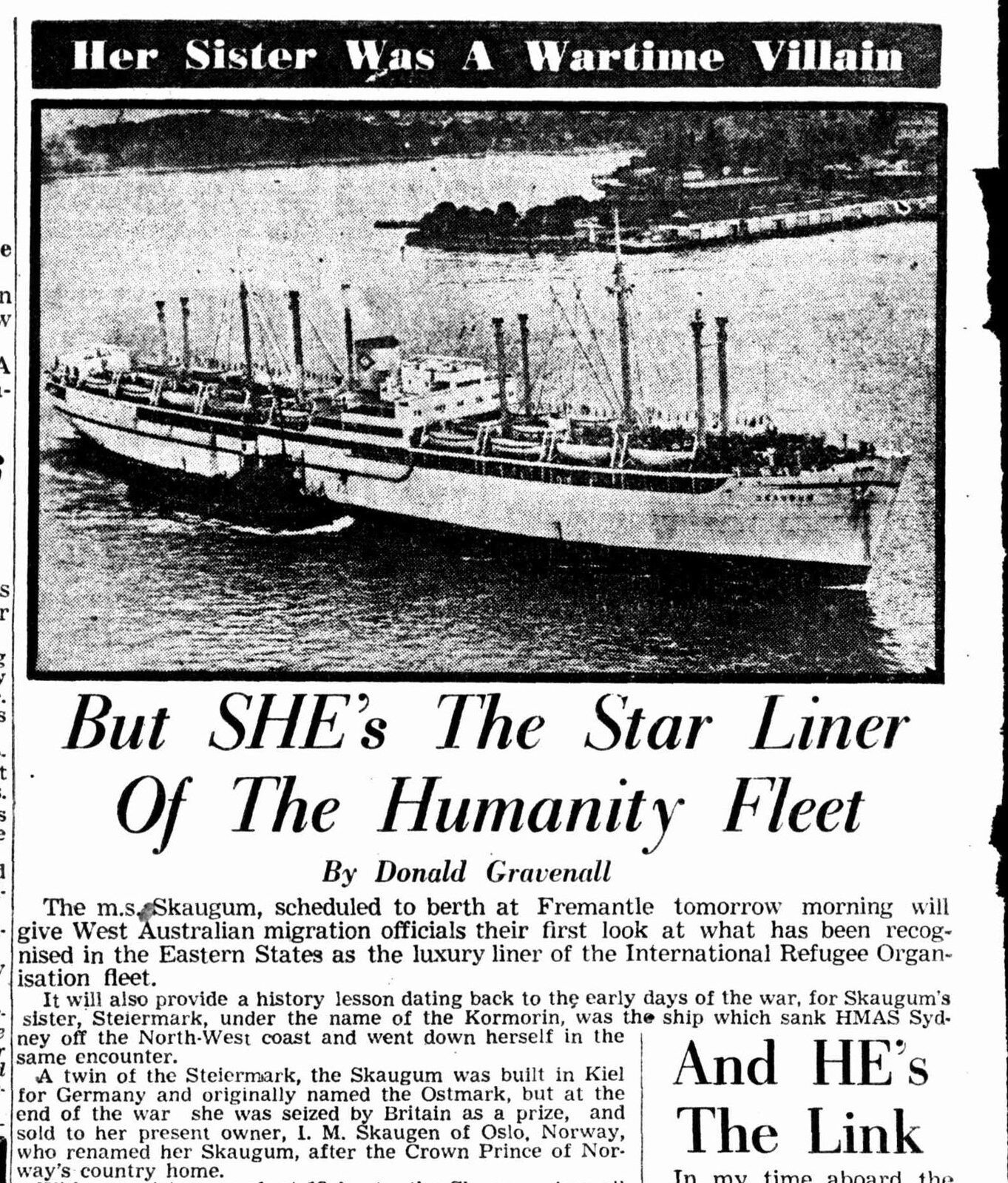
The ship was launched at the Germaniawerft in Kiel in January 1940 as Ostmark, four months after the outbreak of war. She was a sister to the Steiermark, which the German navy converted into the raider Kormoran and which sank HMAS Sydney off the Western Australian coast in November 1941 with the loss of her entire company. Ostmark herself was never completed. She was towed to a backwater and lay unfinished for the duration.1
When British forces entered Kiel in May 1945 she was claimed as a prize of war and placed under the Ministry of Transport. In 1948 the Ministry sold her to Isak M. Skaugen, a Norwegian owner of freighters and tankers. A year later, having obtained a contract to carry displaced persons for resettlement outside Europe, Skaugen had her rebuilt for the trade at Kiel. She emerged as Skaugum in April 1949 and made her maiden voyage nine years after her launch. She measured 552 by 66 feet, registered 11,620 tons, and made fifteen knots on twin screws driven by diesel-electric machinery.1
The ship
| Measure | Detail |
|---|---|
| Launched | January 1940, Germaniawerft, Kiel, as Ostmark |
| Sister ship | Steiermark, converted to the German raider Kormoran |
| War history | Never completed; laid up unfinished, claimed by the British at Kiel in May 1945 |
| Sold | 1948, to Isak M. Skaugen, Norway |
| Rebuilt for migrant service | Kiel, 1949; renamed Skaugum in April 1949 |
| Tonnage | 11,620 tons |
| Dimensions | 552 by 66 feet |
| Machinery and speed | Diesel-electric, twin screws, 15 knots |
| Passengers carried on the November 1949 Newcastle voyage | 1,700 |
| Renamed | Ocean Builder, 1964, under the Liberian flag |
Sources for this section
How the charter worked
Selection happened long before anyone saw the ship. Australian selection teams working with IRO staff interviewed applicants in the camps of the western zones, medical and security screening followed, and those accepted signed a two-year contract binding them to work wherever the Commonwealth directed. Skaugum's loading ports were Naples for the Italian staging route and Bremerhaven for the northern German camps. Passengers were moved to the port by train from resettlement centres and embarkation camps.12
The rebuild put dormitory accommodation into what had been cargo space, with communal washing arrangements and men and women berthed separately. A Ukrainian family who sailed on her first Australian voyage recorded that food was plentiful and that they were well treated, but that seasickness was a serious problem for many; their seventeen-month-old son arrived in poor health. Their journey from Germany, counting staging as well as the sea passage, took almost three months.3
Sickness on board could be worse than seasickness. The Age reported that the crowded Aden transfer voyage arriving at Fremantle on 6 January 1950 carried a measles outbreak in which fifty-six children were treated and a further twenty were in the ship's hospital with other illnesses. A three-year-old boy died during the passage.2
On arrival passengers were counted off the roll and moved inland by train. Melbourne arrivals went to Bonegilla, Fremantle arrivals to Northam, and from those reception centres to holding centres such as Cowra and Benalla and to the jobs their contracts assigned.23
Dated voyages
The first Australian voyage left Naples on 2 May 1949 and reached Melbourne on 31 May. A second left Naples on 4 July and reached Melbourne on 28 July. A third left Naples on 31 August and reached Sydney on 28 September. In November 1949 she left Naples for Newcastle with 1,700 passengers.21
In December 1949, crossing the Indian Ocean back to Europe empty, she was diverted to Aden. The IRO ship Anna Salen had left Naples on 1 December with about 1,600 people aboard and had broken down after leaving Aden. Skaugum took on her passengers and carried them to Fremantle, arriving on 6 January 1950; 1,543 were landed in Western Australia and taken by train to the Northam camp.12
Four further Australian voyages followed during 1950: from Naples to Melbourne in March, from Bremerhaven to Fremantle in June and again in August, and from Naples to Melbourne in November. The Western Australian landing figures record 1,823 on 12 July 1950 and 1,854 on 24 September 1950, while the passenger rolls date the corresponding Fremantle arrivals to 14 July and 29 September. A final Fremantle arrival on 11 December 1950 is also recorded.12
Displaced-person voyages to Australia recorded in the sources read
| Departed | Arrived | Number recorded | Source scope |
|---|---|---|---|
| Naples, 2 May 1949 | Melbourne, 31 May 1949 | not recorded in sources read | |
| Naples, 4 July 1949 | Melbourne, 28 July 1949 | not recorded in sources read | The roll flags 30 August 1949 as an alternative date from the microfilm |
| Naples, 31 August 1949 | Sydney, 28 September 1949 | not recorded in sources read | |
| Naples, November 1949 | Newcastle, 1949 | 1,700 passengers | Whole ship, all nationalities |
| Aden, December 1949, taking over the Anna Salen passengers who left Naples on 1 December | Fremantle, 6 January 1950 | 1,570 carried; 1,543 landed in Western Australia | Ship complement against the Western Australian landing figure |
| Naples, March 1950 | Melbourne, 1950 | not recorded in sources read | |
| Bremerhaven, June 1950 | Fremantle, 12 or 14 July 1950 | 1,823 landed in Western Australia | Western Australian landings only. The landing table gives 12 July, the passenger roll 14 July. |
| Bremerhaven, August 1950 | Fremantle, 24 or 29 September 1950 | 1,854 landed in Western Australia | Western Australian landings only. The landing table gives 24 September, the roll index 29 September. |
| Naples, November 1950 | Melbourne, 1950 | not recorded in sources read | |
| Not recorded | Fremantle, 11 December 1950 | not recorded in sources read |
Ukrainians on board
Skaugum is one of the few ships for which a Ukrainian share of the passengers can be quoted from a passenger roll rather than inferred. Three of her Fremantle lists carry a nationality column. On the 6 January 1950 arrival, of 553 transcribed entries 52 are recorded as Ukrainian, behind Polish at 256 and Yugoslavian at 104. On the 14 July 1950 arrival, of 618 transcribed entries 38 are recorded as Ukrainian. On the small surviving fragment of the 11 December 1950 list, one of 26 entries is Ukrainian.2
These are shares of partial transcriptions, not of whole ships. The 6 January 1950 page states that 1,570 people were carried against the 553 names transcribed. The proportions cannot be scaled up to the full complement, and the nationality recorded is the one the resettlement authorities assigned, which for many people from Galicia and Volhynia was Polish rather than Ukrainian.2
Named Ukrainian passengers appear in family records. Anna Chlebnikowski, born at Monaczyn, and her husband Nicholai, born at Ternopil, landed at Port Melbourne on 31 May 1949 from the Skaugum with two small sons, Anna's father Wasil and her uncle Peter. Nicholai was sent to tank maintenance at Puckapunyal under his two-year contract at six pounds four shillings a week before tax, with one pound ten shillings deducted for board, while his wife and children went first to Cowra and then, on 20 October 1949, to Benalla.3
Nationalities recorded on the three Fremantle passenger rolls
| Nationality | 6 January 1950 | 14 July 1950 | 11 December 1950 |
|---|---|---|---|
| Polish | 256 | 184 | 2 |
| Yugoslavian | 104 | 101 | 3 |
| Ukrainian | 52 | 38 | 1 |
| Hungarian | 32 | 126 | 2 |
| Latvian | 31 | 37 | 7 |
| Czechoslovakian | 18 | 58 | 0 |
| Lithuanian | 12 | 0 | 6 |
| Roumanian | 11 | 10 | 4 |
| Russian | 2 | 25 | 0 |
| Entries with a nationality in the transcription | 553 | 618 | 26 |
Afterwards
Skaugum continued to carry migrants to Australia into the middle of the 1950s, with recorded arrivals through 1953, 1954, 1955 and 1956 after the International Refugee Organisation had wound up. In 1964 she was sold to Ocean Shipping and Enterprises, renamed Ocean Builder and put under the Liberian flag.12
Her Australian legacy is mostly in the reception centres. Passengers she landed at Melbourne and Fremantle filled huts at Bonegilla, Northam, Cowra and Benalla, and Ukrainian families who came ashore from her are recorded in the archives of those camps.31
Sources
- Polish and other migrants in Wyalkatchem 1950-1970
Joseph Poprzeczny / Polish Museum and Archives in Australia, Rocznik tom V · 2012
Chapter section on Skaugum read in full: the Ostmark identity and the Steiermark and Kormoran connection, the January 1940 launch and wartime lay-up, the 1945 British prize and 1948 sale to Isak M. Skaugen, the 1949 rebuild at Kiel, tonnage and dimensions, the 1949 Melbourne and Newcastle voyages, the Anna Salen diversion to Aden, the four 1950 voyages with their ports, and the 1964 sale. Also the table of ships reaching Western Australia 1948 to 1950 with Skaugum on 6 January 1950 (1,543), 12 July 1950 (1,823) and 24 September 1950 (1,854). The chapter cites Peter Plowman for its shipping detail.
- International Refugee Organisation group resettlement to Australia: Skaugum passenger lists
Immigrant Ships Transcribers Guild · Accessed 13 September 2026
Voyage headers read for the arrivals of 31 May 1949, 28 July 1949, 28 September 1949, 6 January 1950, 14 July 1950 and 11 December 1950. The 6 January 1950 page carries the Anna Salen narrative and the measles report attributed to The Age of 6 January 1950, page 3, and states 1,570 passengers. Nationality tallies for the three Fremantle lists were counted from the transcriptions.
- Wasyli and Anna Chlebnikowski
Benalla Migrant Camp 1949-1967, account by Irene Kornienko · Accessed 13 September 2026
Full family account read: birthplaces at Monaczyn and Ternopil, the 31 May 1949 Skaugum arrival at Port Melbourne, food and treatment on board and widespread seasickness, the state of the Bonegilla barracks, the two-year contract and Puckapunyal wage, and the moves to Cowra and Benalla.
- Her Sister Was A Wartime Villain But SHE’s The Star Liner Of The Humanity Fleet
The Daily News (Perth, Western Australia), page 10 · 5 January 1950
Illustrated feature by Donald Gravenall on the eve of the Skaugum’s arrival at Fremantle, carrying a photograph of the ship with her name on the bow. Digitised by the National Library of Australia in Trove; out of copyright as Australian material published before 1955.
- Skaugum migrants
Townsville Daily Bulletin (Queensland), page 1 · 30 September 1949
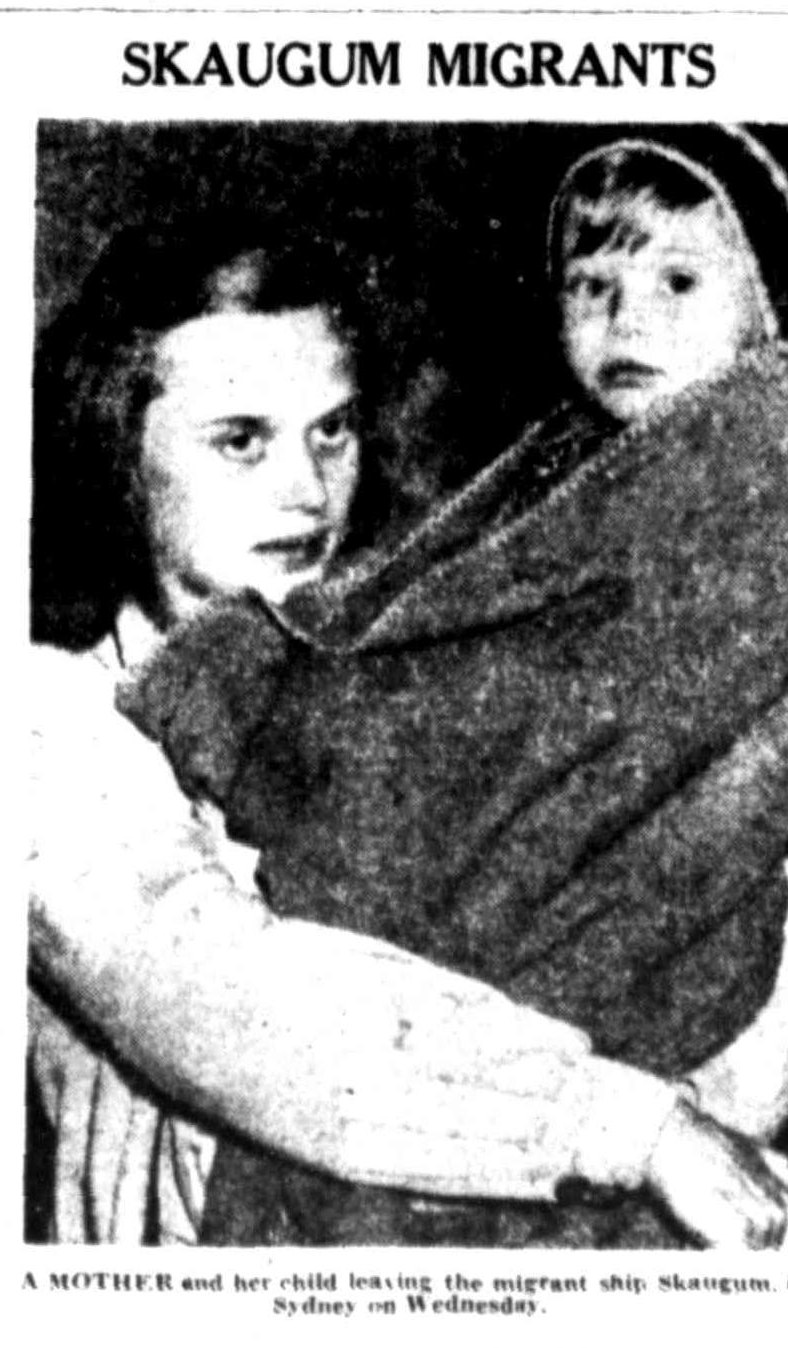
Front-page press photograph of a mother and child leaving the Skaugum at Sydney on 28 September 1949. Digitised by the National Library of Australia in Trove; out of copyright as Australian material published before 1955.
Last researched 13 September 2026