Castle Rankine
Arrival and settlement
Castle Rankine, near Denny, Stirlingshire, Scotland · 1940–about 1953
Castle Rankine, near Denny, became a home for displaced European workers after serving as an internment and prisoner-of-war camp. Ukrainians were among the 175 people whose arrival was reported in February 1948, and the hostel that followed brought together agricultural work, family households and efforts to build relationships with neighbouring communities.
Introduction
Castle Rankine, near Denny, became a home for displaced European workers after serving as an internment and prisoner-of-war camp. Ukrainians were among the 175 people whose arrival was reported in February 1948. The camp’s later history brings together agricultural work, family households and efforts to build relationships with neighbouring communities.
Sources for this section
A history in dates
- 1940Italian internment camp established on Castle Rankine Farm.
- 1946German POW phase began.
- 15 April 1946Air photographs record at least 39 huts in the main enclosure and 24 in the staff camp.
- June 1946German prisoners from the camp erected a dais at Herbertshire Castle Park for the crowning of Denny’s Victory Queen.
- February 1948Displaced workers arrived at Denny station for agricultural employment and the camp passed to the Ministry of Agriculture under Major Alfred Currie.
- April 1948Forty residents attended evening service at Denny Old Parish Church with translation.
- July 1948About 200 Yugoslav residents held a tribute to General Mihailović.
- January 1949Arthur Woodburn, Secretary of State for Scotland, visited the Orthodox Christmas observance; about 200 residents were recorded.
- 1950Iwan Skalskyj and fellow residents participated in local talks.
- May 1950A Falkirk orchestra played in the camp concert hall.
- 1953The EVW designation was replaced by Foreign Workers and the hostel gradually closed; agricultural reuse followed.
- 1990Major clearance of the former camp began; painted wall panels were rescued for the Smith Institute.
The earlier camp
The site began with Italian civilian internees in 1940, later housed Italian prisoners of war and received German POWs in 1946. This succession explains its familiar name, Camp 64; a published camp list dates the numbered prisoner-of-war camp from 1942 to 1947 and records it as also known as Denny, with associated hostels. The barracks stood near Castlerankine Farm about 1.7 kilometres south-west of Denny; the medieval castle was a separate location. Samuel Lewis’s topographical dictionary of 1846 names Castle-Rankine as a glen in Denny. G. B. Bailey’s history describes an exposed site that began as wooden ablution blocks and army tents and grew into more than forty prefabricated huts of concrete frames and panels with brick infill, set on concrete bases and arranged on terraces.
Aerial photographs flown on 15 April 1946 recorded the camp for the national record, which places it at NS 7930 8190 and counts at least 39 huts inside the fenced prison enclosure with a further 24 in the staff camp to the south-west. The German prisoners rebuilt the concert hall near the entrance from two army huts, giving it a stage, a capacity of about 800 and seating for 600.
The prisoners’ work also reached beyond the wire. G. B. Bailey records that in June 1946 German prisoners of war from the Castle Rankine camp erected a dais at Herbertshire Castle Park for the crowning of Elizabeth Sneddon as Denny’s Victory Queen.
Huts recorded on air photographs of 15 April 1946
| Part of the site | Huts visible |
|---|---|
| Main prison camp, within the fenced enclosure | at least 39 |
| Staff camp, to the south-west | at least 24 |
Arrival and agricultural work
The Falkirk Herald of 25 February 1948, reproduced by Bailey, described 175 European displaced persons, among them Ukrainians, Yugoslavs and Poles, arriving at Denny station, which had been closed to passengers for more than twelve years. They had come from the south of England after a few days in camp for examination and formalities. Ministry of Agriculture and Ministry of Labour officials met the train; six Ministry of Agriculture trucks carried people and luggage to Castle Rankine, where a hot meal awaited them. The YMCA organised welfare. The newcomers had volunteered for farm work, were to be sent out in batches daily to surrounding farms, and were to receive civilian privileges and customary British rates of pay. A Glasgow Herald report of 24 February 1948, quoted in a University of Glasgow thesis, recorded the same movement in national terms: “Parties of mostly Ukrainian, Polish, and Yugoslav workers arrived yesterday in special trains at Dingwall and Denny for farm work under the European Volunteer Workers’ scheme.”
The camp passed to the Ministry of Agriculture under a new commandant, Major Alfred Currie, and was soon being called an EVW camp rather than a prisoner-of-war camp. Work beyond the farms was hard to find: Bailey records that strong trade unions kept the residents out of better paid work and that they were often regarded as a cheap source of manual labour. In June 1948 Denny Town Council discussed building a swimming pool at Carron Glen with their help.
Sources for this section
A civilian community
The camp was no longer military. There were no guards, only administrative staff, and families lived together. Bailey describes concerts and visits continuing, and in May 1950 the orchestra of A. Siddal of Falkirk played in the concert hall. His account of a January 1949 visit by the Secretary of State for Scotland, Arthur Woodburn, gives about 200 European residents, including about 50 Poles, with Ukrainians and Yugoslavs making up the remainder. These are mixed-community figures.
Religious and national observance was shared with the town and shaped by the mixture of nationalities. In April 1948 forty of the residents attended evening service at Denny Old Parish Church with translation provided in Yugoslav. In July 1948 about 200 of the Yugoslavs held a tribute to General Mihailović, conducted by the Reverend R. G. Lawrie. Residents of the Orthodox calendar marked Christmas at the beginning of January by burning parts of an oak tree and sharing salt and bread, and it was to this that Woodburn was invited; his remarks were translated by the camp leader, R. Neuwersch, a former officer in the Yugoslav Fleet Air Arm. No separate account of Ukrainian church services, a choir or a school at Castle Rankine has been traced.
Settlement was uneven. One Latvian resident, E. C. Rullis, joined Boy Scout meetings and became a leader in the organisation and well known locally. Others did not manage; Bailey records that one young resident took his own life within months of arriving. Misunderstanding of British regulations also brought residents before the courts, as when a resident was prosecuted in November 1948 for buying ration coupons.
People recorded at Castle Rankine
| Source date | Measure | Number |
|---|---|---|
| 25 February 1948 | Mixed-nationality arrivals | 175 |
| 7 January 1949 | European residents, approximate | 200 |
| 7 January 1949 | Polish residents, approximate | 50 |
Sources for this section
Residents speaking for themselves
Throughout 1950 Alfred Currie gave talks to local societies about the work at Castle Rankine, joined by four residents who each spoke English fluently: Rudolf Neuwersch, spelled Neuwesch in this passage of the source, a Yugoslav; Eric Rullis, a Latvian; Iwan Skalskyj, a Ukrainian; and George Hebda, a Pole. They explained how the war and communist control had changed their lives, giving neighbours an opportunity to hear directly from the people living at the hostel.
Sources for this section
After the hostel
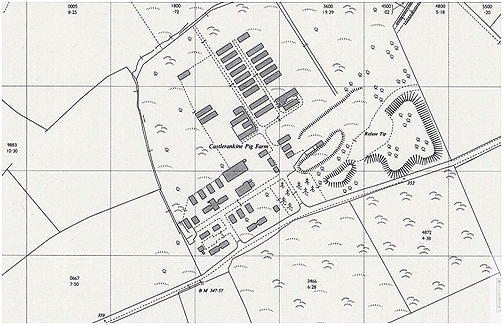
In 1953 the term European Voluntary Worker was replaced by the plainer Foreign Workers, and Bailey dates the camp’s gradual closure to about that year. The buildings were left standing and were taken over by a pig farmer, whose co-worker and heir to the site, Gunter Ilgner, had himself been at the camp in 1947. The national record knows the place as Castlerankine Pig Farm.
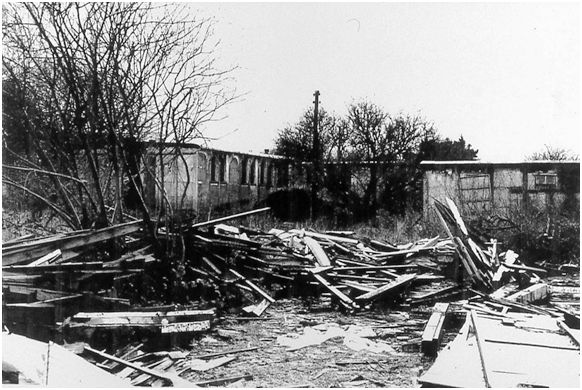
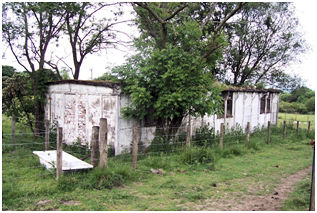
Photographs record demolition in 1990 and one surviving hut in 2010; a 1963 Ordnance Survey map shows the former camp’s layout during its agricultural afterlife. During the 1990 clearance a local councillor, Billy Buchanan, rescued the painted wall panels made by a German prisoner, Otto Laub, and they are now held by the Smith Institute in Stirling.
Sources for this section
Sources
- G. B. Bailey, Castle Rankine (2020)
Undated
Camp and medieval castle are distinct sites; SMR 483 camp.
- Peter Kormylo, Ukrainians in Scotland (2021)
Undated
Hostel directory entry 26, PDF 339.
- G. B. Bailey, POW Camp 64 (2022)
Undated
Full local-history article read. Quotes Falkirk Herald 25 February 1948 p 7 and summarises Scotsman 7 January 1949 p 3; underlying newspaper originals not separately inspected. Images 27–29.
- Castle Rankine, German Working Camp, Camp No.64
Historic Environment Scotland, National Record of the Historic Environment (NS78SE 37) · Archaeology note of June 2005
Locates the camp at NS 7930 8190 in Denny parish and counts at least 39 huts in the main enclosure and 24 in the staff camp from vertical air photographs flown 15 April 1946. Also known as Castlerankine Pig Farm.
- G. B. Bailey, Herbertshire Castle
Falkirk Local History Club · 2020
Local history article read in full. The paragraph following the Second World War section records German prisoners of war from the Castle Rankine camp erecting a dais at Herbertshire Castle Park in June 1946.
- Stephen Roberts, Migration to Scotland in the Age of Total War
University of Glasgow M.Litt. thesis, digitised by Enlighten: Theses · September 1995
Page 109 consulted. It quotes a Glasgow Herald report of 24 February 1948 on European volunteer worker parties arriving by special train at Dingwall and Denny. The newspaper original was not separately inspected.
- Camps listed under lowest number allocated
Second World War prisoner-of-war camps in the United Kingdom (website) · Undated; table revised 2020 to 2026
Camp list table read online. The row for No. 64 names Castle Rankine Camp, Stirlingshire, dated 1942 to 1947, also known as Denny, with hostels. A community-compiled list, used only for that entry.
- Samuel Lewis, A Topographical Dictionary of Scotland, index A to J
S. Lewis, London; digitised by British History Online · 1846
Index entry under C, pages 595 to 623, naming Castle-Rankine as a glen in Denny and cross-referring to volume i, page 278. The referenced entry itself was not consulted.
Last researched 13 September 2026