Cowra Migrant Camp
Arrival and settlement
Cowra, New South Wales, Australia · Late 1940s–1956
A wartime army training camp at Cowra was turned over to migrant families, and by November 1950 a newspaper put its population at 3,300. Ukrainian women founded their first organised branch there in 1949, while the camp’s rations became a national story.
Introduction
Cowra accommodated migrants in a former military training camp. Its post office, school, canteen and chapel served families rebuilding their lives, while many men worked away from the camp. Cowra Tourism estimates that 17,000–19,000 migrants passed through during its operation; this is a cumulative estimate for all nationalities. Heritage NSW gives the same range of 17,000 to 19,000 for the years 1949 to 1956 in its State Heritage Inventory, citing published local histories.
A history in dates
- 1940–1945Some 80,000 Australian troops receive basic training at the Cowra camp.
- 1947The Cowra Military Camp is decommissioned and converted into an immigrant centre, according to Pieris.
- By 1948Over two thousand European women and children, among them Ukrainians, are housed at Cowra, according to Pieris.
- 17 August 1949Iryna Pelenska initiated a Ukrainian women’s meeting.
- 13 September 1949A general meeting elected the committee and adopted a provisional constitution.
- 5 November 1949The women organised a celebration with Plast.
- Before Easter 1950Brunhilde Srejic and her children transferred from Bathurst to Cowra.
- 17–19 November 1950Women in A block fly a black flag in protest at a new ration scale; the camp director releases extra flour and sugar.
- 1951The camp school is recorded on the local interpretation panel.
- 1951The Department of Immigration opens another migrant camp at Bathurst; the Cowra teacher Paul Couvret is posted there before returning.
- 1955Couvret ends his teaching at the Cowra migrant centre, having been sports master to about 800 migrant children.
- By 1952Arrivals are dwindling, according to the interpretation panel.
- 1956The camp closed, according to the local interpretation panel.
- 1 May 1999A plaque marking the 50th anniversary of the Cowra Migrant Camp is unveiled at Europa Park.
Sources for this section
- Cowra Tourism, Historic Migrant & Military Training Camps
- Anoma Pieris, ‘Cowra, NSW: Architectures of Internment’
- L. Hordiieva, Union of Ukrainian Women of Australia, in Ukrainians in Australia, volume 1 (1966)
- Brunhilde Srejic, migration memories, Belongings, NSW Migration Heritage Centre; interviewer Elizabeth Edwards
- ‘COWRA CAMP QUIETER: Women’s Mutiny Over Rations’, The Sydney Morning Herald, 20 November 1950, page 1
- Cowra Migrant Camp interpretation panel, reproduced by Cowra Tourism
- Paul Couvret, interview transcript
- 50th Anniversary of Cowra Migrant Camp
From army training camp to migrant camp
The site came to the migrants already built. Cowra Tourism records that some 80,000 Australian troops received basic training at the Cowra facility between 1940 and 1945, and that the camp was converted for migrants after the war. Cowra’s prisoner-of-war compound, scene of the 1944 breakout, was a separate establishment and is commemorated separately; the migrant camp occupied the army training camp.
Cowra Tourism counts as many as 27 nations among those who lived there, and describes work that took men away from their families: railway construction at Orange, dam building and jobs at the Edgell cannery. Two memorials now mark the two phases, one for migrants in Europa Park on Sydney Road and one on Military Parade for the training camp.
Anoma Pieris dates the change more closely. The Cowra Military Camp, established in 1940 on Darby Falls Road, was decommissioned in 1947 and converted into what she describes as the largest immigrant centre in New South Wales; she records reports of up to 4,000 migrants accommodated at its peak.
Arrivals, sorting and the railways
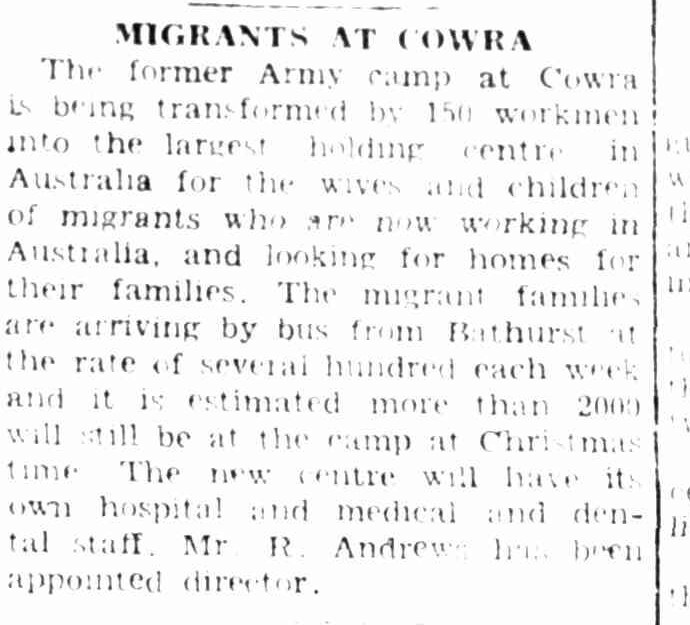
Pieris describes the pipeline that fed the camp. New arrivals were sorted, examined and classified at Bathurst and then separated by gender: the men were sent off to work across the country, and the women and children went to the Cowra family camp, where they remained for up to six months until secure jobs and accommodation might reunite the families.
By 1948, Pieris records, over two thousand European women and children were housed at Cowra: Latvians, Lithuanians, Estonians, Czechs, Ukrainians, Yugoslavs and Poles.
The railway carried them. Heritage NSW records in its inventory entry for the Cowra railway station precinct that new migrants were transported to the Cowra Migrant Camp by rail until the camp closed in 1956, and that the station’s period of most intense use, during and immediately after the Second World War, is associated with the military training camp and then the migrant camp. A family history published by the Benalla Migrant Camp project shows the onward movement: a Lithuanian family that arrived in 1949 on the SS Skaugum was sent first to Cowra and transferred to Benalla later the same year.
Women organise
In her 1966 history, L. Hordiieva traces organised Ukrainian women’s activity to Cowra. Iryna Pelenska initiated a meeting on 17 August 1949. A general meeting on 13 September adopted a provisional constitution and elected a committee, with Pelenska as chair. The group held 27 meetings during its existence at Cowra.
The Australian Women’s Register gives the same founding date, 13 September 1949, at Cowra migrant camp, and calls Cowra the cradle of the association in Australia, noting that Ukrainian women were holding meetings in all the migrant centres across Australia. It renders the inaugural president’s name as “Mrs. I Polensly”, where Hordiieva gives Iryna Pelenska.
Children, dancing and celebrations
The women organised two exhibitions of Ukrainian folk art and a celebration with the Plast scouting group on 5 November 1949. St Nicholas festivities and a shared Christmas Eve brought families together. Lidiia Haievska led Ukrainian studies for children aged six to thirteen and a dance group associated with the school. Hordiieva records 22 performances in the camp and nearby towns.
Ukrainian community activity recorded in the 1966 history
| Date or measure | Recorded detail |
|---|---|
| 17 August 1949 | Initial meeting organised by Iryna Pelenska |
| 13 September 1949 | General meeting adopted a provisional constitution and elected the committee |
| 5 November 1949 | Celebration organised with Plast |
| Ages 6–13 | Children attending Ukrainian studies described by Hordiieva |
| 27 meetings; 22 performances | Totals reported for the group and its associated dance troupe; not population figures |
Sources for this section
Rations and the black flag
In November 1950 the camp became national news. The Sydney Morning Herald reported that women in A block flew a black flag as a symbol of mutiny after officials introduced a new scale of diet. Under the old scale each person, adult or child, had four eggs a week and 35 lb of bread was allocated daily for every 100 people. Assuming that children ate less than adults, officials cut this to one egg a week and 18 lb of bread daily for every 100 people, with vegetables and fruit reduced too and little change to meat and milk.
The paper reported that the camp then held 3,300 New Australians, mostly from central European countries, and that the camp director, Mr J. Andrews, released an extra 50 lb of flour and 40 lb of sugar to the 570 people in A block. The women the reporter interviewed asked not to be named because they feared reprisals. Some said the new scale would force them to buy eggs, lettuce and bread from Cowra shops; a Latvian woman said she still received far more food than she had in a migrant camp in Germany. The report describes migrants of several nationalities and does not attribute the protest to Ukrainian residents.
The article also explains the pattern that made the protest a women’s protest. Husbands lived on the job during the working week and saw their families only at weekends, so the blocks were occupied chiefly by women and children when the rations arrived.
The ration scale reported in November 1950
| Item | Old scale | New scale |
|---|---|---|
| Eggs | Four a week for each person, adult or child | One a week for each person |
| Bread | 35 lb daily for every 100 people | 18 lb daily for every 100 people |
| Vegetables and fruit | Higher allocation | Reduced |
| Meat and milk | As before | Little change |
Population figures reported for Cowra
| Figure | What it counts | Source and scope |
|---|---|---|
| 3,300 | New Australians in the camp, described as mostly from central European countries | Sydney Morning Herald, 20 November 1950; a press figure at one moment, all nationalities |
| 570 | People in A block | Same report |
| 181 | People fed by one kitchen within A block | Same report |
| 17,000–19,000 | Migrants who passed through over the camp’s whole life | Cowra Tourism estimate; cumulative, all nationalities |
| 27 nations | Nationalities represented among residents | Cowra Tourism |
| 80,000 | Australian troops who trained at Cowra, 1940–1945 | Cowra Tourism; the earlier army phase, not the migrant camp |
| Up to 4,000 | Migrants accommodated at the camp’s peak | Pieris 2014, reporting other accounts; all nationalities |
| Over 3,000 | People in the camp at any one time | The 1999 Europa Park plaque; a commemorative inscription, all nationalities |
A hairdresser’s working life
Brunhilde Srejic, a resident of German, French and Swiss background, recalled moving from Bathurst with about sixty women and children on the Wednesday before Easter 1950. At Cowra her family had a room to themselves in a corrugated-iron hut. She resumed hairdressing while her husband worked in Orange and visited on Friday evenings. Without a hairdryer, customers waited for their perms to dry while she supplied coffee and biscuits for their children. The family later left for a room in Orange. Her account offers a view of everyday life among Cowra’s different migrant communities.
Life in the huts
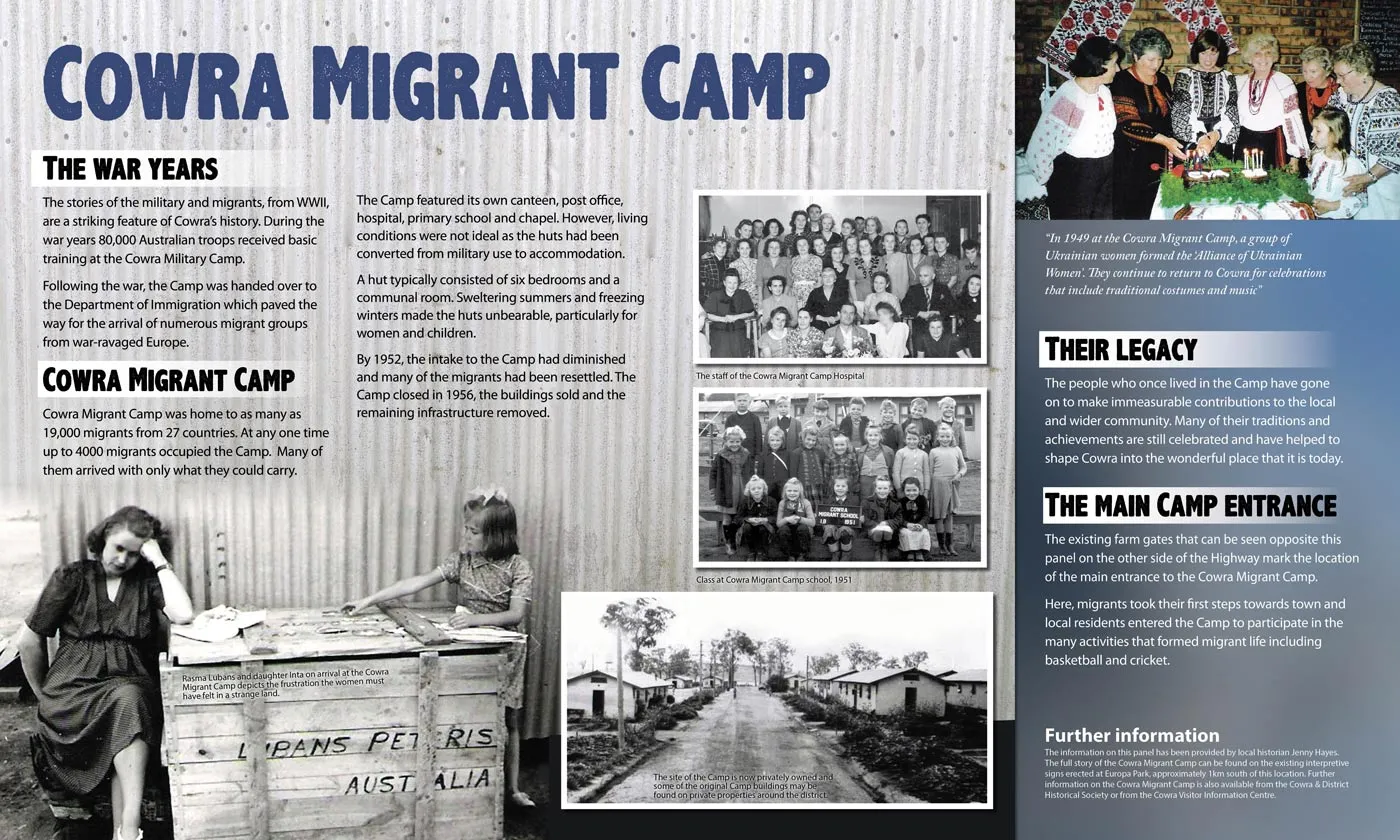
The camp’s interpretation panel describes a typical hut as six bedrooms and a shared room. Hot summers and cold winters made the converted military buildings uncomfortable. Alongside the school and chapel, the camp had a hospital, post office and canteen. The panel records dwindling arrivals by 1952 and closure in 1956, followed by the sale of buildings and removal of remaining infrastructure.
Sources for this section
The camp school through a teacher’s eyes
Paul Couvret, interviewed for the Australians at War Film Archive in 2004, began his Australian teaching career at the Cowra Migrant Centre after a telegram posted him there. His classes held 45 children who, in his words, spoke not a word of English but “all spoke Ukrainian and Polish and Yugoslav”; he recalled that “we had them talking fluently in English in three months’ time”.
His recollections also trace the wider network and the school’s scale. In 1951 the Department of Immigration opened another migrant camp at Bathurst and, because he spoke Dutch, Couvret was sent there before returning to Cowra. He taught at the migrant centre until 1955, serving as sports master at a school he remembered as having about 800 migrant children. These are one teacher’s recollections, recorded half a century afterwards, rather than an official return.
Sources for this section
Beyond the camp
Members gradually left Cowra for permanent homes elsewhere in Australia. Hordiieva describes the dispersal as the end of the local group’s work, but also as a beginning: women carried their organising experience into new branches in the places where they settled.
Sources for this section
Remembering Cowra
Europa Park commemorates migrant families through a memorial wall and personalised pavers. Cowra Tourism identifies the former camp as private land and points to the historical society’s collection of residents’ stories, Australia, A New Country – A New Life.
Cowra Tourism also states that the campsite is now privately owned, that personalised pavers at Europa Park are arranged through the Rotary Club of Cowra, and that the Cowra and District Historical Society’s collection of residents’ testimonies can be consulted at the Visitor Information Centre. The 1956 closure date rests on the local interpretation panel.
Europa Park also carries a dedicated anniversary plaque. Unveiled on 1 May 1999 to mark fifty years of the Cowra Migrant Camp, its inscription records that the first European migrants arrived in 1949 and occupied the buildings of the former army base between the highway and Darby’s Falls Road, that there were over three thousand people in the camp at any one time from many European countries, and that the men were contracted to work for two years on government projects while the women and children stayed in the camp. It closes: “We came from afar to build a new home.”
Sources
- L. Hordiieva, Union of Ukrainian Women of Australia, in Ukrainians in Australia, volume 1 (1966)
Both printed pages visually inspected from original DjVu; author heading checked on page 493. Locators: {"printed_pages": [493, 494]}
- Cowra Tourism, Historic Migrant & Military Training Camps
Full relevant page text inspected 12 September 2026. Photographs not yet visually verified.
- Brunhilde Srejic, migration memories, Belongings, NSW Migration Heritage Centre; interviewer Elizabeth Edwards
Full published testimony read 12 September 2026. Narrative explicitly names Cowra despite category tags Bathurst/Parkes. Resident identifies German/French/Swiss background.
- Cowra Migrant Camp interpretation panel, reproduced by Cowra Tourism
Cowra Tourism; local history information credited to Jenny Hayes
Complete original panel visually read. Names the camp school in 1951, hut configuration, closure in 1956 and Ukrainian women in 1949. Hospital photograph identity follows the panel; no ethnicity inferred from images.
- ‘COWRA CAMP QUIETER: Women’s Mutiny Over Rations’, The Sydney Morning Herald, 20 November 1950, page 1
The Sydney Morning Herald (NSW : 1842 - 1954) · 20 November 1950
Full digitised article read 13 September 2026 through an Internet Archive snapshot of the Trove article page, because Trove’s live site is behind a bot-detection challenge. Contemporary press reporting, not an official return: 3,300 is the paper’s figure for the whole camp and 570 for A block. The women interviewed asked not to be named and are not named here. Ukrainians are not mentioned in the article.
- Migrants at Cowra
National Advocate (Bathurst, New South Wales), page 2 · 5 May 1949
Report that the former army camp at Cowra was being transformed by 150 workmen into the largest holding centre in Australia for the wives and children of migrants already working in Australia and looking for homes for their families; that the families were arriving by bus from Bathurst at the rate of several hundred each week; that more than 2,000 were expected still to be at the camp at Christmas; and that the new centre would have its own hospital and medical and dental staff, with Mr R. Andrews appointed director. Digitised by the National Library of Australia with funding from the State Library of NSW Digital Excellence Program; Australian material published before 1955 is out of copyright.
- Anoma Pieris, ‘Cowra, NSW: Architectures of Internment’
SAHANZ and Unitec ePress, Auckland · 2014
Printed pages 792–793 read in full: the Cowra Military Camp established in 1940 on Darby Falls Road and decommissioned in 1947, its conversion into the largest immigrant centre in New South Wales, the sorting of arrivals at Bathurst and the separation of families, the nationalities housed by 1948, reports of up to 4,000 migrants at the camp’s peak, and the closure of 1956. Published under a Creative Commons Attribution-NonCommercial 4.0 licence.
- 50th Anniversary of Cowra Migrant Camp
Monument Australia · 26 January 2015
Front Inscription section read in full: the text of a plaque unveiled on 1 May 1999 at Europa Park, recording the arrival of the first European migrants in 1949, over three thousand people in the camp at any one time, and two-year work contracts for the men.
- Ukrainian Women’s Association in Australia of New South Wales
The Australian Women’s Register / The Australian Women’s Archives Project · Accessed 14 September 2026
Summary section read in full: the first branch of the Ukrainian Women’s Association formed on 13 September 1949 in Cowra migrant camp, with the inaugural president’s name given as “Mrs. I Polensly”, and Cowra described as the cradle of the association in Australia.
- Paul Couvret, interview transcript
UNSW Australians at War Film Archive · 16 January 2004
Tape 1, approximately 12:00 to 14:30, read in full: teaching at the Cowra Migrant Centre in classes of 45 children, a temporary posting in 1951 to the new Department of Immigration camp at Bathurst, and teaching at Cowra until 1955 as sports master at a school of about 800 migrant children.
- Cowra Railway Station and Locomotive Depot Precinct, State Heritage Inventory
Heritage NSW, Department of Premier and Cabinet (New South Wales) · 2025
History, historical notes and assessment of significance read: the converted military training camp housed between 17,000 and 19,000 new migrants from 1949 to 1956, citing published local histories; new migrants were carried to the Cowra Migrant Camp by rail until its closure.
- Bronius and Dominika Savickas
Benalla Migrant Camp 1949–1967 website; collated by Sabine Smyth · Accessed 14 September 2026
“Savickas Story” section read in full: a Lithuanian family arriving on the SS Skaugum in 1949 was sent first to the camp at Cowra and transferred to Benalla later the same year. A family history compiled from correspondence with a descendant.
Last researched 13 September 2026