Dinkelsbühl DP camp
Displacement in Europe
Dinkelsbühl · Germany · 1945–1949
Dinkelsbühl’s displaced persons were spread through hotels, inns, school buildings and a former brush factory rather than a single barracks. The Ukrainian DPs lived in the brush factory at Nördlinger Straße 52, known to its residents as Camp 73.
Introduction
Dinkelsbühl, a small walled town in Middle Franconia, had no barracks to spare for displaced persons after the war. Its DP camp, listed by the Arolsen Archives as a single assembly centre, AC 92-313, with a capacity of 975 in October 1947, was in practice a network of requisitioned buildings around the town: hotels, inns, two former schools, the station restaurant and a former brush factory. The inventory records Ukrainian, Polish-Ukrainian, Lithuanian and Latvian residents, and the published list of buildings shows that each national group had its own house.
The Ukrainian part of this network was the former brush factory at Nördlinger Straße 52, which its residents knew as Ukrainian DP Camp No. 73. It is a personal recollection, not an administrative record, and its detail should be read in that light.
A history in dates
- 5 May 1945A US military government report counts 6,081 displaced persons in the Dinkelsbühl district; most are soon moved elsewhere.
- 24 January 1946Opening date of the Dinkelsbühl DP camp, AC 92-313, in the Arolsen inventory.
- March 1946The memoir’s family arrives at the Ukrainian camp in the former brush factory, Nördlinger Straße 52.
- 31 October 1947The inventory records a capacity of 975 for the Dinkelsbühl centre.
- September 1948The centre is renumbered OMF 340; the memoir’s family emigrates the same month.
- 1 June 1949Closing date of the Dinkelsbühl DP camp in the Arolsen inventory.
The buildings
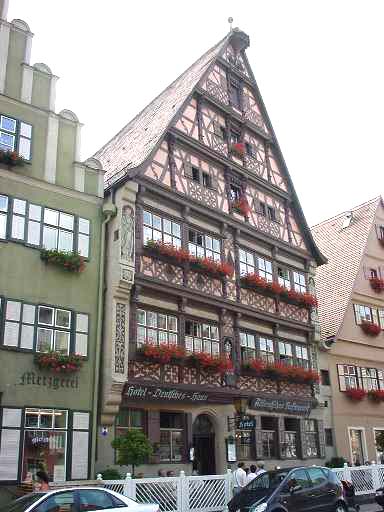
A report of the US military government headquarters dated 5 May 1945 counted 6,081 displaced persons of various nationalities in the Dinkelsbühl district; most were soon moved to other camps in Bavaria, and a later report on the centres in the town and its immediate surroundings registered 627 people. The list of locations compiled from these reports names the hotels Deutsches Haus, Goldene Rose and Weisses Ross, the last housing Latvian DPs; the inns Dinkelbauer, Brauner Hirsch and Kornschranne; the former secondary school at Nördlinger Straße 22 and the former flying school, later a hat factory, at Rudolf-Schmidt-Straße 7; the station restaurant at Luitpoldstraße 19, which housed Lithuanian DPs; and the private house and former brush factory at Nördlinger Straße 52, where the Ukrainian DPs lived. The memoir adds that the Deutsches Haus was Camp No. 2, the Goldene Kanne No. 5, and that a small camp occupied the Goldener Hirsch inn.
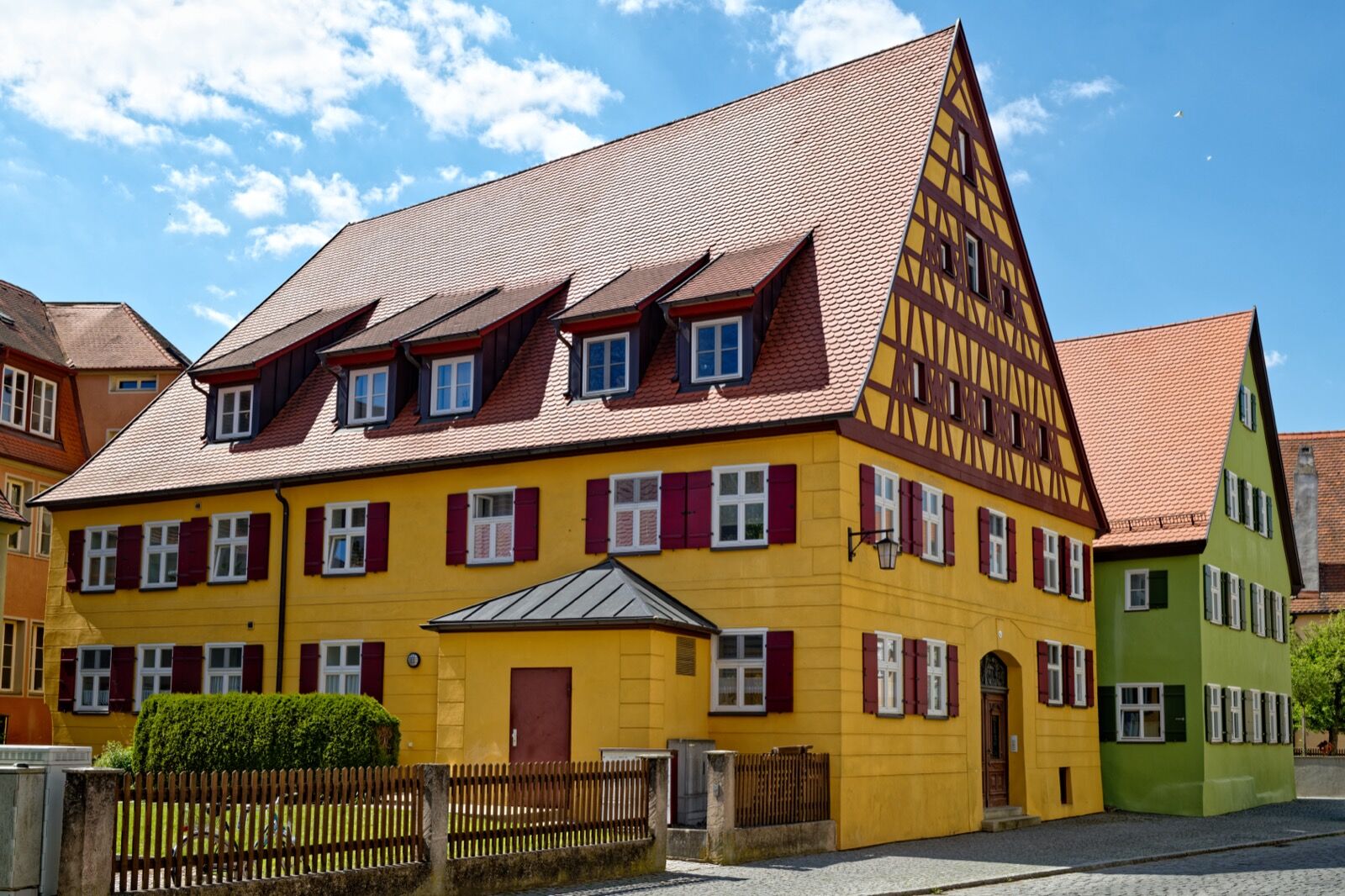
The brush factory building had two floors of usable rooms beneath three attic floors under a steep tiled roof. A wooden gate on the street led through a ground-floor passage to a small courtyard, with a couple of rooms on each side of the passage, one of them later used as a classroom. Across the courtyard stood a larger building with many rooms, full of families, whose basement held a communal shower room. Families lived in single rooms; the memoir describes one room facing the street with a table, a wardrobe, a bed for the parents and a bunk bed for two children, a toilet in a long narrow room and a cold tap in the corridor. A yard behind held the winter wood supply, and residents kept rabbits and small gardens. The building still stood, renovated, when a visitor photographed it in 2006.
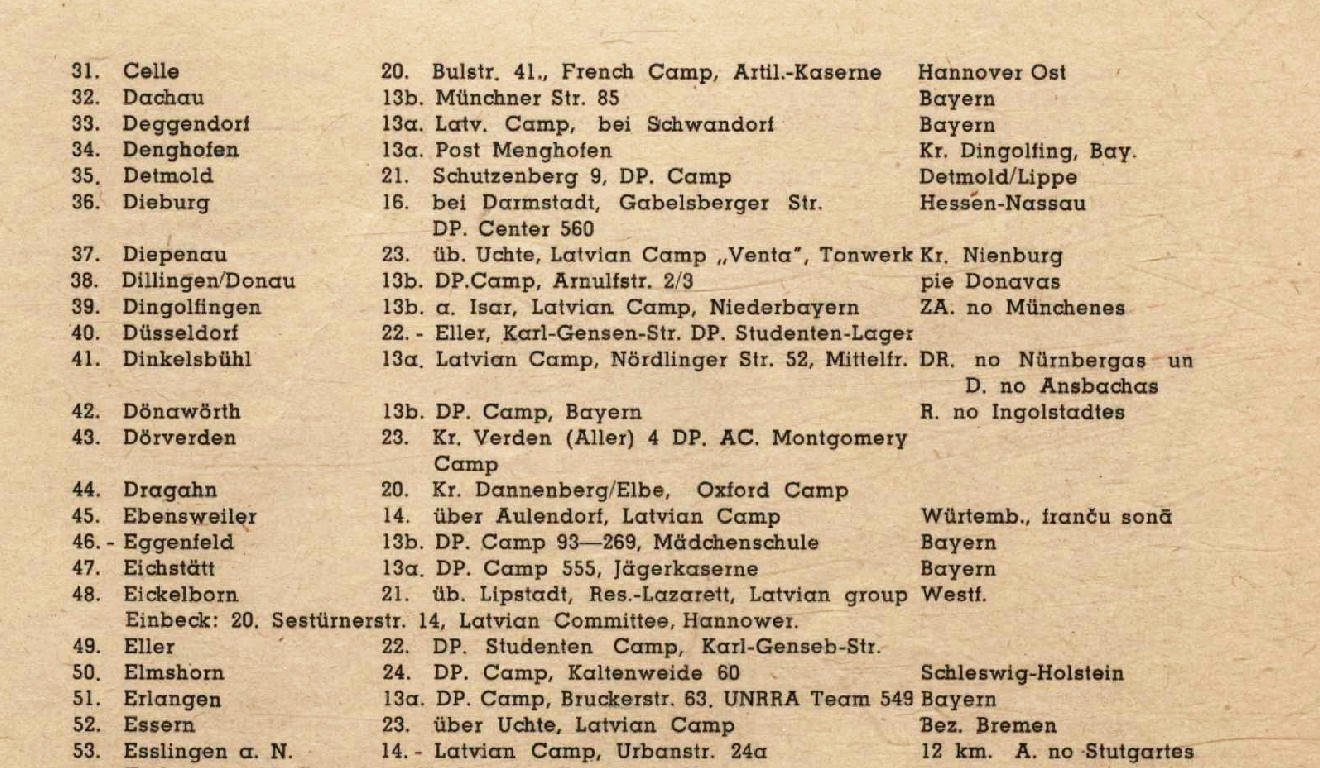
A list of Latvian camps in Germany published in the Latvian periodical Mūsu Pagasts on 1 May 1946 gives the Dinkelsbühl Latvian camp as Nördlinger Straße 52 in Middle Franconia, south-west of Nuremberg and south of Ansbach. That is the address of the private house and former brush factory which the building list and the memoir assign to the Ukrainian residents. How the address was shared between the two groups is not recorded.
DP accommodation in Dinkelsbühl, 1945 to 1949
| Building | Address | Residents noted |
|---|---|---|
| Hotel Deutsches Haus | Not given | Camp No. 2 in the memoir |
| Hotel Goldene Rose | Not given | |
| Hotel Weisses Ross | Not given | Latvian DPs |
| Inns Dinkelbauer, Brauner Hirsch, Kornschranne | Not given | |
| Former secondary school | Nördlinger Straße 22 | |
| Former flying school, later hat factory | Rudolf-Schmidt-Straße 7 | |
| Station restaurant | Luitpoldstraße 19 | Lithuanian DPs |
| Former brush factory, private house | Nördlinger Straße 52 | Ukrainian DPs; Camp No. 73 in the memoir |
UNRRA, school and church
UNRRA fed the camp and kept a representative to look after the residents; the Arolsen inventory assigns Dinkelsbühl to Team 167 at Ansbach and to a local Team 565. A small room in the compound served as the supply centre, where rations were issued against coupons, and the memoir remembers white bread, dried potatoes, peanuts and chewing gum from the American supplies alongside the familiar black bread. What the rations did not cover was obtained by barter, in which cloth, coffee, cigarettes and stockings changed hands; residents also went out to the surrounding villages to trade with farmers. Garden plots were allotted to families at the disused flying school outside the town.
Parents organised a school for the children, drawing teachers from among the residents; the memoir recalls lessons in history, Latin and Greek mythology, as well as violin and piano lessons. The camp’s Catholic priest held services first in the town’s St George’s church and later in a small church by the town wall, taught catechism, and on one occasion married more than a dozen couples in a single ceremony. The children received parcels from the American Red Cross assembled by school pupils in the United States, and the camp put on stage shows and a masked ball with an orchestra. Newsreels and films were shown in a hall near the Goldener Hirsch.
The memoir’s family left in 1948 for a resettlement processing centre near Nuremberg and sailed from Bremerhaven for Canada that September. The Arolsen inventory gives the Dinkelsbühl centre a new number, OMF 340, from September 1948 and records its closure on 1 June 1949.
Sources
- DP Camp #73, Dinkelsbühl, Germany 1946–1948, and DP camps in Dinkelsbühl 1945–1949
dpcamps.org, Michigan Family History Network (memoir by a former child resident, 2002, with a list of camp locations supplied by a German correspondent) · 2002, page accessed 12 September 2026
Full page read. The memoir gives the address, the former brush factory, the layout of the building and courtyard block, UNRRA supply, school, church and camp life from March 1946 to 1948. The appended list cites a US military government report of 5 May 1945 on DPs in Kreis Dinkelsbühl and names the hotels, inns, schools and the former brush factory at Nördlinger Straße 52 used for DPs, with the Latvian, Lithuanian and Ukrainian buildings.
- DP camp inventory: Dinkelsbühl, DP-Camp, entry 867
Arolsen Archives · 26 October 2023
Row 867 read from the downloaded spreadsheet: opening 24 January 1946, closing 1 June 1949, capacity 975 on 31 October 1947, assembly centre AC 92-313, OMF 340 from September 1948, UNRRA Teams T 167 Ansbach and T 565 Dinkelsbühl, Area Team AT 1041 Ansbach, nationalities Ukrainian, Polish-Ukrainian, Lithuanian and Latvian, document IDs 81975737 to 81975742.
- Nördlinger Straße 52, Dinkelsbühl (photograph)
Wikimedia Commons · 10 May 2024
Photograph of the house at Nördlinger Straße 52, the address the memoir gives for the former brush factory in which the Ukrainian DPs lived. Released by the photographer under the Creative Commons Attribution-ShareAlike 4.0 International licence; licence, author and date read from the file page. The photographer is credited in full under the image.
- Hotel Deutsches Haus, Dinkelsbühl, DP camp no. 2
M. John Sklepkowycz, published on DPcamps.org, Michigan Family History Network · undated photograph
Photograph of the gabled timber-framed front of the Deutsches Haus hotel, captioned on the page as camp no. 2 in the town’s numbered series of displaced persons quarters. The recollection is marked Copyright 2002 M. J. Sklepkowycz, all rights reserved; no reuse licence is stated.
- Latviešu nometnes Vācijā (Latvian camps in Germany), Mūsu Pagasts, Nr. 1-2
latvians.com, reproducing Mūsu Pagasts (Our Parish), Nr. 1-2 · 1 May 1946
Facsimile of a numbered list of Latvian camps in Germany; sheet 2 of 6 read. Item (49), No. 41, gives the Latvian camp at Dinkelsbühl as Nördlinger Straße 52, Mittelfranken. The entry is in Latvian with German; the site supplies an English translation of the introduction only.
Last researched 12 September 2026