Greta Migrant Camp
Arrival and settlement
Greta, Hunter Valley, New South Wales, Australia · 1949–1960
Two former army settlements became a first Australian home for Ukrainian families: a place of work departures and weekend reunions, choirs, classrooms and community life.
Introduction
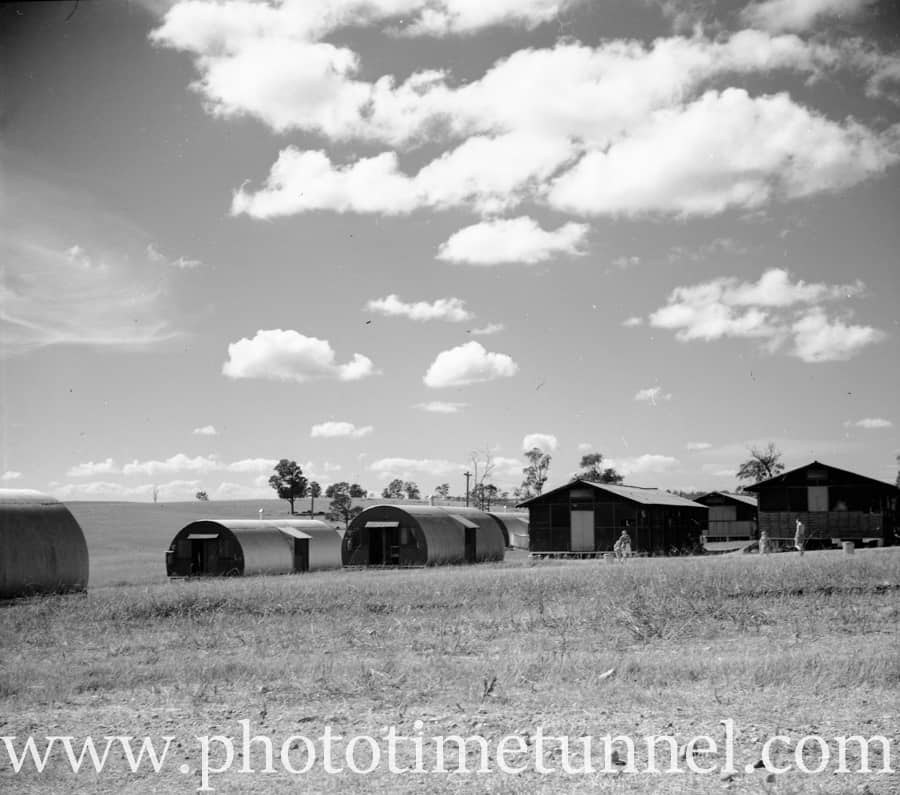
Greta Migrant Camp was a reception and holding centre in the Hunter Valley, New South Wales, operating from 1949 to 1960. Ukrainian families made homes, organised choirs and schools, and worshipped here alongside migrants from many other countries. The former army camp had two distinctive sections: Chocolate City, with brown weatherboard buildings, and Silver City, with corrugated-iron huts.
A history in dates
- November 1939The Commonwealth acquired the army site at Allendale–Greta.
- 15 December 1939The 2/11th Battalion arrived at the new camp.
- Early June 1949The first large transfers from Bathurst reached Greta.
- 19 August 1949Fairsea passengers travelled from Newcastle to Greta by train.
- August 1949A mixed Ukrainian choir began performing at the camp.
- Late March 1950Father F. Boskyi celebrated his first Divine Liturgy at Greta camp.
- 5 January 1960The final 107 residents ate their last camp meal before leaving for Villawood.
- 15 January 1960The migrant camp formally closed.
- 1960Greta’s Ukrainian Catholic community built a church hall with a chapel.
- 1962The Army regained control of the site.
- 1980The former camp site was sold at auction.
Sources for this section
- Australian War Memorial, Greta place record
- Gretel Evans, Remembering Two Cities: Generational Memories of the Greta Army and Migrant Camp, 1939–2020, Studies in Oral History, 2022
- Mykhailo Nimtsiv, Ukrainian community history in Ukrainians in Australia, 1966
- Australian Federation of Ukrainian Organisations, Greta Migrant Camp 1949–1960
- Ukrainian Catholic church history in Ukrainians in Australia, volume 1, Melbourne 1966
The army years
The Commonwealth acquired 2,930 acres in the Allendale–Greta area in November 1939. Construction began quickly, and the 2/11th Battalion arrived on 15 December. More facilities were added during the war as Australian Imperial Force and militia units trained here. After the fighting ended, some surrounding training land returned to grazing while the camp prepared troops for occupation service in Japan. Its transfer to the Department of Immigration in 1949 began a different phase in the same buildings.
Sources for this section
Arriving by train
The first large transfers from Bathurst reached Greta in early June 1949. On 19 August, Fairsea passengers disembarked at Newcastle and continued to the camp by train; the Australian Federation of Ukrainian Organisations records 1,096 people in that group. June brought transfers from another Australian reception centre, while August brought arrivals directly through Newcastle.
Sources for this section
Reception, accommodation and work
Chocolate City processed arrivals and allocated men to employment; Silver City accommodated dependants while families sought a place to live. These roles could change with demand. Gretel Evans’s study describes how the two-year government employment contract shaped family life. Work could take men to Queensland cane fields, steelworks, railways or the Snowy Mountains Scheme, leaving their families in the camp.
A family account published online records a later arrival. German migrants who reached Australia in January 1955 were taken to Sydney and then by train to Greta because the Bonegilla migrant camp was full. The same account describes migrant men working at the BHP steelworks at Newcastle staying in Nissen huts opposite the old Newcastle abattoir site while their families remained at the camp.
Arrivals and accommodation
| Measure | Figure | Period or scope |
|---|---|---|
| Silver City capacity | 2,866 | Reported accommodation capacity |
| Chocolate City capacity | 4,700 | Reported accommodation capacity |
| Displaced-person arrivals | 11,958 | August 1949–December 1950; Keating, cited by Evans |
Everyday life in the two sections
Each section had a school, cinema, canteen and chapels, with the main hospital in Silver City. Teachers came through the Education Department, and an employment office operated at the camp. The Australian Federation of Ukrainian Organisations describes separate administrations for Chocolate City and Silver City, headed by a director or commander. Its account also describes basic accommodation and families separated by employment. These practical arrangements made the camp both a temporary home and an administrative centre.
A camp of many nationalities
| Measure | Figure | What the figure describes |
|---|---|---|
| Fairsea arrival | 1,096 | Newcastle to Greta, 19 August 1949 |
| Christmas gathering | About 9,000 | People gathered at the camp, Christmas 1950 |
Sources for this section
Remembering arrival
The experience of Greta could look very different to a child and to a parent. In interviews studied by Evans, younger and longer-term residents often remembered the camp affectionately, while adults and older children recalled greater difficulty. Ingrid Rudolph, who arrived aged ten in August 1949, remembered empty barracks and families hanging blankets to make private spaces. Her account connects the army origins of the buildings with the immediate challenge of making them suitable for family life.
One family, two camps
Lydia Mamtschak recalls arriving in Sydney with her parents on 6 June 1949. After two weeks at Bathurst, she and her mother were sent to Greta while her father went to Chullora. He repaired train seats at Redfern Railway Yards. Her account brings the family separation described in administrative histories down to one household: mother and daughter in the Hunter Valley, father working in Sydney. She also recalls that her father’s legal qualifications and her mother’s teaching qualifications did not lead to work in their professions.
The Mamtschak family’s route, as recalled by Lydia
| Stage | Family experience |
|---|---|
| 6 June 1949 | Arrived in Sydney |
| Following two weeks | Temporary accommodation at Bathurst |
| After Bathurst | Lydia and mother: Greta; father: Chullora |
Sources for this section
A choir, a school and a stage
In his 1966 history of Ukrainians around Newcastle, Mykhailo Nimtsiv recalls a mixed Ukrainian choir appearing at Greta in August 1949. Roman Hrobelko had organised it during the voyage to Australia; Volodymyr Yankivskyi and Leonid Medvediv later conducted choirs at the camp. Ukrainian residents also taught, organised children’s activities and performed at concerts. Nimtsiv names Roman Drahan and Yevhen Haran among the teachers, and Nina Parubocha and Olena Zaiats among childcare workers.
Sources for this section
Family visits and community organisers
Saturdays brought husbands back from their workplaces to visit wives and children. Nimtsiv recalls concerts, dancing and exhibitions of embroidery, rugs, painted eggs and other objects residents had brought with them. He credits Roman Drahan with organising the Ukrainian community and describes his own work establishing a school and Plast group. These activities were difficult to sustain as families moved out to establish permanent homes.
Sources for this section
Ukrainian Catholic worship
The Catholic parish history in Ukrainians in Australia dates Father F. Boskyi’s first Divine Liturgy at Greta camp to the end of March 1950. A letter from Father M. Kopiakivskyi, dated 8 April 1951 and reproduced in the same volume, describes Boskyi’s pastoral visits to Greta and reports 200 families belonging to their community there. The letter recalls priests hearing confessions, celebrating services and teaching children during their visits to migrant camps.
Sources for this section
Life in the photographs
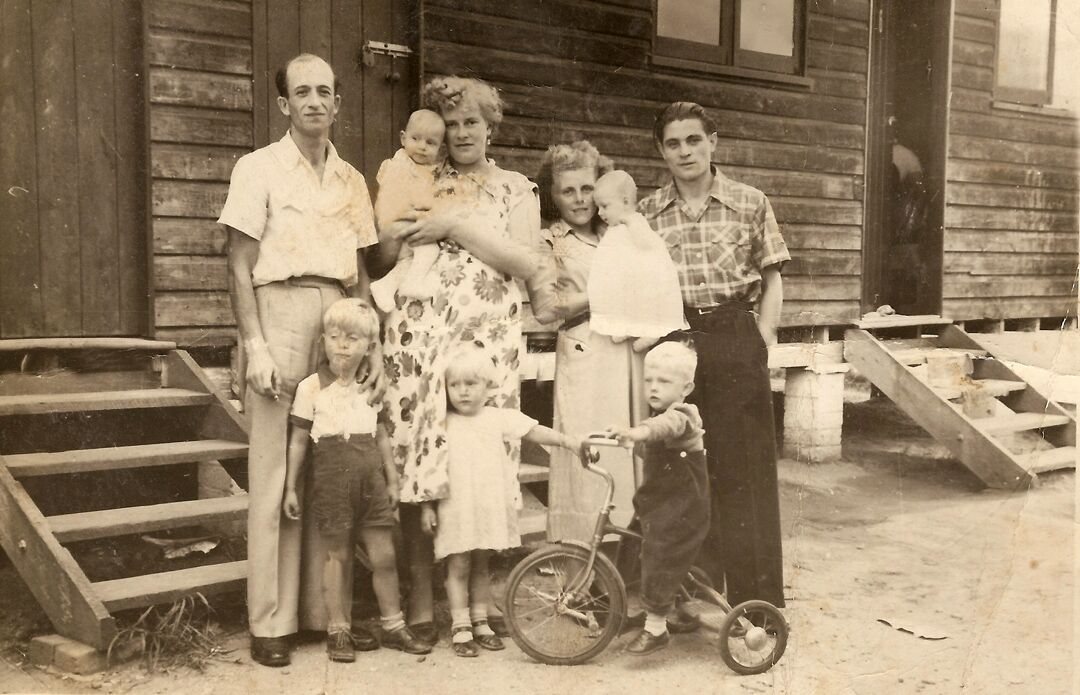
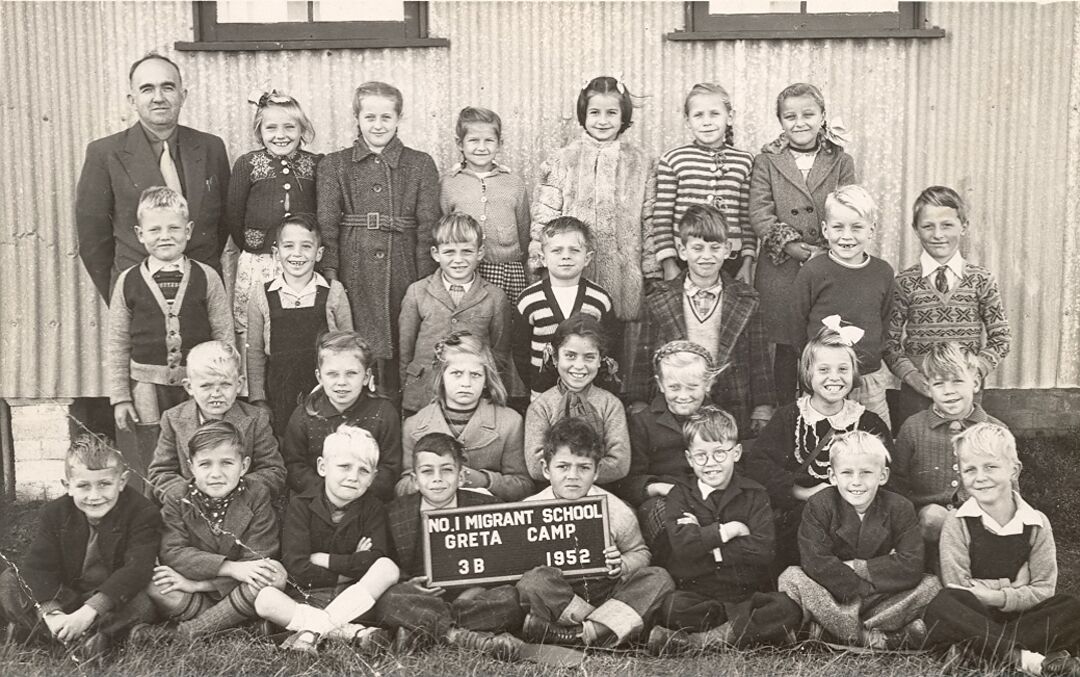
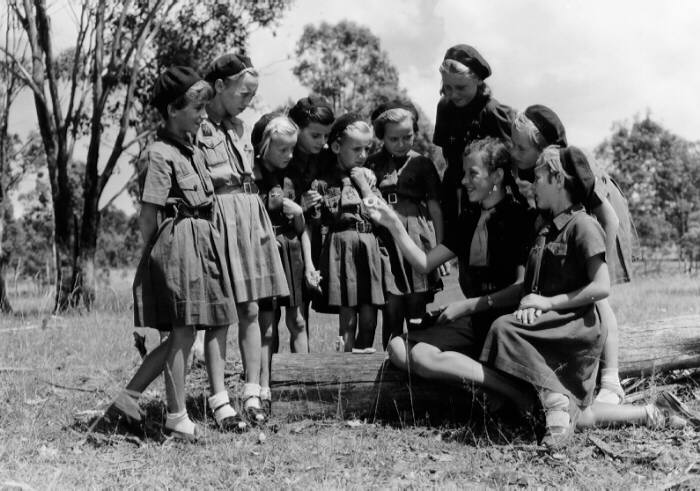
Newcastle Libraries preserves photographs contributed by former Greta residents alongside official and newspaper images. A Mary Ashton series photograph shows two families outside a Chocolate City hut: timber steps lead to separate doors, and a child stands beside a tricycle. The catalogue identifies the Stajkowski and Musialik families and dates the photograph to 1949–1954. A Peter Naglost series school photograph records another part of daily life: children pose outside a corrugated building with a board reading “No. 1 Migrant School, Greta Camp, 3B, 1952”. An Immigration Department image shows Girl Guides and Brownies gathered outdoors in 1954. These photographs give a closer view of accommodation, education and recreation than administrative totals alone.
Sources for this section
Closure and later uses
Evans, citing Val Randall, records a final meal for 107 residents on 5 January 1960 before their departure for Villawood. Formal closure followed on 15 January. Buildings were then sold and dismantled. The Army regained control in 1962, according to the Australian War Memorial, and used the site intermittently for training before its sale at auction in 1980.
A community beyond the camp
Greta’s Ukrainian community continued after the reception camp closed. The 1966 church history records that local faithful bought land and built a church hall in 1960, partitioning part of it as a chapel. Nimtsiv describes 23 Ukrainian families settled in Greta, with a chapel, community hall and Sunday school. These were institutions of the town’s continuing community, where families could meet after leaving camp accommodation.
A place people returned to
Former residents returned for the 2019 anniversary weekend, marking eighty years since the army camp opened and seventy since migrant arrivals began. Speaking at Greta, Governor-General David Hurley recognised both histories and the contribution of former residents to postwar Australia. His commemorative account estimated that around 100,000 migrants, including Ukrainians, passed through the camp over its eleven years of operation.
The Margaret Henry Oral History Archive at the University of Newcastle holds interviews with people who were at the Greta Migrant Camp. Its catalogue lists Felix Dangel under the title “Greta Migrant Hostel”, Elly Slechter under “Immigration of Displaced Persons to Australia Greta Camp” and Ann Buldecki under “Greta Migrant Camp”, together with Bazil Manunczak on displaced persons in the Hunter Region; the recordings themselves have not been consulted here. The Greta Historical Museum holds material on both the Greta Army Training Camp and the migrant camp that followed it.
Greta interviews in the Margaret Henry Oral History Archive catalogue
| Catalogue number | Catalogue title | Interviewee | Interviewer |
|---|---|---|---|
| A6731 (7B) | Greta Migrant Hostel | Felix Dangel | Zbigniew Kczela |
| A7462(ix) | Immigration of Displaced Persons to Australia Greta Camp | Elly Slechter | Cynthia Barker |
| A7463(vii) | Greta Migrant Camp | Ann Buldecki | Katherine Granter |
| A6970 (iv) | Displaced persons in the Hunter Region | Bazil Manunczak | Desmond Thomas |
Sources
- Australian War Memorial, Greta place record
Australian War Memorial
Complete institutional description read; PL2483 is not an image item.
- Gretel Evans, Remembering Two Cities: Generational Memories of the Greta Army and Migrant Camp, 1939–2020, Studies in Oral History, 2022
Oral History Australia · 2022
Full 28-page paper read as extracted PDF text (printed 51–78); interviews remain mediated through Evans and original interview recordings unread. First Bathurst transport: Evans gives 7 June 1949 (600 migrants); Nimtsiv gives 2 June. The article uses early June rather than treating these as separate proven arrivals.
- Australian Federation of Ukrainian Organisations, Greta Migrant Camp 1949–1960
Australian Federation of Ukrainian Organisations
Complete camp article read through ordinary HTTP retrieval after web extractor challenge.
- Governor-General David Hurley, Greta Army Camp and Greta Migrant Camp anniversary weekend, 2019
Governor-General of Australia · 2019
Complete official speech read; commemorative estimates distinguished from census.
- Lydia Mamtschak, Family reunion, Seniors’ Stories 2015, volume 2, pp 103–104
NSW Government · 2015
Parent visually read both original published pages; retrospective first-person family account, not a transport register.
- Newcastle Libraries, Hunter PhotoBank: Greta Migrant Camp photographs
Newcastle Libraries
Public catalogue metadata and four original catalogue JPEGs inspected. Selected accessions MA3, 444 000019, 110 000015, 104 000450. Names and location attributed to catalogue; school board independently legible. Full metadata retained in private research cache.
- Mykhailo Nimtsiv, Ukrainian community history in Ukrainians in Australia, 1966
Ukrainians in Australia, volume 1 · 1966
Research agent visually read 330–332; parent independently read 331. Retrospective named-author account. Printed pages 330, 331, 332, 337. First Bathurst transport: Evans gives 7 June 1949 (600 migrants); Nimtsiv gives 2 June. The article uses early June rather than treating these as separate proven arrivals.
- Ukrainian Catholic church history in Ukrainians in Australia, volume 1, Melbourne 1966
Ukrainians in Australia, volume 1 · 1966
Original DjVu pages 112,117,134 visually inspected. Printed and DjVu page numbers verified. p 117 reproduces letter dated 8 April 1951; original letter itself not inspected.200 families is pastoral community report, not all nationalities camp census. Printed pages 112, 117, 134.
- Greta Migrant Camp: Friends outside their hut in Chocolate City (L-R) Alex Stajkowski, his wife Christine holding baby George with daughter Christine and son Alex in front and Mrs Eliza Musialik with husband and son John in front, baby’s name unknown
Newcastle Libraries, Hunter PhotoBank · 1949–1954
Accession MA3. Original catalogue image visually inspected. Catalogue record 66505.
- Greta Migrant Camp: No. 1 Migrant School, Class 3B, 1952
Newcastle Libraries, Hunter PhotoBank · 1952
Accession 444 000019. Original catalogue image visually inspected. Catalogue record 60506.
- Girl Guides and Brownies at Greta Immigration Centre
Newcastle Libraries, Hunter PhotoBank · 1954
Accession 110 000015. Original catalogue image visually inspected. Catalogue record 32256.
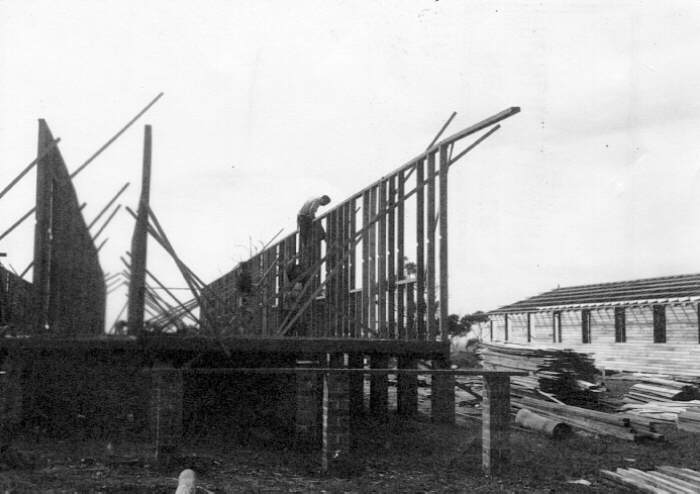
- Erection of Greta Migrant Camp Hostel
Newcastle Libraries, Hunter PhotoBank · 02/06/1949
Accession 104 000450. Original catalogue image visually inspected. Catalogue record 30054.
- The Margaret Henry Oral History Archive
Hunter Living Histories, with Special Collections, University of Newcastle Library · 17 April 2023
Section “Migrant Histories” and the catalogue entries A6731 (7B), A7462(ix), A7463(vii) and A6970 (iv) read: interviews with people who were at the Greta Migrant Camp, with their catalogue titles and interviewers. The recordings and written sources themselves were not consulted. The archive asks to be acknowledged as Margaret Henry Oral History Archive, University of Newcastle (Australia).
- A family’s journey from postwar Bremen to Greta Migrant Camp
Photo Time Tunnel
Article text under the heading “Greta migrant camp and after” read: a German family taken to Greta in January 1955 because Bonegilla was full, and migrant men working at the BHP steelworks at Newcastle housed in Nissen huts opposite the old abattoir site while their families stayed at the camp. A retrospective family account published without a named author.
- Greta Historical Museum, organisation listing
Museums & Galleries of NSW
Organisation listing read: the museum holds material on Warranua Aboriginal information, Greta’s coal mining days, earlier businesses, the Greta Army Training Camp and the migrant camp that followed it. The listing’s dating of the migrant camp to the end of the Second World War is not followed here.
Last researched 12 September 2026