Fairsea
IRO fleet·Displaced-person service: 1949–1952
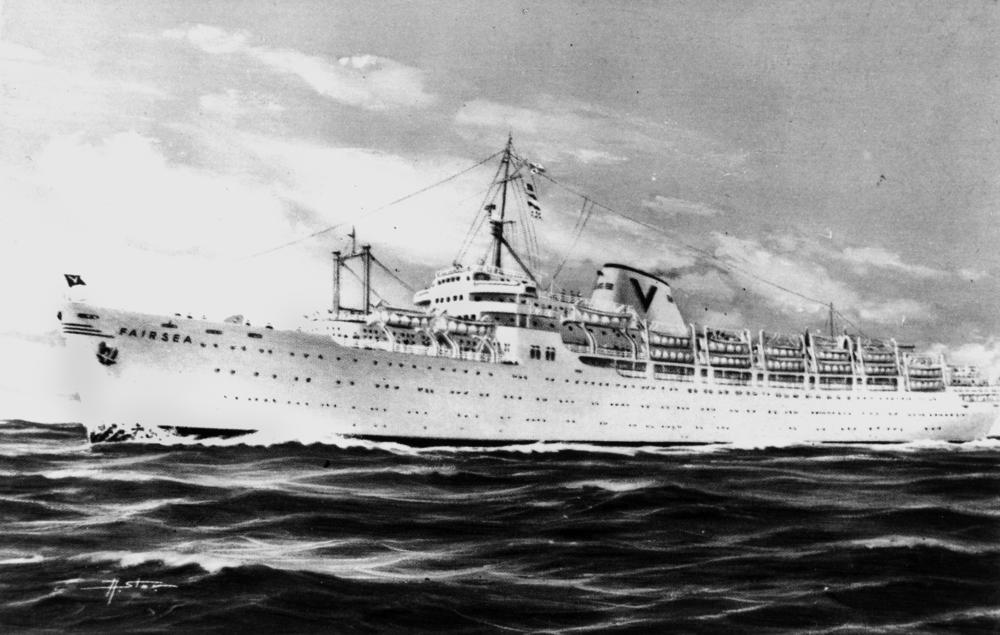
Fairsea was an American escort carrier hull rebuilt at Genoa in 1949 as a migrant ship for Alexandre Vlasov's Sitmar company and chartered by the International Refugee Organisation to carry displaced persons from Naples and Bremerhaven to Australia. Ukrainians were among her passengers on the sailings that filled Greta Migrant Camp and passed through Bonegilla.
Introduction
Fairsea was one of the ships that turned the International Refugee Organisation's resettlement quotas into actual departures. She was not built as a liner and never looked like one. Between May 1949 and the end of the IRO's work she ran a shuttle between the Mediterranean and Australian ports, loaded to about 1,800 people in open dormitories, and returned empty because her charter forbade her to carry anyone the other way.13
For Ukrainians in the camps of the western occupation zones she is one of the named ships that recur in family accounts and in community histories, alongside Skaugum, Castel Bianco and the American General class transports. Her August 1949 sailing produced the first draft of displaced persons landed outside an Australian capital city, and the group went straight to Greta Migrant Camp.54
A history in dates
- 1941
- 1949
- 11 May 1949
- 19 August 19491,096 passengers disembark at Newcastle and go by train to Greta Migrant Camp, the first draft landed outside a capital city; a Ukrainian choir formed during the voyage appears at Greta that month.5
- 2 March 1950
- 20 December 1950Sails from Nordenham and Bremerhaven for Melbourne, arriving 22 January 1951.4
- 1952The IRO contract ends and Sitmar begins selling fare-paying passages on the same ship.1
- Late 1957
- 23 January 1969
A carrier hull turned into a migrant ship
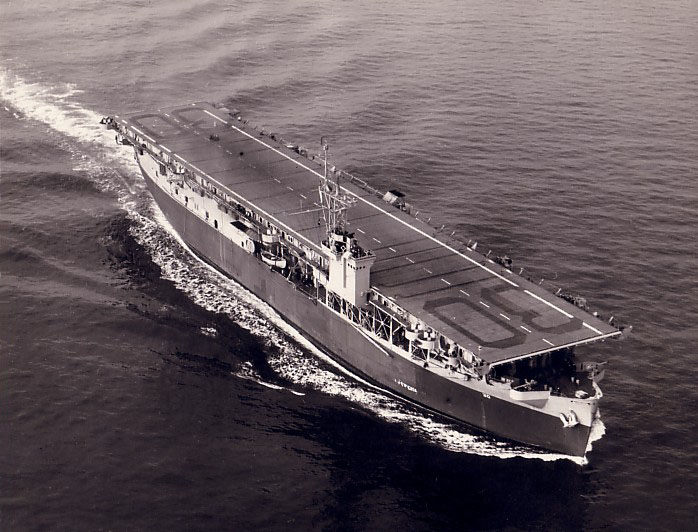
The ship was laid down as Rio de la Plata for the Moore-McCormack Line's New York to South America service and launched in 1941. She never took up that route. She was completed instead as an escort aircraft carrier, commissioned into the Royal Navy as HMS Charger and returned quickly to American hands, serving through the war as USS Charger. After the war she was used briefly as a troop carrier.12
Alexandre Vlasov bought her in 1949 for his Alva Steamship Company, renamed her Fairsea and had her reconstructed at Genoa. The rebuild produced very basic accommodation for about 1,800 passengers. Her registered tonnage was 11,833 tons gross, she measured 492 by 69 feet, and Doxford geared diesels on a single screw gave a service speed of sixteen knots. She was the first passenger ship of what became the Sitmar Line.13
The reconstruction was undertaken for a purpose that did not yet exist on paper. The ship lay idle for a short period while a contract was obtained from the International Refugee Organisation, and only then began work as an emigrant carrier.1
The ship
| Measure | Detail |
|---|---|
| Launched | 1941, as Rio de la Plata for the Moore-McCormack Line |
| Wartime identity | Escort carrier HMS Charger, then USS Charger |
| Rebuilt for migrant service | Genoa, 1949, for Alexandre Vlasov's Alva Steamship Company |
| Registered tonnage | 11,833 tons gross; 13,432 tons after 1958 |
| Dimensions | 492 by 69 feet (150 by 21.1 metres) |
| Machinery and speed | Doxford geared diesels, single screw, 16 knots |
| Capacity as rebuilt in 1949 | about 1,800 in open dormitories |
| Capacity after the 1957 refit | 1,460; 1,212 after 1961 |
| Australian voyages, 1949 to 1969 | 81 |
How the charter worked
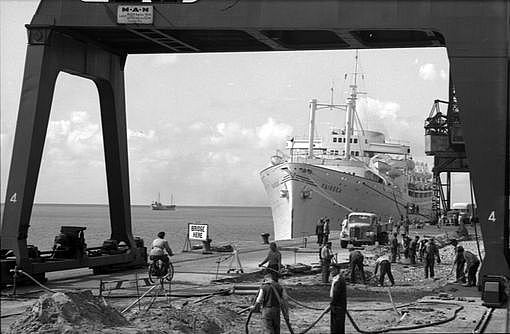
Passengers did not book a passage on Fairsea. They were selected in the camps by Australian officers working alongside IRO staff, signed a two-year labour contract for work directed by the Commonwealth, passed medical and security screening, and were then moved by train to an embarkation centre near the port. Fairsea's usual loading ports under the charter were Naples and, from late 1950, Nordenham and Bremerhaven. The Bremerhaven sailings drew on the northern German camps and resettlement centres, the Italian sailings on the assembly and staging camps that fed the port of Naples.41
On board, accommodation was segregated dormitory space rather than cabins. A Hungarian passenger who sailed in 1951, within the charter period, described the ship as a converted troopship with no cabins, just large open spaces with triple-decked bunks too cramped to sit up in, men in one section and women in the other, and a single long run of toilets and showers. The later comforts often recalled by British assisted migrants belong to the ship after her 1957 refit at Trieste, when air conditioning, an extra deck and new public rooms were fitted and capacity was cut to 1,460. They are not evidence about the displaced-person voyages.13
Reception followed a fixed pattern. Passengers landed at Melbourne, Sydney, Newcastle or Fremantle, were counted off against the ship's roll and were moved by train to a reception and training centre, most often Bonegilla, and from there to holding centres and to the jobs their contracts assigned them.47
Dated voyages
The maiden emigrant voyage left Naples on 11 May 1949 with 1,896 displaced persons of all nationalities and reached Melbourne in the first week of June. Sailings then followed at roughly two-monthly intervals: Naples on 17 July 1949 to Newcastle on 19 August, Naples on 22 September to Melbourne on 19 October, Naples on 3 December to Sydney on 31 December, Naples on 7 February 1950 to Fremantle on 2 March. The Fremantle call on 2 March 1950 landed 1,898 people in Western Australia before the ship continued east.426
From December 1950 she loaded in Germany. A voyage from Nordenham and Bremerhaven departing on 20 December 1950 reached Melbourne on 22 January 1951; the passenger roll for it was compiled from National Archives of Australia series A12052. On one 1951 voyage a record 1,902 passengers disembarked at Melbourne. The IRO contract ended in 1952, after which Sitmar sold fare-paying passages on the same ship; the transcribed roll for her Fremantle arrival of 2 October 1952 is entirely Dutch, and belongs to that later commercial traffic rather than to refugee resettlement.421
Not every sailing completed as planned. A Ukrainian woman who left Germany with a two-year-old son in October 1949 recorded that her ship, the Fairsea, broke down in the Suez Canal and had to put back to Naples, where her party transferred to the Castel Bianco and finally reached Port Melbourne on 24 May 1950.7
Displaced-person voyages to Australia recorded in the sources read
| Departed | Arrived | Number recorded | Source scope |
|---|---|---|---|
| Naples, 11 May 1949 | Melbourne, 8 or 9 June 1949 | 1,896 displaced persons | Whole ship, all nationalities. The two Australian sources give 8 and 9 June. |
| Naples, 17 July 1949 | Newcastle, 19 August 1949 | 1,096 disembarked at Newcastle | Disembarkation total at Newcastle, all nationalities |
| Naples, 22 September 1949 | Melbourne, 19 October 1949 | not recorded in sources read | |
| Naples, 3 December 1949 | Sydney, 31 December 1949 | not recorded in sources read | |
| Naples, 7 February 1950 | Fremantle, 2 March 1950 | 1,898 landed in Western Australia | Western Australian landings only; the voyage continued east |
| Nordenham and Bremerhaven, 20 December 1950 | Melbourne, 22 January 1951 | not recorded in sources read | Roll compiled from National Archives of Australia series A12052 |
| Not recorded | Melbourne, 1951 | 1,902 disembarked | A record disembarkation at Melbourne on one 1951 voyage, all nationalities |
Ukrainians on board
The transcribed Fairsea rolls for 1949 and 1950 carry sequence number, surname and forename only, without a nationality or birthplace column, so they cannot be used to count Ukrainians. The Ukrainian presence on her voyages is documented instead by community records and by the camps that received her passengers.4
The clearest case is the sailing that arrived at Newcastle on 19 August 1949. The Australian Federation of Ukrainian Organisations records that 1,096 migrants disembarked there and went by steam train straight to Greta Migrant Camp, the first draft of displaced persons to be landed outside a capital city. That figure covers all nationalities. What is specifically Ukrainian in the record is that a mixed Ukrainian choir appeared at Greta that month, organised by Roman Hrobelko during the voyage itself, and that Volodymyr Yankivskyi and Leonid Medvediv later conducted choirs at the camp. A choir assembled at sea implies a Ukrainian group large enough to rehearse on the passage out.5
Other Ukrainian passengers reached Bonegilla and, after 1953, the new migrant centre at the Broadmeadows army barracks. The interrupted October 1949 sailing described above is the one Fairsea voyage for which a Ukrainian passenger's own account has been read.7
What the transcribed passenger rolls record about nationality
| Voyage | Columns transcribed | Ukrainian count possible |
|---|---|---|
| Melbourne, 8 June 1949 | Sequence number, surname, forename | No |
| Newcastle, 19 August 1949 | Sequence number, surname, forename | No |
| Melbourne, 19 October 1949 | Sequence number, surname, forename | No |
| Sydney, 31 December 1949 | Sequence number, surname, forename | No |
| Melbourne, 22 January 1951 | Name, date of birth, family barcode | No |
| Fremantle, 2 October 1952 | Sequence number, surname, forename, nationality | Yes: of 52 transcribed entries all 52 are recorded Dutch, a post-charter commercial sailing |
Afterwards
When the IRO charter ended Fairsea stayed on the Australian run. A ship history of the line dates the end of the contract to February 1952 and records that Sitmar then opened an office in Sydney and began to offer passage on the ship to Australia. Sitmar sold paid passages, and from 1955 the Australian government chartered her to carry assisted immigrants from Britain. The 1957 Trieste refit changed her appearance and her interior, and a further upgrade in 1961 reduced capacity again, to 1,212. She made eighty-one voyages to and from Australia between 1949 and 1969.138
The end came at sea. On 23 January 1969, about 900 nautical miles west of Panama, fire destroyed her engine room. She was towed to Balboa, reached on 3 February. Repair was judged uneconomic for a hull already twenty-eight years old, and on 9 July 1969 she left for the shipbreakers at La Spezia.21
Sources
- M.V. Fairsea, 1949-1969, post World War II migrant ship
Company of Master Mariners of Australia, reproducing Museums Victoria · Accessed 13 September 2026
Full text read: build history, dimensions and tonnage, the 1949 Genoa rebuild for 1,800, the IRO contract and its ban on return passengers, the maiden voyage dates, the 1952 end of the charter, the 1955 British assisted-passage charter, the 1957 refit, the Frank Kriesl account of dormitory conditions in 1951 and the 1969 fire. Used in place of the Museums Victoria original, which refused every retrieval attempt.
- MV Fairsea and fire at sea
Naval Historical Society of Australia · Accessed 13 September 2026
Full text read: the 11 May 1949 Naples departure with 1,896 displaced persons and 9 June Melbourne disembarkation, the record 1,902 disembarked at Melbourne on a 1951 voyage, eighty-one Australian voyages, and the detailed narrative of the January 1969 engine-room fire, the tow to Balboa and the passage to La Spezia.
- Sitmar's much loved Fairsea, once a mini-aircraft carrier
Fremantle Shipping News · 16 February 2023
Read for the Vlasov purchase and Genoa reconstruction, the dating of the IRO displaced-person work to 1949 to 1952, the November 1953 Melbourne engine-room fire, and the capacity figures after the 1957 Trieste refit and the 1961 upgrade.
- International Refugee Organisation group resettlement to Australia: Fairsea passenger lists
Immigrant Ships Transcribers Guild · Accessed 13 September 2026
Voyage headers read individually for the arrivals of 8 June 1949, 19 August 1949, 19 October 1949, 31 December 1949, 2 March 1950, 22 January 1951 and 2 October 1952, giving departure port and date against arrival port and date. The 22 January 1951 roll states that it was formatted from National Archives of Australia series A12052. Nationality tallies were taken from the transcriptions where a nationality column exists.
- Greta Migrant Camp 1949-1960
Australian Federation of Ukrainian Organisations · Accessed 13 September 2026
Read for the 19 August 1949 Fairsea landing of 1,096 migrants at Newcastle, the statement that this was the first draft of displaced persons landed outside a capital city, the steam train to Greta, and the Ukrainian choir organised by Roman Hrobelko during the voyage.
- Polish and other migrants in Wyalkatchem 1950-1970
Joseph Poprzeczny / Polish Museum and Archives in Australia, Rocznik tom V · 2012
Table 'Ships Reaching Western Australia 1948-50' read in full for arrival dates and numbers landed in Western Australia, including Fairsea on 2 March 1950 with 1,898.
- Destination DownUnder: Your Story 2012, Olga's memoir
Kalyna Care · 2012
Printed pages 22 to 24 read: a Ukrainian passenger's account of sailing from Germany in October 1949, the Fairsea breaking down in the Suez Canal and returning to Naples, transfer to the Castel Bianco, arrival at Port Melbourne on 24 May 1950 and the move through Mildura and Bonegilla to Broadmeadows.
- Fairsea (1941) - Sitmar Line
IstriaNet.org (Istria on the Internet) · Created 11 August 2005; last updated 18 August 2024
Main text read in full. A secondary ship history without cited references; used only for its dating of the end of the IRO contract to February 1952 and the opening of a Sitmar office in Sydney selling paid passages. Its capacity figure of 1,900 and its naming of the Alvion Steam Ship Company were not adopted, both conflicting with the sources already cited.
Last researched 13 September 2026