Holden Migrant Centre
Arrival and settlement
Northam, Western Australia, Australia · 1949–1957; reopened in the 1960s
In a former army hospital in Hutt Street, Northam, migrant families waited for a breadwinner’s work placement to turn into a home, while children went to school and adults learned English. It was a separate establishment from the much larger Northam Army Camp on the Great Eastern Highway.
Introduction
Holden Migrant Centre occupied a former army hospital on Hutt Street in Northam. It was a separate establishment from the large Northam Army Camp, often called Top Camp, and confusing the two is the commonest error in family accounts of Northam. Holden provided longer-term accommodation for families whose breadwinners had been sent to work elsewhere.
Ukrainians were part of this settlement network. The Encyclopedia of Ukrainian Diaspora lists Holden separately from Northam, Cunderdin and Graylands, describing families living in camps while relatives employed at distant workplaces returned at weekends.
A history in dates
- 1941The military hospital buildings are constructed in Hutt Street.
- 10 August 1949Holden Camp opens, according to the Heritage Council’s assessment documentation.
- September 1951Northam Accommodation Centre closes; Holden continues reception and accommodation at Northam.
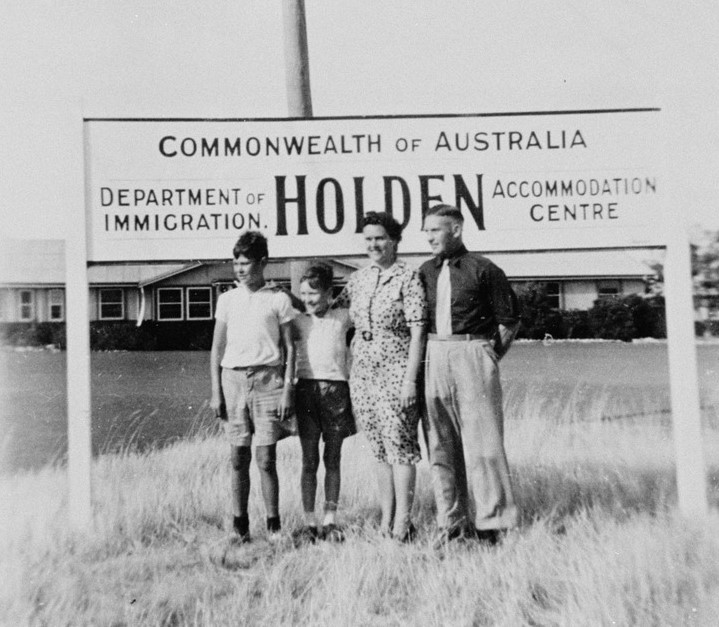
- 1952A surviving photograph records a Dutch family outside the centre.
- 1953The van Lamoen family stay at Holden after arriving at Fremantle, before moving to Scarborough.
- 1957The initial period of migrant accommodation ends, according to the heritage association.
- 1962–1968The centre reopens for further migrant accommodation and closes; the Heritage Council instead dates the final closure to 1963.
- 2012The municipal inventory records the former camp site as Northam TAFE.
Sources for this section
The hospital before the migrants
The buildings were put up in 1941 as the 118th military hospital, on Lot 1 Hutt Street. The wartime camp complex at Northam was extensive, and the hospital stood apart from the training camp itself. The municipal heritage inventory records the site’s original use as an immigration holding centre and its construction date as 1941, and notes that the buildings have been demolished.
Sources for this section
A place for families to wait
The former hospital was adapted for migrant accommodation in 1949. Under the reception system, workers were interviewed at the Northam Reception and Training Centre by the Commonwealth Employment Service and generally began contract work within three or four weeks, after which their wives and children were moved to the longer-term residences at Holden. The Commonwealth’s own 1950 hostels programme classed Holden as a holding centre, alongside Northam, Graylands and Cunderdin in Western Australia. Holden’s purpose therefore differed from the initial processing carried out at Top Camp.
Figures given for the place vary with what is being counted. The Heritage Council’s assessment documentation states that Holden Camp opened on 10 August 1949 and accommodated over 8,000 wives and children until the men could secure housing for their families. A history of migrants in nearby Wyalkatchem places its capacity at approximately 850 people at one time. Neither figure describes the number of Ukrainian residents, and no such count has been found.
Two different Northam centres
| Centre | Original buildings | Initial migrant role |
|---|---|---|
| Northam Army Camp / Top Camp, Great Eastern Highway | Military training camp | Reception, interviews and allocation to work; closed September 1951 |
| Holden, Hutt Street | Former 118th military hospital, built 1941 | Longer-term accommodation for wives and children; reception work from 1951 |
Learning English and growing up
English teaching connected Holden with the other Western Australian centres. The State Library’s records of a migrant-education teacher confirm her work at Holden, Northam and Cunderdin and preserve correspondence dating from 1950–51. Language learning was part of the adjustment from temporary camp residence to employment and life outside it.
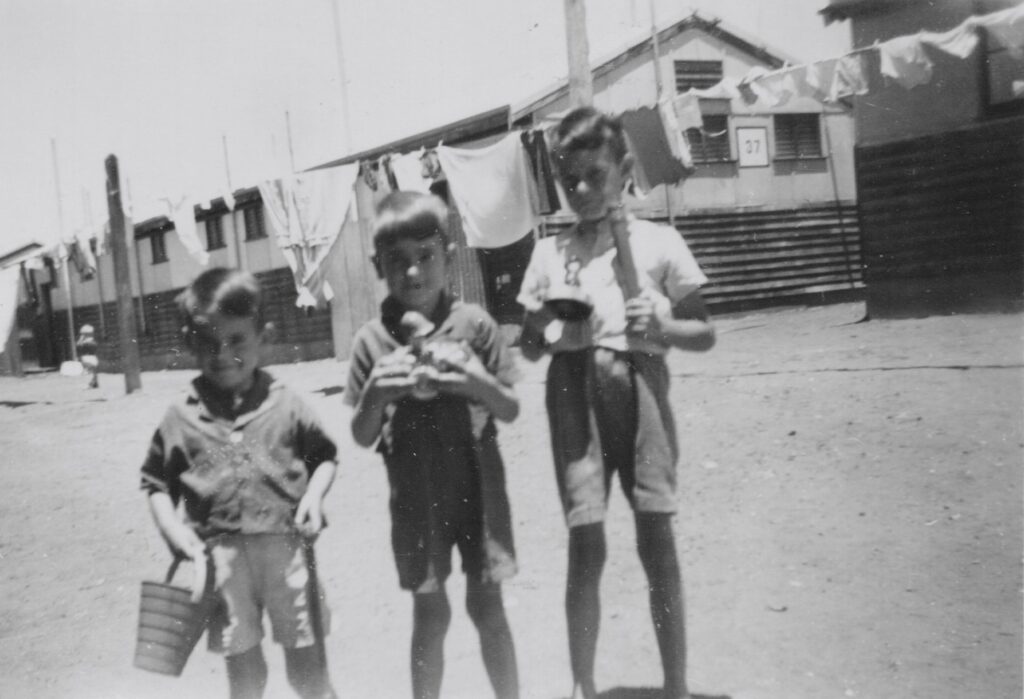
Family photographs give the place a more personal scale. A 1952 image shows a Dutch family outside the centre, while another photograph preserves children together at Holden. These are pictures of particular households within a mixed migrant community, rather than a record of a single national group.
From Holden to the wheatbelt and Perth
For some residents, leaving Holden meant another form of temporary accommodation. A family history in the Wyalkatchem study records a six-month stay followed by a move to the railway camp, where work under the government’s two-year arrangement shaped the next stage of settlement. A camp address could therefore change before a family obtained an independent home.
Other routes led towards Perth or back to Northam itself. The van Lamoen family, who arrived at Fremantle from Rotterdam in 1953, stayed at Holden before moving to Scarborough. Renato Frigieri, who arrived in October 1952, lived at Holden and travelled each day to construction work at the Army Camp, a reminder that the two Northam establishments remained linked in daily life even after Top Camp stopped receiving migrants.
A changing role and a different site today
When Top Camp’s reception operation ended in September 1951, Holden continued as Northam’s reception and accommodation centre; it had been operating in that role since June 1951. Published end dates differ: the heritage association gives 1949 to 1957 and a further period from 1962 to a final closure in 1968, while the Heritage Council’s assessment documentation states that Holden Camp finally closed in 1963. Both accounts agree that its migrant use extended well beyond the first displaced-person arrivals, and no contemporary closure record has been inspected to settle the difference.
The site later became the Northam TAFE campus. The municipal heritage inventory records the demolition of most accommodation huts, the hospital and the administrative buildings, and assesses the surviving significance of the place as little. Holden’s physical traces were largely lost even while its memories survived in photographs and family histories.
Published dates and figures for Holden
| Source | Opening | Ending | Numbers given |
|---|---|---|---|
| Heritage Council of WA assessment documentation, 2000, citing Peters, Bush and Gregory 1997 | 10 August 1949 | Finally closed 1963 | Over 8,000 wives and children accommodated |
| Northam Army Camp Heritage Association | 1949 | 1957, reopened 1962, finally closed 1968 | Not stated |
| Wyalkatchem migrant study, 2012 | 1949 | 1957, and again during 1962–63 | Capacity approximately 850 people |
Sources
- Northam Municipal Heritage Inventory, item 125
Shire of Northam · 2012
Printed p 180 read in full. Place name Holden Immigration Holding Centre (site), HCWA number 18655, Lot 1 Hutt Street, date of construction 1941 (demolished), original use Immigration Holding Centre, current use TAFE campus, level of significance Little, integrity and authenticity None.
- Migrant centres in Western Australia
Northam Army Camp Heritage Association · Undated
Distinguishes the former army camp from the former 118th General Field Hospital and lists Holden Holding Centre, Northam (1949–57 and 1962–68) among Western Australian migrant centres. The association’s other migrant pages describe Northam Camp and do not mention Holden, so they have not been used here.
- Closure of the Camp
Northam Army Camp Heritage Association · Undated
States that Northam Accommodation Centre closed in September 1951, that Holden operated as the reception and accommodation centre from June 1951 to 1957 and finally closed in 1968, and gives the example of Renato Frigieri commuting from Holden Camp to construction work at the Army Camp after arriving in October 1952.
- Polish and other migrants in Wyalkatchem 1950–1970
Joseph Poprzeczny / Polish Museum and Archives in Australia · 2012
Original chapter pp 7, 25, 36; Holden capacity and family moves.
- Encyclopedia of Ukrainian Diaspora, volume 4
Shevchenko Scientific Society · 1995
Resettlement camps entry explicitly includes Holden separately from Northam and Cunderdin.
- Peggy de Jong papers, MN 3395
State Library of Western Australia · 2020
Finding aid confirms English teaching at Holden; underlying papers not reviewed.
- Photographs of Holden Immigration Accommodation Centre
Dutch Australia Cultural Centre / Nonja Peters collection · 2024
Original camp images; the accompanying article has since been revised and is cited separately as source 10.
- Family outside Holden Immigration Accommodation Centre, 061374 PD
State Library of Western Australia · 1952
Collection metadata independently confirms place and date of the Dutch family photograph.
- Register of Heritage Places assessment documentation: Northam Army Camp
Heritage Council of Western Australia · 7 January 2000
Full documentation read. States that wives and children were relocated from the Northam Reception and Training Centre to the longer-term residences at Holden Holding Centre; that Holden Camp opened on 10 August 1949 and finally closed in 1963; and that it accommodated over 8,000 wives and children. Cites N. Peters, F. Bush and J. Gregory, Holden Army Camp, Centre for WA History, Nedlands, 1997, pp 19 and 23; that monograph has not been read here.
- Northam’s post-war migrant reception centres
Dutch Australia Cultural Centre · 13 September 2024
Article read in full. Sets out the distinction between the Reception and Training Centre on the Great Eastern Highway and the Holden Accommodation Centre in Hutt Street, and records the van Lamoen family staying at Holden in 1953 before moving to Scarborough.
- Commonwealth Government Hostels
Migration Heritage Project · 12 April 2022
Table 4, the 1950 Commonwealth Hostels Programme drawn from National Archives of Australia MT105/8, 2/71/1146, lists Holden as a Western Australian holding centre alongside Northam, Graylands and Cunderdin.
Last researched 13 September 2026