Fremantle and Port Melbourne: the Australian arrival ports
Fremantle and Melbourne, Australia·Displaced-person arrivals: 1947-1954; assisted migration to 1969
Fremantle and the passenger piers at Port Melbourne were where International Refugee Organisation transports landed their passengers in Australia, and where disembarkation, customs, the immigration formalities and the trains inland were organised. Ukrainians passed through both ports from 1948, going on to Bonegilla and to the Western Australian camps under two-year labour contracts signed before they sailed.
Introduction
Almost every displaced person resettled in Australia by the International Refugee Organisation first stood on Australian ground at one of two places: the wharves of Fremantle in Western Australia, or the passenger piers at Port Melbourne. Fremantle was the first port of call for ships coming from Europe by way of the Indian Ocean; Port Melbourne was where most of them ended their voyage. The two ports handled disembarkation, customs, the immigration formalities and the trains that carried new arrivals inland, above all to the Bonegilla Migrant Reception and Training Centre.125
The two ports worked differently. At Fremantle most displaced persons were in transit, either re-embarking for the eastern states or waiting in metropolitan camps. At Port Melbourne the pier itself was built for the transfer: trains ran onto the pier deck, and passengers crossed from the ship's side to a carriage.1311
A history in dates
- November 1906The Immigration and Information Bureau is completed on Victoria Quay, Fremantle.1
- 1912-1915Princes Pier is built at Port Melbourne with railway sidings and passenger gangway tracks.4
- 1923-1930
- 28 November 1947The USAT General Stuart Heintzelman reaches Fremantle with 839 refugees from Estonia, Latvia and Lithuania, the first government-funded non-British transport.5
- 29 November 1947Baggage from the Heintzelman is taken to Perth for customs examination; passengers later claim it at the Graylands camp.7
- 2 December 1947
- 7 December 1947
- 1947-1949Immigration authorities turn ships around at Fremantle during the peak displaced-persons years to make the most of scarce shipping.1
- 11 October 1948Sixty Ukrainian men arrive at Fremantle on the Kanimbla, the first Ukrainian arrivals recorded by the Ukrainian Association of Western Australia.13
- 1948-1952Nineteen thousand displaced persons arrive in Western Australia, with Fremantle as their port of entry.17
- 31 May 1949A Ukrainian family of six lands at Port Melbourne from the Skaugum and is taken on to Bonegilla.15
- 10 January 1954The Fair Star reaches Melbourne with a group of Ukrainians from Trieste, who are met on the wharf and taken by train to Bonegilla.18
- 1960Passenger arrivals at Station Pier peak at 110,802 for the year, all nationalities counted.2
- 1962A new passenger terminal at Fremantle supersedes the Victoria Quay immigration buildings and customs sheds.1
- 12 December 1964The Department of Immigration officer vacates the Victoria Quay building.1
- 1969The last migrant ships arrive at Princes Pier.4
Origins and purpose
Fremantle's inner harbour had been the state's principal passenger port since 1896, and an Immigration and Information Bureau was completed on Victoria Quay in November 1906. Apart from the Depression and the Second World War, that building, the customs sheds and the adjoining waiting rooms were the focus of immigration work in the harbour until 1962. Officials returned to it in 1948 as shipping increased.1
At Port Melbourne, Princes Pier was built between 1912 and 1915 with a gatehouse, terminal building, railway sidings and passenger gangway tracks. Station Pier was rebuilt on the site of the 1854 Railway Pier between 1923 and 1930, with inner and outer passenger terminals, a baggage room and an office building later listed as the Boat-Train Shelter. Both piers were connected to the Victorian Railways.234
The mass migration scheme devised under Arthur Calwell, the first federal Minister for Immigration, gave these structures a new task. In the peak displaced-persons years of 1947 to 1949 immigration authorities made the most of scarce shipping by turning ships around at Fremantle, so that people bound for the eastern states were landed in Western Australia and moved on by other means.1
The heritage assessment of the Port of Fremantle Passenger Terminal sets the scheme in a longer history. It records that from European settlement in 1829 until the mid 1970s Fremantle was the main point of entry for migrants and visitors entering Western Australia, that Victoria Quay became the centre for migrant and visitor facilities, and that the terminal has national significance as the point of entry for tens of thousands of migrants arriving under the federal government's post-war immigration policies. The same assessment records 19,000 displaced persons arriving in Western Australia between 1948 and 1952.17
Published figures for the arrival ports and the scheme
| Measure | Figure | Source scope |
|---|---|---|
| Chartered ships carrying European refugees to Australia | 149 voyages | Tundern-Smith: most of the 180,000 and more European refugees, 1947-1954, all ports |
| Displaced persons admitted through the IRO | 182,000 | eMelbourne: Australia as a whole, 1947-1951 |
| Refugees arriving through other organisations by 1955 | 75,000 | eMelbourne: Australia as a whole, additional to the IRO figure |
| Share of the 250,000 who came to Victoria | about one quarter | eMelbourne: Victoria, whole postwar refugee intake to 1955 |
| Passengers arriving at Station Pier | average 61,000 a year | Ports Victoria: 1949-1966, all nationalities and all schemes |
| Peak year at Station Pier | 110,802 | Ports Victoria: calendar year 1960, all nationalities |
| Immigrants processed at the Victoria Quay buildings | more than 435,000 | Peters: peak years of the Fremantle buildings, people who settled in Western Australia |
| Ships in the postwar migration programme | 169 ships, nearly 2,000,000 immigrants | Peters citing Gray 1992: 1947-1970, all ports and all nationalities |
How it worked in practice
Selection and contracts were settled in Europe before anyone sailed. Every person over sixteen, displaced person or assisted migrant, signed an undertaking to work for two years in any job anywhere in Australia, with qualifications and experience left out of account.1012
As a ship came in, immigration and other officials boarded her at anchor in Gage Roads off Fremantle to check passports and documents; only then did she berth at Victoria Quay. State officers handled passengers remaining in Western Australia and Commonwealth officers those bound for the eastern states. Representatives of both governments welcomed the passengers over the ship's speakers and explained the disembarkation arrangements, which several arrivals remembered as their first encounter with spoken English. Displaced persons were met at the wharf by the Commonwealth Migration Officer, responsible for the formalities and for onward movement.1
Customs came next, and it was rarely gentle. Officers took fruit, flowers and stuffed toys out of hand luggage; one woman remembered her cactus, a parting present from her mother, being thrown away. Hold baggage could be moved off the wharf: after the first transport reached Fremantle the luggage went up to Perth for examination on 29 November 1947, and migrants then identified their own cases at the Graylands camp, where about two hundred packages carried no legible marks. Several people never saw their belongings again.17
Medical screening was chiefly a matter of the selection examination in Europe and of the ship's hospital during the voyage, but health inspection remained part of the port routine, and a health inspector worked out of the Victoria Quay building after 1948. Arrivals could still be refused entry at the quayside: on the first transport two people were not allowed to land, one on security grounds and one who had become mentally ill during the passage.16
Transport inland was by train. At Fremantle voluntary organisations worked alongside the officials: the Good Neighbour Council, the Red Cross, the YWCA and the Travellers Aid Society met the ships, and arrivals remembered Red Cross women in powder blue and powder pink handing up an orange and a drink, and tea brewed beside the railway tracks, before the train pulled out. Displaced persons went to Northam, ninety-eight kilometres from Perth, or on to Cunderdin; British migrants were bussed to Point Walter. At Port Melbourne a train came out onto the pier so that new arrivals crossed the deck from the gangway straight into a carriage. These trains, known as red rattlers, set down their passengers at the Bonegilla siding, where staff prided themselves on serving a hot meal within an hour of arrival.11011
Reception was split between port and camp: the port did the legal work of admission, the centre did registration, English classes and labour allocation. The Bonegilla Migrant Reception and Training Centre took the largest share of the traffic from Port Melbourne, while Graylands Migrant Centre, Northam Army Camp and Cunderdin Migrant Centre took Fremantle arrivals who stayed in Western Australia.11013
The first transport: reported passenger numbers
| Figure | Source | Point of reference |
|---|---|---|
| 839 refugees | Tundern-Smith, First Transport to Australia | Arrival at Fremantle, 28 November 1947 |
| 837 Latvians, Lithuanians and Estonians | eMelbourne | Arrival at Princes Pier, Melbourne, 7 December 1947 |
| 849 emigrants, two not permitted to land | Salyte-Kruziene, passenger account, 1997 | Recollection of the voyage as a whole |
The Ukrainian experience
Ukrainians were part of this movement from 1948. The Internet Encyclopedia of Ukraine records about 21,500 Ukrainians emigrating to Australia in 1948 to 1951, a national figure covering four years rather than any one port or year. They arrived within a larger flow: 182,000 displaced persons reached Australia through the International Refugee Organisation between 1947 and 1951, about a quarter going to Victoria.81214
In Western Australia the community dates its beginning to a single arrival. The Ukrainian Association of Western Australia records that the first Ukrainian emigrants reached Fremantle on the Kanimbla on 11 October 1948, a group of sixty men from Germany. Twenty went to the Kalgoorlie goldfields, others to the railways and to Mundaring Weir, which became the largest concentration of Ukrainians in the state. Later arrivals went to the hostels and camps at Graylands, Northam and Cunderdin.13
On the Melbourne side the record is family by family. A Ukrainian family of six, from Monaczyn and Ternopil by way of eight years in Germany, landed at Port Melbourne from the Skaugum on 31 May 1949 after nearly three months of travel, with a seventeen-month-old child in poor health, and went on to Bonegilla and later to Benalla Migrant Camp.15
The contract signed in Europe took effect from the moment of landing. Men were commonly sent to work within weeks while wives and children moved to holding centres, so for many Ukrainian families the port was where the household was split up.1215
Individual accounts show how differently a Ukrainian arrival could run. A study of the Ukrainians who settled in Geelong records factory owners meeting boats of displaced persons at the Port of Melbourne and nominating new arrivals for work in a Carlton clothing factory; one family that landed at Port Melbourne in 1950 was taken first to Bonegilla and then, because the father's contract was on a farm near Wagga Wagga, to the Uranquinty migrant camp in New South Wales. For one woman who came through Fremantle, all she could see on arrival were stones. Later arrivals still came by sea: a group of Ukrainians from Trieste reached Melbourne on the Fair Star on 10 January 1954, were met on the wharf by Ukrainians already settled there and were taken by train to Bonegilla in the heat of the Australian summer. In a 1964 interview Arthur Calwell recalled that he had personally welcomed Ukrainians, like many other immigrants, at the pier in Melbourne whatever the hour of the ship's arrival.18
The same study's passenger appendix records Geelong-bound Ukrainian families disembarking at both ports between 1949 and 1965, at Fremantle from the Mozaffari, the Skaugum and, as late as 1965, the Guglielmo Marconi, and at Port Melbourne from the Nelly, most going on to Bonegilla. One entry records a family transferred from the Liguria to the Nelly at Fremantle before continuing to Melbourne, the Fremantle turnaround applied to a Ukrainian voyage.18
Ukrainian arrivals
| Measure | Figure | Source scope |
|---|---|---|
| Ukrainians emigrating to Australia | about 21,500 | Internet Encyclopedia of Ukraine: 1948-1951, Australia as a whole, not by port |
| First Ukrainian arrivals at Fremantle | 60 men, 11 October 1948, ex Kanimbla | Ukrainian Association of Western Australia: one voyage |
| Ukrainians entering and leaving Australia, 1952-1961 | 346 entered, 498 left | Internet Encyclopedia of Ukraine: net movement after the mass programme |
What happened afterwards
Displaced-persons traffic gave way to assisted migration, but the ports stayed busy for another twenty years. Between 1949 and 1966 an average of 61,000 passengers a year arrived at Station Pier, all nationalities counted, peaking at 110,802 in 1960. Princes Pier received migrants until 1969.24
At Fremantle a new passenger terminal superseded the old arrangements in 1962, and the Department of Immigration officer left the Victoria Quay building on 12 December 1964. Across the peak years the buildings had handled more than 435,000 immigrants of all nationalities who settled in Western Australia.1
Air travel replaced sea passage for migrants in the early 1970s. Station Pier remains on the Victorian Heritage Register, its passenger terminals, baggage room and boat-train shelter still standing as the fabric of the arrival process.23
The paperwork of the arrivals survives in public custody. The State Library Victoria records that most European ships stopped at Fremantle before continuing to other ports and that Fremantle passenger lists for 1897 to 1963 are searchable; inwards passenger lists for the port of Melbourne for 1924 to 1964 are held on microfilm at the National Archives of Australia, which also holds the migrant selection documents completed by or for post-war assisted migrants, including those for the resettlement of refugees and displaced persons.19
Sources
- The immigration buildings Victoria Quay 1906-1966
Nonja Peters, Fremantle Studies 3, pp. 40-52 (Fremantle History Society), republished on Freotopia · 2004
Full text read. Describes officials boarding ships in Gage Roads to check passports, berthing at Victoria Quay, the division of work between state and Commonwealth officers, welcome announcements over the ship's speakers, customs procedures, Red Cross oranges and tea beside the railway tracks, and trains to Northam and Cunderdin. Gives 169 ships and nearly 2,000,000 immigrants 1947-1970 (citing Gray 1992), the turning round of ships at Fremantle during the peak displaced-persons years 1947-1949, and more than 435,000 immigrants processed at the buildings.
- Station Pier history
Ports Victoria · Accessed 13 September 2026
Read in full. Gives the 1854 Railway Pier opening, the 1923-1930 rebuilding as Station Pier at a cost of 624,375 pounds, and passenger figures: an average of 61,000 arrivals a year between 1949 and 1966, peaking at 110,802 in 1960, with up to four migrant vessels berthed at once.
- Station Pier, Victorian Heritage Register H0985
Heritage Victoria / Victorian Heritage Database · Statement of significance last updated 7 April 2021; report generated 13 September 2026
Registration report read. Statement of significance names the pier as the place of arrival for European refugees and immigrants under the assisted migration programme. The listed fabric includes the Inner and Outer Passenger Terminal buildings of 1927-28, the Baggage Room and elevated platform, and the East Railway Office described as the Boat-Train Shelter.
- Princes Pier, Victorian Heritage Register
Heritage Victoria / Victorian Heritage Database · Statement of significance last updated 29 November 1996; report generated 13 September 2026
Registration report read. Built 1912-1915, with gatehouse, terminal building, railway sidings and passenger gangway tracks; identified as a major arrival point for migrants from 1915 until 1969.
- Why the First Transport?
Ann Tundern-Smith, First Transport to Australia · 26 October 2020, updated 29 June 2026
Read in full. States that 839 refugees from Estonia, Latvia and Lithuania reached Fremantle on the USAT General Stuart Heintzelman on 28 November 1947, that the voyage was organised by the Preparatory Commission of the IRO on behalf of the Australian government, and that 149 chartered ships brought most of the 180,000 and more European refugees who came to Australia between 1947 and 1954.
- Beginning Life in Australia
Viltis Salyte-Kruziene, speech of 6 July 1997 printed in Musu Pastoge 4 August 1997, translated by Daina Pocius, First Transport to Australia · 22 August 2025
Passenger account read in full: the approach to Fremantle on the morning of 28 November 1947, customs officers checking luggage before passengers went ashore, buses to the Graylands and Swanbourne camps, Calwell's leaflet handed out before lunch, English assessments recorded at Graylands before departure, four days ashore, the week-long passage to Melbourne on the Kanimbla, and the train from Port Melbourne to Bonegilla on the day of arrival. The account gives 849 emigrants and two people not permitted to land.
- Lost luggage
Ann Tundern-Smith, First Transport to Australia · 30 June 2025
Read in full. Documents luggage transferred from Fremantle to Perth for customs examination on 29 November 1947, migrants identifying their own baggage at the Graylands camp, some 200 packages carrying no marks or numbers, the Kanimbla's departure on 2 December 1947, and correspondence between the Acting Commonwealth Migration Officer for Western Australia and his counterpart at Bonegilla.
- Displaced Persons
Moya McFadzean, eMelbourne: The Encyclopedia of Melbourne Online, University of Melbourne · July 2008
Read in full. States that Australia received 182,000 displaced persons through the International Refugee Organisation between 1947 and 1951 and a further 75,000 refugees by 1955, that about a quarter of the more than 250,000 came to Victoria, and that the first selected group of 837 Latvians, Lithuanians and Estonians arrived at Princes Pier in Melbourne on 7 December 1947.
- A History of the Department of Immigration: Managing Migration to Australia
Department of Immigration and Border Protection, Commonwealth of Australia · Revised edition, June 2017
Read the postwar chapters. Records the resettlement of 170,000 people from displaced-persons camps in Europe and captions the National Archives photograph A12111, 1/1947/3/6 as HMAS Kanimbla arriving in Melbourne with the first group of displaced persons in December 1947, from where they joined the train to Bonegilla.
- Bonegilla Migrant Experience Site Guide
Bonegilla Migrant Experience / Wodonga Council · July 2026
Read. Describes hundreds of people arriving each week from the Melbourne docks, trains known as red rattlers unloading passengers at the Bonegilla siding, luggage collection and the short trip to the centre, where staff aimed to serve a hot meal within an hour of arrival, and the two-year work contract signed by everyone over sixteen.
- Migrants on train to Bonegilla Immigration Reception Centre, ANMS0215[073]
Australian National Maritime Museum collection, gift from Barbara Alysen · Photograph dated 10 July 1955; record accessed 13 September 2026
Catalogue record read. The description and the typed text on the reverse record a train pulled in on Station Pier and new arrivals crossing the pier from ship to train. No image is published with the record.
- Australia
Internet Encyclopedia of Ukraine, Canadian Institute of Ukrainian Studies · Accessed 13 September 2026
Read in full. States that Australia admitted war refugees and displaced persons under an agreement with the International Refugee Organisation, that about 21,500 Ukrainians emigrated to Australia in 1948-51, that immigrants were obliged to work for two years at assigned locations after a short stay in transfer camps, and that permanent residency followed after two years and citizenship eligibility after five.
- History of the Association
Ukrainian Association of Western Australia · Accessed 13 September 2026
Read. Records the first Ukrainian arrivals at Fremantle on the Kanimbla on 11 October 1948, a group of sixty men from Germany, twenty of whom went to the Kalgoorlie goldfields while others went to the railways and to Mundaring Weir, and later arrivals settled at Graylands, Northam and Cunderdin.
- Overview of the Ukrainian Community in Australia
Andrew Mandyczewsky, Australian Federation of Ukrainian Organisations · Accessed 13 September 2026
Read. Traces the Australian Ukrainian community to the postwar displaced persons who began arriving in 1948, and lists Perth, Melbourne, Geelong and Albury-Wodonga among the resulting centres.
- Wasyli and Anna Chlebnikowski
Benalla Migrant Camp Inc., Migrant Families archive · Accessed 13 September 2026
Family account read. A Ukrainian family of six landed at Port Melbourne from the Skaugum on 31 May 1949 after almost three months of travel, with a seventeen-month-old child arriving in poor health, and were taken on to Bonegilla.
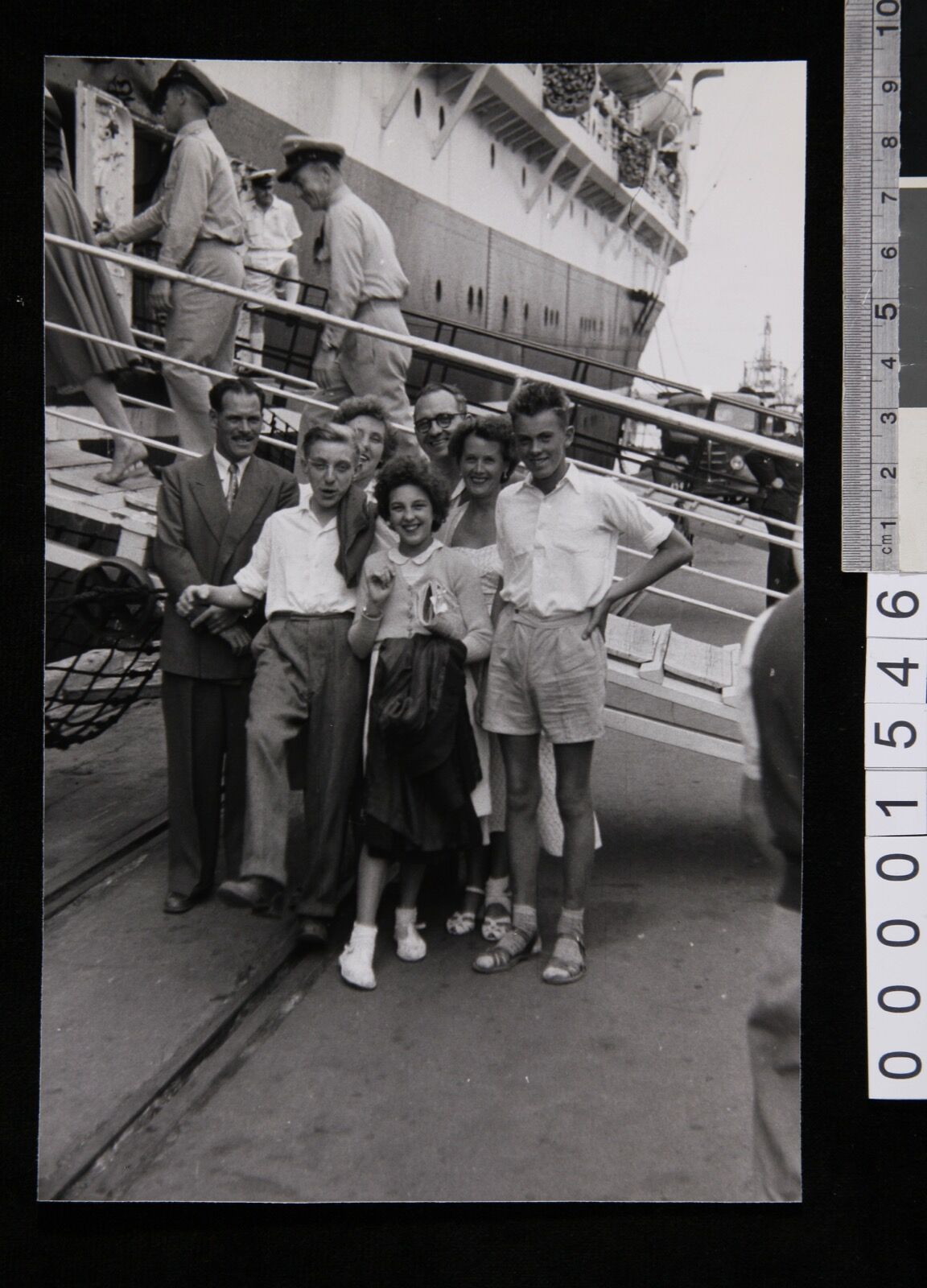
- Group beside the passenger ramp of New Australia at Fremantle wharf, Western Australia
Australian National Maritime Museum on The Commons, from the collection of Vaughan Evans · 1955
Photograph of passengers of the migrant ship New Australia on the wharf at Fremantle in 1955, on the voyage from Southampton to Sydney. Published by the Australian National Maritime Museum through Flickr Commons with the rights statement no known copyright restrictions.
- Register of Heritage Places, assessment documentation: Port of Fremantle Passenger Terminal
Heritage Council of Western Australia (inHerit); documentary evidence compiled by Kristy Bizzaca · 7 April 2000
Pages 2, 5 and 6 read: Fremantle as the main point of entry for migrants entering Western Australia from 1829 until the mid 1970s, Victoria Quay as the centre for migrant and visitor facilities, the terminal's national significance under the post-war immigration policies, and the figure of 19,000 displaced persons arriving in Western Australia between 1948 and 1952. The document's dating of the first displaced persons to 13 February 1948 on the General Stewart was not used; it conflicts with the November 1947 landing recorded at source 5.
- Two Twigs: The Unique Ukrainian Australian Emigrants in Geelong, Victoria, 1948-1960s
Natalie Senjov-Makohon, Sydney; digital copy on Diasporiana · 2017
Printed pages 55 to 56, 83, 85 to 86, 103 and 107 and the passenger appendix at pages 190 to 195 read: factory owners meeting boats at the Port of Melbourne and nominating arrivals for work, a 1950 arrival taken from Port Melbourne to Bonegilla and then to Uranquinty, a woman's first impression of Fremantle, the Fair Star's arrival at Melbourne on 10 January 1954 with a Ukrainian group from Trieste, Arthur Calwell's recollection in a 1964 interview, and the ports and ships recorded for Geelong-bound Ukrainian families. The page carries an all-rights-reserved statement; only short attributed detail has been used and no arrival is named.
- Immigration records, 1924 onwards
State Library Victoria research guide · Last updated 21 April 2026
Sections 'Passenger lists' and 'Migrant selection documents' read: most European ships calling at Fremantle before continuing to other ports, searchable Fremantle passenger lists for 1897 to 1963, inwards passenger lists for the port of Melbourne for 1924 to 1964 on microfilm at the National Archives of Australia, and the migrant selection documents for the post-war assisted passage schemes held there.
Last researched 13 September 2026