Kildary Hostel
Arrival and settlement
Kildary, Ross-shire, Scotland · Two-hut prisoner-of-war camp from 1946; YMCA hostel in the Ukrainian directory
A small camp in Logie Easter parish connected workers with farms between Portmahomack and Invergordon. Its later YMCA hostel appears in the Ukrainian accommodation directory, while surviving buildings and a former prisoner’s memories preserve the site’s earlier history.
Introduction
Kildary appears in Peter Kormylo’s directory as a YMCA hostel used by Ukrainians. The locality also preserves the remains of a prisoner-of-war camp south of Marybank Wood. Highland Council recorded its buildings, and former German prisoner Paul Lippok recalled the small camp from which he began working on local farms.
A history in dates
- March 1946Paul Lippok was transported to Liverpool from captivity in the United States and sent north through Comrie and Brahan.
- 1946Twenty-five men went on to the two-hutted camp at Kildary between Balnagown and Scotsburn.
- 1946 to 1947Lippok worked at Viewfield above Tain and registered at Kildary each Saturday after moving onto the farm.
- 1947The men learned they could return to Germany or remain in Britain; most of the Kildary party stayed in Scotland.
- PostwarKildary is listed as a YMCA hostel used by Ukrainians.
- Later site surveyHighland Council records four surviving camp buildings and their reused interiors.
Paul Lippok’s arrival
Lippok’s journey to Scotland passed through captivity in the United States. He was transported to Liverpool in March 1946 because the state of Germany made return impossible, and two trainloads of prisoners were sent north. He woke in Perthshire, at Comrie, and was then sent to Dingwall, to a large camp beside Brahan Castle where a field had been set aside for timber huts that had housed Canadian soldiers and then Italian prisoners. From there twenty-five men went on to Kildary.
He remembered a small two-hutted camp between Balnagown and Scotsburn: one hut for the prisoners, the other holding the kitchen, the dining room and the guard. Small stoves heated the huts. There was no barbed wire and only two guards, and he thought the countryside beautiful. These details describe his German prisoner-of-war group at that time, rather than the later Ukrainian hostel population.
The camp as Paul Lippok remembered it
| Feature | Recalled detail |
|---|---|
| Party size | Twenty-five men sent on from the Brahan Castle camp |
| Huts | Two: one for prisoners, one for kitchen, dining room and guard |
| Heating | A small stove in each hut |
| Security | No barbed wire; two guards |
| Work area | Farms from Portmahomack to Invergordon, men dropped in ones or twos |
| Registration | Saturdays at Kildary for men billeted on farms |
Sources for this section
Farms, transport and accommodation
Two lorries collected the prisoners each morning and distributed them among farms between Portmahomack and Invergordon, dropped off in ones or twos depending on the size of the farm; Balmuchy and Bindal took three or four men each. Lippok worked at Viewfield above Tain. When farmers had room, prisoners could live at the workplace instead of travelling daily. Lippok moved into Viewfield, where a brother and sister farmed alone, but still cycled to Kildary each Saturday to register.
His account remembers enough food, trips into Tain despite restrictions, and dances they were not supposed to attend. In 1947 word came that the men were to be demobilised and could return to Germany or stay. Lippok stayed, worked at Viewfield for eighteen years and played for years in the Mansefield and later the Tain Dance Band alongside other former prisoners. He recalled that most of the men from the camp at Kildary decided to remain in Scotland, which is one reason the place mattered locally long after the huts emptied.
Sources for this section
The YMCA hostel and Ukrainian residents
The Ukrainian accommodation directory names YMCA Hostel, Kildary, Ross-shire. This provides the explicit Ukrainian connection to the hostel network. The designation is consistent with national practice: the Ukrainians in the United Kingdom encyclopaedia lists the YMCA among the bodies that administered European Voluntary Workers hostels, alongside the National Service Hostels Corporation, the Ministry of Agriculture, the National Coal Board, local authorities and private firms, after the camps passed from War Office control from 1947 and were redesignated as hostels.
Beyond that entry the hostel is undocumented. Neither the Highland Council record nor the National Archives catalogue gives Kildary a camp number, an operator, an opening or closing date, a capacity or a single resident’s name, and the Scottish Catholic Directory for 1953 does not mention Kildary anywhere. Lippok’s personal history belongs to the German prisoner-of-war phase; his decision to stay and his employment cannot be treated as a collective account of the Ukrainians who also used accommodation at Kildary.
Four surviving buildings
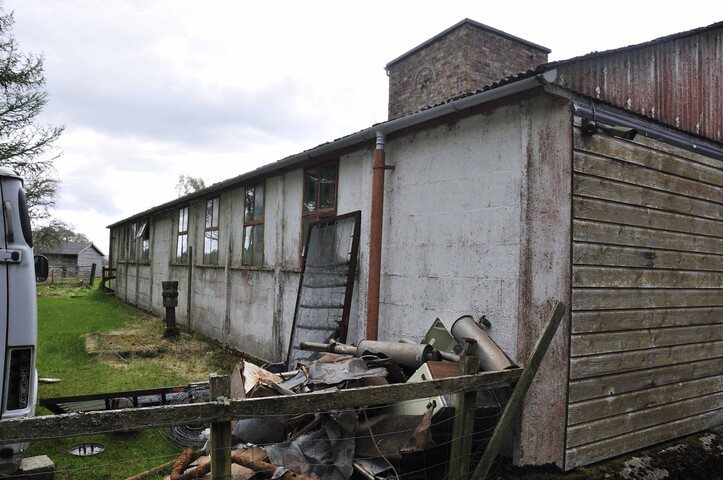
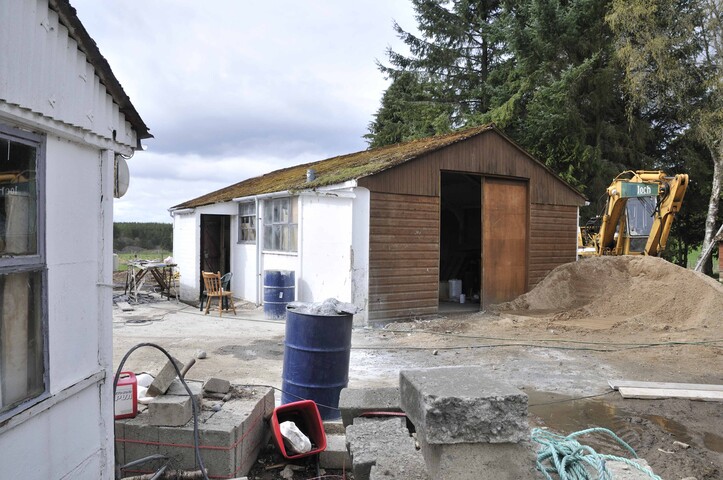
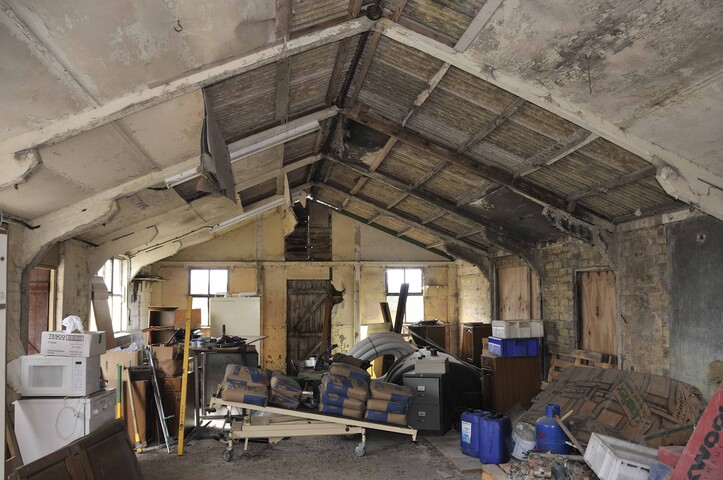
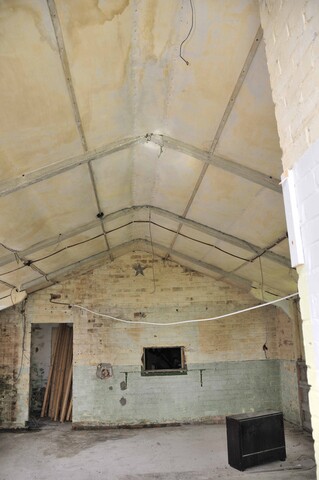
Highland Council’s archaeological record places the remains south of Marybank Wood, centred NH 7508 7631 in Logie Easter parish, and describes four substantially intact camp buildings threatened by a demolition proposal. Two parallel barracks ran north to south and were five bays long, built from brick and prefabricated concrete under corrugated asbestos roofs. A smaller building stood beside them. Some original windows, internal lining, paintwork and ducting survived.
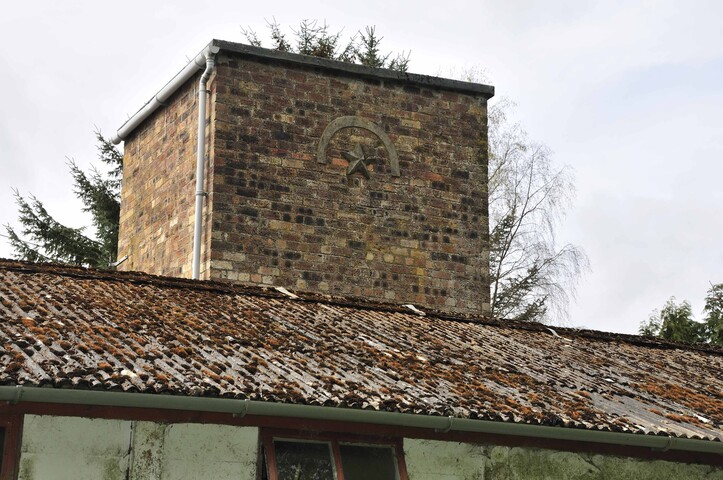
A fourth building formed a T shape around a brick water tower. The survey interpreted it as a possible mess, kitchen and washhouse. A star motif survived inside, with another star and a crescent on the tower’s exterior. The motifs are recorded features; the survey does not establish their makers or a Ukrainian meaning. The four recorded buildings are also more than the two huts Lippok remembered on arrival, so the camp either grew or the record covers a wider spread of structures than his party used.
Buildings recorded by Highland Council
| Structure | Recorded features |
|---|---|
| Two parallel barracks | Five bays; brick and prefabricated concrete; corrugated asbestos roofs |
| Smaller adjacent building | Similar construction |
| T-shaped building | Brick water tower; possible mess, kitchen and washing facilities |
| Later uses | Stores, sheds and stables |
| Location | Centred NH 7508 7631, 80m by 86m, Logie Easter parish |
Sources for this section
Reuse and recording
The buildings were later used as stores, sheds and, in one case, stables. Council photographs preserve exterior elevations, interior spaces and details of the water tower. This architectural record describes what survived at the time of the survey, rather than reproducing the arrangement Lippok remembered.
Together, the photographs, memoir and hostel directory show distinct layers of Kildary’s history: wartime imprisonment and farm labour, postwar accommodation used by Ukrainians, and the reuse of former camp buildings in the surrounding landscape. What is missing is the middle layer. Nothing yet found describes the hostel years themselves.
Sources
- In which ways is the Ukrainian community in Scotland a diaspora?
Peter David Kormylo, University of Glasgow · 2021
Appendix xii, printed 323, entry 39: YMCA Hostel, Kildary, Ross-shire. Original directory previously visually checked; no exact hostel lifespan supplied.
- MHG 54231: Prisoner of War Camp, Kildary
Highland Council Historic Environment Record · Undated site-recording photographs
Full description re-read 13 September 2026. Centred NH 7508 7631, 80m by 86m, Logie Easter parish, Ross and Cromarty. Public council image gallery SHG 23993 inspected in an earlier pass; six images downloaded with original captions and URLs. Architecture and motifs described without national attribution; mess and kitchen function is interpretation. The record gives no camp number and no hostel designation.
- Paul Lippok: We Will Remember Them
Inver Primary School; Scottish Library and Information Council, War Detectives · Created 25 April 2005; updated 12 August 2005
Whole archived page read on 13 September 2026, including passages not used in the earlier pass: the route through Comrie and the Brahan Castle camp, the named farms Balmuchy and Bindal, the Saturday registration, and the statement that most of the Kildary party stayed in Scotland. German prisoner-of-war testimony; no arrival date at Kildary is given and nothing is transferred to Ukrainian residents.
- Roman Krawec, Post-war camps and hostels
Ukrainians in the United Kingdom online encyclopaedia · Published 10 February 2013
Read in full. Names the YMCA among the organisations that administered European Voluntary Workers hostels, and describes the 1947 transfer of camp administration from the War Office to civilian bodies. General framework; Kildary is not named in the article.
- Discovery catalogue searches for Kildary
The National Archives · Searched 13 September 2026
Searches for Kildary camp, Kildary hostel and YMCA hostel Kildary returned no camp or hostel record; the only Kildary results are personal service records that mention it as a place of birth. Discovery indexes catalogue descriptions, not the contents of files.
- Scottish Catholic Directory 1953
Scottish Catholic Archives, digital copy · 1953
Volume downloaded in full and searched on 13 September 2026: no occurrence of Kildary. The Diocese of Aberdeen entry for Dingwall lists Ross Memorial Hospital, Invergordon I.D. Hospital and the Torr-Achilty works camp of the hydro-electric scheme, and no camp or hostel at Kildary.
Last researched 13 September 2026