Monymusk Hostel
Arrival and settlement
Monymusk, Aberdeenshire, Scotland · Prison camp 1943–1947; hostel from the late 1940s; site cleared in the early 1980s
Camp 111 at Monymusk opened in 1943 for Italian prisoners, became a German working camp, and then housed Polish and other European refugees, among them Ukrainians. Its record survives in War Office camp lists, a prisoners’ magazine, two museum photographs and the memory of a chapel painted inside a hut.
Introduction
Monymusk’s postwar hostel occupied a former military camp also known as Deer Park. Ukrainians were among the people who lived here, and the hostel appears in Peter Kormylo’s directory of accommodation used by ethnic Ukrainians in Scotland. The site’s history includes both wartime imprisonment and the later creation of a place of worship by Catholic refugees.
Historic Environment Scotland records the camp as Monymusk, Deer Park, Camp 111, German Working Camp, at NJ 6845 1555 in Monymusk parish. Kormylo lists an E.V.W. Hostel at Monymusk among four Aberdeenshire entries, alongside Stuartfield, Huntly and Pitmedden, but gives no dates, numbers or administration.
A history in dates
- 1943The camp opens on the Deer Park at Monymusk.
- 28 May 1943A Red Cross inspection records Italian prisoners and a capacity of 750.
- May and November 1944War Office lists class the camp as an Italian labour battalion and then an Italian working camp.
- 15 September 1945Hostels at Alford and Insch are listed as attached to the camp.
- 24 August 1946The prisoners publish the first number of their magazine, Deer Park Ring.
- February 1947Issues 11 and 12 of Deer Park Ring, now held by the Imperial War Museums, are printed.
- 1947The camp list records 111 (G.W.C.) under Major T. Smith, with the entry later struck through and Harlaw, Inverurie substituted.
- 25 August 1947A German prisoner dies of injuries received in the railway station yard at Monymusk.
- After the warThe camp becomes a refugee hostel; Catholic residents create a chapel decorated by a Ukrainian artist.
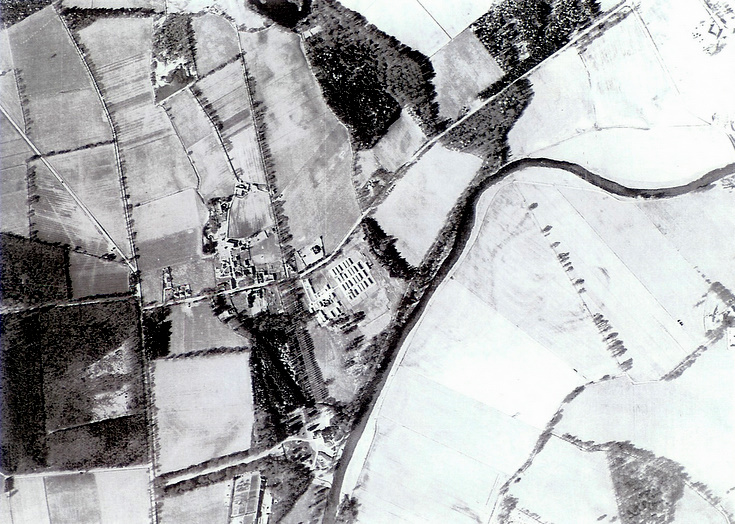
- 1948An aerial photograph records the camp beside the River Don.
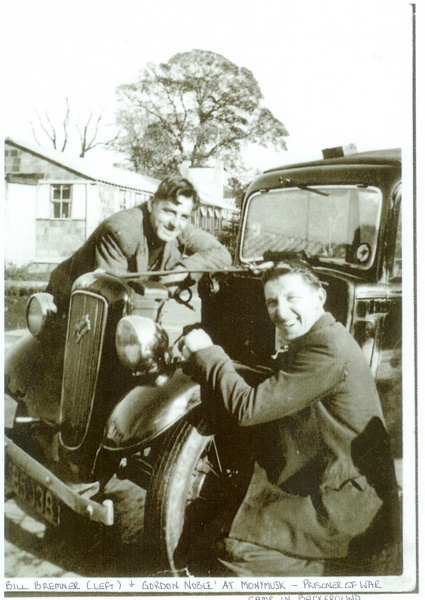
- 1949Bill Bremner and Gordon Noble are photographed with a camp building behind them.
- 15 October 1953RAF vertical air photography records the site of the camp.
- Early 1980sThe camp is demolished.
- 1 December 1999A revision of the national record finds no trace of the camp on the ground.
Sources for this section
- Camp 111, Deer Park Camp, Monymusk, Aberdeenshire (+Harlaw), camp research file
- Deer Park Ring: Lagerblatt Monymusk Camp 111, catalogue record
- Deer Park Ring Camp 111, Monymusk, LBY E.J. 344
- Monymusk, Camp 111 — MAB53499
- History: World War Two, Monymusk Estate
- Aerial view of Monymusk, photograph 1198
- Monymusk POW camp, photograph 100
- Monymusk, Deer Park, Camp 111, German Working Camp, NRHE 107500
The camp beside the River Don
An aerial photograph dated 1948 shows the camp between the River Don and the road towards Pitfichie and Chapel O’ Garioch, its rows of buildings beside cultivated fields with the river curving around the eastern side.
This was Camp 111, a German working camp that had also held Italians. The later refugee hostel occupied the same site; its name should not be confused with Deer Park at Dalkeith, which was Camp 16.
From Italian working camp to German working camp
The camp opened in 1943, and a Red Cross inspection on 28 May 1943 found Italian prisoners and a capacity of 750. War Office lists of 1944 classed it as an Italian labour battalion under Scottish Command and then as an Italian working camp, recording the Italians as non-co-operators. Outlying hostels changed over time: Alford, Ballater and Culter in 1943, and Alford and Insch by September 1945.
By the 1947 camp list the site was 111 (G.W.C.), a German working camp, with the telegraphic address Priswar, Monymusk and Major T. Smith as commandant. On that list the Monymusk entry has been struck through in blue crayon and replaced in handwriting by Harlaw, Inverurie. No trace of a camp at Harlaw has been found, so what the alteration means for Monymusk’s closure is unresolved.
A fatal accident inquiry record at Aberdeen Sheriff Court names Erich Behrendt, a German prisoner at No. 111 camp, who died on 25 August 1947 of injuries received the same day in the railway station yard at Monymusk.
Camp 111 in the official record
| Record | Entry |
|---|---|
| 1945 ICRC camp list | Labour Camp 111, Deer Park Camp, Monymusk, Aberdeen |
| 1947 camp list | 111 (G.W.C.), Deer Park Camp, Monymusk, Aberdeen; telegraphic address Priswar, Monymusk; telephone Monymusk 29; station Monymusk; Major T. Smith; reference v/1452/2 |
| Alteration on the 1947 list | Monymusk entry struck through in blue crayon, Harlaw, Inverurie written in |
| English Heritage survey, 2003 | Camp 111, Deer Park Camp, Monymusk, Aberdeenshire, German Working Camp, Scotland |
| National record (NRHE 107500) | Monymusk, Deer Park, Camp 111, German Working Camp; NJ 6845 1555; site number NJ61NE 37 |
| Ukrainian directory | E.V.W. Hostel, Monymusk, Aberdeenshire |
Hostels listed as attached to Camp 111
| Date of list | Hostels |
|---|---|
| 1943 | Alford, Ballater, Culter |
| 5 May 1944 | Ballater; Culter (given in the list with an incorrect county) |
| 15 September 1945 | Alford, Insch |
Sources for this section
Housing and farm work
The wartime camp had accommodation huts and tents, with separate cooking, washing, medical and storage facilities. Its huts had concrete bases and frames, hollow-brick walls and pitched roofs. Prisoners slept in wooden bunks and warmed the rooms with stoves.
A 1943 plan divides the camp into a prisoners’ section, a guards’ section and a tented area, with workshops for a shoemaker, a tailor and a barber on the prisoners’ side. Huts planned at the back of the compound were never built, and the tents were removed later.
Prisoners travelled by bus to surrounding farms, where they harvested crops, dug ditches and repaired fences. German and Italian prisoners also built the bridge over the River Don by Enzean Farm. These descriptions concern the prison camp: they do not establish the later hostel residents’ employment arrangements.
The historic prison camp
| Feature | Recorded scale |
|---|---|
| Area | 25 acres |
| Capacity | 1,300 men |
| Accommodation | Approximately 23 huts and 68 tents |
| Hut occupancy | 35 men |
Learning, sport and a camp magazine
Sport, workshops, concerts and lectures were organised inside the camp, and Mr Whiteley, the dominie of Monymusk School, gave English lessons on Monday evenings. Prisoners who already worked on local farms had picked up Scots words, and the estate account recalls them correcting his English word for potato with “na, na, tatties”.
On 24 August 1946 the prisoners began a magazine called Deer Park Ring. Its first number described vegetable gardens, a sports field, a ping-pong hall, a small theatre room for film and stage plays, a newly formed choir and a small orchestra, and carried a timetable of classes in English, German, mathematics, commercial studies, shorthand, mechanical engineering and book-keeping.
The Wiener Holocaust Library holds number 1, of 24 August 1946: fourteen pages in German and English, handstitched with a sewing machine and illustrated by Toni Loesen. The Imperial War Museums hold the fortnightly issues 11 and 12 of February 1947. Both were German prisoners’ publications and predate the hostel phase.
A chapel made inside a hut
After the war, the camp became accommodation for Polish and other European refugees. Catholic residents converted a hut into a chapel. An unnamed Ukrainian artist painted saints and a version of Leonardo da Vinci’s Last Supper above the altar. The altar incorporated wood, cardboard and tin; biscuit tins became an elaborate chandelier.
The estate account adds that Mrs Whiteley attended the inauguration and said afterwards that she was “moved to see those weather beaten faces with tears on their cheeks”, and that a dinner of borshch followed. The two accounts differ on who built it: the Aberdeenshire record says Catholic refugees, the estate page Catholic prisoners of war. Only a photograph of the altar is said to survive.
Sources for this section
The hostel years
The Aberdeenshire record states that the camp became a hostel for Polish and other European refugees at the end of the war, and the WW2 POW Camps in the UK file records the site housing displaced persons under the European Voluntary Worker scheme. Kormylo’s directory confirms the Ukrainian connection. No opening or closing date for the hostel, and no count of its Ukrainian residents, has been found in any source read.
Two surviving views
The 1948 aerial photograph records the whole setting. A second museum-contributed photograph, dated 1949, shows Bill Bremner and Gordon Noble beside a vehicle, with a camp building behind them. Their names belong to the photograph’s caption; it does not identify either man as a Ukrainian resident.
Sources for this section
The later site
Vertical air photography flown on 15 October 1953 recorded the camp, and the 1980 Ordnance Survey map marked a disused camp site, but a revision of the record on 1 December 1999 could identify no trace on the ground. The huts were sold off gradually and the camp was demolished in the early 1980s, the estate account linking the clearance to the sale of the land for the St Ninian’s housing estate.
The ground the camp stood on is itself designated. Historic Environment Scotland carries Monymusk on its Inventory of Gardens and Designed Landscapes, and the parkland section of that record states that a prisoner-of-war camp was constructed over the Deer Park during the Second World War and that a housing estate was built following its demolition.
Sources
- Monymusk, Camp 111 — MAB53499
Aberdeenshire Council Historic Environment Record · Record edited 22 July 2026
Full description read. Gives camp construction, wartime capacity, work, later refugee hostel and Ukrainian chapel artist. Full Description: “It covered 25 acres with a capacity for holding 1,300 men in approximately 23 accomodation huts and 68 tents.” Quantities concern the historic camp and must not be labelled Ukrainian population. Cites Defence of Britain correspondence and 1953 RAF aerial photograph.
- In which ways is the Ukrainian community in Scotland a diaspora?
Peter David Kormylo, University of Glasgow · 2021
Original appendix xii, printed 323, entry 38: EVW Hostel, Monymusk, Aberdeenshire. Directory header establishes ethnic Ukrainian accommodation; map period is not an exact hostel lifespan.
- Aerial view of Monymusk, photograph 1198
Alford Image Library; contributor Alford Heritage Centre and Museum · 1948
Original photograph and complete catalogue caption inspected. Shows camp between road and River Don.
- Monymusk POW camp, photograph 100
Alford Image Library; contributor Alford Heritage Centre and Museum · 1949
Original photograph and complete caption inspected. Names Bill Bremner and Gordon Noble; camp building visible. Tentative comment about later cinema use omitted because not independently established.
- Camp 111, Deer Park Camp, Monymusk, Aberdeenshire (+Harlaw), camp research file
WW2 POW Camps in the UK
Freely downloadable research file read in full from its Word text. Compiles the 1945 and 1947 camp lists, War Office file WO 32/10737, the 1943 camp plan, Roger J. C. Thomas’s 2003 English Heritage survey, quotations from the Monymusk Estate website and NRS reference SC1/16/1947/13. The inquiry date printed for the 1947 death precedes the date of death and is not reproduced.
- Monymusk, Deer Park, Camp 111, German Working Camp, NRHE 107500
Historic Environment Scotland
National record read in full (via curl; WebFetch returned 403). Supplies NJ 6845 1555, site number NJ61NE 37, the 1953 RAF sortie reference and the RCAHMS revision of 1 December 1999 finding no trace.
- History: World War Two, Monymusk Estate
Monymusk Estate · 2007
The live estate page renders by JavaScript and returns no text; the 2007 capture of the same page was read instead. Its claims of a 1,700 capacity and of a displaced persons hostel at the start of the war conflict with the camp lists and the Aberdeenshire record and are not used. Copyright asserted by the estate, so its photographs were not reproduced.
- Deer Park Ring: Lagerblatt Monymusk Camp 111, catalogue record
The Wiener Holocaust Library
Catalogue record read. Number 1 of 24 August 1946 held; fourteen pages, German and English, handstitched, illustrated by Toni Loesen. The issue itself was not read.
- Deer Park Ring Camp 111, Monymusk, LBY E.J. 344
Imperial War Museums
Catalogue record read. Issues 11 and 12 of February 1947, described as fortnightly, produced by German prisoners of war. Not available online and not read.
- Monymusk: Inventory of Gardens and Designed Landscapes record
Historic Environment Scotland · Record added 1 July 1987
Designation record for the Monymusk designed landscape, read in full. Its parkland section records the construction of a prisoner-of-war camp over the Deer Park during the Second World War and the building of a housing estate after its demolition.
Last researched 13 September 2026