Munlochy Hostel
Arrival and settlement
Munlochy, Black Isle, Ross-shire, Scotland · Wartime camp; EVW alterations planned February 1948; harvest accommodation in the 1950s
A hut camp on the church glebe at Munlochy held Italian and then German prisoners of war, and was afterwards adapted as a hostel for European Voluntary Workers, Ukrainians among them. A Ministry of Works plan of February 1948 records the alterations, and Ukrainian community lists name the place as a YMCA hostel, but no register of the people who lived there is known to survive.
Introduction
Munlochy is named as an EVW hostel in Peter Kormylo’s Ukrainian accommodation directory. A Ministry of Works plan dated February 1948 independently identifies the Munlochy hostel as accommodation for European Voluntary Workers. Local memories place the village camp in the church glebe fields and describe its changing uses.
The place appears twice in Kormylo’s thesis. His appendix of hostels which held significant numbers of ethnic Ukrainians gives entry 28 as E.V.W. Hostel Munlochy, Ross-shire. His map of Ukrainian camps in Scotland between 1946 and 1951 gives the same place as YMCA Hostel, Munlochy, alongside Brahan Castle near Dingwall and the hostel at Evanton. The map’s stated sources are camp lists from the archives of the Association of Ukrainians in Great Britain and of the Ukrainian Catholic Church in Scotland.
A history in dates
- Second World WarLocal accounts remember Italian and then German prisoners in the church-side camp, built on the glebe.
- February 1948Ministry of Works plan records additional and altered hutting for EVWs.
- PostwarMunlochy appears in the Ukrainian EVW hostel directory, and on Kormylo’s map of Ukrainian camps in Scotland 1946 to 1951 as a YMCA hostel.
- 1949Fr Alexandr Babij’s daybook records his visits to the forty-four Scottish camps and hostels where Ukrainians were living; the Scottish list of camps derives from it and from AUGB records.
- 1950sThe camp is remembered as accommodation for Glasgow boys helping with the potato harvest.
- 1990sLocal memories describe a largely cleared site with a few hut foundations, rubble still present in 1994.
Sources for this section
- Remembering Knockbain Parish Heritage
- Knockbain Parish Church: A Brief History
- Munlochy Hostel, Knockbain: layout plan
- In which ways is the Ukrainian community in Scotland a diaspora?
- Ukrainians in Displaced Persons camps 1946–51 in Scotland (Figure 4-2) and the chaplain’s daybook
- A Walk Around Munlochy Village
Beside the church
The 2014 Knockbain heritage project located the camp around grid reference NH 64698 53094. Contributors remembered Italian prisoners followed by Germans, with men working on neighbouring farms. German prisoners made toys for children; raffia and felt shoes were also remembered.
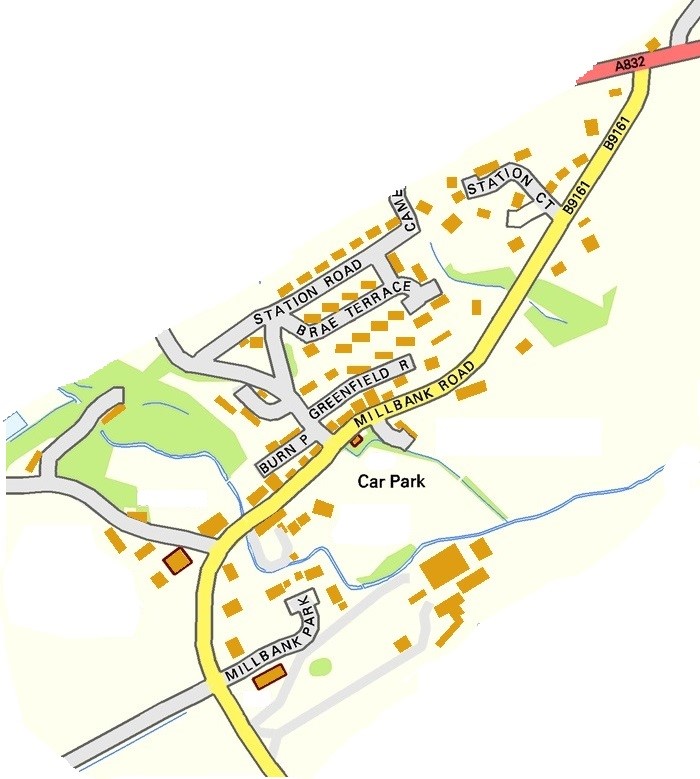
The project’s walking leaflet locates the former camp beside the church, south of the main village centre. It distinguishes that site from the village hall and the former Young Men’s Club near the station.
A recent parish history states that the ground taken was Munlochy’s church glebe, requisitioned during the Second World War for a prisoner-of-war camp holding Italians and then Germans, and used immediately after the war for eastern European refugees. That account rests on the same 2014 community report, but it identifies the land as glebe rather than ordinary farmland. The Highland Historic Environment Record holds no monument entry for the camp, and the 2014 report itself left the record-number columns for it blank.
Adapting the huts for EVWs
The February 1948 drawing was prepared by “LM” at the Ministry of Works office in Union Street, Aberdeen. The National Records of Scotland describes a layout and location plan, with extra hutting and changes to existing huts marked in pencil and red ink. This records planned adaptation, rather than proving when every alteration was finished.
The archive file also contains a Church of Scotland gallery-partition drawing dated 28 April 1939.
Those two drawings appear to be all that survives in the national catalogues under the hostel’s name. A search of the National Records of Scotland for Munlochy returns sixty-two records, of which the only hostel or camp items are RHP140447 and its two parts. The National Archives at Kew returns fifteen, all personal, naval or hydrographic, with no camp file and no prisoner-of-war camp number.
Displaced people and village life
Residents recalled displaced people using the camp after the war, including Poles and others from eastern Europe. Kormylo’s directory supplies the explicit Ukrainian connection. The local account also remembers dances at the camp, and that when the police were called the trouble usually came from visitors rather than from the residents.
Wartime contact extended into the village: prisoners helped clear the school garden, while a local garage supplied vehicles transporting POWs. These recollections concern the prisoner phase, separately from the later EVW accommodation.
Nothing has been found that describes Ukrainian life inside the hostel itself: no choir, chapel, school or branch report has been traced for it. Kormylo notes that no registers or lists of Ukrainian occupants of these camps are known to survive in any archive in Scotland, and that the Scottish list rests on the 1949 daybook of Fr Alexandr Babij, the Ukrainian Greek Catholic priest whose parish covered the whole country and who visited all forty-four camps and hostels where Ukrainians were living, collecting donations towards the community house at 6 Mansionhouse Road in Edinburgh. No contemporary newspaper report of the hostel has yet been recovered, and the Ukrainian Weekly archive returns nothing for Munlochy.
Munlochy was one of hundreds of such places. Almost all of the 21,000 Ukrainian European Voluntary Workers brought to Britain between 1947 and 1950 lived in hostels run by bodies including the National Service Hostels Corporation, the Ministry of Agriculture and the YMCA. Residence restrictions were lifted from 1951, and most of those placed in farming districts moved to industrial towns and cities.
Sources for this section
- In which ways is the Ukrainian community in Scotland a diaspora?
- Remembering Knockbain Parish Heritage
- Ukrainians in Displaced Persons camps 1946–51 in Scotland (Figure 4-2) and the chaplain’s daybook
- Negative checks: Ukrainian Weekly archive, British Newspaper Archive, Hansard, Canmore and Am Baile
- Post-war camps and hostels
Other Ross-shire camps
Munlochy should not be confused with the other Ross-shire places on the same Ukrainian lists, which also include Evanton and Kildary. Brahan, in a home farm field about two miles from Maryburgh, was leased by the Ministry of Works from 1944 to 1957, held German and Italian prisoners, then housed displaced persons employed in agriculture, among them Polish, Hungarian and Ukrainian people, and was later used for schoolchildren brought north for the potato harvest. That sequence closely resembles the one remembered at Munlochy, which makes careful separation of the two sites necessary.
Ross-shire places in the Ukrainian camp lists
| Place | How it is listed | Where |
|---|---|---|
| Munlochy | YMCA Hostel, Munlochy | Map of Ukrainian camps in Scotland 1946–51 (Kormylo, printed 99-100) |
| Munlochy | E.V.W. Hostel Munlochy, Ross-shire | Appendix of hostels which held significant numbers of ethnic Ukrainians, entry 28 (printed 323) |
| Brahan Castle, Conon Bridge, Dingwall | Brahan Castle, Conon Bridge, Dingwall | Map of Ukrainian camps in Scotland 1946–51 |
| Evanton | NBC Education Centre Hostel Evanton | Map of Ukrainian camps in Scotland 1946–51 |
| Kildary | Y.M.C.A Hostel, Kildary, Ross-shire | Appendix entry 39 (printed 323) |
Harvest workers and the cleared site
The camp subsequently housed boys from Glasgow during the 1950s potato harvest. The walking leaflet recalls nightly films during that use. Recruiting children for the harvest had begun in earnest by 1948, with recruitment centres in Glasgow and Edinburgh and a minimum of a shilling an hour for those who stayed in hostels. No document has been found placing Munlochy formally within that scheme, so the connection rests on local memory.
By the 1990s, contributors remembered only the foundations of about three huts and rubble still lying in 1994. A footbridge across the burn behind the camp had also gone, perhaps when Munlochy flooded in the 1960s or 1970s.
Sources
- In which ways is the Ukrainian community in Scotland a diaspora?
Peter David Kormylo, University of Glasgow · 2021
Printed 323, appendix entry 28: EVW Hostel Munlochy, Ross-shire.
- Munlochy Hostel, Knockbain: layout plan
National Records of Scotland · February 1948
RHP140447/1 catalogue fully read. Plan 595 × 930 mm, by LM, Ministry of Works, 259 Union Street, Aberdeen. Underlying plan not digitised on this catalogue page.
- Remembering Knockbain Parish Heritage
Knockbain Community Council / Archaeology for Communities in the Highlands · 2014
Original report read: page 5 camp entry 18, page 7 school entry 8, page 13 garage entry 78. Camp entry visually checked and text re-extracted. Oral-history synthesis, not contemporaneous occupancy records.
- A Walk Around Munlochy Village
Knockbain Community Council / ARCH · 2014
Both leaflet pages read; map page visually inspected. Based on the same community heritage project, not independent testimony.
- Munlochy Hostel file: gallery plan
National Records of Scotland · 1939-04-28
Catalogue describes Church of Scotland Munlochy gallery partition, Alex Ross & Son architects. No 1939 EVW operation inferred.
- Ukrainians in Displaced Persons camps 1946–51 in Scotland (Figure 4-2) and the chaplain’s daybook
Peter David Kormylo, University of Glasgow · 2021
Printed 99-100 (map key lists YMCA Hostel, Munlochy under Ross-shire, with Brahan Castle and Evanton; data from AUGB archives and the Ukrainian Catholic Church in Scotland); printed 136-137 on Fr Alexandr Babij’s 1949 odnodnivka and the absence of surviving occupant registers; printed 206 on AUGB branches. No occupancy figure is given for Munlochy.
- Knockbain Parish Church: A Brief History
Mike Rattenbury · 2026
Full text read. States that Munlochy’s church glebe was requisitioned for a prisoner-of-war camp holding Italians then Germans, and eastern European refugees immediately after the war. Its footnote 40 cites the 2014 ARCH report, so it is derivative on this point.
- Highland Historic Environment Record: Munlochy record search
The Highland Council · Searched 13 September 2026
All 66 monument records listed and read; none relates to the camp or hostel. A search for prisoner of war camp Munlochy returns nil.
- National Records of Scotland catalogue: Munlochy keyword search and Knockbain place record
National Records of Scotland · Searched 13 September 2026
Keyword search returns 62 records; the only hostel or camp items are RHP140447 and its two parts. No Department of Agriculture for Scotland or Ministry of Works hostel file is catalogued under the name.
- The National Archives, Discovery: Munlochy search
The National Archives · Searched 13 September 2026
15 records, all read: service, naval, hydrographic, health and naturalisation records. No camp file and no camp number for Munlochy.
- Politics, publicity and potatoes: Scotland’s tattie howking films
Emily Munro, National Library of Scotland · 18 May 2020
National scheme only: recruiting of children from 1948, recruitment centres in Glasgow and Edinburgh, publicity campaign 1949–51, and pay of at least one shilling an hour with hostel deductions. Not a Munlochy record.
- Prisoner Of War Camp (Brahan, Maryburgh)
S. Fraser, Maryburgh Primary School, for Ross and Cromarty Heritage · March 2015
Cited to distinguish Brahan from Munlochy: Ministry of Works lease 1944–1957, German and Italian prisoners, then displaced persons in agriculture including Ukrainians, later harvest schoolchildren.
- Post-war camps and hostels
Ukrainians in the United Kingdom online encyclopaedia · Read 13 September 2026
National framework: 21,000 Ukrainian EVWs and 860 dependants in hundreds of hostels 1947–1950; administering bodies; restrictions lifted from 1951. Munlochy is not named. Geographical entry read for the Scottish totals.
- Negative checks: Ukrainian Weekly archive, British Newspaper Archive, Hansard, Canmore and Am Baile
Various · Searched 13 September 2026
Ukrainian Weekly search returns nil for Munlochy. The British Newspaper Archive results interface could not be filtered without a subscription and yielded no camp or hostel article; Hansard and Am Baile blocked automated access; no Canmore site record for the camp was found.
Last researched 13 September 2026