North Hill
Arrival and settlement
Laurencekirk, Scotland · Camp 75 from about 1945; Ukrainian European Voluntary Workers recorded 1949
North Hill Camp at Laurencekirk was Camp 75, a German working camp with a wide ring of farm hostels across Angus and the Mearns. Ukrainian former prisoners released as European Voluntary Workers were later housed there, and a Ukrainian Catholic priest collected money from them in 1949 towards a church in Edinburgh.
Introduction
North Hill Camp at Laurencekirk accommodated Ukrainians during postwar resettlement. Also written Northhill, the site appears in Peter Kormylo’s directory of Scottish hostels with significant Ukrainian populations. Its surviving records connect several phases of use: an Italian prisoner-of-war camp, a German working camp, a later home for civilian European Voluntary Workers, and a housing estate.
A history in dates
- 11 November 1944Enzo Tanzi, an Italian prisoner from North Hill, and the retired farmer John Lindsay were killed when an aeroplane crashed into the field where they were working.
- 11 and 12 August 1945James Grant inspected Camp 75 and found no library, films or gramophone records.
- 10 May 1946Otto Schmidt was killed by a train near Blackiemuir Bridge returning from a sawmill.
- 20 February 1947The Foreign Office camp list records 75 (G.W.C.), North Hill Camp, Laurencekirk, under Lieutenant Colonel T. Reilly.
- 11 to 15 August 1947S. Denham Jacobs surveyed the camp, recording a strength of 928 and 830 prisoners repatriated to date.
- 22 to 24 October 1947A. Robinson inspected Camp 75, its six hostels and its English classes.
- January 1948A German former prisoner at Northhill signed a year’s farm contract as an agricultural labourer.
- 1949Kormylo reports a Ukrainian Catholic priest’s visit to collect funds for an Edinburgh church.
- 1990sThe camp ground was sold for housing and became the Northhill Park estate.
Sources for this section
- What do you know about Northhill POW camp?
- FO 939/155 hostel table, remarks, and James Grant’s visit report
- Foreign Office list of prisoner-of-war camps, page 9
- Re-educational survey of Camp 75, 11 to 15 August 1947
- Camp 75 English inspector’s report, 22 to 24 October 1947
- Peter Kormylo, Northhill camp contribution, 27 July 2017
- MAB62472, Northhill Camp
The camp and its ground
The camp lay between Laurencekirk and Auchenblae and was the only one of its kind in the district. Aberdeenshire Council’s historic environment record centres it at NO 7036 7463 in Laurencekirk parish, notes that Canmore records a wireless station at the same location, and repeats a recollection gathered by the Defence of Britain project that prisoners were used to build roads in Drumtochty Forest. The Foreign Office list of camps gives the camp’s telegraphic address as Priswar, Laurencekirk, its telephone number as Laurencekirk 128 and its railway station as Laurencekirk, under the classification 75 (G.W.C.), German Working Camp, with Lieutenant Colonel T. Reilly as commandant.
The camp changed occupants as the war changed. Italians came first and Germans followed after the Italian capitulation, and both groups included men allowed out to work on local farms. Two deaths at work are recorded. On 11 November 1944 Enzo Tanzi, an Italian prisoner from North Hill, died with John Lindsay, a retired farmer, when an aeroplane crashed into the field in which they were working. On 10 May 1946 Otto Schmidt was killed by a train near Blackiemuir Bridge while making his way back from a sawmill where he worked; he is buried at the German war cemetery at Cannock Chase.
The working camp in 1947
Two inspections a few months apart show the camp at its fullest. A re-educational survey by S. Denham Jacobs, made between 11 and 15 August 1947, gives a strength of 928, of whom 346 were at headquarters and the rest at hostels at Nigg, Kinnell, Rickarton, Rosemount and Tannadice, in billets or detached. Eight hundred and thirty prisoners had been repatriated to date, three new hostels had just opened, and the strength was expected to approach 2,000 by the end of August. The commanding officer was Lieutenant Colonel Minchin and the camp leader was Papon.
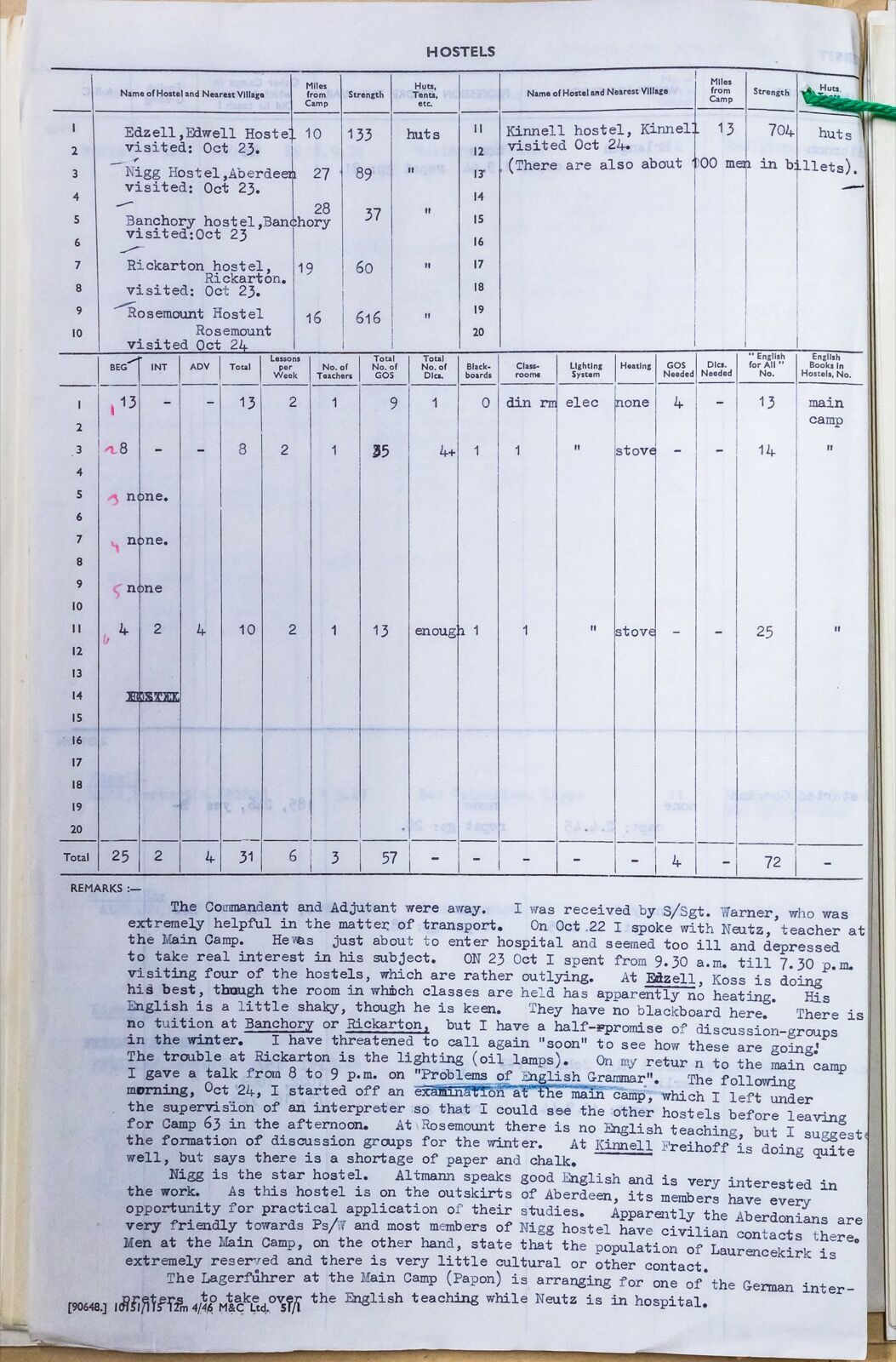
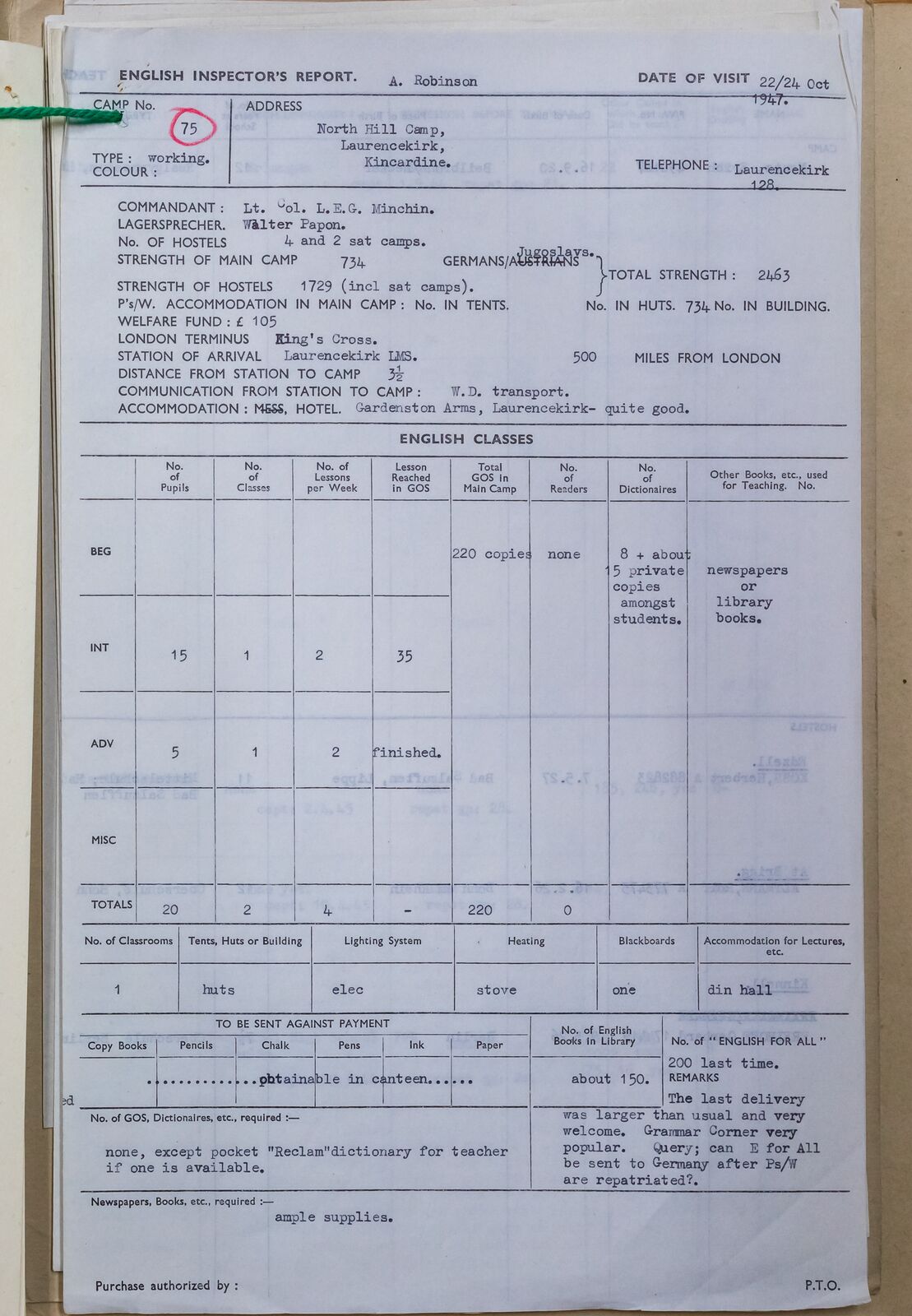
Inspector A. Robinson visited on 22 to 24 October 1947. His report identifies Camp 75, North Hill Camp, Laurencekirk, under Lieutenant Colonel Minchin, with Walter Papon as camp spokesman. All 734 men in the main camp were accommodated in huts. Four hostels and two satellite camps brought the associated administrative total to 2,463. His hostel table names Edzell, Nigg, Banchory, Rickarton, Rosemount and Kinnell, from ten to twenty-eight miles from the camp, with about a hundred more men in billets. These figures describe the prisoner-of-war establishment at that date, rather than the later Ukrainian civilian community.
Camp 75, 22 to 24 October 1947
| Measure | Recorded figure | Scope |
|---|---|---|
| Main camp strength | 734 | Main camp POWs |
| Hostels and satellite camps | 1729 | Associated accommodation, not main camp |
| Total strength | 2463 | 734 + 1729 |
| Hostels | 4 | Plus 2 satellite camps |
| English-class pupils | 20 | 15 intermediate and 5 advanced |
| Classrooms | 1 | Hut; electric lighting and stove heating |
The hostels of Camp 75 in October 1947
| Hostel | Miles from camp | Strength |
|---|---|---|
| Edzell | 10 | 133 |
| Kinnell | 13 | 704 |
| Rosemount | 16 | 616 |
| Rickarton | 19 | 60 |
| Nigg, Aberdeen | 27 | 89 |
| Banchory | 28 | 37 |
Re-educational survey, 11 to 15 August 1947
| Measure | Recorded figure |
|---|---|
| Total strength | 928 (1 officer and 927 other ranks) |
| At headquarters | 346 |
| In hostels | 74 Nigg, 227 Kinnell, 28 Rickarton, 45 Rosemount, 37 Tannadice |
| In billets, detached and sundries | 79, 75 and 17 |
| Prisoners repatriated to date | 830 |
| Aged under 25 | 35 per cent |
Learning English, and the town
The inspector recorded 20 English learners: 15 in an intermediate class and 5 advanced pupils. Each class met twice a week. A single hut classroom had electric lighting, a stove and one blackboard; the dining hall could also accommodate lectures. The library held about 150 English books. Newspapers and library books supplemented formal teaching, and students had private dictionaries in addition to the camp’s eight copies. A note asked whether English for All could continue to reach prisoners after repatriation to Germany, showing that interest in language learning extended beyond their expected stay.
Robinson’s remarks describe a camp thinly connected to its neighbours. He praised Nigg on the edge of Aberdeen as the star hostel, whose members had civilian contacts in the city, and then wrote that men at the main camp “state that the population of Laurencekirk is extremely reserved and there is very little cultural or other contact”. The August survey had already found the same thing in its own way: interest in religion was not great, though prisoners were welcome in local churches, there was no camp magazine and only a small orchestra that occasionally visited hostels. Four hostels at that point had no English teaching at all, two of them lit by oil lamps.
Ukrainian residents and a new church
Kormylo describes Ukrainian former prisoners of war living at Northhill after their release as European Voluntary Workers. In his 2017 local-history contribution, he reports that a travelling Ukrainian Catholic priest visited in 1949 to collect money towards a church building in Edinburgh. Kormylo says he holds the contributors’ list. The account links workers at this rural hostel with the church community developing in Scotland’s capital.
That visit fits the wider pattern. From 1947 the administration of such camps passed from the War Office to civilian bodies and they were redesignated as hostels, and the Association of Ukrainians in Great Britain and its predecessor helped to arrange visits by Ukrainian priests to conduct services and provide pastoral care. Nothing survives to say how many Ukrainians lived at North Hill, when they arrived or when they left. Local recollection has the camp used later for borstal boys brought to gather potatoes, and one German former prisoner signed an annual farm contract in January 1948 to work as a labourer near Brechin, an illustration of how prisoners turned into hired men on the same farms.
The surviving record, and the site today
The October 1947 inspection form places the camp three and a half miles from Laurencekirk railway station, with War Department transport providing the connection. Its columns distinguish the main camp, attached accommodation and classroom resources. The file also holds an earlier report by James Grant, dated on its face 11 and 12 August 1945, which found the camp “more neglected than most as far as educational and re-educational requirements are concerned. No library, no films, no GOS.” The original pages preserve the scale and practical arrangements of North Hill’s operation before the 1949 Ukrainian church collection described by Kormylo.
Afterwards the ground was put to other uses. One local account remembers the land bought by a neighbour and turned into a salvage yard, with car parts stored in huts still in good condition. The camp was sold for housing in the 1990s, and the historic environment record now describes the site simply as Northhill Park housing estate.
Sources
- Peter Kormylo, Ukrainians in Scotland (PhD thesis, 2021)
University of Glasgow · 2021
Printed pages 100 and 323, directory entry 25: Northhill map label and North Hill hostel.
- Peter Kormylo, Northhill camp contribution, 27 July 2017
Laurencekirk AB30 · 27 July 2017
Researcher’s named comment at 7:44 am; retrospective account, donor list not inspected, priest not named.
- Camp 75 English inspector’s report, 22 to 24 October 1947
The National Archives, FO 939/155, photographed by the Repatriated Landscape project · 1947
Original page visually inspected; POW-phase figures.
- Re-educational survey of Camp 75, 11 to 15 August 1947
The National Archives, FO 939/155, photographed by the Repatriated Landscape project · Report handed in 15 September 1947
Pages 15 to 18 downloaded and read. Visitor S. Denham Jacobs; strength 928 with the hostel distribution; 830 repatriated to date; commandant Lt Col Minchin, typed R.E.G. here and read as L. E. G. on the October form; religion, newspapers, library, wireless and entertainment notes. German prisoner-of-war establishment only.
- FO 939/155 hostel table, remarks, and James Grant’s visit report
The National Archives, FO 939/155, photographed by the Repatriated Landscape project · 1945 and 1947
Pages 10, 11 and 28 downloaded and read. Hostel strengths at Edzell 133, Nigg 89, Banchory 37, Rickarton 60, Rosemount 616 and Kinnell 704 with about 100 men in billets; the inspector’s remarks on Laurencekirk; James Grant’s report dated on its face 11 and 12 August 1945. The 1945 date is as typed and has not been independently corroborated.
- What do you know about Northhill POW camp?
Laurencekirk AB30 · Article 17 December 2013, with reader comments to 2024
Article and all 56 comments read. Position between Laurencekirk and Auchenblae; Italians then Germans then borstal boys; the 1944 and 1946 deaths cited by Malcolm Sanders to National Records of Scotland SC5/29/1945/1 and to Cannock Chase; the January 1948 farm contract; the salvage yard; the 1990s sale for housing. Family recollections submitted to a community website, not contemporaneous records.
- MAB62472, Northhill Camp
Aberdeenshire Council Historic Environment Record · Undated
Full record read. Camp 75 used for Italian and later German soldiers, now Northhill Park housing estate; centred NO 7036 7463, Laurencekirk parish; wireless station recorded by Canmore; Defence of Britain recollection of prisoner labour on Drumtochty Forest roads. Does not mention the European Voluntary Workers phase.
- Foreign Office list of prisoner-of-war camps, page 9
The National Archives, FO 1120 series, photographed by the Repatriated Landscape project · Captioned as the list at 20 February 1947
Image downloaded and read. Row for 75 (G.W.C.) North Hill Camp with telegraphic address, telephone Laurencekirk 128, railway station and commandant Lt Col T. Reilly. The row is struck through by hand on the copy, an annotation of unknown date. The publishing project cites FO 1120/183 while the image file name gives 1120/182.
- Roman Krawec, Post-war camps and hostels
Ukrainians in the United Kingdom online encyclopaedia · Published 10 February 2013
Read in full. Transfer of camp administration to civilian bodies from 1947 and redesignation as hostels; AUGB support for visits by Ukrainian priests. General framework; North Hill is not named in the article.
Last researched 13 September 2026