Camp Ohio
Displacement in Europe
Burgdorf, Lower Saxony, Germany · 1945–1950
A fire-police compound on both sides of Sorgenser Straße in Burgdorf became Camp Ohio in April 1945, run under British military government in the Hannover region. Children learned in wooden classrooms, adults trained for new work, a football team carried the name Zaporozhets, and by April 1950 the residents had dispersed across the world.
Introduction
Camp Ohio occupied a former fire-police site on both sides of Sorgenser Straße in Burgdorf. The town’s memorial dates the earlier installation to 1942 and the Allied displaced persons camp to April 1945. Former forced labourers, prisoners of war and refugees lived here, including many Ukrainians. The memorial records periods with more than a thousand residents and dates the camp’s operation through April 1950.
Sources for this section
A history in dates
- 1942The municipal memorial dates construction of the fire-police site to this year; the dpcamps account gives 1943.
- June 1944A resistance movement involving Ukrainian firemen and forced labourers leads to 300 arrests, forty of them sent to Neuengamme.
- 11 April 1945The United States Ninth Army liberates Burgdorf and opens Camp Ohio.
- April 1945The former installation becomes a displaced-persons camp.
- 28 May 1945British military government takes over the camp under the 503 Military Government Detachment.
- September 1945More than 200 residents formally refuse repatriation and ask to be treated as stateless.
- January 1946Residents perform the Ukrainian play Poschylys’ u durni.
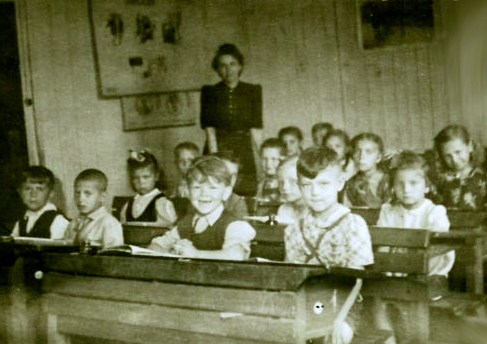
- May 1946A first-grade class is photographed in the camp school.
- June 1946An ammunition explosion at Hänigsen kills 89 people, among them 20 displaced persons.
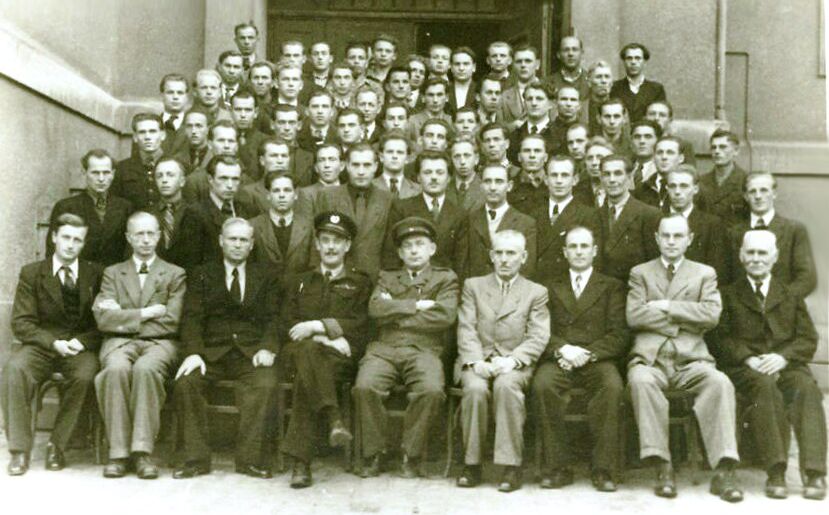
- May–October 1947An agricultural training course takes place.
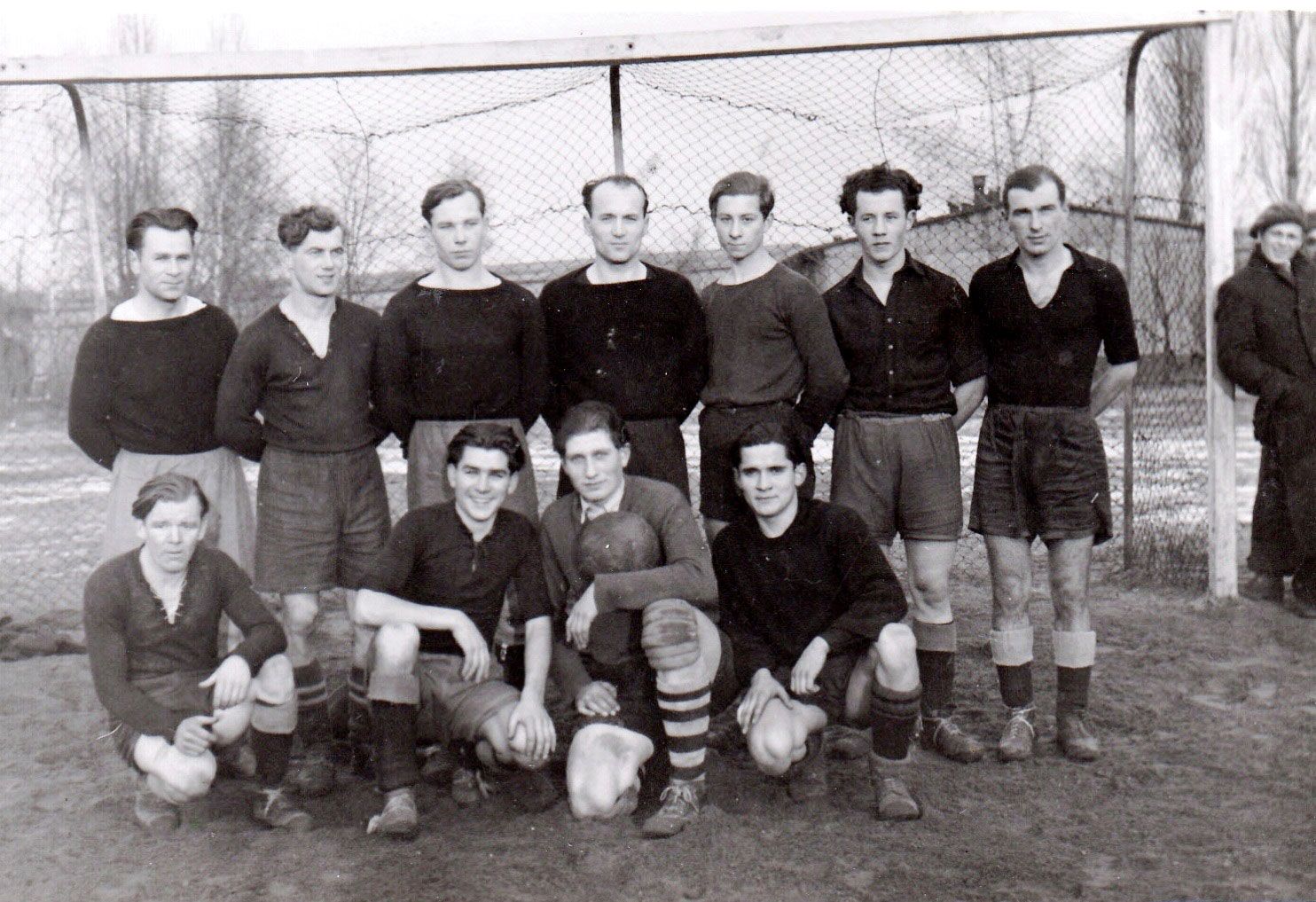
- 21 January 1948The Zaporozhets football team is photographed.
- April 1948Wasyl Makota leaves for Britain through Westward Ho!.
- April 1950Camp Ohio closes.
- 16 June 1951Wasyl Makota arrives in Halifax, Canada.
- 2017Burgdorf residents sponsor the camp memorial.
The site before 1945
The municipal memorial describes a large compound of 26 barracks and vehicle halls on 75,000 square metres, established in 1942 as the station of the Hannover/Burgdorf fire-police detachment. The dpcamps research page gives 1943 for the same construction and names the unit as Feuerschutzpolizei-Abteilung 2 ‘Hannover’; the two dates are not reconciled here. The same page reports that in June 1944 a resistance movement involving Ukrainian members of the Burgdorf fire brigade and forced labourers in a nearby camp led to 300 arrests, with forty of those arrested sent to Neuengamme concentration camp, and that two of them later lived in Camp Ohio. It states that the participants have not been identified.
Sources for this section
Liberation and administration
The dpcamps account records that the United States Ninth Army liberated Burgdorf on 11 April 1945 and opened Camp Ohio, and that British military authorities formally took over its management on 28 May 1945, when the area became part of the British zone under the 503 Military Government Detachment. It reports that in September 1945 more than 200 residents formally refused repatriation when they registered, writing to the camp commander to ask to be treated as stateless and eligible for emigration, and that in 1946 Soviet officers visited in search of people to repatriate. As the population grew a second camp was built opposite the first, the two being known as Camp Ohio I and Camp Ohio II. The Arolsen Archives inventory records the camp as Ukrainian, in the British zone, under Team 80, with no opening or closing date, no assembly-centre number and no capacity; its archive reference is to emigration applications and other International Tracing Service documents. A separate camp listing gives the number 2711 for Burgdorf and names Balts, Poles, Yugoslavs, Ukrainians and others. These numbering systems are not reconciled by the sources read.
Who ran the camp
| Date | Authority | Source and scope |
|---|---|---|
| 11 April 1945 | United States Ninth Army liberates Burgdorf and opens the camp | dpcamps research page |
| 28 May 1945 | British military government, 503 Military Government Detachment | dpcamps research page; the area passed to the British zone |
| Undated | UNRRA/IRO Team 80 | Arolsen inventory; no dates given |
| April 1950 | Camp closed | Municipal memorial |
Sources for this section
Learning, work and community
Children attended the camp school: a photograph dated May 1946 shows a first-grade class seated at desks in a wooden classroom. A 2012 report of a public discussion evening in Burgdorf, drawing on a camp diary, records that the camp had a kindergarten and a school and that residents could attend an agricultural school and complete a course. A large group portrait identifies an agricultural course held from May to October 1947.
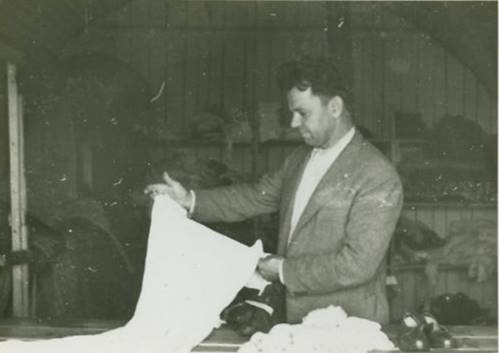
Work was visible throughout the camp. Photographs identify the clothing warehouse, a canteen, butchers, shoemakers, a tailor’s workshop, a painter, baking and embroidery classes, and residents employed by North German Timber Control. The 2012 report lists employment with Burgdorf firms, giving 275 people at the canning factory, 200 at the Tappe furniture works, 23 at the Henckel weighing-machine factory and 42 in various craft businesses, the Klauke sawmill and timber trade and Frees & Nilson. Those figures are described as forced labourers working for named firms; the report gives no dates and does not say that all of them were Camp Ohio residents, so they are not a camp employment census.
Sport, music and worship brought residents together outside work and lessons. Zaporozhets, the camp football team, appears in a photograph dated 21 January 1948. The collection also records men’s and women’s choirs, participants in the Ukrainian play Poschylys’ u durni in January 1946, a theatre production in April 1947, and a touring musical and Cossack ballet group that performed at various camps. Residents’ recollections describe Ukrainian Catholic, Baptist, Russian and Lithuanian churches, with a priest visiting regularly from the camps at Seedorf and Heidenau for Ukrainian Orthodox worshippers. Five Ukrainian Catholic priests and one Ukrainian Baptist pastor have been identified by name in that research; the 2012 report likewise records Ukrainian and Greek Catholic masses in the camp.
Employment with Burgdorf firms as reported in 2012
| Employer | People reported |
|---|---|
| Canning factory | 275 |
| Tappe furniture works | 200 |
| Henckel KG weighing-machine factory | 23 |
| Craft businesses, Klauke sawmill and timber trade, Frees & Nilson | 42 |
Sources for this section
Beyond the fence
Camp Ohio was not the only such place in the district: the 2012 report names further camps at Heeßel, Hülptingsen, Otze and Ramlingen, which must be kept distinct from it. Children born to camp families were usually delivered at the hospital in Celle and their births registered there. Life outside the camp could also be lethal: the dpcamps page records the explosion of an ammunition dump in a disused salt mine at Hänigsen in June 1946, which killed 89 people, among them 20 displaced persons. Graves of camp residents remain in the Burgdorf cemetery on Uetzerstraße.
Sources for this section
Leaving Burgdorf
The municipal memorial names Brazil, Australia, Great Britain, Canada and the United States among the countries where residents subsequently settled; the dpcamps account adds England, Belgium and Luxembourg. Neither gives destination-by-destination totals. Burgdorf residents sponsored the memorial in 2017.
Sources for this section
One journey: Burgdorf, Britain, Canada
Daria Valkenburg traces her father Wasyl Makota’s journey from Camp Ohio to Britain and then Canada. He entered the camp in October 1945 and left in April 1948 through the Westward Ho! recruitment programme. Her account describes agricultural work in Scotland before mining training and employment. In Britain he also played music with other Ukrainians. He later applied to Canada and reached Halifax in June 1951. His experience shows how resettlement could involve several moves rather than a single journey from camp to permanent home.
Wasyl Makota’s route, as recorded by his daughter
| Date | Place or event |
|---|---|
| October 1945 | Entered Camp Ohio |
| April 1948 | Travelled to Britain |
| 16 June 1951 | Arrived at Halifax, Canada |
Sources for this section
Sources
- City of Burgdorf, Camp Ohio memorial text
City of Burgdorf · Undated
Full one-page memorial text read; 1942 fire-police installation with 26 barracks and vehicle halls on 75,000 square metres, camp established April 1945, at times more than a thousand residents of eastern European origin including many Ukrainians until April 1950, destinations named, plaque sponsored by Burgdorf citizens in 2017.
- DP Camps in Burgdorf
dpcamps.org, Michigan Family History Network; Camp Ohio material compiled by Daria Valkenburg · Undated
Full page re-read 13 September 2026: camp listing 2711, 1943 construction, June 1944 arrests, liberation and British takeover, September 1945 refusals of repatriation, Camp Ohio I and II, churches and clergy, Hänigsen explosion, photograph captions. Compiled from residents’ recollections and family collections, not from contemporaneous administrative records. Lists of residents’ names, deaths and burials on the page have not been reused.
- Daria Valkenburg, Leaving Camp Ohio For Great Britain Under The Westward Ho! Program
2021-07-01
Full article text read; retrospective family account quoting personal writings; original illustrated documents not yet read.
- Alfred Donner, Erzählcafé report: Das Burgdorfer DP-Lager Ohio
myheimat.de, citizen-reporter platform, Burgdorf · 2012-09-04
Full report read. Camp diary describing residents mostly from Russia, Ukraine and Poland; football, Ukrainian and Greek Catholic masses, agricultural school with a course certificate, kindergarten and school; employment figures for named Burgdorf firms, undated and not identified as camp residents; further camps at Heeßel, Hülptingsen, Otze and Ramlingen; graves in the Uetzerstraße cemetery. A local account of a public discussion evening, not an archival record.
- DP camp inventory: DP-Camp “Ohio”, Burgdorf
Arolsen Archives · 2023-10-26
Record 100: nationality Ukrainian, British zone, Team 80; no opening or closing date, no assembly-centre number and no capacity recorded. Archive reference: ITS documents including emigration applications, document IDs 81973131-81973371.
Last researched 13 September 2026