Parkes Migrant Camp
Arrival and settlement
Parkes, New South Wales, Australia · 1949–1952
At a former RAAF air school east of Parkes, a holding centre took in displaced families from Europe from August 1949 until May 1952. Ukrainian mothers and children waited there for a family home while work took their husbands to other towns.
Introduction
Parkes’s migrant accommodation occupied a former RAAF site at the airport east of town. The local council’s history describes a centre receiving displaced European migrants, with its own hospital, before closure in the early 1950s. Its population included Ukrainian families moving between reception camps and employment elsewhere in New South Wales.
A history in dates
- 1941–1946RAAF training units occupy the Parkes air school; the base is empty by 1946.
- 27 June 1949A Commonwealth list of centres includes Parkes among the holding centres.
- July 1949The state camp school at Parkes opens.
- 9 August 1949The Parkes Migrant Centre opens at the former RAAF air school.
- October 1949Anna and Kate Babij moved from Bathurst to Parkes while Nikola began work in Orange.
- 24 January 1950Council minutes record 2,000 people accommodated at the centre.
- 1950Poliomyelitis cases are found at the centre during the central-west outbreak.
- 1950A Latvian displaced-persons family lived at the Parkes Holding Centre on arrival in Australia; Ervīns Apinis designed an unplying machine there.
- April 1950Anna and Kate joined Nikola in rented accommodation in Orange.
- 8 April 1951A priest’s letter recorded Parkes among Ukrainian Catholic camp visits.
- 1952Residents flooded out of Forbes are housed at the migrant centre.
- 30 May 1952The Parkes migrant hostel closes.
Sources for this section
- Parkes Airport during and after WWII: Migrant Camp
- Commonwealth Government Hostels
- Teaching English to post-WWII migrants
- August 9 marks the 70th anniversary when Parkes Migrant Centre opened
- Kate and Anna Babij interview, by Elisabeth Edwards
- The Rise, Fall and Rise of the Population of the Parkes Shire, Part 2, 1947–1971
- The DP era Apinis loom (Memmingen)
- Ukrainians in Australia, volume 1, 1966
The airport site
The camp occupied the former RAAF accommodation at Parkes Airport, five kilometres east of town on Henry Parkes Way. The aerodrome had been built in the early 1940s for the Empire Pilot Training Scheme, and units based there included No. 1 Air Navigation School and No. 2 Wireless Air Gunners School from 1941 to 1945 and, from 1944, the Central Flying School and No. 8 Operational Training Unit. All RAAF presence had gone by 1946 and the barracks were left empty.
Newspaper and community accounts describe how the buildings were used. Most of the long barracks became dormitories for single people, while others were partitioned into small rooms for families with thin plywood that gave little privacy. The centre had its own hospital, and the council’s local history records that several hundred babies were born there. A Commonwealth list of 27 June 1949 places Parkes among the holding centres, distinct from the reception and training centres at Bathurst and Bonegilla, and it appears again as a New South Wales holding centre in the 1950 Commonwealth hostels programme.
Opening and scale
The centre opened on 9 August 1949. Parkes Municipal Council minutes of 24 January 1950 record that 2,000 people were accommodated there, which required additional infrastructure from the town, and the Parkes Shire Library’s account of the district’s population notes that the camp temporarily added up to 2,000 people to the shire. That is a figure for the whole centre; no count of its Ukrainian residents has been found.
The camp’s presence ran through the district’s public health and emergencies. Cases of poliomyelitis were found at the centre during the 1950 outbreak in the central west. When severe flooding left Forbes almost empty in 1952, flood-affected residents were housed at the Parkes Migrant Centre, and women from the camp were reported as saving the Forbes bean crop.
Living there
Millie Schillick, who arrived as a small child in 1949, recalled the camp through her parents Ivan and Sonia Schillich. Her mother was born in Ukraine in 1926 and had been taken for forced labour when the German army invaded in 1941; the family reached Sydney from Naples six days before the Parkes centre opened, went first to Bathurst, and then travelled by train to Parkes, where they were given a small room with thin partitions in a long hut with shared toilets. Her father was offered work at Newcastle, Maitland and Wilcannia, but refused to be separated from his family again and took local jobs clearing rocks, pitching hay and cleaning railway and cattle yards.
Her account also describes the everyday texture of the camp: children minded by whoever was not working that day, European food cooked on smuggled primus stoves, complaints about greasy mutton and tinned vegetables that were eventually met by putting migrant cooks and kitchen hands into the kitchen, and camp social nights at which townspeople came to look at the food. After about eight months the family left the camp for work at a Parkes hotel, and the camp remained their social world, with word going round that there were migrants behind the bar. Historypin’s account of the camp, written by the same former resident and held with a Parkes Library rights statement, adds that many of the men were sent away to farms, factories and other states, leaving the women to work in the camp or locally as domestics or on factory lines.
Ukrainian families were not the only displaced people at the centre. A family memorial page devoted to the Latvian weaver Anna Apinis records that the family lived at Parkes Holding Centre on arrival in Australia in 1950, and that, suitable weaving materials being difficult to find in post-war Australia, her husband Ervīns put his engineering skills to use and designed an unplying machine there. The page is a private retrospective account rather than a camp record.
Anna and Kate Babij wait for a family home
In an interview recorded for Orange’s migration heritage project, Kate Babij traces her mother Anna’s journey from Ukraine through forced labour and displaced-persons camps in Austria. After arriving in Sydney in September 1949, the family went to Bathurst. Kate recalls that her father Nikola received work at Orange’s Emmco factory in October, while she and Anna went to Parkes.
Kate remembers six months at Parkes while Nikola lived in a tent beside the factory in Orange. In April 1950, mother and daughter joined him in a rented orchard packing shed. They lived there while he built a house in Tynan Street, moving into the unfinished house around March 1951. Other Ukrainian families and individuals shared the house as they too established themselves.
A second interview in the same project describes the identical pattern. Rosalie Borschtsch, deported from Ukraine to Poland in 1943 at the age of sixteen to build railways, married Wasyl in Munich in 1946 and reached Australia with their daughter. She spent a year at the Parkes migrant camp while Wasyl worked at the Emmco plant at Orange and lived in the tent city beside the factory; the couple later shared a house in Tynan Street with another Ukrainian family. Parkes, in these accounts, was where the women and children of Ukrainian families waited out the two-year work contract.
The Babij family’s route, as recalled
| Period | Accommodation |
|---|---|
| September 1949 | Bathurst after Sydney arrival |
| October 1949–April 1950 | Anna and Kate at Parkes; Nikola in Orange |
| April 1950 | Family reunited in an Orange packing shed |
Ukrainian pastoral visits
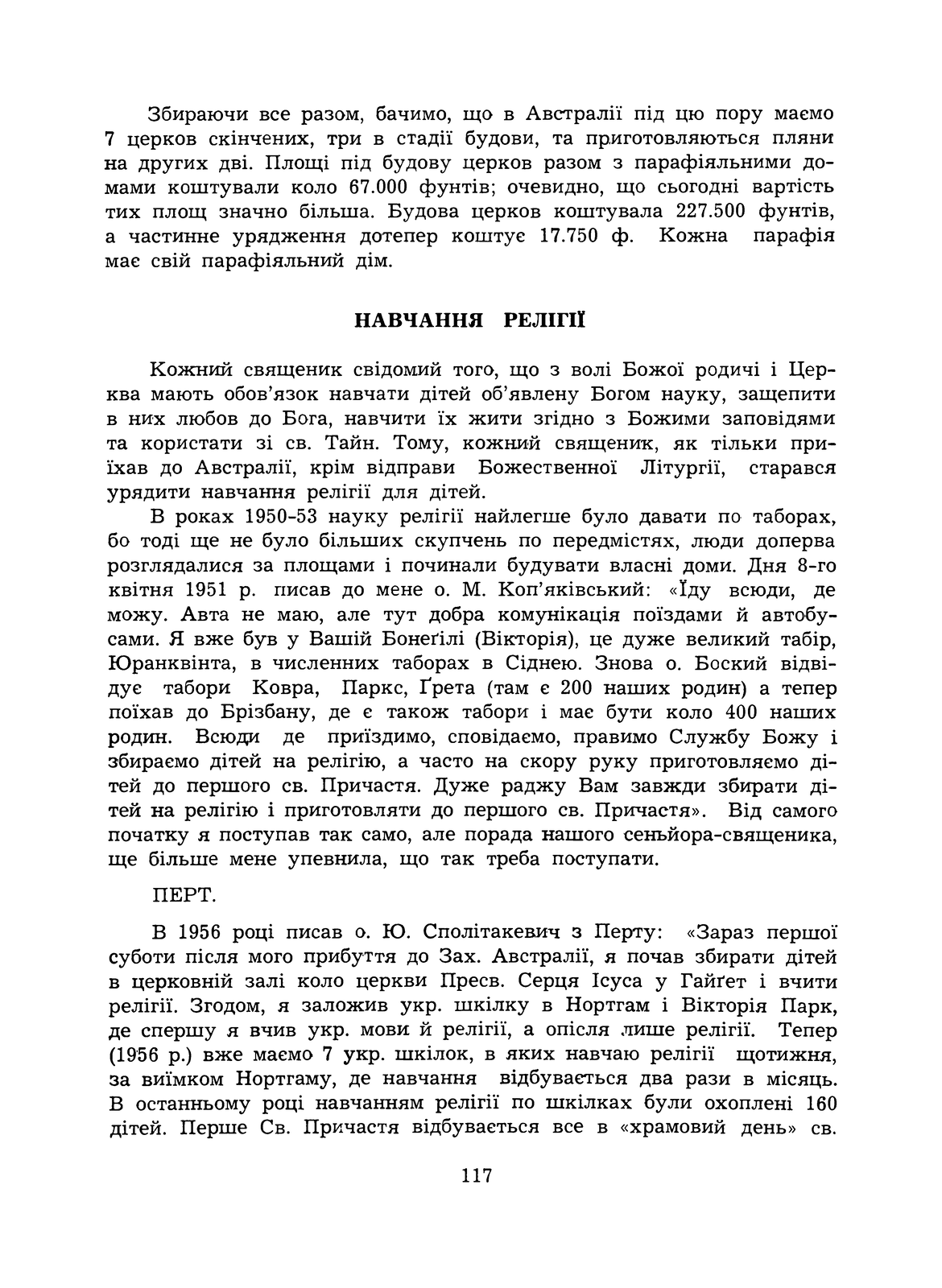
Parkes was part of the circuit served by Ukrainian Catholic priests. A letter dated 8 April 1951 from Father M. Kopiakivsky, reproduced in the 1966 community history, reports Father Bosky visiting Cowra, Parkes and Greta. The clergy heard confessions, celebrated liturgy and gathered children for religious instruction during their camp visits.
Sources for this section
School, closure and the site today
A state camp school operated at Parkes from July 1949 to May 1952, and its admission register, covering September 1949 to April 1952, survives in the New South Wales state archives. These schools were intended to teach English and the Australian school routine so that children could move on to local schools.
The centre closed on 30 May 1952, reportedly against the wishes of Parkes people who valued what the migrants had brought to the town; the council’s own history dates the closure to the early 1950s. Several thousand people had passed through, many of them Polish, and some stayed and settled permanently in the district. Concrete foundations remain at the airport site, with a commemorative plaque recognising those who passed through.
Dates recorded for the camp and its school
| Record | Dates | Scope |
|---|---|---|
| Opening and closure reported on the centre’s seventieth anniversary | 9 August 1949 to 30 May 1952 | The camp itself, as given in a 2019 newspaper feature |
| Parkes Migrant Camp school, NSW Department of Education | July 1949 to May 1952 | The state camp school, not the camp |
| Admission register [1/9681], NSW State Archives | September 1949 to April 1952 | Coverage of the surviving school register |
| Parkes Municipal Council minutes, 24 January 1950 | 24 January 1950 | 2,000 persons then accommodated at the centre |
Sources
- Parkes Airport during and after WWII: Migrant Camp
Parkes Shire Council · Undated
Official local-history web text read in full, including the RAAF units based at Parkes and the migrant camp section; underlying camp records unread.
- Kate and Anna Babij interview, by Elisabeth Edwards
Orange City Council, Half a World Away · 2007
Full published interview read. Retrospective oral testimony; introduction and detailed interview disagree about duration. Introductory summary compresses the stay into September–October 1949; the detailed first-person chronology is used with attribution.
- Ukrainians in Australia, volume 1, 1966
Melbourne, 1966 · 1966
Original printed page 117 visually inspected previously. Letter reproduced in a later history; the original 1951 manuscript is unread.
- August 9 marks the 70th anniversary when Parkes Migrant Centre opened
Christine Little, The Senior · 9 August 2019, updated 28 August 2023
Full article read. Gives the opening date of 9 August 1949, the closing date of 30 May 1952, an accommodation figure of about 2,000 and the recollections of Millie Schillick, whose mother Sonia was born in Ukraine in 1926. Journalism based on one former resident’s memories; figures not traced to camp records here.
- Parkes Migrant Holding Camp 1949–1952
Historypin, pin by Millie S., rights statement Parkes Library, licensed CC-BY-SA · Added 28 April 2021
Full text read. Describes the reuse of the RAAF barracks as dormitories and partitioned family rooms and the separation of families by work allocation. Written by the same former resident as source 4, so the two are not independent.
- Rosalia Borschtsch interview, by Elisabeth Edwards
Orange City Council, Half a World Away · 2007
Full published interview read. Ukrainian deportee; records a year at the Parkes migrant camp while her husband worked at Emmco in Orange. Retrospective oral testimony without exact dates.
- The Rise, Fall and Rise of the Population of the Parkes Shire, Part 2, 1947–1971
History Parkes, Parkes Shire Library · 28 November 2016
Full article read. Cites Parkes Municipal Council meeting minutes of 24 January 1950, number 86, for 2,000 persons accommodated, and reproduces newspaper reports on polio at the centre, the Forbes flood evacuation and the bean harvest. The underlying council minute book was not inspected.
- Teaching English to post-WWII migrants
Museums of History NSW · Undated
Institutional guide listing the Parkes Migrant Camp school July 1949 to May 1952 and its admission register [1/9681] for September 1949 to April 1952. These are record and school dates, not necessarily the camp’s exact operating dates.
- Commonwealth Government Hostels
Migration Heritage Project · 12 April 2022
Reproduces the list of reception and holding centres as at 27 June 1949 from National Archives of Australia A6006, 1949/04/07, and the 1950 Commonwealth Hostels Programme from MT105/8, 2/71/1146; Parkes appears as a New South Wales holding centre in both.
- Parkes ’Drome as immigrant centre
The Forbes Advocate (New South Wales), page 5 · 25 March 1949
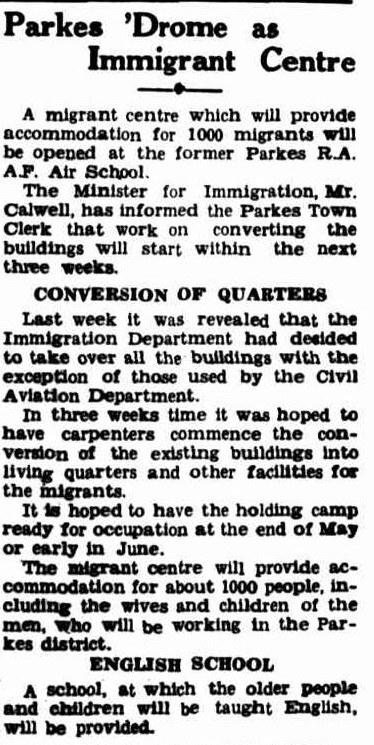
Report that a migrant centre providing accommodation for 1,000 migrants was to open at the former Parkes RAAF air school; that the Minister for Immigration, Mr Calwell, had told the Parkes town clerk conversion work would begin within three weeks; that the Immigration Department would take over all the buildings except those used by the Civil Aviation Department; that the holding camp was hoped to be ready for occupation at the end of May or early in June; that it would house about 1,000 people including the wives and children of men working in the Parkes district; and that a school would be provided at which older people and children would be taught English. Digitised by the National Library of Australia with funding from the State Library of NSW Digital Excellence Program; Australian material published before 1955 is out of copyright.
- The DP era Apinis loom (Memmingen)
latvians.com, S. A. and P. J. Vecrumba · Updated after December 2024
Main body paragraph beginning ‘When Anna migrated with her father and family to Australia in 1950’ read in full. A private family memorial page about the weaver Anna Apinis and her loom, which places the family at Parkes Holding Centre in 1950. Not drawn from camp records.
Last researched 13 September 2026