Puch Camp
Displacement in Europe
Puch bei Hallein, Salzburg, Austria · 1943–1956
A forced-labour compound in the Ursteinau at Puch became a refuge for four successive communities. Ukrainians appear in its wartime labour force, in its first postwar intake and among the eastern European refugees of its last years.
Introduction
Puch Camp occupied an extensive area beside Schulstraße, on the western edge of Puch bei Hallein, south of Salzburg. Established for the Eugen-Grill armaments works, its barracks passed through several uses: forced labour, emergency accommodation, a Jewish displaced-persons camp and a mixed refugee transit camp.
Ukrainians belonged to more than one chapter of this history. The federal heritage catalogue identifies Ukrainian men and women among the wartime labour force. A later study of municipal registration records also identifies Ukrainians among the refugees who lived here after Austrian authorities took over the camp.
The name changed with the population. In June 1945 the mayor reported on it as the Lager Aufeld; that summer the register office called it the Jugoslawisches Nationalitätenlager; the stamp it used in 1947 read Bejt Israel; from 1949 the Austrian files call it simply Lager Puch. The barracks in the Ursteinau were the same barracks throughout.
A history in dates
- 1941Land in the Ursteinau is expropriated and the first barracks go up.
- 1943The Eugen-Grill works’ forced-labour camp is in operation and reaches its final form of twenty barracks.
- 1944Three Polish inmates are shot in the camp after attempts to avoid work.
- 4–5 May 1945The guards leave, the inmates break up the camp, and American troops move the forced labourers out within a fortnight.
- June 1945The mayor reports 513 people in the camp: 194 from Hungary, 306 from Croatia and twelve from Ukraine.
- July 1945The military government and district authority inspect the camp and find bedbugs in every barrack.
- September 1945The camp football side, of refugees and villagers, becomes the FC Puch.
- Summer 1946The camp is cleared without warning and refilled with Jewish refugees; it takes the name Bejt Israel.
- February 1948The IRO reports over 1,300 people in the camp.
- End of November 1948The last Jewish residents move to Hallein and Puch becomes a transit camp for eastern European refugees.
- End of 1948The gendarmerie chronicle records 383 refugees in the camp.
- 1 September 1949Austrian authorities take the camp over from the IRO with about 700 people in it.
- 17 September 1949The local school council considers the admission of camp children to the village school.
- 1954Eight Austrian families made homeless by flooding in Salzburg are housed in one of the barracks.
- 31 January 1956The camp closes.
- 23 October 1999The memorial designed by Günter Stanzer is unveiled, followed by the first Pucher Geschichtswerkstatt.
- 2021The memorial is renewed.
Sources for this section
The barracks in the Ursteinau
The exact date of building cannot be established. Witnesses place it between 1941 and the beginning of 1943; land was expropriated in 1941 and the first barracks went up in the months that followed, and by the middle of 1943 the camp had reached the form it kept until 1956. A plan of 1949 shows twenty wooden barracks, seven of them called stone barracks because they stood on masonry foundations. Fifteen of the buildings were in use as accommodation; the rest held communal and store rooms.
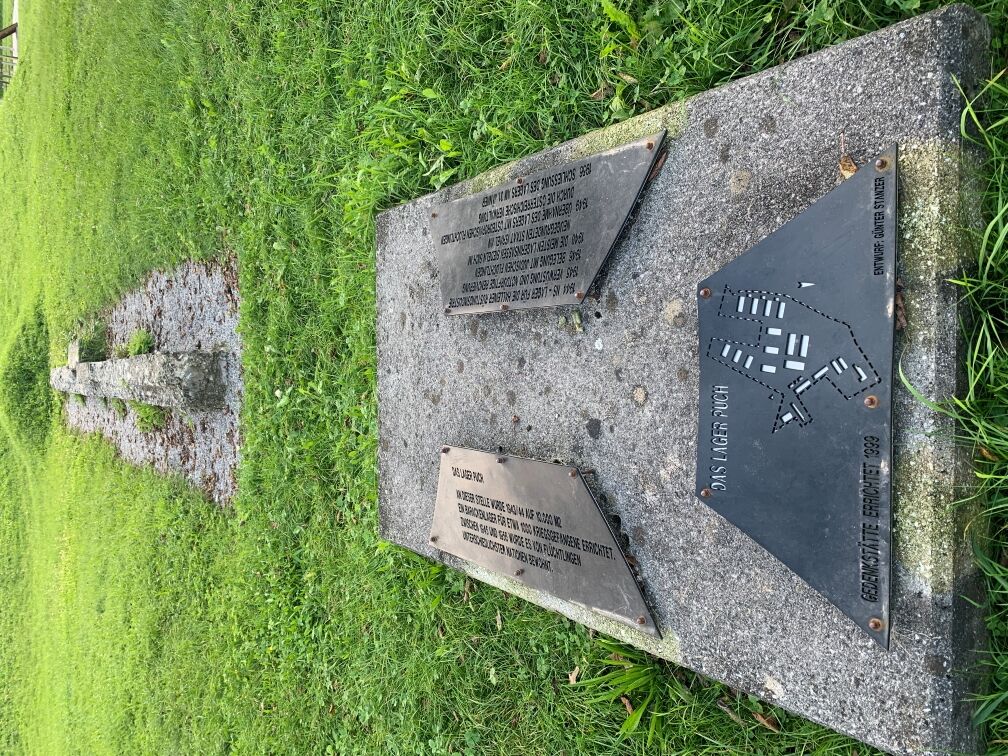
The ground belonged to local people rather than to the works that used it. Lothar Kuhlmann gave up 21,460 square metres, Johann Hetz 6,654 and Johann Strubegger 821, while the Grill works themselves owned barely 3,000; the owners were without their land for more than ten years. The memorial panel records barracks put up on 10,000 square metres for about a thousand prisoners.
The forced-labour compound
The camp began operating in 1943. People confined here supplied labour to industrial enterprises in nearby Hallein under harsh and crowded conditions. The Federal Monuments Office lists French, Polish, Ukrainian, Greek, Italian and Czech workers; the population reached as many as one thousand.
A woman who worked in the camp office from 1943 until the end of 1944 recorded French, Czech, Polish, Italian and Greek inmates and a large group of women from Ukraine. Men and women alike worked at the Grill works in Hallein, a branch of a Stuttgart armaments firm that made aircraft guns and other aircraft equipment for the works at Wiener Neustadt. The working day was twelve hours, and the road between Puch and Hallein had to be walked twice a day.
The camp was open: no fence separated it from the village, and inmates could move about, although contact with local people was limited. The barracks were single undivided rooms of beds heated by stoves, with no running water; they are described as sound and dry, but vermin were a standing problem and delousing brought only short relief. Lavatories and showers, separate for men and women, stood at the back of the site, and there was one cooked meal in the evening from a central kitchen, with a short break for food during the shift in Hallein.
Attempts to avoid work were not tolerated. In 1944 several Poles were found to have been shaking their thermometers up in the camp sick bay for days on end; a warning failed, and three Poles were shot in the camp as a warning to the rest. Until the end of 1943 the camp had a commandant said to have come from East Prussia; he was withdrawn on disciplinary grounds and not replaced, and the administration passed to an Austrian woman from Neualm.
This was a site of coercion before it became a place of refuge. The American liberation in 1945 changed its function, but the same barracks remained available while the region struggled to house displaced people.
May 1945 and the first refugees
The Americans reached Puch at the beginning of May 1945 without fighting. On the night of 4–5 May the guards disappeared, and the inmates broke the camp up and went into the village to loot and to look for representatives of the regime. Paul Tribolet, a French officer held in the camp, calmed his compatriots, prevented worse and told the Americans what was happening; the occupying troops moved the inmates out quickly, and by the middle of the month none of the forced labourers was left. Villagers had joined the looting themselves, carting food and drink away from the guards’ stores.
The barracks were patched up within weeks and the occupying power moved refugees out of the provincial capital into the Tennengau. In June 1945 the mayor reported 513 people in the camp: 194 from Hungary, 306 from Croatia and twelve from Ukraine. A month later there were 926, and the number stayed just under a thousand into the summer of 1946, the municipal statistics recording the residents as Yugoslavs. A considerable number of them were ethnic Germans.
An inspection in July 1945 by the military government and the district authority found the inmates’ health good for the supply situation, though some children were undernourished; there were no lice, but every barrack was badly infested with bedbugs and some rooms were dirty. Showers were available once a week, and soap and washing powder were short across Austria. From the summer of 1945 the camp was run by an English officer and supplied by UNRRA and the occupying forces. Its football-minded commandant, Major Sewell, had a pitch and a stand built, and the camp side of refugees and villagers became, in September 1945, the FC Puch.
The camp population reported by the mayor, June 1945
| Origin | People |
|---|---|
| Hungary | 194 |
| Croatia | 306 |
| Ukraine | 12 |
| Total | 513 |
Sources for this section
A stop on the way out of Europe
German-speaking refugees predominated in 1945–1946. Jewish displaced people occupied the camp during 1946–1948, before its later eastern European phase. These successive populations should not be combined into a single Ukrainian camp total.
In the summer of 1946 the occupying power cleared the camp without warning and refilled it with Jewish refugees from eastern Europe; neither the Austrian authorities nor the municipality were told, and villagers first met the new residents when they came upon them bathing in the Mühlbach one Saturday afternoon in August. Puch was one of ten camps with a Jewish population in the province of Salzburg. Municipal statistics give about 1,200 residents for the summer and autumn of 1946, and the IRO reported over 1,300 in February 1948; most of the people came from Poland and Ukraine.
There was a rabbi in the camp but no prayer house. The residents had a carpentry workshop, their own fire brigade and their own camp police, and a cinema that drew village people in — young ones especially — to watch American westerns. Relations with the village ran mostly through the black market, in tinned food, cigarettes and clothing, and through a series of quarrels over refuse, firewood, trampled hay and, in one cold winter, the burning of the football stand for fuel. In 1947 the camp gave forty litres of petrol for the Puch schoolchildren’s outing.
Puch was part of the Salzburg network used by the Bricha movement, which helped Jewish survivors leave Europe. The city’s archive identifies Salzburg, Puch, Bad Gastein and Saalfelden as important transit locations. American Jewish relief organisations supported the movement, while Salzburg offered connections from Vienna towards Italy.
Routes changed as border controls tightened. After the Brenner and Reschen crossings became harder to use, the high mountain route through the Krimmler Tauern became particularly important in 1947. Puch’s role belonged to this wider movement rather than an isolated local resettlement programme.
The camp’s Jewish years left a record beyond Salzburg. The YIVO Archives in New York hold a record group on displaced persons camps and centres in Austria whose administrative history names twelve camps, among them Puch, alongside Salzburg, Linz, Ebelsberg, Saalfelden, Hallein, Wegscheid, Wels and Enns.
One site, successive populations
| Period | Principal use | Recorded numbers |
|---|---|---|
| 1943–May 1945 | Forced-labour compound for the Eugen-Grill works | Up to about 1,000 |
| June 1945–summer 1946 | Refugees moved out from the city of Salzburg; the “Jugoslawisches Nationalitätenlager” | 513 in June 1945, 926 a month later, just under 1,000 into 1946 |
| Summer 1946–November 1948 | Jewish displaced persons, the camp Bejt Israel | About 1,200 in autumn 1946; over 1,300 reported by the IRO in February 1948 |
| Late 1948–31 January 1956 | Mixed eastern European refugee accommodation | 383 at the end of 1948; about 700 at the handover of 1 September 1949 |
Ukrainians in the final refugee community
At the end of November 1948 the last Jewish residents were moved to Hallein, and Puch became a transit camp for eastern European refugees. The gendarmerie chronicle records 383 refugees in the camp at the end of 1948. Austrian authorities took it over formally on 1 September 1949 — the state had been paying for it, and complaining about the cost, since the spring — and it was handed over with about 700 people in it.
The camp leader’s report at the handover describes what the buildings had become. The approaches to the latrines were impassable in bad weather, the paths muddy and the filth ankle-deep, so that people relieved themselves beside the barracks instead; at night the latrines were unlit and the camp itself badly lit for want of fittings; keys to many locked doors were missing and the doors had to be opened with picklocks; the water from the camp well was not fit to drink and the pump had been under repair for months, so residents fetched water from a neighbouring stream or the village well; the wash-house was too derelict to use.
Registration slips survive in the Puch municipal archive from the autumn of 1949, and they are the basis for what can be said about the last community. Of some 1,500 refugees recorded between 1949 and 1956, more than 40 per cent came from Hungary and more than 10 per cent each were Yugoslavs, Soviet Russians and Ukrainians, the rest divided among other eastern European countries. The numbers fell steadily as people were repatriated, emigrated or settled in Austria — the last especially for the ethnic Germans.
Food was the daily grievance. One resident’s report describes very thin soups, cabbage soup for twenty-four days without a break, bread that could not be eaten, sausage cut into cubes and mixed with macaroni at barely ten grams a head, and kitchen staff who held back part of the fat, oil and sugar and stole even the children’s milk. The provincial resettlement office observed that it was hardly surprising that morale in the camp was not what might fairly be expected by comparison with other camps, and noted that very few residents were in regular work.
School access became a practical conflict. When the camp leader asked the municipality to admit Hungarian children to the village school he was refused, on the argument that so many foreign-language pupils would depress standards, and referred instead to the possibility of a camp school provided by the province. The Hungarian Caritas then set up a school inside the camp, which not all the residents accepted. A deputation of mothers came to Puch, invoked an assurance from the provincial school board and pointed out that they were not Hungarians; some of their children were admitted to the village school. The local school council took the matter on 17 September 1949.
The camp was increasingly unwelcome. In the summer of 1950 the municipality collected signatures against a group of Roma from Czechoslovakia who were to be moved in, and wrote to the provincial governor asking for a stronger gendarmerie post — though the gendarmerie chronicle records no offences by them. Eight Austrian families from the city of Salzburg, made homeless by the flood of 1954, lived for a time in one of the barracks.
The Ukrainian connection in the sources
| Period | Evidence |
|---|---|
| Wartime | Ukrainian men and women in the federal forced-labour camp catalogue; a large group of women from Ukraine recalled by a member of the camp staff |
| June 1945 | Twelve people from Ukraine among the 513 in the first postwar intake |
| 1946–1948 | Most of the Jewish residents came from Poland and Ukraine |
| 1949–1956 | More than 10 per cent of the roughly 1,500 residents recorded on the municipal registration slips |
Closure and the surviving foundations
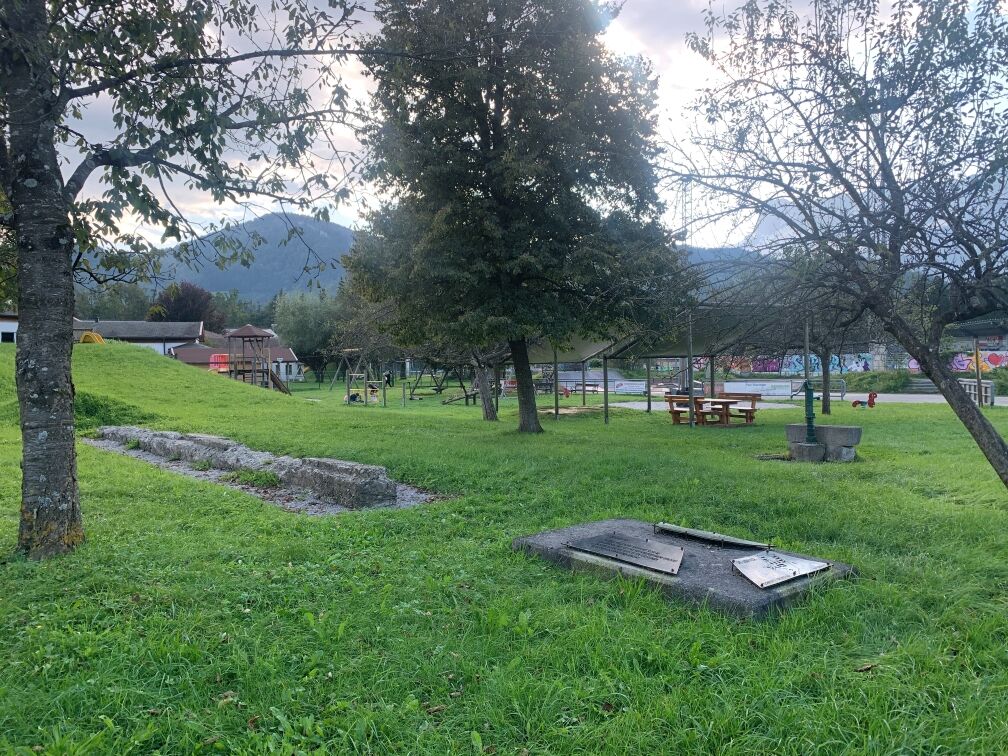
Puch closed on 31 January 1956. Usable huts were taken for further use and the land was repurposed. The former enclosure is now marked near the playground and senior citizens’ home on Schulstraße.
A chronicle of the municipality written under Gerhard Ammerer between 1995 and 1998 examined the camp for the first time, helped by the release of Interior Ministry files. In 1997 the council decided to adapt the camp ground in the Ursteinau for an enlarged kindergarten and a children’s playground and, at the same time, to mark what had stood there. Günter Stanzer, an artist from Puch, set plaques of metal and hard rubber on a concrete plinth built on a masonry barrack foundation, and the memorial stone was unveiled on Saturday 23 October 1999; the first Pucher Geschichtswerkstatt on the history of the camp followed the same day.
A surviving foundation became the focus of a memorial established in 1999 and renewed in 2021. Its low concrete base and information panels draw attention to the traces beneath an ordinary recreational space. The panels explain both the forced-labour camp and the refugee years.
The plaques were later restored to their original condition by Stanzer himself, at the request of the municipality under Mayor Helmut Klose, after criticism of their condition.
Local pupils later investigated the site through the educational project “Forgotten people? Forgotten places?”. Their work linked the remaining wall, historical accounts and the decision to preserve a public memorial. The site’s history can therefore still be read in the village landscape, despite the disappearance of its huts.
Sources
- Katalog der NS-Opferlager in Österreich
Bundesdenkmalamt · January 2022
Lager Puch entry: exact site, forced-labour nationalities and successive postwar uses.
- Gedenkstätte für das Lager Puch
University of Graz, DERLA · 2024 documentation
Exact Schulstraße memorial, foundation remains, chronology transcribed from panels, photographs by Marlene Horejs.
- Vom Arbeiter- zum Flüchtlingslager: Die Geschichte des Lagers Puch
Norbert Ramp, Geschichte und Politik 11/3 · 2001
Municipal and regional archive study, pp 6–14; inspected relevant pages 9–11. Nationality proportion describes accumulated residents 1949–56, not a single-date census.
- Auswanderung nach Palästina: Die Bricha in Salzburg
Stadtarchiv Salzburg · Accessed 2026
Institutional account of Jewish transit network and changing border routes.
- Vergessene Menschen? Vergessene Orte: Lager Puch
erinnern.at · Educational project documentation
School research, closure and preservation of camp remains.
- Vom Arbeits- zum Flüchtlingslager. Die Geschichte des Lagers Puch vom Aufbau bis zur Auflösung
Norbert Ramp, in Salzburg. Geschichte und Politik. Mitteilungen der Dr.-Hans-Lechner-Forschungsgesellschaft 2001/3 · 2001
The issue’s own PDF. Ramp’s article, pages 6–14, read in full, together with Friedrich Steinkellner’s editorial on page 3. The article draws on the Gemeindearchiv Puch, the Salzburger Landesarchiv, the Archiv der Republik (Bundesministerium für Inneres, Abteilung 12U, 33.227-12U/50), the Puch gendarmerie chronicle and interviews with witnesses recorded between 1996 and 1999.
- Gedenkstätte erneuert: Gefangenenlager in der Pucher Au
MeinBezirk, Tennengau · Accessed 14 September 2026
Local report read: the municipality under Mayor Helmut Klose commissioned Günter Stanzer to restore the plaques he had designed in 1999 to their original condition, after criticism of their state; the camp is described as an NS labour camp from 1943 holding at times over 1,000 prisoners, closing in 1956.
- Displaced Persons Camps and Centers in Austria (RG 294.4)
YIVO Institute for Jewish Research · Records dated 1945–1951
Control card for the record group read: the administrative history states that the records cover twelve camps, at Salzburg, Linz, Ebelsberg, Saalfelden, Puch, Hallein, Wegscheid, Wels and Enns.
Last researched 12 September 2026