Ryton Miners’ Hostel
Arrival and settlement
Ryton-on-Tyne, County Durham, England · Documented 1948–1949
Ryton Miners’ Hostel stood on Hexham Old Road in Ryton-on-Tyne and housed a coalfield workforce drawn from several countries, Ukrainians among them. What survives of it is a scatter of newspaper notices: a tracing appeal, a Mass announcement, a personal advertisement from seven young men and the address of a welfare officer who organised an Estonian gathering in Newcastle.
Introduction
Ryton Miners’ Hostel appears in Peter Kormylo’s directory of Ukrainian accommodation as entry 35, “Ryton Miners’ Hostel, Ryton on Tyne”. It stood on Hexham Old Road in the Tyneside colliery district of Ryton, then in County Durham, and housed a multinational workforce. Ukrainians were among the communities associated with it, while Estonian and Lithuanian sources preserve much of what can now be seen of its everyday life: employment, worship, missing friends, courtship and the search for a family home.
A history in dates
- 26 May 1948An Estonian newspaper prints a tracing request using Ryton Miners’ Hostel as the reply address.
- 31 July 1948The family of a Ryton hostel interpreter moves to temporary accommodation in Hull.
- 20 August 1948Seven men advertise for correspondence from “Ryton Hostel, Hixham Old Road, Ryton-on-Tyne, Co. Durham”.
- 21 November 1948Confession and Mass are advertised for Lithuanian hostel residents at St Agnes’ Church, Crawcrook.
- 21 December 1948The interpreter’s family leaves Hull for a jointly purchased home in Newcastle.
- 10 June 1949A Newcastle gathering is announced for 9 and 10 July, with arrangements by V. Noot, welfare officer of the coal miners’ hostel.
- 8 July 1949The gathering is moved to 16 and 17 July, opening with a service at St Thomas’s Church, Haymarket, Newcastle.
- 29 October 1992Harry Lauffaart, born in Tallinn in 1927, dies at Ryton-on-Tyne.
Sources for this section
- Tracing notice: Heino Hallik and Ernst Tomsal
- My experiences as a child of Estonian EVW parents
- Personal advertisement from seven men at Ryton Hostel
- Catholic services for Ryton hostel residents
- Summer days of the northern church district
- Summer days of the northern church district on 16 and 17 July
- Death notices, 18 December 1992
The hostel on Hexham Old Road
The hostel’s postal address is printed in the Estonian weekly published in Britain on 20 August 1948: “Ryton Hostel, Hixham Old Road, Ryton-on-Tyne, Co. Durham”. The street is Hexham Old Road in Ryton, and the spelling is a compositor’s slip. Estonian correspondents writing from the place in 1949 called it plainly the coal miners’ hostel, which matches the name in the Ukrainian directory and the coalfield setting.
Hostels of this kind were administered by bodies such as the National Service Hostels Corporation, the Ministry of Agriculture, the National Coal Board, the YMCA, local authorities and private industrial firms, and most had closed by the middle of the 1950s.
Life across languages
Juri Noot, the son of Estonian displaced people, remembered his stepfather working as an interpreter at Ryton Miners’ Hostel. He spoke and wrote Estonian, Finnish, Hungarian, Russian, German and English. That range of languages reflects the practical work of helping people from different countries communicate in a new setting.
Noot’s account describes Ryton as still partly rural. His family lived outside the hostel, and the shortage of suitable accommodation shaped their movements even while his stepfather’s work stayed in the North East.
The same surname appears in print a year later, when the Estonian weekly gave V. Noot as welfare officer of the coal miners’ hostel at Ryton. Interpreting and welfare were two sides of one job in a hostel where several languages were spoken.
Finding friends after the war
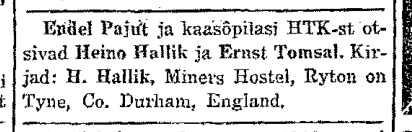
On 26 May 1948, the Estonian newspaper Eesti Teataja published a small tracing notice from Heino Hallik and Ernst Tomsal. They were trying to reconnect with a former school friend and other classmates, and asked for replies to H. Hallik at the Miners’ Hostel in Ryton-on-Tyne.
The notice makes the hostel visible as a postal address in an international network: a few lines in a Swedish-published Estonian newspaper could reach people scattered by war and migration.
People and places in the surviving records
| Person or group | Connection | Record |
|---|---|---|
| Heino Hallik and Ernst Tomsal | Searching for an old school friend and classmates | Eesti Teataja, 26 May 1948 |
| Harry, Udo, Ants, Heino, Fred, Pekka and Alex | Advertising for correspondence from Ryton Hostel, Hexham Old Road | Eesti Hääl, 20 August 1948 |
| Juri Noot’s stepfather | Interpreter at the miners’ hostel | Family recollection published 2018 |
| Lithuanian hostel residents | Service advertised at St Agnes’ Church, Crawcrook | Britanijos Lietuvis, 11 November 1948 |
| V. Noot | Welfare officer of the coal miners’ hostel; organiser of the Newcastle gathering | Eesti Hääl, 10 June and 8 July 1949 |
| Harry Lauffaart, born Tallinn 1927 | Died at Ryton-on-Tyne, 29 October 1992 | Eesti Päevaleht, 18 December 1992 |
Sources for this section
Seven young men and a small advertisement
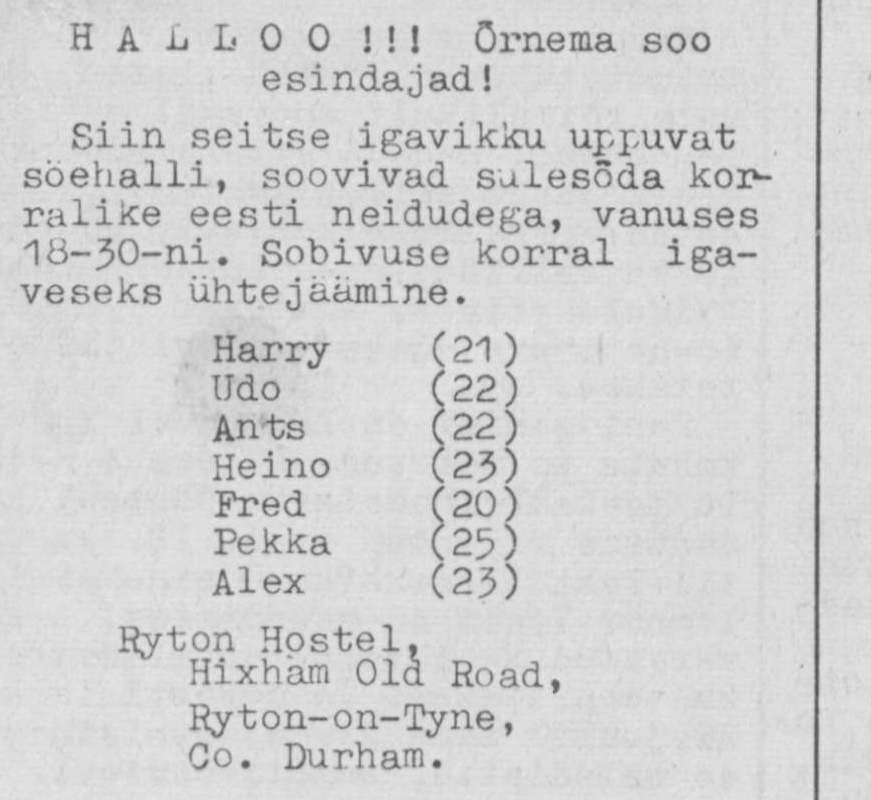
On 20 August 1948 the classified column of the Estonian weekly carried a short advertisement from the hostel. Seven men gave their first names and ages, Harry 21, Udo 22, Ants 22, Heino 23, Fred 20, Pekka 25 and Alex 23, and asked to correspond with respectable Estonian girls aged between eighteen and thirty, adding that if it suited they would stay together for good.
The tone is wry rather than plaintive: the men call themselves seven coal-grey souls sinking into eternity. The same column carried a near identical notice from three men at the YMCA hostel at Woolfox Lodge in Rutland, so the form was familiar across the hostel network.
The seven men named in the advertisement of 20 August 1948
| Name as printed | Age given |
|---|---|
| Harry | 21 |
| Udo | 22 |
| Ants | 22 |
| Heino | 23 |
| Fred | 20 |
| Pekka | 25 |
| Alex | 23 |
Sources for this section
Sunday worship in Crawcrook
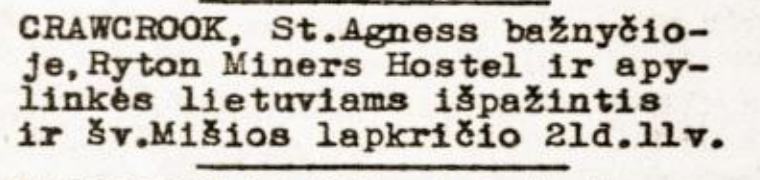
The Lithuanian weekly Britanijos Lietuvis announced confession and Mass for Lithuanians from Ryton Miners’ Hostel and the surrounding area at St Agnes’ Church, Crawcrook, at 11 am on 21 November 1948. The announcement places religious life beyond the hostel itself, in a nearby parish church.
Alongside the Estonian notices and the Ukrainian hostel directory, the announcement shows several distinct national communities using the same local accommodation.
A gathering in Newcastle
On 10 June 1949 the same paper announced summer days for the northern church district, a joint gathering at Newcastle fixed for 9 and 10 July. It would open with a Saturday service at five o’clock and continue with talks, a communal supper and a sociable evening, the music promised by a small orchestra recently formed at the agricultural workers’ camp at Belford. Local arrangements had been taken on by V. Noot, and anyone wanting a supper place or a bed for the night was asked to register with him at Ryton Miners’ Hostel.
A follow-up on 8 July moved the gathering to 16 and 17 July and named the church: St Thomas’s, Haymarket, Newcastle. No room for the social gathering had yet been found. Guides from around Leeds were coming north with songs and recitations, and Colonel A. Rebane was expected to greet old friends.
Moving towards a family home
In July 1948, Noot’s family moved to the Priory Road holding hostel in Hull because their accommodation near Ryton had proved unsuitable. His stepfather continued working as an interpreter. The family left Hull on 21 December after three Estonian families arranged to buy a house together in Newcastle.
For this family a job was only one stage in settling. Their account links a workplace hostel, temporary family accommodation and a shared house, and it distinguishes Ryton’s employment role from the displaced persons camp in Germany where they had lived earlier.
Sources for this section
Afterwards
Most hostel residents could move out only after the beginning of 1951, when employment restrictions began to be lifted from those who had been in the United Kingdom three years, and by the mid-1950s most hostels had closed. No closure date for Ryton has been found, and no photograph of the buildings has been traced.
Some of those the hostel brought to Tyneside stayed. A Stockholm Estonian paper recorded in its death notices of 18 December 1992 that Harry Lauffaart, born in Tallinn on 8 October 1927, had died at Ryton-on-Tyne on 29 October. The notice does not place him in the hostel, but he was of the generation it housed and he was still in the village more than forty years later.
Sources for this section
Sources
- Ukrainians in Scotland: camp and hostel directory
Peter Kormylo / University of Glasgow · 2021
Printed page 323, entry 35: Ryton Miners’ Hostel, Ryton on Tyne.
- My experiences as a child of Estonian EVW parents
Juri Noot / Changing Identities, introduced by Emily Gilbert · 9 February 2018
First-person family recollection, including interpreter work, six languages and dated moves in 1948. Original author confirms his account in a comment.
- Tracing notice: Heino Hallik and Ernst Tomsal
Eesti Teataja / National Library of Estonia · 26 May 1948
Page 3; original PDF inspected. Names and hostel reply address checked against scan.
- Catholic services for Ryton hostel residents
Britanijos Lietuvis / Spauda archive · 11 November 1948
Page 3, Pamaldos column: St Agnes’ Crawcrook, 21 November at 11 am; original Lithuanian notice inspected.
- Personal advertisement from seven men at Ryton Hostel
Eesti Hääl = Estonian News / National Library of Estonia · 20 August 1948
Page 4, classified column 1. Article text and issue PDF read; the printed column inspected in the page scan. Gives the address “Ryton Hostel, Hixham Old Road, Ryton-on-Tyne, Co. Durham” and seven forenames with ages.
- Summer days of the northern church district
Eesti Hääl = Estonian News / National Library of Estonia · 10 June 1949
No. 77, page 3. Names V. Noot as welfare officer of the coal miners’ camp and gives Ryton Miners’ Hostel as the registration address.
- Summer days of the northern church district on 16 and 17 July
Eesti Hääl = Estonian News / National Library of Estonia · 8 July 1949
Page 3. Revised dates, St Thomas’s Church, Haymarket, Newcastle, and the hostel again as the contact address for V. Noot.
- Death notices, 18 December 1992
Eesti Päevaleht = Estniska Dagbladet, Stockholm / National Library of Estonia · 18 December 1992
Page 7. Records the death at Ryton-on-Tyne on 29 October of Harry Lauffaart, born in Tallinn on 8 October 1927. OCR of a poorly printed column, read in full.
- Post-war camps and hostels
Ukrainians in the United Kingdom, online encyclopaedia · accessed 13 September 2026
Framework source for hostel administration, the bodies that ran hostels, the lifting of employment restrictions from 1951 and closures by the mid-1950s. Used for general context only, not for any Ryton figure.
Last researched 13 September 2026