The Cuxhaven to Hull route
Germany to England·1946-1950
The European Volunteer Worker schemes moved recruits from displaced persons camps through the zonal transit camp at Muenster and out by train to Cuxhaven or the Hook of Holland, then overnight across the North Sea to Hull, Harwich or Tilbury. Over a third of the more than 80,000 arrivals landed at Hull, where a reception centre at Priory Road and holding camps such as Full Sutton near York carried them into British employment.
Introduction
The European Volunteer Worker schemes moved displaced people out of Germany by a fixed administrative route that ended on an English quayside. Recruits were gathered from their camps into a regional collecting centre, held for several days at an embarkation transit camp at Muenster in Westphalia, put on a train to Cuxhaven or to the Hook of Holland, and shipped overnight across the North Sea to Hull, Harwich or Tilbury.1
Hull carried the largest single share. Over a third of the more than 80,000 refugees who came to Britain under the EVW schemes landed there, the rest through Tilbury and Harwich. Baltic, Ukrainian and other east European arrivals came down the Humber in the early morning after a night crossing, and were taken from the dock to a reception centre at Priory Road.2
A history in dates
- October 1946Recruitment of displaced persons for British labour schemes begins, opening the movement that ran until December 1949.9
- April 1947
- June 1947Accommodation for approximately 1,000 European volunteer workers is in place at the holding camp at Full Sutton, near York.3
- August 1947The Muenster barracks become the zonal transit camp for the operation; about 60,000 displaced persons of all nationalities eventually pass through on the way to Britain.5
- 23 September 1947George Isaacs, Minister of Labour and National Service, inspects the reception centre at Priory Road, Hull.2
- 17 January 1948An immigration officer at Harwich endorses a Certificate of Identity permitting landing on condition of police registration and employment as directed by the Ministry of Labour.9
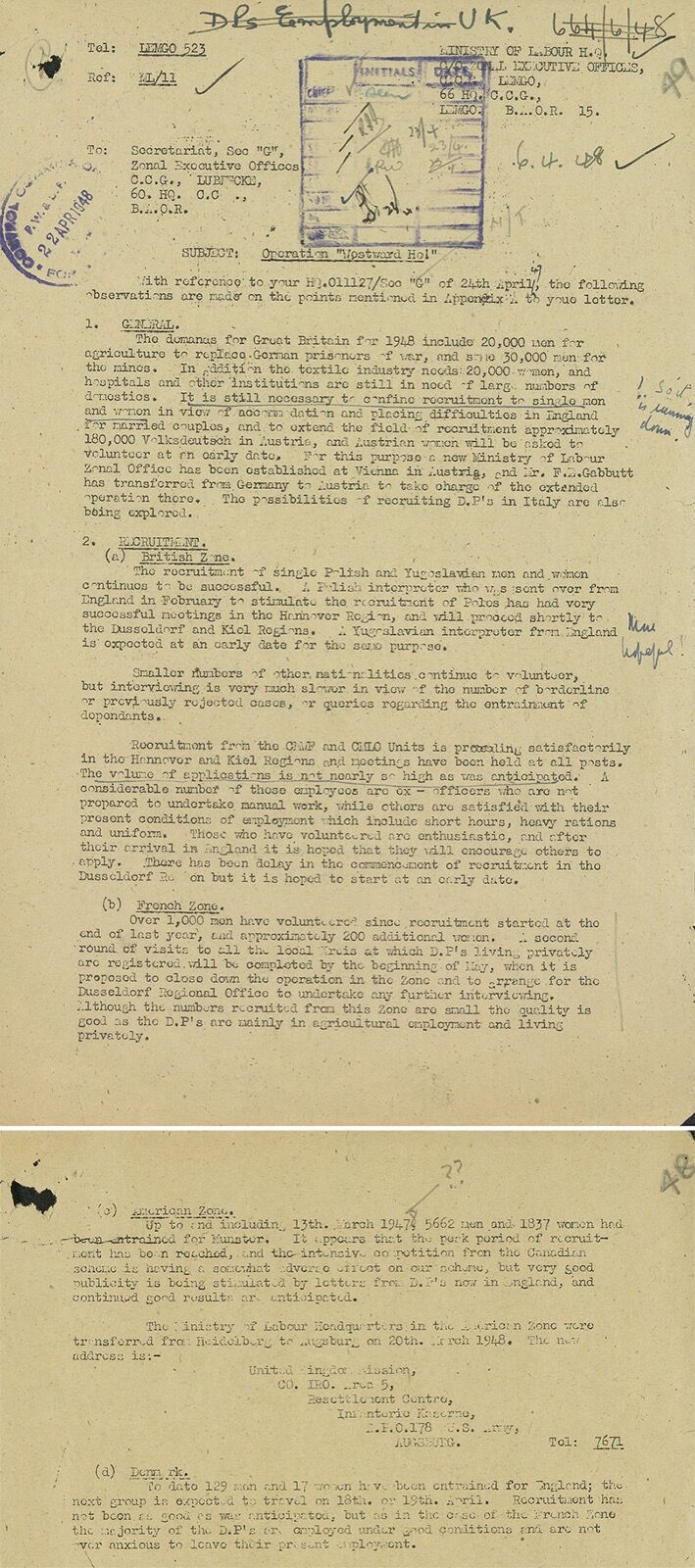
- 6 April 1948A Control Commission progress report records recruitment across the zones and the entraining of recruits for Muenster.6
- 20 April 1948Parliament is told that over 50,000 European volunteer workers of all nationalities have been brought to Britain, about 15,000 of them in the first quarter of 1948.10
- June 1949Operation Westward Ho ends; the Muenster camp is turned to IRO resettlement to Australia, Chile and France.5
- 29 November 1949Full Sutton holds 776 European volunteer workers and is described in the Commons as a holding camp for those who had failed to make the grade.4
- 1 January 1951EVWs resident in the United Kingdom for at least three years may apply for release from the restriction on choice of employment.7
Origins and purpose of the route
A Control Commission progress report of 6 April 1948 set out the British requirement: about 20,000 men for agriculture to replace German prisoners of war, some 30,000 for the mines, 20,000 women for textiles, and domestic workers for hospitals and institutions. Recruitment reached across the British, French and American zones and into Austria, Denmark and Italy, but the pipeline ran through the British zone, because the shipping and transit accommodation were British.6
The assembly point was Muenster. In April 1947 a camp reopened in the army barracks at Hoher Heckenweg, renamed Portsmouth Barracks, as the regional processing centre for Operation Westward Ho, and in August 1947 the barracks became the zonal transit camp for the whole operation. About 60,000 displaced persons of all nationalities passed through it on their way to Great Britain. By mid-March 1948 the American zone alone had entrained 5,662 men and 1,837 women for Muenster.56
Sources for this section
Selection, contracts and medical screening
Selection took place before the train left. Ministry of Labour teams interviewed applicants in the camps and inspected them medically, and those accepted signed an undertaking to work only as directed by the Ministry and not to change their place of work without official approval. Preference went to people willing to take unskilled manual work and, because of the housing shortage in Britain, to those with no dependants in the camps or willing to leave them behind.76
The medical standard was a general examination plus an X-ray for tuberculosis, with tuberculosis, venereal disease and pregnancy the chief official worries. Age limits were nominally 50 for men and 40 for women, and 35 for textiles, though not always applied strictly. Screening in Germany was thin: facilities were inadequate and little time could be given to each candidate. A further check waited at the far end, where doctors examined arrivals at the port and tested women for pregnancy.81
Sources for this section
The crossing
From Muenster, after a stay of several days, recruits went by train to Cuxhaven on the Elbe estuary or to the Hook of Holland and boarded ship there. The sailing was normally overnight. Baggage was minimal and warm coats were issued for the crossing. Those landing at Harwich or Tilbury and bound for the north went on to London for a night before continuing.1
Landing was a formal admission. An endorsement stamped by the immigration officer at Harwich on a Certificate of Identity issued in lieu of a passport, dated 17 January 1948, permitted the holder to land on condition that he registered at once with the police, entered such employment as the Ministry of Labour might specify, and did not leave it without the Ministry's consent.9
Stages of the route from camp to workplace
| Stage | Place | Source scope |
|---|---|---|
| Regional collecting centre | Various, near the DP camps | Gilbert, describing the general EVW route; interview base Latvian, Lithuanian and Estonian |
| Embarkation transit camp, stay of several days | Muenster, Westphalia (Hoher Heckenweg / Portsmouth Barracks) | Gilbert; dpcamps.org for the barracks and its dates |
| Train to the port | Cuxhaven, or the Hook of Holland | Gilbert |
| Overnight sea crossing | To Hull, Harwich or Tilbury | Gilbert |
| Reception centre at the port | Priory Road Camp for Hull arrivals; London for Harwich and Tilbury arrivals heading north | Gilbert; WVS leaflet quoted for the southern ports |
| Holding camp | Nine in Britain, including Full Sutton near York | Hanson for the nine camps; Hansard for Full Sutton |
| Hostel or lodgings near the workplace | Across Britain | Hanson |
Sources for this section
Reception: Hull, Priory Road and the Yorkshire holding camps
At Hull the ships came up the Humber and docked in the morning. Women of the Women's Voluntary Service met the boats with tea and food and explained the next stage, a role they performed at the southern ports too, escorting and interpreting as far as the reception centre. Arrivals were taken by bus to Priory Road Camp, a former army barracks of wooden buildings that had previously held prisoners of war, where the National Service Hostels Corporation registered them and issued an identity card, a towel and soap, a small sum of money and clothing where needed. Most stayed one or two nights before moving to a camp in Yorkshire or further afield, though some who took local agricultural work remained longer.21
George Isaacs, Minister of Labour and National Service, inspected Priory Road on 23 September 1947 and called it a first class job, singling out its cubicles rather than the dormitories used elsewhere. The Hull Daily Mail reported him addressing Estonian, Latvian, Lithuanian and Polish workers in the canteen through German, the camp's common language.2
Beyond the port transit camps stood nine holding camps with room for about 10,000 people, from which the Ministry of Labour placed people into work and then into hostels or lodgings near their jobs. Full Sutton, near York, was the Yorkshire link in that chain: accommodation for approximately 1,000 European volunteer workers had been provided there by June 1947, and workers could be moved from it to employment anywhere in Yorkshire.83
Figures for the route, the ports and the reception camps
| Measure | Figure | Source scope |
|---|---|---|
| Refugees brought to Britain under the EVW schemes | Over 80,000 | All nationalities, 1946 to 1950; Gilbert |
| Arrivals under the EVW scheme, October 1946 to December 1949 | About 85,000 | All east European nationalities; Kormylo citing Tannahill 1958 |
| Share of EVW arrivals landing at Hull | Over one third | All nationalities, 1946 to 1950; Gilbert. Remainder via Tilbury and Harwich |
| Displaced persons passing through the Muenster zonal transit camp | About 60,000 | All nationalities, April 1947 to June 1949; dpcamps.org |
| Recruits entrained for Muenster from the American zone | 5,662 men and 1,837 women | American zone only, to mid-March 1948; FO 1052/487 |
| EVWs brought to Britain in 1948, first quarter | About 15,000 | All nationalities; Hansard, 20 April 1948 |
| EVWs brought to Britain in total by 20 April 1948 | Over 50,000 | All nationalities; Hansard, 20 April 1948 |
| Holding camps in Britain and their capacity | Nine camps, about 10,000 places | All nationalities; Hanson |
| Capacity at Full Sutton holding camp | Approximately 1,000 | All nationalities, June 1947; Hansard, 19 June 1947 |
| Workers at Full Sutton | 776 | All nationalities, 29 November 1949; Hansard |
| Ukrainians admitted as EVWs | 20,912 (16,194 men, 4,718 women) | Ukrainians only, whole scheme; official statistics via the AUGB encyclopaedia |
| Ukrainian dependants admitted | 411 adults and 451 children | Ukrainians only, whole scheme; AUGB encyclopaedia |
| EVW arrivals identifying as Ukrainian | About 21,000 | Ukrainians only, October 1946 to December 1949; Kormylo citing Kay and Miles 1992 |
| Galicia Division veterans transferred to EVW status | 8,128 | Autumn 1948; these men came from Italy in 1947 as prisoners of war and did not travel the sea route from Germany |
Sources for this section
- Hull: the experiences of Latvian, Lithuanian and Estonian EVWs who arrived in Britain, via the Port of Hull, 1946-1950
- Arriving in Britain, 1946-1950: Excerpts from the book
- Sympathy, Antipathy, Hostility: British Attitudes to Non-Repatriable Poles and Ukrainians after the Second World War and to the Hungarian Refugees of 1956
- European Volunteer Workers, written answer of 19 June 1947
Ukrainians on the route
Ukrainians were among the first nationalities recruited when selection began in spring 1947, and most Ukrainian EVWs arrived in the second half of 1947 and the first half of 1948, with the last in 1949. Official statistics give 20,912 Ukrainians admitted as EVWs, 16,194 men and 4,718 women, plus 411 adult dependants and 451 children; about 700, mainly men, returned or were deported soon after arriving. About 8,128 former soldiers of the Galicia Division, brought to Britain from Italy in 1947 as prisoners of war, were released from that status in the autumn of 1948 and taken onto the scheme. They did not travel this sea route, and their numbers should not be added to the recruits shipped from Germany.7
Ukrainians made up roughly a quarter of the whole intake: of the approximately 85,000 east European refugees who arrived under the scheme between October 1946 and December 1949, about 21,000 identified as Ukrainian. The arrivals are not broken down by port in the sources used here, so the Ukrainian share of the Hull landings is unknown, although Ukrainians are recorded among those who came ashore there.92
What happened afterwards
Operation Westward Ho ended in June 1949, after which the Muenster camp was turned over to IRO resettlement to Australia, Chile and France. In Britain the reception apparatus persisted: 118 workers' hostels were still open in 1951, housing EVWs alongside the Polish Resettlement Corps, and Priory Road took many Polish arrivals in 1949 and 1950.582
Full Sutton outlasted its original function and changed character. By 29 November 1949 it held 776 European volunteer workers of all nationalities and was described in the Commons as a holding camp for those who had failed to make the grade. Between August and October that year 244 refused offers of agricultural employment, and in 175 of those cases the reasons were judged unacceptable and unemployment insurance benefit was disallowed. The Parliamentary Secretary declined a suggestion that the camp be closed, noting that its residents were a small fraction of some 180,000 foreign workers then in Britain.4
The direction of labour written into the landing condition lasted into the next decade. In July 1950 the Ministry decided that from 1 January 1951 EVWs resident in the United Kingdom for at least three years could apply for release from the restriction on choice of employment,.7
Sources for this section
- DP Camps Muenster, continued
- Sympathy, Antipathy, Hostility: British Attitudes to Non-Repatriable Poles and Ukrainians after the Second World War and to the Hungarian Refugees of 1956
- Hull: the experiences of Latvian, Lithuanian and Estonian EVWs who arrived in Britain, via the Port of Hull, 1946-1950
- European Volunteer Workers, Full Sutton Camp
- European Voluntary Workers
Sources
- Arriving in Britain, 1946-1950: Excerpts from the book
Emily Gilbert, Changing Identities (accompanying Rebuilding Post-War Britain, Pen and Sword, 2017) · 10 October 2013
Read in full. Gives the route stage by stage: DP camp, regional collecting centre, embarkation transit camp at Muenster, train to Cuxhaven or the Hook of Holland, overnight ship to Tilbury, Harwich or Hull, then holding camps. Also the WVS leaflet, pocket money on landing, warm coats issued for the crossing and medical checks at the port. Its interview base is Latvian, Lithuanian and Estonian.
- Hull: the experiences of Latvian, Lithuanian and Estonian EVWs who arrived in Britain, via the Port of Hull, 1946-1950
Emily Gilbert, Changing Identities · 12 November 2017
Read in full. Over a third of more than 80,000 EVW arrivals came through Hull; Ukrainians named among those landing there. Describes the WVS reception on the quay, the bus to Priory Road Camp, registration by the National Service Hostels Corporation, and quotes the Hull Daily Mail report of the ministerial visit of 23 September 1947.
- European Volunteer Workers, written answer of 19 June 1947
Hansard, House of Commons · 19 June 1947
Read. Ness Edwards states that accommodation has been provided for approximately 1,000 European volunteer workers at a holding camp at Full Sutton, near York, from which workers can be moved to employment in any part of Yorkshire. Accompanying table of 3,800 placements by industry, all nationalities.
- European Volunteer Workers, Full Sutton Camp
Hansard, House of Commons · 29 November 1949
Read. 776 workers in the camp; 244 refusals of agricultural work between August and October 1949 with benefit disallowed in 175 cases; about 2,696 pounds paid in benefit over three months; the Parliamentary Secretary declines to close the camp.
- DP Camps Muenster, continued
dpcamps.org, sponsored by the Michigan Family History Network · Accessed 2026
Read in full. Dates the reopening of the Hoher Heckenweg barracks as the regional processing centre for Westward Ho to April 1947 and its conversion to zonal transit camp to August 1947, with about 60,000 displaced persons passing through on the way to Great Britain, and the end of the operation in June 1949. Also carries the commandant's account of Operation North Sea at Camp V20, including the five-day stay for medical and other tests.
- Westward Ho scheme: FO 1052/487, 6 April 1948
The National Archives (UK), education resource · 6 April 1948 (document); accessed 2026
Read. Control Commission progress report giving the British labour requirement, the preference for single recruits, recruitment across the British, French and American zones and in Austria, Denmark and Italy, and the entraining of 5,662 men and 1,837 women from the American zone for Muenster by mid-March 1948.
- European Voluntary Workers
Roman Krawec, Ukrainians in the United Kingdom online encyclopaedia · Published 2010, updated 2016
Read in full. Selection by interview and medical inspection, the undertaking on direction of labour, preference criteria, and the Ukrainian totals: 20,912 EVWs (16,194 men, 4,718 women), 411 adult dependants and 451 children, about 700 returns or deportations, and 8,128 former Galicia Division soldiers transferred to EVW status in autumn 1948. Also the July 1950 decision releasing three-year residents from direction of labour from 1 January 1951.
- Sympathy, Antipathy, Hostility: British Attitudes to Non-Repatriable Poles and Ukrainians after the Second World War and to the Hungarian Refugees of 1956
Janine Hanson, PhD thesis, University of Sheffield · June 1995
Read the relevant chapters. Medical and character screening of volunteers, including the tuberculosis X-ray and the age limits, and the inadequacy of screening facilities in Germany; the arrival sequence of transit camps near the port of arrival and nine holding camps for about 10,000 people; the 46,000 pounds of Ministry of Works capital costs reported to Parliament on 28 June 1948; 118 workers' hostels still open in 1951; first Westward Ho volunteers arriving April 1947.
- Ukrainians in Britain (PhD thesis)
Kormylo, University of Glasgow · 2021
Read the relevant sections. Approximately 85,000 east European refugees arrived under the EVW scheme between October 1946 and December 1949, of whom about 21,000 identified as Ukrainian, citing Tannahill 1958 and Kay and Miles 1992. Also reproduces the landing endorsement stamped by the immigration officer at Harwich on 17 January 1948.
- European Volunteer Workers, 20 April 1948
Hansard, House of Commons · 20 April 1948
Read. About 15,000 arrivals in the first quarter of 1948, over 50,000 brought to the country in total by that date, and 23 returns to displaced persons camps on the Continent out of that total.
- Operation “Westward Ho”: Ministry of Labour report, FO 1052/487 (document image)
The National Archives, Kew · 6 April 1948
Digitised image of the two-page Ministry of Labour report of 6 April 1948, catalogue reference FO 1052/487, the report summarised in this article. Published on The National Archives education site, where all content is available under the Open Government Licence version 3.0 except where otherwise stated.
Last researched 13 September 2026